
Health Insurance

Bancassurance: How Banks Sell Insurance in India

Aaryaa Nagpal Jambhulkar

Written by Aaryaa Nagpal Jambhulkar

Insurance Writer

Gaurav Bhat

Reviewed by Gaurav Bhat

IRDAI-Certified Expert at Ditto

SP0738578124

Certified
Bancassurance: How Banks Sell Insurance in India

Overview

Bancassurance is a distribution model in which banks sell life, health, and general insurance policies for insurers and earn commissions.

How Bancassurance Works

  • Bank-Insurer Partnership: Insurers design and underwrite policies, while banks distribute them through branches, relationship managers, and digital platforms.
  • Commission-Based Revenue: Banks earn commissions from insurers when they sell policies.
  • Customer Convenience: Customers can purchase insurance through their existing bank.

Common Bancassurance Models

  • Corporate Agency: Banks partner with multiple insurers to distribute their policies.
  • Referral Model: Banks refer interested customers to insurance providers.
  • Insurance Broking Model: Banks registered as brokers can offer policies from multiple insurers, while corporate agents work with their partner insurers.

Benefits and Limitations

  • Benefits: Provides insurers access to bank customers, generates additional revenue for banks, and simplifies insurance purchases.
  • Limitations: Banks may offer limited policy choices and post-sales support, with potential risks of commission-driven mis-selling. Compare policies or consult a trusted advisor before buying.

Bancassurance combines a bank’s distribution network with an insurer’s products. Through branches, relationship managers, websites, and apps, banks make insurance accessible to customers who might not otherwise actively shop for it.

According to the IRDAI Annual Report 2024-25, banks brought in 49.66% of private life insurers’ individual new-business premiums. This reflects their role as a major insurance distribution channel, though premium share doesn't indicate the number of policies sold.

But does buying insurance through your bank mean you’re getting the right policy for your needs?

In this guide, we’ll explain how bancassurance works in India, its benefits and drawbacks, the regulations that govern it, and what to check before buying a policy.

What Are the Different Bancassurance Models in India?

Distribution Routes

    • Corporate Agency Model: This is the most common model in India. Banks register with the Insurance Regulatory and Development Authority of India (IRDAI) as corporate agents and sell policies from their partner insurers through authorized staff, websites, or banking apps.
    • Insurance Broking Model: Most banks in India operate as corporate agents. Banks registered as insurance brokers can offer policies from multiple insurers and must recommend suitable coverage, explain policy terms, and compare available options. You can check your bank’s registration status in the IRDAI’s list of registered corporate agents.
    • Referral Model: The bank introduces interested customers to an insurance company, which handles the sale directly. RBI's updated framework permits qualifying insurance referrals from January 1, 2027, subject to specified conditions.

Partnership/Ownership Structure

    • Joint Venture Model: A bank invests in or jointly establishes an insurance company. For example, SBI (The State Bank of India) holds a majority stake in SBI Life. However, owning an insurance company does not automatically authorize the bank to sell its policies.
    • Strategic Alliance Model: A bank partners with an insurer to sell policies, train employees, integrate technology, and provide customer support. However, the actual insurance sales must still follow the applicable IRDAI distribution rules.

Can Banks Sell Insurance From Multiple Companies?

Yes. Even if a bank owns part of an insurance company, it can sell policies from other insurers.

For example, SBI owns a majority stake in SBI Life, while HDFC Bank has ownership links with HDFC Life and HDFC ERGO. Similarly, ICICI Bank has ownership links with ICICI Life and ICICI Lombard.

Under IRDAI’s open-architecture framework, corporate agent banks can partner with up to nine life, nine general, and nine health insurers. Composite agents may exceed individual category limits, provided total arrangements do not exceed 27. Customers buying through a bank can choose from that bank's insurance partners.

Examples of Bancassurance Partnerships Between Indian Banks and Insurance Companies

Bank (IRDAI CA Registration No.)Partner Life Insurers (Examples)Partner General and Health Insurers (Examples)
State Bank of India (CA0003)SBI LifeSBI General
HDFC Bank (CA0010)HDFC Life, Tata AIA, Aditya Birla Sun LifeHDFC ERGO, ICICI Lombard, Niva Bupa
ICICI Bank (CA0112)ICICI LifeICICI Lombard
Axis Bank (CA0069)Axis Max Life, LIC, Tata AIATata AIG, ICICI Lombard, Niva Bupa
Punjab National Bank (CA0256)PNB MetLife, LICOriental Insurance, Care Health, Star Health
Bank of Baroda (CA0004)IndiaFirst LifeTata AIG, Cholamandalam MS, Star Health, Niva Bupa
Canara Bank (CA0045)Canara HSBC Life, LICNew India Assurance, Bajaj General, Tata AIG
Union Bank of India (CA0117)Star Union Dai-ichi LifeCare Health, ManipalCigna
Bank of India (CA0035)Star Union Dai-ichi Life, LICBajaj General, Generali Central, Care Health, Niva Bupa, Aditya Birla Health

Note: These are illustrative bank-insurer partnerships, not exhaustive lists of all insurers or policies available through each bank. Banks act as corporate agents and can distribute products only from insurers with which they have valid arrangements. These partnerships may change, so check the bank's latest disclosures before purchasing.

Source: IRDAI's List of Corporate Agents, official bank insurance disclosures, and Ditto's bank-specific insurance guides. (Partnership information reviewed as of 28 October 2026.)

How Significant Is Bancassurance in India?

Bancassurance is one of India's major insurance distribution channels. 

  • As of March 31, 2025, the IRDAI reported 237 banks operating as active corporate agents, including 220 registered as composite corporate agents.
  • In FY2024-25, banks accounted for 32.59% of new-business premium from individuals across the life insurance industry, including LIC. Their contribution extended to other segments, with corporate-agent banks accounting for 8.21% of health insurance premium (excluding personal accident and travel) and 5.08% of general insurance premium.

These statistics show that banks play a substantial role in distributing insurance across multiple segments.

Background Image

What Types of Insurance Can You Buy Through a Bank?

01

Life Insurance

Term insurance, endowment plans, money-back policies, Unit-Linked Insurance Plans (ULIPs), and retirement annuities. These offer life cover, savings, investment, or retirement benefits, depending on the policy.

02

Credit-Linked Life Insurance

Helps repay outstanding home or personal loans if the borrower passes away, subject to the policy's coverage limits and conditions.

03

Health Insurance

Banks may offer individual, family-floater, senior-citizen, and critical illness policies. Most regular health plans are indemnity policies that cover eligible medical expenses, while benefit-based critical illness policies pay a fixed amount when a covered condition is diagnosed, subject to policy terms.

04

Personal Accident Insurance

Provides financial benefits for covered accidental death or disability.

05

Motor and Property Insurance

Covers eligible vehicle damage, theft, and property-related risks, such as fire or damage to insured homes.

Note: Not every bank offers all these policies. Available options depend on the bank's insurer partnerships and the insurance products the bank is authorized to sell.

Banks vs. Individual Agents vs. Direct Purchase vs. Ditto: Key Differences

Feature Bank (Corporate Agent) Individual Agent Direct Purchase Ditto
Regulatory Role Corporate agent Individual insurance agent Insurer Corporate agent (CA0738)
Policy Options Partner insurers Limited to insurers the agent is authorized to represent  One insurer Ditto's partner insurers
Policy Comparison Limited to available plans Limited to authorized plans Only own plans Advisor-assisted comparison of recommended and popular market options
Buying Experience Bank branch or app Agent-assisted (usually offline) Website or insurer staff Free advisor consultation and online purchase
Claim Support Varies by bank Varies by agent Direct insurer assistance or Third Party Administrator (TPA) Dedicated claims and post-sales support
Costs Insurer-set premiums

Banks earn commission
Insurer-set premiums

The agent may earn a commission
Channel rates or discounts may differ Free consultation

Insurers set the premium and pay Ditto's commission

Customers pay no separate consultation fee

How Is Ditto Different?

At Ditto, we primarily focus on insurance advice and servicing. We are also an IRDAI-licensed corporate agent, and our IRDAI-certified advisors help you assess your coverage needs, compare suitable insurer policies, and understand key terms. These include waiting periods, co-payments, and room-rent restrictions for health insurance, as well as coverage amounts, policy exclusions, and premium payment terms for life insurance.

Our consultations are free, and our dedicated support team helps with documentation, renewals, and claims. However, the insurer remains responsible for underwriting and claims decisions.

Talk to an expert
today and find
the right
insurance for you.
Ditto Advisor

IRDAI and RBI Regulations for Bancassurance

Bancassurance in India is regulated by both IRDAI and RBI. These regulations govern how banks distribute insurance, protect customers from mis-selling, and establish responsibilities for product recommendations and post-sales support.

RegulationKey RequirementsStatus
IRDAI (Registration of Corporate Agents) Regulations, 2015, as amendedBanks acting as corporate agents cannot force insurance purchases. They must explain policy terms, disclose commissions on request, and assist with policy servicing and claims.In force
RBI (Commercial Banks: Undertaking of Financial Services) Directions, 2025Banks cannot force customers to buy insurance from a particular insurer or link purchases to banking services. They must assess suitability, including for investment-linked plans, and have qualified staff.In force
RBI (Commercial Banks: Responsible Business Conduct) Second Amendment Directions, 2026Banks must obtain explicit consent, avoid preselected digital options and forced bundling, and check suitability. Proven mis-selling requires refunds and compensation for eligible losses.Effective 1 January 2027
RBI (Commercial Banks: Undertaking of Financial Services) Third Amendment Directions, 2026Banks may refer customers to third-party financial providers, subject to regulatory rules. They must distinguish referrals from direct sales and follow applicable conditions.Effective 1 January 2027

Regulatory Watch: In September 2026, IRDAI proposed changes to address concerns about high commissions and mis-selling, including forced insurance bundling with loans and presenting long-term insurance as an alternative to fixed deposits. High distributor payouts can also increase costs and reduce value for policyholders. To encourage suitable recommendations and protect customers, the reform proposes lower commission limits for certain term and loan-linked policies and better transparency. These proposals are not yet in force. 

How to Buy Insurance Through a Bank?

Online vs. Offline Purchase

    • Online: Explore policies through the bank's official app or website, review the terms, complete the proposal form, and pay the premium.
    • Offline: Visit a bank branch to discuss available policies and request the relevant documents before purchasing.

What Should You Check Before Buying Insurance Through a Bank?

    • Insurance Partners: Ask which insurers the bank represents and compare suitable policies outside its panel.
    • Policy Type: Confirm whether you are buying an individual policy or joining a group policy.
    • Loan-Linked Insurance: Check whether the insurance premium is added to your loan balance (meaning you may also pay interest on it), whether the cover reduces with the outstanding balance, and what happens after prepayment or refinancing.
    • Coverage and Premiums: Compare equivalent coverage, not just premiums. Check exclusions, waiting periods, limits, and charges.
    • Proposal Form: Verify your personal, medical, occupational, and lifestyle details, even if a bank employee fills out the form.
    • Policy Documents: Request the Customer Information Sheet (CIS) and policy schedule. For ULIPs and applicable savings-linked life policies, review the benefit illustration and surrender conditions.
    • Commissions: Ask about the bank's commission structure if relevant to your decision.
    • Servicing and Claims: Keep the insurer's direct customer service and claims contact details.

Be cautious if insurance is presented as a fixed deposit, non-guaranteed returns are described as guaranteed, recurring premiums are portrayed as a one-time payment, or anyone asks you to conceal medical information.

Verify Your Policy After Issuance

Check the policy schedule and Customer Information Sheet (CIS) against what you agreed to. Verify the sum insured or assured, premiums, policy duration, disclosures, exclusions, and other conditions. Contact the insurer in writing if you find discrepancies.

Understand Your Free-Look Period

Individual life and health insurance policies with a term of at least one year have a 30-day free-look period from the date you receive the policy document. You can request cancellation and alteration during this period, subject to applicable rules and deductions.

Why Choose Ditto for Insurance?

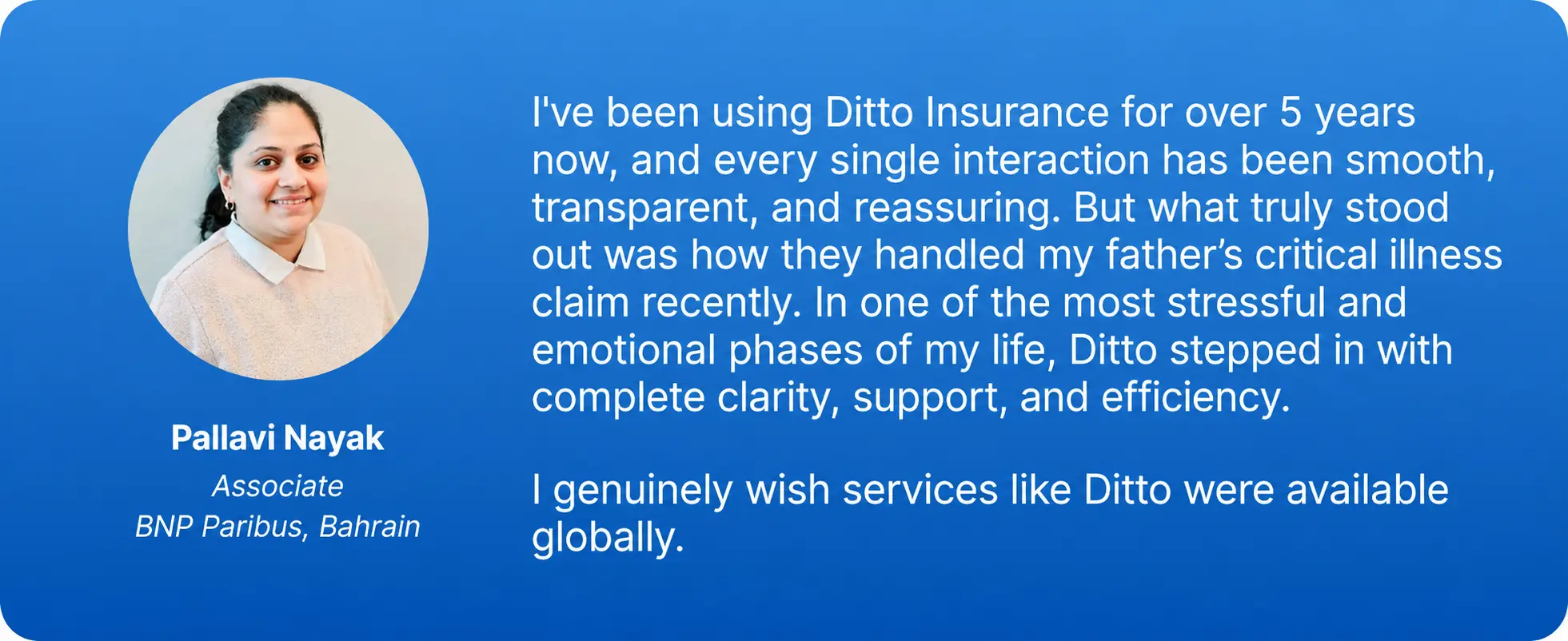
At Ditto, we have helped answer insurance questions for 12,00,000+ people so that they can choose the right health and term insurance with clarity. Why customers like Pallavi love us:
Pallavi Nayak LinkedIn Testimonial
    • 100% Free Consultation
    • No Spam. No Sales Pressure.
    • Rated 4.9/5 on Google Reviews by 30,000+ Happy Customers
    • Backed by Zerodha
    • Dedicated Claim Support Team
    • Compare Plans and Premiums with a Trusted Insurance Advisor

Confused about the right insurance? Speak to Ditto’s certified advisors for free, unbiased guidance. Book your call now or chat with us on WhatsApp. Slots fill up fast!

Conclusion

Buying insurance through a bank is not inherently a bad decision. Banks are a regulated distribution channel that can make insurance easier to access. However, their recommendations are generally limited to partner insurers, so the policy they offer may not be the most suitable option on the market.

Before purchasing, compare alternatives and review the policy's coverage, exclusions, disclosures, and conditions. Use the 30-day free-look period, where applicable, if you need to cancel a policy that does not meet your needs.

Note: Ditto is also an IRDAI-licensed corporate agent that works with partner insurers. Since insurance advice, policy comparisons, and claims support are central to our services, we place greater emphasis on these factors when evaluating insurance distribution channels. Our recommendations reflect our focus on policy suitability, personalized guidance, and long-term support. Keep this perspective in mind when comparing options.

Frequently Asked Questions

Is buying insurance through a bank branch safe and secure in India?

Yes, buying insurance through an authorized bank distributor is safe because an IRDAI-regulated insurer issues and underwrites the policy. However, this does not guarantee that the recommended policy suits your needs. Before purchasing, verify the insurer, check exclusions, and ensure that the written policy terms match what the bank representative promised.

What happens to my insurance if I close my bank account or repay my loan?

If you bought an individual policy through your bank, closing your bank account or the bank ending its insurer partnership won't cancel it as long as the policy remains active and you pay your premiums. However, group insurance coverage may depend on your account, loan, or membership status. Before purchasing, check your policy's continuation and cancellation terms, including any refunds, and obtain your Certificate of Insurance and CIS for group coverage.

What is the meaning of bancassurance in India?

The bancassurance meaning refers to banks distributing insurance policies on behalf of insurance companies. Banks act as distribution channels, helping customers access insurance alongside banking services. Insurers remain responsible for underwriting, issuing policies, and deciding claims. In India, bancassurance commonly operates through IRDAI-regulated corporate agency arrangements.

Can a bank force a customer to buy an insurance policy to get a loan?

No, banks cannot force customers to buy insurance from a particular insurer or bundle an unrelated insurance policy with a loan. However, lenders may require insurance to protect an asset financed through a secured loan. In such cases, borrowers should generally be allowed to choose an eligible insurer. Ask the bank to provide any insurance requirement in writing.

Which banks have bancassurance tie-ups with life insurers such as SBI Life and HDFC Life?

Several Indian banks have bancassurance partnerships with life insurers. For example, State Bank of India distributes SBI Life policies, while HDFC Bank partners with HDFC Life, Tata AIA, and Aditya Birla Sun Life. Other examples include ICICI Bank with ICICI Life, Axis Bank with Axis Max Life, and Punjab National Bank with PNB MetLife. Since partnerships can change, check the bank's official website for its current insurance partners.

What is the free-look period for an insurance policy bought through a bank?

Eligible life insurance and newly issued individual health insurance policies with a term of at least one year have a 30-day free-look period from receipt of the policy document. If no claim has been made, you can request cancellation. The refund may be reduced by proportionate risk premium, medical examination expenses, and stamp duty. ULIP refunds also depend on the applicable unit value.

Does a bank earn a commission on selling insurance, and does it change the premium?

Yes, banks earn commissions or other permitted remuneration from insurers for distributing insurance policies. The insurer pays the bank's commission, rather than charging customers a separate commission fee. This does not mean every bank-sold policy costs the same as an online alternative, as premiums can differ across products and channels. Compare identical coverage, benefits, exclusions, and premium quotes before deciding.

How can a customer complain about insurance mis-selling by a bank?

Submit a written complaint to the bank and insurer, preserving your proposal form, policy documents, emails, and sales messages. Under IRDAI's 2024 framework, insurers should resolve grievances within 14 days. You can escalate unresolved insurance complaints through IRDAI's Bima Bharosa portal and, if eligible, approach the Insurance Ombudsman. For a separate complaint about the bank's services, RBI's Ombudsman framework may apply after the bank has had the prescribed opportunity to respond.

Are bancassurance policies more expensive than a term plan bought online?

Not necessarily. Lower premiums are not guaranteed simply because a policy is purchased directly. Pricing depends on the insurer, product, age, health profile, coverage amount, and available rates. Compare quotes for the same sum assured, policy tenure, riders, and benefits before deciding whether the bank's recommendation offers good value.

How does bancassurance work in public sector banks?

Bancassurance in public sector banks works through partnerships with insurance companies. For example, State Bank of India distributes SBI Life and SBI General Insurance policies through its banking network. Under the SBI Life bancassurance arrangement, the bank helps customers purchase eligible life insurance policies, while SBI Life handles underwriting and policy issuance. Other public sector banks also partner with insurers, although their product offerings and distribution arrangements may differ.

Last updated on: