Claim Settlement Ratio (CSR) is the percentage of the number of claims settled by an insurance company against the total number of claims received during a financial year. Based on the insurers' public disclosures and IRDAI annual reports data for FY 2024-2026, the updated top 10 health insurers by 3-year average CSR in 2026 are:
Digit (99.01%)
New India Assurance (98.00%)
HDFC ERGO (97.61%)
Aditya Birla (96.25%)
SBI General (95.94%)
Acko (95.64%)
Bajaj General (95.63%)
Care (95.45%)
United India (95.03%)
National Insurance (93.76%)
However, CSR alone does not provide a complete picture of an insurer's claims performance, as the IRDAI has not specified a standard formula for its calculation.At Ditto Insurance, we recommend evaluating additional metrics such as the Incurred Claims Ratio (ICR), complaint volume, and solvency ratio to gain a more comprehensive understanding of an insurer's reliability and financial strength.
Consider this scenario: You buy health insurance, pay your premium every year without fail, and assume you're protected. Then a hospitalization happens, you file a claim, and the insurer starts asking questions you weren't ready for. That's the situation thousands of Indian policyholders face every year.
The good news? You can spot a reliable insurer before you sign up. The Claim Settlement Ratio (CSR) is one of the easiest ways to do that. According to the IRDAI Annual Report (FY 2024-25), Indian general and health insurers achieved an 87.5% claim settlement rate by volume, successfully paying out ₹94,247 crore across 3.26 crore health insurance claims, showing just how much is at stake if you pick the wrong insurer.
This guide breaks down the top 10 claim settlement ratio of health insurance companies in India and how to choose the best health policy for you.
Claim Settlement Ratio (CSR) is the percentage of the number of claims settled by an insurance company against the total number of claims received during a financial year. A CSR above 90% is considered healthy and a sign of the company's ability to honor claims.
For example, if an insurer receives 100 claims and settles 97 of them, its claim settlement ratio is 97%.
How to Interpret CSR?
90% and Above: This indicates that the insurer has a strong, consistent track record of settling claims. It gives a reasonable degree of confidence that your claim will be honored.
85% to 90%: Most claims get settled, but the insurer isn't at the top of the chart. Worth looking at complaints, ICR, and plan features before making a final call.
Below 85%: A CSR in this range can point to a higher chance of delays, partial settlements, or rejections. It doesn't mean your claim will definitely be rejected, but it's a signal to be more cautious. You can check out the reasons for claim rejection and how to avoid them.
How to Calculate the Claim Settlement Ratio?
IRDAI does not mandate a single formula for calculating CSR, which is why numbers vary across websites and insurers. At Ditto, we use a consistent formula applied across all insurers to ensure a fair comparison.
Claim Settlement Ratio = (Total number of claims settled / Total number of claims available to settle) x 100
Where:
Total number of claims available to settle = Claims outstanding at the start of the year + Claims reported during the year - Claims closed without payment - Claims outstanding at the end of the year
Applying the formula yields a CSR of 97.45% for HDFC ERGO for FY 2024-25.
Note: A 99% or 100% CSR can look impressive, but context matters too. A high ratio over a short window, say three months or a single year, is much easier to achieve than sustaining it over time. At Ditto, we look at the 3-year average across all metrics because one good year doesn't tell you how an insurer behaves when claim volume rises or circumstances change.
Top 10 Health Insurance Companies by Claim Settlement Ratio
Insurer Name
Average CSR (FY 2024-2026)
CSR (FY 2026)
CSR (FY 2025)
CSR (FY 2024)
Digit Health Insurance
99.01%
99.21%
98.98%
98.83%
New India Assurance
98.00%
97.18%
98.38%
98.44%
HDFC ERGO
97.61%
98.19%
97.45%
97.19%
Aditya Birla Health Insurance
96.25%
97.27%
95.88%
95.61%
SBI General Insurance
95.94%
93.62%
96.13%
98.08%
Acko Health Insurance
95.64%
94.86%
95.75%
96.31%
Bajaj General Insurance
95.63%
93.40%
97.32%
96.16%
Care Health Insurance
95.45%
96.99%
96.74%
92.61%
United India Insurance
95.03%
96.46%
95.92%
92.72%
National Insurance Company
93.76%
93.04%
93.56%
94.68%
Note:
The data here does not include Narayana and Liberty Health Insurance due to possible unclarified discrepancies in their reported data. It also excludes Shriram Health Insurance, as its product portfolio primarily consists of personal accident plans rather than regular indemnity health insurance.
All data shown in the table is derived frompublic disclosures and form NL-37 provided by insurers.
Detailed Comparison: Top 10 Companies by Claim Settlement Ratio
01
Digit Health Insurance
Digit Health Insurance is a newer, digital-first insurer that has steadily earned its place at the top. It's CSR has consistently improved over the years.
Digit Health Insurance
3.7
Overall Rating
CSR Rating
5.0/5
Network Hospital Score
5.0/5
GWP Score
2.0/5
Customer Service Rating
4.0/5
That upward trend is one of the best signals you can see from a growing insurer. It's a strong pick for tech-savvy buyers who want transparency and fast processing with minimal paperwork. However, its relatively shorter track record compared to established insurers is an important consideration for potential buyers.
02
New India Assurance
Founded in 1919 and nationalized in 1973, New India Assurance is one of India's oldest Public Sector Undertaking (PSU) insurers with 1,668 offices nationwide. Its CSR has stayed above 98% for three straight years, making it one of the most reliable options on this list for claim settlements.
New India Assurance
3.4
Overall Rating
CSR Rating
5.0/5
GWP Rating
5.0/5
Customer Service Rating
5.0/5
TPA Score
3.0/5
In it's stable, the New India Assurance Mediclaim policy is the most straightforward and budget-friendly offering. That said, some plans come with room-rent restrictions and disease-wise sub-limits that can reduce your actual payout. Its high Incurred Claim Ratio (ICR) is also worth watching, as it signals potential financial stress over time.
03
HDFC ERGO
A joint venture between HDFC and Germany's ERGO International AG, this insurer operates 200+ branches and has a wide network of 13,000+ hospitals across India.
HDFC ERGO
5.0
Overall Rating
CSR Rating
5.0/5
Network Hospital Score
5.0/5
GWP Score
5.0/5
Customer Service Rating
5.0/5
Considered one of the most reliable insurers in India, its CSR has improved year over year, from 97.19% in FY 2024 to 98.19% in FY 2026. Plans like Optima Secure+ are popular for their comprehensive coverage and clean claim records. The policy also ranks in our list of the best health insurance plans in India.
04
Aditya Birla Health Insurance
Aditya Birla Health Insurance is a joint venture between Aditya Birla Capital Limited and Momentum Group Ltd of South Africa. The company focuses on integrating health insurance with wellness benefits, setting it apart from traditional insurers.
Aditya Birla Health Insurance
4.5
Overall Rating
CSR Rating
5.0/5
Network Hospital Score
5.0/5
GWP Score
3.0/5
Customer Service Rating
5.0/5
Aditya Birla Health Insurance is a good fit for younger buyers and families who want a modern health plan. It combines strong HealthReturns with a high Claim Settlement Ratio and a large cashless hospital network, all available through plans like Activ One Max.
05
SBI General Insurance
Backed by the State Bank of India, SBI General benefits from one of the most trusted brand names in India. With 146+ branches and solid backing, it's a dependable choice for buyers who value institutional trust.
SBI General Insurance
3.8
Overall Rating
CSR Rating
5.0/5
Network Hospital Score
5.0/5
GWP Score
3.0/5
Customer Service Rating
3.0/5
While the insurer's CSR dropped from 96.13% in FY 2025 to 93.62% in FY 2026, it still maintains a strong 3-year average CSR of 95.94%. Its flagship plan, Super Health Platinum Infinite, remains one of the most comprehensive options in the market.
06
Acko Health Insurance
Acko is a fully digital insurer founded in 2016. It uses technology to speed up claim processing and reduce the paperwork burden. It currently offers two main variants to it's Platinum plan: Platinum Lite and Platinum Health.
Acko Health Insurance
3.1
Overall Rating
CSR Rating
5.0/5
Network Hospital Score
3.0/5
GWP Score
1.0/5
Customer Service Rating
4.0/5
Its strength is the experience, which is fast, straightforward, and mostly online. The insurer is worth considering if you prefer managing everything through an app.
07
Bajaj General Insurance
Bajaj General Insurance Limited was founded in 2001 as a joint venture between Bajaj Finserv and Germany's Allianz SE. In 2025, Allianz exited the partnership, making Bajaj Finserv the sole owner of the company.
Bajaj General Insurance
5.0
Overall Rating
CSR Rating
5.0/5
Network Hospital Score
5.0/5
GWP Score
5.0/5
Customer Service Rating
5.0/5
Strong claims performance combined with plans like Health Care Supreme Smart and Health Guard Gold makes it a well-rounded insurer to consider. If you file a claim with Bajaj General, chances of it being approved are high. This means significantly less financial stress during an already difficult time.
Talk to an expert today and find the right insurance for you.
08
Care Health Insurance
Care is one of India's leading Standalone Health Insurers (SAHIs), underwriting premiums of more than ₹10,000 crore. The company primarily focuses on health and travel insurance products.
Care Health Insurance
4.2
Overall Rating
CSR Rating
4.5/5
Network Hospital Score
3.0/5
GWP Score
5.0/5
Customer Service Rating
3.0/5
It has consistently improved its claim performance, with its CSR rising from 92.61% in FY 2024 to 96.99% in FY 2026. With flagship plans like Care Supreme and Care Ultimate, it is an attractive option for anyone looking to buy health insurance.
09
United India Insurance
Founded in 1938, United India Insurance is a Public Sector Undertaking (PSU) insurer with over 1,545 offices across the country. Its FY 2026 CSR of 96.46% shows consistent recovery, but its 3-year average of 95.03% still keeps it at the bottom of this list.
United India Insurance
3.1
Overall Rating
CSR Rating
4.5/5
TPA Rating
1.0/5
GWP Score
5.0/5
Customer Service Rating
4.0/5
It's a reliable fallback option if private insurers aren't accessible or decline your application because of your medical history. Key offerings from the insurer include Family Medicare and the Individual Platinum plan.
10
National Insurance
Founded in 1906, National Insurance is a government-owned insurer with over a century of operating history. It handles large claim volumes and maintains stable, if not spectacular, performance.
National Insurance
3.1
Overall Rating
CSR Rating
5.0/5
TPA Rating
1.0/5
GWP Score
5.0/5
Customer Service Rating
3.0/5
It offers decent plans, such as the National Mediclaim policy and the National Parivar Mediclaim policy. The plans are simple and budget-friendly, making them a practical option if cost is the primary concern. Just be aware of plan-level restrictions, such as copayments and room-rent limits, before buying.
Ditto's Insight
Out of a total 3-year average (FY 2024-26) business volume of ₹1,18,464, nearly 54.05% comes from insurers with a CSR of 95% and above. Another 15.6% comes from insurers in the 90% and 95% CSR range.
This means that close to 69.65% of the business is concentrated among insurers with a CSR of 90% or higher. This shows that CSR is not just a number that runs in the background. It actively shapes customer trust and buying decisions, making it one of the key factors people rely on when choosing a health insurer.
Why Is Claim Settlement Ratio Important?
Tells Who Actually Pays: CSR tells you how often an insurer actually pays the claims it receives. A higher number means fewer claims are being turned away, which makes the insurer more dependable when you need them most.
Builds Trust Factor: A company with a strong, consistent CSR is more likely to honor your claim without unnecessary pushback. It's one of the clearest trust signals you have before buying a policy.
Rewards Consistency Over Time: A CSR that holds steady above 90% for three or more consecutive years is far more meaningful than a single strong year followed by a dip.
Helps With Comparison: When two plans offer similar coverage and pricing, CSR helps break the tie. The insurer with the stronger ratio is usually the safer bet.
Is Claim Settlement Ratio Alone Enough?
CSR is just one piece of the puzzle. It doesn't tell you about partial payments or how long the process took. Even the top health insurance claim settlement ratio should be checked alongside other factors, as discussed below:
Incurred Claim Ratio (ICR): This shows how much of the premium collected in a year is paid out as claims. A healthy ICR sits between 50% and 80%. Too high suggests unsustainable pricing and hampers long-term sustainability. Too low may mean claims are being denied more aggressively.
Complaint Volume: Fewer than 20 complaints per 10,000 claims is a good benchmark. It reflects how customers actually experience the claim process. General insurers have lower complaint numbers than standalone health insurers because they are spread across products such as motor insurance.
Hospital Network: Over 10,000 network hospitals ensure you have broad access to cashless treatment, especially in smaller towns and cities. A good network of hospital coverage, especially in your locality, ensures easy access to quality healthcare.
Gross Written Premium (GWP): Companies with large business volumes usually have stronger networks and more robust servicing systems. High volumes also reflect customer trust. An insurance company with over ₹2,500 crores in gross written premiums reflects strong financial strength and stability.
Note: If you'd like to explore the detailed figures reported by insurers and the IRDAI in their annual disclosures and public reports, visit Ditto Data Labs, our proprietary repository of health insurance data, meticulously compiled, verified, and maintained by the Ditto team over the years.
How to Choose the Best Health Insurance Company for You?
Compare Plans, Not Just Premiums Once you've shortlisted insurers, dig into the actual plan. A lower premium often means tighter coverage, room rent caps, longer waiting periods, or fewer benefits.
Read the Fine Print Before You Buy Go through the policy document carefully, especially the exclusions and sub-limits. Most claim rejections happen because of terms the buyers never read. A plan with fewer restrictions almost always leads to a smoother claim experience.
Check What Other Customers Say Reviews tell you what the numbers don't. Look specifically for feedback on cashless approvals, claim turnaround times, and the insurer's communication during hospitalization. Consistent complaints about delays or poor support are a warning sign, even if the CSR looks strong.
Get Help From a Neutral Advisor Policy documents can be difficult to read and understand. A good advisor breaks down the differences between plans, flags hidden clauses, and factors in your age, health history, and budget. Ditto offers free consultations with IRDAI-certified insurance advisors to help you navigate through complex terms.
Look for Additional Benefits Once the insurer-level basics check out, look for these features:
01
No Room Rent Restrictions
Without this, upgrading to a better hospital room can increase your out-of-pocket costs significantly, even if you're fully insured.
02
No Copayment Clause
A 10% co-pay on a ₹20 lakh bill means you pay ₹2 lakh yourself. That adds up fast and defeats the purpose of having insurance.
03
Cumulative Bonus
A good plan increases your sum insured year on year, even if you make a claim. This helps you increase your overall coverage over the years so that you have sufficient cover when you actually need to make a claim.
04
Restoration Benefit
This refills your sum insured if it runs out during the year. Look for plans that cover restoration for any illness, with no waiting period and no cap on how many times it applies.
05
Short Waiting Periods
IRDAI's 2024 product guidelines cap the waiting period for pre-existing diseases at 3 years, down from 4 years earlier. Some insurers, such as HDFC ERGO and Aditya Birla, reduce this further through riders or specialized plans.
06
Consumables Coverage
Non-payable items such as gloves, syringes, masks, and PPE kits can make up a significant portion of your medical bills. Check for consumable coverage, whether it is available by default, as an add-on, or not covered at all.
Why Choose Ditto for Health Insurance?
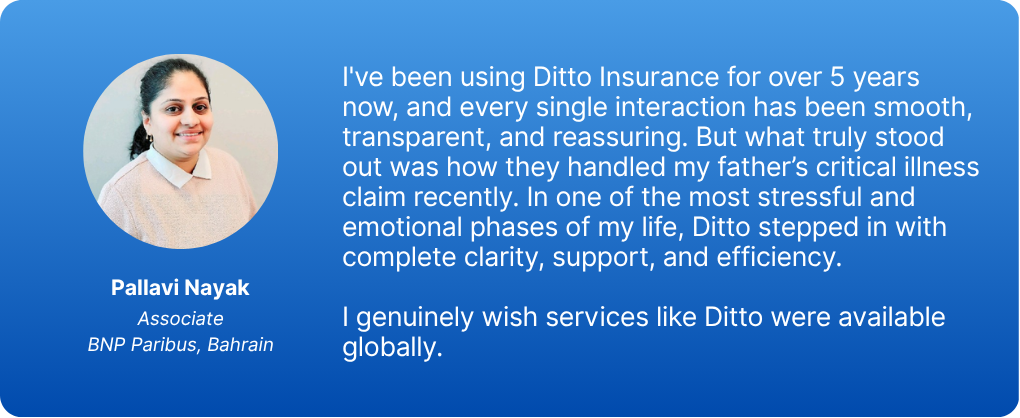
At Ditto, we’ve assisted over 8,00,000 customers with choosing the right insurance policy. Why customers like Pallavi below love us:
No-Spam & No Salesmen
Rated 4.9/5 on Google Reviews by 15,000+ happy customers
Ditto’s Verdict on Top 10 Health Insurance Companies by CSR
A high claim settlement ratio is a useful signal, but it does not guarantee your specific claim will be paid. Your policy terms matter just as much as the insurer’s historical numbers.
Public sector insurers like New India Assurance top the CSR charts, but many of their plans come with room rent caps, disease-wise limits, and weak restoration benefits. You could be with a 98% CSR insurer and still end up paying a large chunk of your hospital bill out of pocket if the plan is restrictive.
The better approach is to use CSR as your starting point, then review the plan's features, check other metrics like ICR, complaints, and network hospital coverage, and read real customer reviews before you decide.
Before you buy, take a few minutes to go through Ditto'scomprehensive rating framework to understand how insurers and plans are scored. Then head to thehealth insurance comparison page and run a side-by-side check of plans that fit your budget and coverage needs.
Share Your Feedback!
If you found our content helpful or have any suggestions, feel free to share your feedback with us on LinkedIn, Reddit, X, or via email at marketing@joinditto.in. We'd love to hear from you!
Frequently Asked Questions
What are the top 5 health insurance claim settlement ratio companies in India?
The top 5 health insurance companies by 3-year average CSR (FY 2024-26) are Digit Health Insurance at 99.01%, New India Assurance at 98.00%, HDFC ERGO at 97.61%, Aditya Birla Health Insurance at 96.25%, and SBI General Insurance at 95.94%. At Ditto, we calculate these numbers using form NL-37 from each insurer’s public disclosure data for FY 2024, FY 2025, and FY 2026. A 3-year average tells you far more about reliability than any single year's figure, since even a weaker insurer can post one strong year under favorable conditions.
What is a good claim settlement ratio for health insurance in India?
A CSR above 90% is generally considered acceptable. At Ditto, we recommend seeking insurers that consistently maintain a higher CSR across at least three financial years. A one-time spike to 98% or 100% means far less than steady performance year after year. For context, Universal Sompo had a 100% CSR in FY 2023 but dropped to 84.12% by FY 2026, which is exactly why trend-based evaluation matters more than any single data point. CSR is not just a figure. It shapes customer trust and is one of the first things people check before committing to a health plan.
Does a high CSR guarantee my health insurance claim will be paid?
No, a high CSR does not guarantee your specific claim will be approved. CSR reflects how an insurer performed across all claims in a given year, not how it will handle your individual case. Your claim can still be rejected if the treatment is excluded, a waiting period has not been completed, or required documents are missing. Even an insurer with a 98% CSR can deny a valid-looking claim if the policy terms are not met. At Ditto, we recommend going with a trusted and experienced advisor who can navigate post-sales support and claim complexities.
What is the difference between CSR and ICR in health insurance?
CSR and ICR measure different things. CSR, or claim settlement ratio, tells you what percentage of claims the insurer paid out. ICR, or incurred claim ratio, tells you how much of the premium collected was paid out as claims. A CSR of 97% means 97 out of 100 claims were settled. An ICR of 75% means the insurer paid ₹75 in claims for every ₹100 collected as premium. At Ditto, we recommend a healthy ICR range of 50% to 80%. An ICR that is too high suggests the insurer may struggle financially over time.
Are government health insurance companies better than private ones for claims?
Not always. Government insurers like New India Assurance are among the top 10 health insurance claim settlement ratio companies, with a 3-year average of 98.00%, but many of their plans have room-rent limits, disease-wise sub-limits, and weaker restoration benefits. Private insurers like HDFC ERGO and Aditya Birla Health Insurance both score above 96% in CSR and offer better plan designs. At Ditto, we recommend evaluating the plan features alongside the CSR, because a high-CSR insurer with a restrictive plan can still leave you with a large out-of-pocket hospital bill.
What is restoration benefit in health insurance, and why does it matter for claims?
Restoration benefit is a feature that refills your sum insured if it gets fully or partially used up during the policy year. It is especially valuable for families or individuals with recurring medical needs. The best restoration features apply to any illness, including the same condition that triggered the first claim, without a waiting period and with no cap on how many times it applies. At Ditto, we recommend looking for plans that kick in restoration even after partial exhaustion of the sum insured, since more restrictive versions can leave you underprotected during a second hospitalization in the same year.
How does a copayment clause affect my health insurance claim?
A copayment clause requires you to pay a fixed percentage of every claim out of your own pocket, with the insurer covering the rest. For example, a 10% co-pay on a ₹20 lakh hospital bill means you personally pay ₹2 lakh, regardless of how much premium you have paid. Copayment clauses are more common in senior-citizen plans and in some budget policies. At Ditto, we advise buyers to avoid plans with copayment clauses whenever possible, as they reduce the effective value of your coverage, especially during large hospitalization events when costs are highest.
What does the solvency ratio tell you about a health insurance company?
The solvency ratio measures an insurer's financial ability to pay claims even during periods of stress, such as a surge in hospitalizations or broader economic pressure. IRDAI requires all insurers to maintain a minimum solvency ratio of 1.5x. A higher ratio signals stronger financial health and a lower risk of the insurer defaulting on claims. At Ditto, we evaluate solvency alongside CSR and ICR because a company with a high CSR but low solvency may not be able to sustain that performance over the long term.
What are the timelines for claim settlement?
For cashless authorization, the insurer must decide immediately, but no later than 1 hour after receiving the request. In final discharge authorization, the insurer must grant final authorization within 3 hours of receiving the hospital’s discharge request. If there is a delay in approval, the policyholder should not be made to wait, and any extra charges resulting from the delay should be borne by the insurer. Insurers must collect the required documents from hospitals. No claim should be repudiated without approval from the Product Management Committee or Claims Review Committee.
Customer Reviews
4.9
20915 reviews
Ditto is doing really great. Absolutely spam free- that's the best part. They don't talk to you like they are forced to sell the product. It's more like, helping us buy better. Advisor Nuha was very patient and answered all my questions with clarity. Thanks for the service
I
INDHUMATHI M
Loved the service! Maheta Nidhi Hitesh was incredibly helpful and knowledgeable. She guided me through the whole process and made everything super easy to understand. I really appreciated how patient she was with all my questions—there was no pressure at all, just clear and honest advice. Honestly, I'm very happy with my experience at Ditto so far. Highly recommend!
RK
Ragul Kumar
I had a great experience with Ditto while exploring health insurance options. The process was smooth and everything was explained clearly.
A special thanks to Swaroop SK for patiently answering all my questions and guiding me through the policy details without any pressure. The transparency and support made it much easier to understand and choose the right plan.
Really appreciate the assistance!
PS
Pulkit Singh
Had a great experience with Ditto Insurance. Ishita Sudrania was extremely helpful in guiding me through choosing the right term plan. There was no spamming or sales pressure, and all my questions were patiently answered. She also assisted me thoroughly with the entire application process. Highly recommend!
SS
Samil Shah
I had a great experience with Ditto while filing my health insurance claim. Their team guided me clearly through the entire process, helped with the required documents, and promptly answered all my queries. Their support made the claim process much smoother and less stressful. Highly appreciate their assistance.