



Overview
India is aging fast. The India Ageing Report 2023, prepared by UNFPA India and the International Institute for Population Sciences (IIPS), estimated that 149 million Indians were aged 60 or above in 2022 and projects that number will more than double to 347 million by 2050. For senior citizens or families with parents above 60, this raises an important question: if you're already past 60, do you actually need term insurance? Because by the time you cross 60, you've usually done the bulk of your financial planning already.
The answer is generally need-based. A term plan can still make sense if your spouse or child depends on you financially, you have a sizable outstanding loan, or your family would face a genuine financial shortfall if you were no longer around. But if your dependents are financially independent and your major liabilities are already taken care of, buying fresh cover at this stage may not offer enough value for the cost.
This guide covers who can buy term insurance after 60, how age and health affect eligibility and premiums, which plans are worth considering, how much cover makes sense, and alternatives if term insurance doesn’t make sense.
Note: Premiums for term insurance vary widely, and where you fall within that range depends on your exact age and health. Ditto's term insurance premium calculator narrows that down for you.
What Is Term Insurance for Senior Citizens?
‘Term insurance senior citizen’ isn't a separate product category under IRDAI. It's the exact same term plan a 30-year-old would buy, just purchased later in life.
The only difference is that insurers treat older applicants as higher risk and with shorter life expectancy. This leads to shorter tenures, stricter medical underwriting, and premiums that can be five to seven times higher than what a much younger buyer pays for the same cover.
In practice, term life insurance for senior citizens works exactly like any other term plan. You pick a sum assured and a policy term, pay your premium (usually every year), and if the policyholder passes away while the policy is active, their nominee receives the full sum assured as a tax-free lump-sum or monthly income payout.
Note: There's no maturity payout if you outlive the term (unless you've chosen a return-of-premium variant), and that's exactly what keeps the premium relatively affordable compared to savings-linked or other types of life insurance plans.
For your family, that payout works as a cushion. It can help cover a spouse's living expenses, clear an outstanding loan, or support a dependent who can't earn on their own, without forcing anyone to dip into retirement savings at the worst possible time.
Best Term Insurance Plan for Senior Citizens: Ditto's Top 5 Picks
There's no single "best" senior citizen life insurance policy for everyone. The right pick depends on your age, income, health profile, and how much cover you actually need. That said, based on Ditto's proprietary scoring framework (which weighs claim settlement performance, insurer metrics, plan features, and pricing), here are the five plans we'd recommend evaluating first if you're a senior citizen looking for term insurance in India.
Note: Sum assured, riders, and eligibility depend on your age, health profile, and the insurer's underwriting at the time you apply. Always check the latest brochure or talk to an advisor before deciding.
Let’s discuss plans that offer an entry age up to 65 years in detail.

Did You Know?


Features of Term Insurance After 60
Death Benefit
The core promise of a term insurance plan for senior citizens is the death benefit. If the insured person passes away during the policy term, their nominee gets the sum assured as a lump-sum. Most plans pay it out as a single payment, though some plans offer income-style payout options if your family would rather receive it in installments.
Premium Payment Term
Senior citizens can choose between regular pay (premiums spread across the full policy term) and limited pay (you finish paying in a shorter window, say 5 or 10 years, while the cover continues for longer). For a senior citizen relying on a fixed retirement income, limited pay can help avoid premium payments dragging on for decades, but it also means a heavier annual outflow while you're paying. Ultimately, the right choice depends on your retirement income and cash flow.
Optional Riders
Riders like critical illness cover and waiver of premium can add useful layers of protection. The catch is that rider availability shrinks as you get older, and adding riders on top of an already-high base premium can push the total cost up significantly. Ask specifically which riders your insurer still offers at your age before assuming they're included. Also, don't include riders just because they are available. Evaluate your needs, then choose the rider that makes the most sense.
Tax Benefits
The premium you pay qualifies for a deduction under Section 80C (renumbered as Section 123 under the Income Tax Act, 2025) up to ₹1.5 lakh a year, but only if you're still filing under the old tax regime. Moreover, the death benefit your nominee receives is tax-free under Section 10(10D) (renumbered as Schedule II under the new Act).
Did You Know?
Eligibility Criteria for Term Insurance for Parents
If you're researching term insurance for parents in India, the eligibility rules are the same ones your parent would face when buying the policy directly, since your parent has to be both the proposer and the life assured.
Note: The insurer will usually arrange and pay for the required medical tests. However, seniors may be asked to undergo multiple rounds of testing, and a Treadmill Test (TMT) can be physically demanding at 60+. If one is requested, it’s worth checking whether the test fits the applicant’s health profile before proceeding.
A few things worth knowing if you're buying this for a parent specifically, rather than for yourself:
- You Cannot Claim Tax Deductions: Even if you're the one paying the premium, the Section 80C (Section 123) deduction under term insurance for parents in India can only be claimed by your parent, since the policy is in their name. If your goal is a tax deduction along with the cover, this route will not help you.
- Eligibility Is Not the Same as Approval: A 62-year-old parent might technically fall within the entry-age window, but the insurer can still ask for extensive medicals, apply a premium loading, reduce the cover, or reject the application outright, especially if they're retired and have no documented active income.
- Term Insurance Above 65 Years: Finding term insurance for senior citizens above 65 years is genuinely hard. Most mainstream insurers simply stop accepting new applicants past 65. If your parent is already 70 or 75, a new term policy is rarely realistic through the standard buying process.
Why Is Term Insurance Important for Senior Citizens?
Term insurance for senior citizens above 60 years isn't for everyone, but in these specific situations, it can genuinely help:
Financially Dependent Spouse
Outstanding Liabilities
Dependents With Special Needs
Business Obligations
On the other hand, if you have a well-funded retirement corpus, no outstanding debts, and no one who depends on your income, buying a fresh senior citizen life insurance policy at 60 or 65 may not add much value relative to what you'll pay in premiums. The same logic applies if your spouse is financially independent. Then the core need that term insurance solves, replacing lost income, may simply not exist anymore.
Note: If any of this sounds like your situation, it's worth finding out what cover would actually cost at your age. Ditto's term insurance premium calculator gives that answer instantly.
Ditto's Expert Insights on Term Insurance for Senior Citizens in India
Our advisors have noticed one thing consistently: most people who reach out about term insurance for senior citizens in India after 60 don't actually need it. What they usually need is a clearer picture of where they already stand financially. Here's the process we'd suggest walking through before you buy anything:

Calculate Your Retirement Corpus First
If your savings and pension income can comfortably support your spouse's lifestyle for the next 15 to 20 years, a fresh term plan probably won't add much value.
Map Out Your Liabilities
A term plan makes real sense only if you have outstanding loans or financial obligations that would outlast your existing corpus.
Don’t Buy It as a Legacy Tool
Term insurance is built for protection, not wealth transfer. If your real goal is leaving behind an inheritance, options like fixed deposits or mutual funds usually do that job more efficiently.
Be Completely Honest About Your Health if You Do Go Ahead
Undisclosed pre-existing conditions are the single biggest reason term claims get rejected. At 60-plus, insurers scrutinize claims more closely, so full disclosure at the proposal stage matters.
Compare Premiums Carefully Before Committing
As you'll see in the next section, the same ₹50 lakh cover can cost anywhere from ₹40,000 to ₹58,000 a year depending on the insurer. Weigh that total outgo against the actual financial risk you're protecting against, not against a round number that sounds reassuring.
Premium Comparison: Term Insurance for Senior Citizens Above 60 Years
Premiums for a term insurance plan for senior citizens climb sharply with age, and they climb further with the sum assured and maturity age you choose. Here's what a healthy, salaried, non-smoking 60-year-old in a Tier-1 city like Delhi (110010) can expect to pay (excluding first-year discounts).
₹50 Lakh Cover Premiums for Senior Citizens
Worked Example: How Much Cover Might a 62-Year-Old Need?
Note: In most cases, at Ditto, our advisors do not recommend subtracting your existing savings or investments from the required cover calculation. But for senior citizens, it can make sense to reduce the financial burden of paying high premiums.
₹1 Crore Cover Premiums for Senior Citizens
₹2 Crore Cover Premiums for Senior Citizens
Key Takeaway: The biggest practical reality of buying term insurance late is the cost. A healthy 60-year-old can end up paying five to seven times more annually than a 30-year-old would for the exact same cover. That's precisely why, at Ditto, we always recommend buying term insurance as early as possible, and why we ask a lot of questions before recommending it to anyone past 60.
Things to Keep in Mind While Buying a Term Plan as a Senior Citizen
1) Assess Your Real Need
Run an honest, needs-based calculation before you look for plans. Are your outstanding debts genuinely higher than your liquid assets? Only buy a cover amount that matches your actual liabilities, not a round figure like ₹1 crore just because it sounds standard. Also match your policy term to how long your obligation will last. Ditto's term insurance cover calculator can help you work this out with real numbers, not guesswork.
2) Choose the Right Insurer
Beyond premiums, check metrics like Claim Settlement Ratio (CSR), Amount Settlement Ratio (ASR), complaint volume, solvency ratio, and overall business scale. These numbers tell you how an insurer actually behaves at claim time, which matters more at this stage of life than a slightly lower premium. Our guide to the best term insurance companies in India breaks this down insurer by insurer.
3) Compare Multiple Options
Premiums and features for a term insurance plan for senior citizens vary a lot across insurers, as the tables above show. Don't default to the cheapest option. Balance affordability against the actual benefits and claim-time reliability you're getting. Ditto's term insurance comparison tool lets you line up multiple plans side by side before deciding.
4) Do Not Hide Medical History
Never withhold a medical condition, past surgery, ongoing medication, or relevant family medical history. Non-disclosure remains one of the leading causes of claim rejection, and insurers investigate senior citizens' claims far more thoroughly than they do for younger policyholders. If they later discover something you didn't declare, they can, and will, reject the claim.
Section 45 of the Insurance Act
How to Buy Term Insurance for Senior Citizens from Ditto?
Buying term insurance for senior citizens isn't as simple as picking the cheapest plan online. At 60 or 65, the right decision depends on your income, dependents, liabilities, health profile, and honestly, whether term insurance is even the right product for your situation. That's the gap Ditto exists to fill.
You can book a call with us, and one of our advisors will walk you through the entire process, from checking your eligibility to comparing realistic options, filling out the application, and assisting with claims later if it's ever needed. The premium you pay stays exactly the same whether you buy through Ditto or go directly to the insurer.
The process stays spam-free throughout, and our advisors stay with you at every step. That matters even more for senior citizens, since applications at this age usually involve detailed medical disclosures, pre-existing disease declarations, and underwriting requirements that need careful handling to avoid problems later.
Alternatives to Term Insurance for Senior Citizens
Here's the honest truth about senior citizen life insurance: most people over 60 who come to us already have limited entry-age windows, shorter tenure options, tougher medical underwriting, and already high premiums.And if the insurer finds additional health risks during underwriting, they may apply a premium loading (an extra charge over the standard premium to account for the higher risk). Depending on your age, health condition, and medical history, this loading can range from around 25% to 100% in some cases, making an already expensive policy considerably costlier.
So, if the numbers don't make sense for you, or you don't have a strong need for life cover anymore, these alternatives may be a better use of the same money.
Health Insurance
For most senior citizens, hospitalization is a far more immediate financial risk than income replacement, which is really what term insurance is built to solve. A comprehensive health insurance plan for senior citizens, or a super top-up layered on an existing base policy, protects your retirement corpus from the kind of hospital bills, surgeries, and ongoing treatment costs that tend to climb sharply with age.
It's also worth knowing about the government's safety net. Since October 29, 2024, every Indian citizen aged 70 and above qualifies for free coverage of ₹5 lakh a year under the Ayushman Vay Vandana Card scheme, regardless of income. If your parent is 70 or older, check this first. You can read more in our guide to government health insurance for senior citizens.
Senior Citizens' Savings Scheme (SCSS)
SCSS is a government-backed, five-year deposit scheme built specifically for retirees. It currently pays 8.2% per annum, among the highest rates on any government-backed savings instrument, with interest credited to your account every quarter rather than at maturity. You can deposit up to ₹30 lakh per individual (₹60 lakh for a couple, if both spouses open separate accounts), and the deposit itself qualifies for a deduction under Section 80C (Section 123) up to ₹1.5 lakh a year.
Eligibility is straightforward: anyone 60 or above can open an account, and those who took voluntary or superannuation retirement between 55 and 60 can also open one within a set window after receiving their retirement benefits (50 and above for retiring defense personnel). Keep in mind the interest is fully taxable at your income slab, and TDS kicks in once your annual SCSS interest crosses ₹1 lakh.
Pension and Annuity Plans
Rather than paying out a death benefit, pension and annuity plans work the other way around: you invest a lump-sum, and the insurer pays you a guaranteed regular income for life. For example, LIC Jeevan Akshay VII is an immediate annuity plan where you invest a lump-sum upfront and receive regular pension payouts based on the annuity option you choose. These plans can work for retirees who prioritize predictable income over liquidity or market-linked growth.
One scheme you may come across while researching this, the Pradhan Mantri Vaya Vandana Yojana (PMVVY), is worth a quick clarification: it stopped accepting new subscriptions on March 31, 2023. If you already hold a PMVVY policy, it continues as normal, but any website or agent offering to enroll you in it today isn't giving you accurate information.
Fixed Deposits
Plain fixed deposits remain one of the simplest options for senior citizens. Ordinary FDs don't qualify for a tax deduction, but notified five-year tax-saving bank deposits can qualify under Section 123 of the Income-tax Act, 2025, within the overall ₹1.5 lakh deduction limit, if you're opting for the old tax regime.
Senior citizens can also get a slightly better deal on interest rates, since many banks and NBFCs offer them an additional rate over what regular depositors receive.
Compared to SCSS or annuities, regular FDs offer more flexibility in choosing tenures and accessing your money, although premature withdrawals may come with a penalty. Tax-saving FDs are different: they come with a five-year lock-in. So, for some seniors, a mix of SCSS for retirement income and regular FDs for greater flexibility can work better than relying entirely on either one.
Why Choose Ditto for Term Insurance?
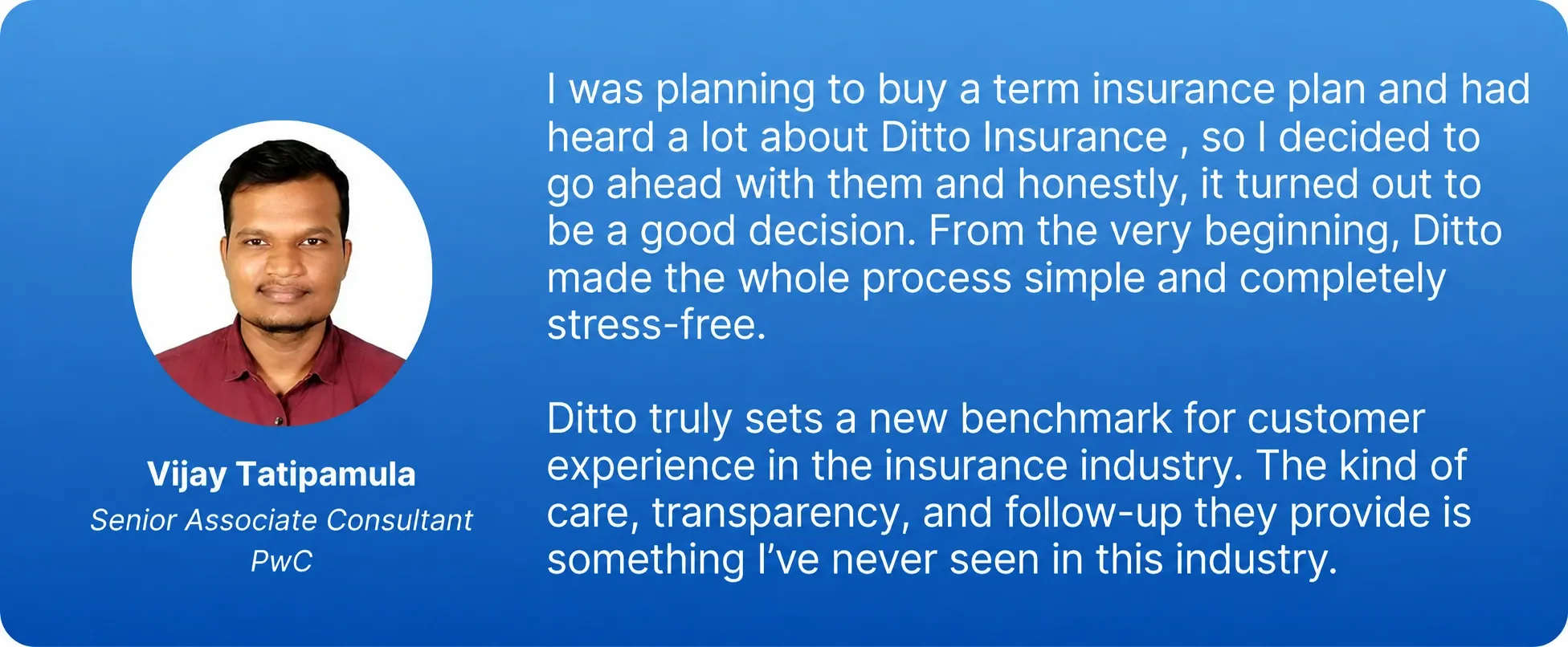
At Ditto, we’ve assisted over 12,00,000 customers with choosing the right insurance policy. Why customers like Vijay below love us:
- 100% Free Consultation
- No Spam. No Sales Pressure.
- Rated 4.9/5 on Google Reviews by 30,000+ Happy Customers
- Backed by Zerodha
- Dedicated Claim Support Team
- Compare Plans and Premiums with a Trusted Insurance Advisor
If you'd like to see exactly how our process works, check out our detailed guide on how Ditto helps you find the best term insurance for senior citizens.
Confused about the right insurance? Speak to Ditto’s certified advisors for free, unbiased guidance. Book your call now or chat with us on WhatsApp. Slots fill up fast!
Ditto's Verdict on Term Insurance for Senior Citizens
The instinct to protect your family never really goes away, but buying fresh life cover in your 60s is usually an inefficient use of retirement money. Unless you're carrying large outstanding debts or supporting dependents who can't earn on their own, you're likely better off skipping a new term plan altogether.
Here's why: the financial risks you face in your 60s look nothing like the ones you faced in your 30s or 40s. During your working years, term insurance replaces the income your family would lose without you. In retirement, that income has usually already stopped, so the bigger threat becomes rising healthcare costs, not lost income.
That's exactly why health insurance tends to matter far more than term insurance for senior citizens. A solid health plan protects the retirement corpus you've spent decades building from being wiped out by a single hospitalization or a long treatment course, something a term plan was never designed to do in the first place.
If you're still unsure where you stand, that's completely reasonable. Talk to one of our advisors, walk through your corpus, liabilities, and dependents honestly, and let the numbers tell you whether a senior citizen life insurance policy actually earns its place in your plan, or whether that money is better parked in health cover, SCSS, or an annuity instead.
Frequently Asked Questions
Customer Reviews
Last updated on: