



Introduction
The India Ageing Report 2023, by the Ministry of Social Justice & Empowerment, Government of India, says India had 149 million people aged 60 and above in 2022, making up about 10.5% of the population. By 2050, this could rise to 347 million, or 20.8% of the population. As India's population ages, life insurance planning for later life becomes increasingly important. However, that doesn't necessarily mean every senior citizen needs a term insurance plan.
At Ditto, we’ve seen many families ask the same questions like: “My father is 62 and still earning. Should he buy term insurance?” or “My mother has diabetes. Will any insurer accept her?” The answer isn't straightforward. It depends on the senior’s income, dependents, loans, health history, and your budget.
Age also plays a significant role, as the term insurance age limit in India is usually restrictive after 60 or 65. Beyond this point, premiums increase sharply, and medical underwriting becomes considerably more stringent. For example, IRDAI's standard Saral Jeevan Bima term product allows entry only up to age 65, although individual insurers may have different limits for their products.
This guide explains how Ditto helps you find the best term insurance for senior citizens by checking eligibility, comparing realistic options, helping you prepare for medicals, and deciding whether it’s even worth buying.
Common Questions Senior Citizens Ask
What Is Term Insurance for Senior Citizens?
Term insurance for senior citizens is a pure life insurance policy designed for individuals typically aged 60 and above. If the policyholder passes away within the policy term, the insurer pays a guaranteed death benefit to the nominee. This helps provide financial security for a dependent spouse, pay off unpaid loans, or support children/grandchildren.
Ditto’s Key Insight: According to IRDAI, term insurance for senior citizen isn’t a separate category of plans. Instead, these are normal term plan offerings for people over 60.
In our experience at Ditto, we’ve seen multiple families consider term insurance for their senior citizen parents for three main reasons:
- Unpaid home/business loans
- Dependent spouse
- Dependent child (for life, maybe due to disability, etc)
For such families, buying term insurance may still make sense. However, for everyone else, it doesn’t make sense to buy a plan after 60 because by then most of your financial responsibilities are already taken care of.
Can Senior Citizens Buy Term Insurance in India?
Yes, senior citizens can buy term insurance in India, but the options become narrow after 60. In our experience at Ditto, we’ve seen that most insurers accept new applicants up to 60, while a few might even go up to 65, with coverage generally lasting until 80 to 85 or 99/100 for whole life variants.
For example, Axis Max Life Smart Term Plan Plus and ICICI Life iProtect Smart Plus offer a maximum entry age of up to 60. On the other hand, HDFC Life Click2Protect Supreme Plus and Bajaj Life eTouch II offer a maximum entry age of up to 65.
Ditto’s Key Takeaway: Eligibility is not the same as approval. A 62-year-old may be “eligible,” but the insurer can still request detailed medicals, apply a premium loading, reduce the cover, or reject the proposal.
What Is the Maximum Entry Age for a Term Insurance Plan?
The term insurance age limit for buying a new policy is generally between 60 and 65 years, depending on the insurer and the specific plan.
Although some policy brochures may mention higher entry ages for select variants, these usually come with strict eligibility conditions and may not be available through the standard purchase process. In practice, applicants over 65 often have limited options when buying a new term insurance policy.
Ditto’s Key Insight: Some online purchase journeys may still restrict applications to those aged 65 or older, even if brochures mention higher variant-specific limits. In most cases, you’ll see an error message stating “age is more than 65”.
What Is the Best Term Insurance Plan for Senior Citizens?
There is no single “best” term insurance plan for senior citizens, which is why at Ditto, we evaluate the senior’s income, liabilities, dependents, medical history, and affordability before shortlisting plans.
Currently, the best term insurance plans you can consider include Axis Max Life Smart Term Plan Plus, HDFC Life Click2Protect Supreme Plus, ICICI Life iProtect Smart Plus, Bajaj Life eTouch II, and Aditya Birla Sun Life Super Term Plan. These plans have been carefully selected according to our detailed proprietary policy rating framework, which compares them on plan features, insurer metrics, and premiums.
Is Term Insurance Worth Buying After 60 or After Retirement?
Usually, no, unless there is a clear financial reason.
At Ditto, we’ve seen that most retired seniors no longer need income replacement, which is the core purpose of term insurance. In our experience, we’ve seen that after 60, active income usually stops, premiums become steep, underwriting becomes stricter, and policy terms shrink.
It may still make sense if the senior is working, has an unpaid loan, supports a dependent spouse, or has a child with lifelong dependency. Otherwise, the premium may be better directed toward health insurance, a super top-up, emergency liquidity, or retirement income products/corpus.
Why Are Term Insurance Premiums Higher for Senior Citizens?
Premiums rise because insurers view older applicants as higher-risk. Age, health conditions like diabetes, hypertension, heart history, smoking, income, and existing cover all affect underwriting.
Here is an indicative premium comparison for a ₹2 crore cover for a healthy, non-smoking individual, living in a tier-1 city like Delhi (pincode 110010), covered up to age 75:
Ditto’s Key Takeaway: The premiums for senior citizens are exponentially higher than for young adults who buy term insurance during their 20s or 30s. This is partly why we don’t recommend term insurance to everyone for senior citizens. The annual premium can become hard to justify unless there is a strong dependency or liability.
Do Senior Citizens Need a Medical Test to Buy Term Insurance?
Yes, almost always. Senior applicants usually undergo a telemedical interview and physical tests such as blood work, HbA1c/fasting blood sugar, lipid profile, liver and kidney tests, urine tests, ECG, TMT, and sometimes chest X-rays.
In our experience at Ditto, we’ve seen that medical evaluation is mandatory and helps decide approval, premium loading, reduced cover, or rejection.
Ditto’s Advice: Always keep your prescriptions, surgery summaries, past reports, and medical dosage details ready before your medicals. Moreover, it’s important to give honest answers during telemedicals, as vague answers can create inconsistencies later.
Can You Get Term Insurance With Diabetes or Other Pre-Existing Conditions?
Yes, but it depends on control and severity. A senior with well-controlled type-2 diabetes or hypertension may still get a policy, often with premium loading. But uncontrolled diabetes, heart disease, kidney complications, recent surgeries, or multiple conditions can lead to postponement, reduced cover, or rejection.
Ditto’s Key Insight: We never suggest hiding health history. Non-disclosure of smoking, diabetes, heart issues, prior hospitalization, or existing policies is one of the biggest reasons a genuine family can face claim trouble later.
Talk to an expert
today and
find
the right
insurance for you.

How Much Term Cover Does a Senior Citizen Actually Need?
A senior citizen should not blindly buy a ₹1 crore cover. At Ditto, we calculate cover based on actual liabilities, dependency, unpaid loans, and income gap, rather than a random thumb rule.
Ditto’s term insurance calculator also considers age, protection duration, monthly expenses, outstanding loans, and inflation.
Simple Rule: If there is no active income to replace and no dependent who would be left financially stranded, the senior may not need a new term insurance policy at all.
What Are the Alternatives if a Senior Citizen Can't Get a Term Plan?
Better alternatives include buying health insurance or a super top-up for hospitalization risk, an emergency fund for liquidity, Senior Citizen Savings Scheme (SCSS) or Fixed Deposits (FDs) for predictable income, and annuity/pension products for lifelong cash flow.
Ditto’s Key Takeaway: If the family’s biggest risk is medical bills, don’t force-fit term insurance. Upgrade health cover first.
Ditto's Unique Insights on Term Insurance for Senior Citizens
We First Check if You Actually Need Term Insurance
At Ditto, we don’t start by asking, “Which term plan should a senior citizen buy?” We start by asking, “Does this senior citizen need a term plan at all?”
That distinction matters because term insurance is primarily meant to replace income. So, if a senior citizen is retired, has no active income, no dependent spouse or child, and no large unpaid loan, buying a fresh term plan after 60 may not be the best use of money.
In such cases, Ditto advisors suggest strengthening senior health insurance, adding a super top-up, building an emergency fund, or considering retirement income options such as SCSS, FDs, or annuity products.
We Recommend Term Plans Only When There Is a Clear Need
Term insurance above 60 years usually makes sense only in specific cases. For example, the senior citizen may still be earning, a spouse may depend on that income, there may be a large home or business loan, or there may be a dependent child who needs long-term financial support.
Even then, Ditto does not recommend choosing an arbitrary cover amount, such as ₹1 crore. Instead, we calculate the cover based on actual liabilities, income replacement needs, spouse dependency, and affordability.
We Match Health Profiles With Insurer Underwriting
Before a senior citizen goes for medical tests, Ditto advisors evaluate their health profile against the insurer’s underwriting appetite.
This is important because not every insurer treats senior applicants the same way. A person with controlled type-2 diabetes, mild hypertension, past surgery, or cardiac history may receive different decisions from different insurers. Some insurers may be relatively more comfortable with certain health profiles, while others may apply heavy loading or reject the application.
We Prepare Seniors for Telemedical and Physical Tests
Senior citizens are usually asked detailed questions about past illnesses, surgeries, medicines, smoking history, alcohol use, and current prescriptions. They may also need to undergo tests such as CBC, fasting blood sugar, HbA1c, lipid profile, kidney function test, liver function test, urine test, ECG, TMT, or chest X-ray.
At Ditto, we help seniors prepare for this process by asking them to keep prescriptions, surgery summaries, discharge records, dosage details, and past reports ready. This reduces the chances of vague or inconsistent answers during the insurer’s telemedical call and medical evaluation.
We Set Premium Expectations Upfront
Term insurance for those over 60 can be expensive. The premium depends on age, gender, smoking status, health history, sum assured, policy duration, and insurer underwriting.
For senior citizens with diabetes, hypertension, a heart history, or other pre-existing conditions, the final premium may increase further through loading. In some cases, the insurer may offer a lower sum assured or a shorter policy term instead of approving the originally requested cover, or even reject the application.
Why Choose Ditto for Term Insurance?
At Ditto, we’ve assisted over 8,00,000 customers with choosing the right insurance policy. Why customers like Aaron below love us:
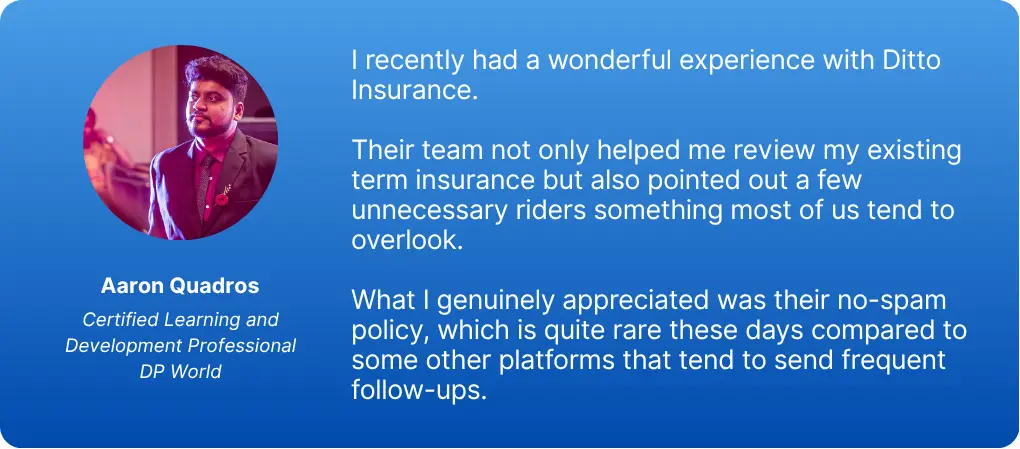
- No-Spam & No Salesmen
- Rated 4.9/5 on Google Reviews by 25,000+ happy customers
- Backed by Zerodha
- Dedicated Claim Support Team
- 100% Free Consultation
You can book a FREE consultation. Slots are running out, so make sure you book a call or chat on WhatsApp now!
Conclusion
At Ditto, we are selective about recommending term insurance for senior citizens. If needed, we help shortlist suitable insurers, calculate appropriate cover, prepare documents, and navigate the underwriting process.
But if the need does not exist, we say that clearly. For many senior citizens, health insurance coverage, liquidity, and retirement-income planning may be more useful than buying an expensive term plan late in life.
Last updated on: