



Introduction
India's senior-citizen population is projected to reach 17.32 crore in 2026, according to the National Commission on Population. That's a lot of families quietly asking: Can I still get my aging parents covered under life insurance?
The answer depends on how old the person you're buying insurance for is.
If you're a parent between 45 and 50, planning ahead, buying term insurance is typically straightforward and affordable, allowing you to lock in low premiums for decades.
However, if you're trying to buy term insurance for your parents who are already in their late 50s or 60s, your options become more limited. Coverage is harder to qualify for, premiums are much higher, and in many cases, term insurance may not even be the most suitable solution.
This guide is designed for both situations. We'll explain what term insurance for parents actually means, the maximum entry age most insurers allow, common reasons applications get rejected, how underwriting affects premiums, and when alternatives like health insurance or annuity plans may make more sense.
We'll also show you how Ditto helps you find the best term insurance for parents.
Common Questions People Buying Term Insurance for Parents Ask
What Is Term Insurance for Parents (Senior Citizen Term Insurance)?
Term insurance for parents (senior citizen term insurance) is a pure life insurance policy designed to financially protect the dependents of older individuals in the event of their untimely death during the policy term.
These plans function exactly like traditional term insurance policies.
At Ditto, we divide this into two buckets. For young, earning parents, term insurance is straightforward income protection. For older parents, especially after 55 or 60, the same product becomes term insurance for senior citizens with higher premiums, complex medical tests, and rejection rates rising sharply.
Ditto’s Key Insight: Young parents should definitely opt for term insurance to protect their dependents’ financial future. However, senior citizens or parents over 55 should consider it only if they have a dependent spouse, children dependent for life, or major loans to pay off.
Can You Buy Term Insurance for Your Parents in India?
Yes, you can buy term insurance for parents in India if they meet the insurer’s age, income, and health criteria. But there must be an insurable need.
At Ditto, we usually see term insurance for parents make sense when the parent is still earning, has unpaid loans, supports a spouse, or has dependent children. If your parent is retired, has no active income, and no one depends on them financially, a term plan may not be useful.
Ditto’s Advice: First, make sure you, the earning child, have adequate term cover. In many families, that matters more than buying a late-life term plan for retired parents.
What Is the Maximum Entry Age for Senior Citizen Term Insurance?
Most practical term insurance options for parents cap entry around 60 to 65 years, though the exact limit depends on the plan and variant.
For instance, Axis Max Life Smart Term Plan Plus and ICICI Life iProtect Smart allow policyholders to enter up to the age of 60. In comparison, HDFC Life Click2Protect Supreme Plus and Bajaj Life eTouch II extend the maximum entry age to 65.
Ditto’s Key Takeaway: Eligibility does not equal approval. While a parent may be within the entry age, the insurer can still apply loading charges, reduce cover, shorten tenure, or reject riders or the application in its entirety.
What Is the Best Term Insurance Plan for Parents Aged 55 to 65?
There is no single best term insurance plan for parents aged 55–65. At this age, underwriting matters more than features.
That said, if your parent is eligible and they have dependents, the following plans can be evaluated:
Ditto’s Advice: For older parents, don’t chase the most feature-heavy plan. First, check which insurer may approve the base cover easily at a reasonable loading.
Which Health Conditions Lead to Rejection in Term Insurance for Parents?
Health conditions do not always mean rejection, but they make underwriting stricter.
Controlled diabetes, controlled hypertension, or managed cholesterol may still get approval with loading. But severe heart disease, recent stroke, cancer, kidney disease, uncontrolled diabetes, organ damage, or multiple comorbidities can lead to postponement or rejection.
At Ditto, we’ve seen that senior applications are judged as a full health profile, not one condition at a time. A 58-year-old with controlled diabetes may be treated differently from a 58-year-old with diabetes, high BP, obesity, and abnormal kidney markers.
Ditto’s Advice: Never hide medical history. Senior citizens’ claims are scrutinized more closely, and incomplete disclosure can put the family’s claim at risk later.
How Does a Term Insurer Underwrite a Senior Citizen's Application?
Underwriting is the insurer’s risk check before issuing the policy.
For senior parents, insurers evaluate age, income, occupation, requested sum assured, medical history, current medication, smoking status, alcohol use, BMI, blood pressure, diabetes, cardiac history, and past hospitalizations.
The insurer may then approve the policy, approve it with a loading (usually 25% to 100% on an already high premium), request additional tests, reduce the cover or tenure, restrict riders, postpone the application, or reject it.
At Ditto, we’ve seen that proof of income is especially important. If a parent is retired and has no active income, a high sum assured may not be financially justified from the insurer’s perspective. It’s important to note that pension income and interest on fixed deposits are not accepted as income.
What Medical Reports Do Insurers Ask for From Senior Citizens?
Senior parents should expect a more detailed medical evaluation than younger applicants.
Keep the following reports handy: CBC and blood tests, HbA1c/fasting sugar, lipid profile, Liver Function Test (LFT)/Kidney Function Test (KFT), ECG, TMT/stress test, 2D Echo, urine test, etc.
Ditto’s Advice: Keep prescriptions, discharge summaries, past reports, and current test results ready before applying. Missing reports delay underwriting and increase back-and-forth.
How Much Higher Is the Term Insurance Premium for Parents?
Premiums rise sharply with age, steepening after 55 or 60, and any health condition adds a loading on top of that.
If there are health conditions, loading may further increase the premium. Return of Premium (ROP) variants can also be significantly more expensive (60%-100% more) than plain term plans and should be avoided because they’re not worth it.
For this example, we’ve considered healthy profiles of salaried, non-smoking individuals living in a tier-1 city like Delhi and covered for a sum assured of ₹2 crore until age 65.
Ditto’s Key Takeaway: Age has a much bigger impact on premiums than most people expect. The same ₹2 crore cover costs a fraction at 25 compared to 45 or 55, making early purchase one of the simplest ways to reduce your lifetime insurance costs. Moreover, for older parents, calculate the total premium outlay over the policy lifetime, not just the annual premium. In most cases, the math simply does not work.
Talk to an expert
today and
find
the right
insurance for you.


What Happens if My Parents' Health Worsens After the Policy Is Issued?
If the policy was issued after full disclosure and premiums are paid on time, later health changes do not affect the existing term cover.
So, if your parent buys a policy while healthy and later develops diabetes, hypertension, or a heart condition, the insurer cannot simply increase the premium because of that later diagnosis.
The real risk is non-disclosure at the proposal stage.
Ditto’s Advice: Accurate disclosure at the start is more important than getting the lowest premium. It helps reduce the risk of future claim disputes. Also remember that while Section 45 of the Insurance Act limits an insurer's ability to reject a policy after three years on the grounds of misrepresentation or non-disclosure, it is not a substitute for honest disclosure. Insurers can still reject claims if they can prove fraud. Therefore, providing complete and truthful information when buying the policy remains the safest approach.
Are There Better Alternatives Like an Annuity or Critical Illness for Parents?
For most senior parents, health insurance takes precedence over term insurance because hospitalization is the more immediate financial risk. After that, consider emergency funds, the Senior Citizen Savings Scheme (SCSS), Fixed Deposits (FDs), annuities, or pension products based on the parents’ income needs.
Ditto’s Advice: Don’t use term insurance as a retirement-income tool. If the goal is monthly income, look at annuity or pension options separately.
How Does Ditto Help You Find the Right Term Insurance for Parents?
At Ditto, we first check whether your parent actually needs term insurance.
For younger parents, we help calculate the right cover, compare insurers, check premiums, and shortlist plans based on policy quality and insurer metrics.
For older parents, we go deeper. We check age, income, liabilities, dependents, medical history, and likely underwriting outcomes. If a term plan is realistic, we help prepare the application and medical disclosures. If it is not realistic, we say that clearly and suggest alternatives.
In addition, we provide claims assistance if you’ve purchased your policy through us. Our team will guide you through the claims process, help you understand the required documentation, coordinate with the insurer when needed, and keep you informed every step of the way.
Key Takeaway: We do not recommend term insurance for parents just because it is available. We recommend it only when there is a real financial dependency or liability to protect.
Can I Claim a Tax Deduction for Life Insurance Premiums Paid for My Parents?
No. You cannot claim a deduction under Section 80C (now Section 123) for life insurance premiums paid for your parents. Under Section 80C, the deduction is available only for premiums paid on life insurance policies covering yourself, your spouse, or your children.
Policies covering your parents or parents-in-law do not qualify, regardless of whether they are financially dependent on you.
In practice, a term insurance policy for a parent is typically issued with the parent as both the proposer and the life assured. Even if you pay the premium on your parent's behalf, the policy belongs to the parent, the nominee should generally be the parent's dependent, and any eligible tax deduction can be claimed only by the parent, subject to the applicable provisions of the Income-tax Act.
Ditto's Unique Insights on Term Insurance for Parents
- Young Parents Should Buy Early
At Ditto, we’ve seen that term insurance for parents works best when the parent is young, earning, and financially responsible for the family. For parents under 45, premiums are usually lower, medical scrutiny is lighter, and the policy can protect the years when children’s education, home loans, and household expenses are at their peak. - Senior Parents Should Do a Need-Based Check
For older parents, we are much more selective. A senior citizen term insurance plan makes sense only if there is a clear financial dependency or liability.
For example, it may be worth considering if your parent is still earning, supports a spouse, has dependent children, or is repaying a major loan. But if your parent is retired, debt-free, and financially independent, buying a new senior citizen term insurance policy may not be worth the premium. - The Earning Child’s Term Cover Comes First
At Ditto, we often see families focus on buying term insurance for parents in India before checking whether the earning child has enough cover.
That order is usually backward. If you are the person supporting your parents, spouse, or children, your term insurance should come first. Your death could create a larger financial gap than your retired parent’s death, especially if your parent no longer has active income. - Health Insurance Often Comes First
For senior parents, hospitalization is usually the more immediate financial risk. So before buying a senior citizen term insurance plan, check whether they have adequate health insurance, a super top-up, and an emergency fund.
Term insurance solves income-replacement risk. It does not pay hospital bills, fund regular treatment, or create retirement income. If the main concern is medical expenses, health insurance should come first. - A Lower Cover May Be More Realistic
At ages 55 to 65, asking for a very high sum assured can trigger stricter financial and medical underwriting. Insurers check whether the cover amount is justified by the parent’s income, liabilities, and financial role in the family.
So instead of blindly choosing ₹1 crore or ₹2 crore, Ditto advisors calculate the actual gap: outstanding loan, dependent spouse’s needs, dependent child’s needs, and years of income replacement required. - Avoid Rejections Where Possible
A rejection can make future applications harder. That’s why Ditto does not recommend applying to multiple insurers at random. For older parents, we first review age, income, medical history, and the likely underwriting outcome. If the case looks difficult, we help set expectations upfront instead of letting your parent go through multiple medicals and formal rejections.
Why Choose Ditto for Term Insurance?
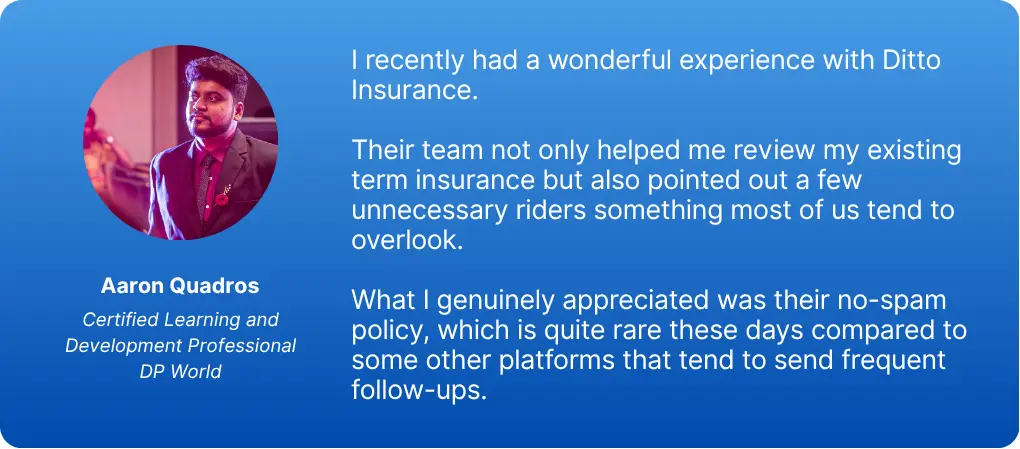
At Ditto, we’ve assisted over 8,00,000 customers with choosing the right insurance policy. Why customers like Aaron below love us:
- No-Spam & No Salesmen
- Rated 4.9/5 on Google Reviews by 25,000+ happy customers
- Backed by Zerodha
- Dedicated Claim Support Team
- 100% Free Consultation
You can book a FREE consultation. Slots are running out, so make sure you book a call or chat on WhatsApp now!
Conclusion
If you or your parents are young and have dependents, don't wait: buy term insurance now, while premiums are low and health is on your side. If your parents are already senior citizens, fix their health insurance first, check whether critical illness cover is appropriate, and consider senior citizen term insurance only if there's a clear income or loan to protect. Talk to an advisor before applying, since one rejection can affect how the next insurer views the case.
Last updated on: