



Overview
If your family depends on your income, here’s an uncomfortable question worth sitting with: Could they manage next month’s EMI, school fees, and everyday expenses if you were no longer around?
It’s not an easy question to think about, but it highlights an important part of financial planning: protecting your family’s financial future even when you’re not there to provide. That’s where term insurance comes in.
But what is term insurance, how does it work, and how much coverage do you actually need?
This guide discusses what term insurance means, how it works, the different types of term insurance, how much cover you may need, what it costs, and the key factors to consider when choosing a plan.
What Is Term Insurance? Meaning and Definition
Term insurance means a life insurance contract that protects your family for a set number of years, in exchange for a fixed premium.
If the policyholder passes away during the policy term, the insurer pays their nominee the promised sum assured (as a lump sum, monthly income, or a combination of both, depending on their choice). If they survive the term, there’s no refund or maturity value unless you’ve specifically opted for the Return of Premium (ROP) option.
So, when someone asks, “What is a term insurance policy?” the simplest answer is that it is an income replacement tool.
Eligibility
- Entry Age: 18 to 60/65 years.
- Maximum Maturity Age: 65 to 85 years (up to 99-100 for whole life variants).
- Payout Options: Lump sum, monthly income, or a combination of both.
- Premium Payment Modes: Annual, half-yearly, quarterly, or monthly.
- Premium Payment Terms: Regular pay, single pay, or limited pay.
Note: Features and eligibility can vary by insurer and plan, so always check the specific policy wording before buying.
What Is a Term Plan? Term Plan Meaning
A term plan is just another name for a term insurance policy.
Term plan meaning doesn't change based on the insurer or the marketing name attached to it. Every term plan, regardless of insurer, works on the same core promise: pay a small fixed premium now, and your family gets a large payout later if you're gone before the policy ends.
Imagine you're 28, just started a new job, and are wondering whether you even need this yet. A term plan is essentially you telling your future family, "even if I'm not here, you'll be financially fine."
Term Life Insurance Meaning: Is It the Same as Term Insurance?
Yes. Term life insurance meaning is the same as term insurance.
Both phrases describe the exact same product: a pure protection policy with a death benefit and no maturity payout. "Term life insurance" is more common outside India, while "term insurance" and "term plan" are the go-to phrases in the Indian market, and insurers and comparison sites use all three interchangeably.
People often confuse term insurance with life insurance more broadly.
Life insurance is the umbrella category that includes term plans, ULIPs, endowment plans, and whole life policies. Term insurance is simply the purest, most affordable branch under that umbrella. We'll unpack the full differences later in this guide.
How Does Term Insurance Work?
Term life insurance works on a simple risk-transfer model: the policyholder pays the insurer a small, predictable cost each year, and in exchange, the insurer assumes the financial risk of the policyholder's untimely death for a fixed period.
Here's the five-step flow that plays out behind the scenes:
- You choose your sum assured, term, and payment option. This means deciding how much cover your family needs, how many years you want it for (usually up to age 60 to 70), and whether you'll pay monthly, quarterly, or annually.
- The insurer underwrites your application. Based on your age, income, education, health disclosures, occupation, and lifestyle habits (like smoking), the insurer decides your final premium and whether to approve, modify, or decline your request.
- You pay premiums to keep the policy active. As long as you pay on time, your cover stays in force for the full term, no matter how your health changes later.
- If the policyholder passes away during the term, their nominee receives the benefit. They file a claim, submit the required documents, and once verified, receive the death benefit as a lump sum, monthly income, or a mix of both.
- If you outlive the term, the policy simply ends. There's no refund or payout, which is why term insurance premiums cost a fraction of savings-linked life insurance.
A Worked Example
Why Is Term Insurance Important?
Term insurance can create a large financial safety net before you have had decades to build the same amount through savings.
A young working person may still have 20–30 years of future income ahead. If they die early, that earning capacity disappears immediately. The death benefit can replace part of that lost future income, clear liabilities, and provide liquidity for everyday expenses and long-term goals without forcing the family to sell investments or property.
Think of this as protection leverage, not investment return. A relatively small premium transfers a much larger financial risk to the insurer.
Types of Term Insurance
Not all term plans work the same way. The type you choose changes how your cover behaves over time, and picking the wrong one can mean paying more for less protection.
Talk to an expert
today and
find
the right
insurance for you.


Beyond these five, you’ll also come across group term insurance (usually employer-provided), joint term insurance for couples, or housewife term plans. At Ditto, we generally don't recommend group or joint covers as your primary protection, since employer-linked policies can end the moment you switch jobs, and joint plans sometimes come with payout order or rider restrictions that individual plans don't have.
Who Should Buy Term Insurance?
Term insurance means the most to people whose absence would leave others in genuine financial trouble.
You should seriously consider buying term insurance if you’re:
- A young professional who expects to have financial dependents in the future and wants to secure cover while they are younger and healthier.
- Married, especially if your spouse depends fully or partly on your income.
- A parent whose income or unpaid household contribution supports a child's daily expenses, education, or future financial goals.
- Carrying a home loan, car loan, or personal or business loan that your family shouldn't have to repay alone.
- Self-employed or a business owner, where your absence could also disrupt the business itself.
- The sole breadwinner in your household, with no one else to fall back on financially.
Who Doesn’t Need Term Insurance?
If you have no dependents (current or potential future ones), no loans, and enough personal savings to cover your own final expenses, term insurance is less pressing, though it's rarely a bad idea, since premiums only get more expensive as you age.
Similarly, someone nearing retirement with grown, financially independent children and no outstanding liabilities may need much less cover, or none at all, than a 30-year-old with a new mortgage and a toddler.
However, it’s important to note that many insurers also offer premiums roughly 15% lower for women than for men, given women's statistically longer life expectancy and lower mortality rates. Homemakers can often qualify for cover too, usually assessed against the earning spouse's income, existing term plan, and the household's overall finances.
When Should You Buy Term Insurance?
The honest answer: as early as possible.
Term insurance pricing is built mainly around age and health, so every year you wait adds a real, permanent cost.
Here's what that "cost of waiting" actually looks like for a healthy, non-smoking male buying ₹2 crore of cover until age 65, using Axis Max Life Smart Term Plan Plus as an example:
In this example, waiting from 25 to 35 increases the annual premium by more than 50%. Even though you pay premiums for fewer years when you buy at 35, the higher annual rate can still increase your total lifetime premium outflow. Waiting also creates underwriting risk because a new health condition can increase your premium or reduce your options.
There's rarely a "perfect" time to buy term insurance, but the earliest financially responsible moment (your first stable job, taking on a loan, getting married, or having a child) is usually the right one. If you want to see exactly what your premium would look like at your current age, you can run the numbers on Ditto's term insurance premium calculator in under a minute.
How Much Term Insurance Cover Do You Actually Need?
This is the question we hear most often, and there's no single number that fits everyone.
At Ditto, we follow the expense and liability replacement method:
Your cover should be enough to help your family maintain their lifestyle, clear outstanding loans, and fund future goals like your children's education, even if you're not around to earn.
In practice, that means adding up your family's yearly living expenses multiplied by the number of years they'd need support, your outstanding loans, and high future costs like education or your child's wedding, then subtracting any existing life cover you already have.
Imagine you're 32, earning well, with a ₹40 lakh home loan, a 3-year-old daughter, and a spouse who isn't currently working. Over 20 to 25 years, household expenses, the home loan, and future education costs could easily add up to ₹1.5 to ₹2.5 crore, depending on your city and lifestyle.
Rather than estimating this by hand, Ditto's term insurance cover calculator factors in your age, expenses, liabilities, and existing cover to give you a personalized number in a few minutes.
Note: We use the conservative approach and recommend not subtracting your existing investments from the required life cover, as those are meant for wealth creation.
Insurer Eligibility Limits
These multiples vary by insurer, education, occupation, and city, so treat them as a rough ceiling, not a target. Just because an insurer will approve a ₹4 crore policy doesn't mean you need ₹4 crore. Your actual requirement should always come back to your family's real expenses and liabilities, not the maximum number an insurer is willing to underwrite.
Note: If you already hold an existing personal life insurance cover, deduct that sum assured from your calculated need and declare it honestly when applying for a new policy. There is no limit on the maximum number of life insurance policies, or term plans, a person can hold.
How Much Does Term Insurance Cost?
For this example, we’ve considered healthy, non-smoking, salaried individuals living in a tier-1 city like Delhi (pincode: 110010), covered for a sum assured of ₹2 crore until age 65.
These premiums are indicative and can vary based on factors discussed below:

Age
The single biggest factor. Premiums climb steadily every year you wait.
Gender
Women typically pay 15% to 20% less than men for the same cover, reflecting longer average life expectancy.
Smoking or Tobacco Use
Any tobacco use, including chewing tobacco or occasional smoking, can push premiums up by 60% to 100%.
Health Profile
Conditions like diabetes, hypertension, or a family history of heart disease can trigger premium loading of 25% to 100%, or restrictions on cover amount, tenure, or riders offered, depending on severity.
Occupation
High-risk jobs, like those involving hazardous machinery, aviation, or offshore work, may attract additional loading, though they rarely lead to outright rejection.
Coverage Amount and Policy Term
Higher sum assured and longer terms increase the absolute premium, though the cost per lakh of cover often improves at higher amounts.
Note:
- Four insurers, one profile, in this table. Swap in your own details on Ditto's term insurance premium calculator and get a quote built specifically for you.
- Since September 22, 2025, individual term insurance premiums in India attract 0% GST, down from the earlier 18%. If your base premium is ₹10,000, you now pay exactly ₹10,000 instead of ₹11,800.
Term Insurance Riders: What to Buy and What to Skip
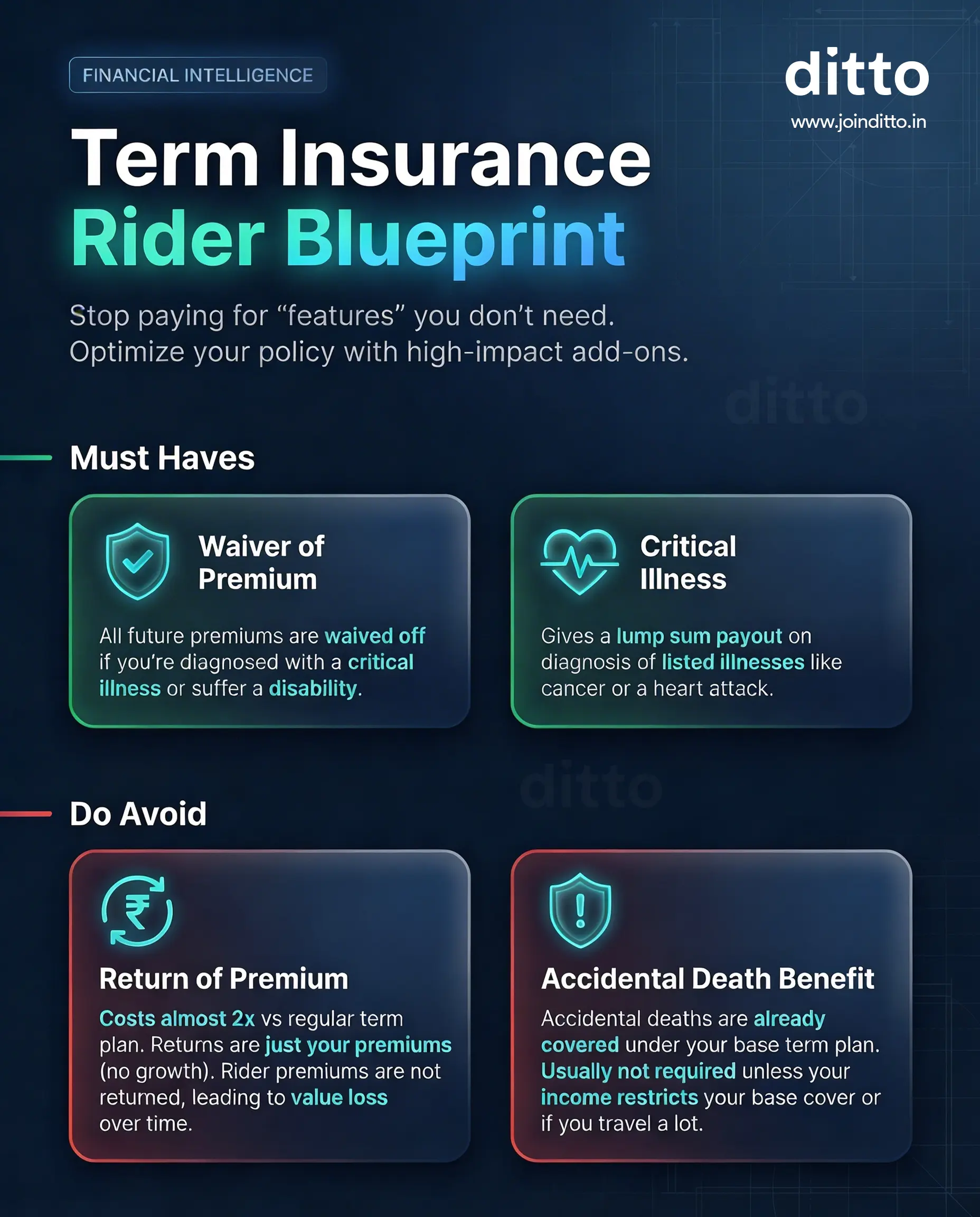
Riders are paid optional add-ons that extend your base term plan to cover situations beyond death, like critical illness or disability, for a small additional premium.
Riders Worth Buying
- Critical Illness Rider: Pays a lump sum on diagnosis of a listed illness like cancer, a heart attack, or kidney failure, especially valuable for sole earners for income replacement during recovery. It also complements your health insurance.
- Waiver of Premium: Keeps your policy active without further premium payments if you're diagnosed with a listed critical illness or permanent disability.
Riders to Avoid
- Accidental Death: The accidental death benefit rider provides an additional lump sum on top of the base sum assured if death occurs due to an accident. However, term insurance already covers accidental death by default. It’s better to buy a larger sum assured than opt for this rider unless you're in a high-risk occupation or travel frequently.
A simple rule of thumb is to pick riders based on real gaps in your existing coverage, not just because they’re bundled attractively.
What Term Insurance Does Not Cover
Term insurance is built to cover almost every kind of death, whether from illness, accident, or natural causes, as long as your policy is active. But every policy carries a standard set of exclusions you should know before you buy:
- Suicide Within the First 12 Months: If death by suicide happens in the first policy year (or within one year of revival), the nominee typically receives only a portion of premiums paid (at least 80%), not the full sum assured. This restriction lifts after the first year. You’ll notice this exclusion explicitly mentioned in almost all policy documents.
- Death from Illegal Activities: If the policyholder dies while committing a crime, like theft, assault, or evading arrest, the insurer can deny the claim.
- Death from Substance Abuse: Death caused by drug overdose, or alcohol and narcotic use where the policy specifically excludes it, is usually not covered.
- Fraud or Non-Disclosure: If you hide material facts, like your smoking status or a health condition, at the time of purchase, the insurer can investigate and potentially reject the claim, though only within the first three years, after which most policies become largely incontestable except in cases of proven fraud.
- Death Caused by the Nominee: If the nominee is found responsible for the policyholder's death, the claim is not paid to them but to another legal heir.
Note: For exact exclusions, refer to your policy wording.
Rider-Specific Exclusions
There are rider-specific exclusions also. For example, critical illness, accidental disability or death, and other riders have their own exclusions, waiting periods, definitions, and claim conditions. Check these separately in the rider wording.
Medical Tests and Documents You Will Need
Documents
To buy term insurance, you'll typically need identity and age proof (Aadhaar, PAN, passport, or driving license), address proof, income proof (salary slips and bank statements for salaried applicants, or 2-3 years of ITRs and computation of income for the self-employed), nominee details, and passport-sized photographs. You can learn more about this in our detailed guide on documents required for term insurance.
Medical Tests
Whether you need a medical test depends on your age, the sum assured you're requesting, and your health disclosures.
- For younger applicants with a straightforward profile and moderate cover, some insurers rely on a quick telemedical interview instead of an in-person checkup.
- For higher covers, typically above ₹1-₹2 crore, or for applicants with medical histories or older applicants, insurers may ask for blood work, an ECG, and blood pressure checks.
- For older or higher-risk profiles, they may require more detailed tests like a TMT or CTMT.
The good news is that the insurer usually arranges and pays for these tests directly. And the reports are shared with you as well.
Ditto’s Key Insight: A medical test isn't something to avoid or worry about. Instead, it actually protects you by creating a clear, documented health record that reduces the odds of a claim being disputed later over "hidden" conditions. Being fully upfront about your health and habits during this process is one of the simplest ways to help your family's claim go through smoothly years later.
Myths About Term Insurance
- Myth 1: “Term insurance is a waste of money since you get nothing back if you survive.”
Reality: That's the entire point. You're paying for protection, not a savings return, the same way you don't expect your car insurance premium back if you never get into an accident and file a claim. - Myth 2: "I'm young and healthy, so I can buy it later."
Reality: Premiums are at their absolute lowest when you're young and healthy. Waiting doesn't just cost more money later, but it also risks a future health condition, making you harder, or costlier, to insure. - Myth 3: "My employer's group life cover is enough."
Reality: Group cover typically ends the moment you resign, retire, or get laid off, and it's sized for the average employee, not your specific loans and family needs. - Myth 4: "A high cover amount, like ₹1-₹2 crore, is unaffordable."
Reality: If you buy young, a ₹1 to ₹2 crore term plan often costs less per month than a mid-range OTT and food delivery subscription combined, especially now that individual policies carry 0% GST. - Myth 5: "Insurance companies find excuses to reject claims."
Reality: The industry's average Claim Settlement Ratio is 99.00% over a three-year average (FY 24-26). Most rejections trace back to non-disclosure or incomplete documentation, not insurer reluctance. - Myth 6: "Only married people with kids need term insurance."
Reality: If you have a loan, aging parents who depend on you, or business liabilities, your absence still creates a real financial gap, regardless of your marital status.
Term Insurance vs. Life Insurance: What's the Difference?
Life insurance is a broad category that includes term plans alongside savings-linked products like endowment plans, ULIPs (Unit-Linked Insurance Plans), and whole life policies.
The trade-off between term insurance and other life insurance policies is simple.
Term insurance gives you a much larger death benefit for a much smaller premium, because none of your money is being set aside for a maturity payout.
At Ditto, we generally recommend buying term insurance for protection and, if you also want to invest, doing it separately through growth-focused instruments like mutual funds, National Pension System (NPS), or fixed deposits, rather than bundling the two.
Tax Benefits of Term Insurance
How to File a Term Insurance Claim?
- Inform the insurer as soon as possible, through their website, branch, email, or helpline.
- Submit the claim form and key documents.
- The insurer verifies the documents and may request additional information for accidental, premature, or unusual deaths.
- Once approved, the payout goes directly to the nominee's registered bank account.
How Long Does a Term Insurance Claim Take to Settle?
Under IRDAI's policyholder protection framework, insurers must settle claims within 15 days of claim intimation. If an investigation is required, insurers must complete it within 45 days of the claim being reported.
If the insurer exceeds the applicable timeline, the claimant is entitled to interest at the bank rate plus 2% from the date of receipt of intimation until payment, which the insurer must pay automatically along with the claim amount.
If your claim is unreasonably delayed, you can escalate it to the insurer's grievance redressal cell and then the Insurance Ombudsman.
Note: If you bought your policy through Ditto, you can reach out to us for claims assistance.
How to Make the Term Insurance Claim Process Easier?
- Before Buying: Disclose tobacco use, past diagnoses, medication, tests, hospitalization, occupation, and existing insurance exactly as asked, to the best of your knowledge.
- After Buying: Review the issued policy and medical declarations, correct errors during the free-look period, keep nominee/contact details updated, and tell your nominee which insurer issued the policy and share the document with them.
What Happens If You Miss a Premium?
Missing a due date doesn't end your cover instantly, as insurers provide a grace period of 15 days for monthly premiums, and 30 days for quarterly, half-yearly, or annual premiums.
If the policyholder passes away during this window, their nominee still receives the payout, though any unpaid premium is deducted from the claim amount.
- If you pay within the grace period, your policy continues exactly as before, with no extra paperwork.
- If you miss it entirely, the policy lapses, and your life cover stops immediately, meaning no claim would be payable if something happened to you during a lapsed period.
Reviving a Lapsed Policy: Under IRDAI rules, you generally have up to 5 years from the date of the first missed premium to revive a non-linked term policy, though insurers get progressively stricter the longer you wait in terms of asking you to undergo medicals, payment of missed premiums with penalties, and restarting the section 45 contestability period.
Best Term Insurance Plans in India (2026)
For a detailed, feature-by-feature breakdown of these and other top-rated plans, along with which profile each one suits best, head over to our full guide on the best term insurance plans in India.
How to Decide the Right Term Insurer for You?
Choosing the right term plan comes down to picking a financially reliable insurer and a policy that genuinely fits your income, dependents, and goals.
At Ditto, we evaluate insurers using publicly disclosed metrics like:
1) Claim Settlement Ratio (CSR)
This shows the percentage of death claims an insurer settles out of the total claims received. A consistently high CSR generally indicates a strong claims track record. An ideal CSR is above 97%.
2) Amount Settlement Ratio (ASR)
ASR measures the proportion of the total claim amount the insurer pays out, rather than just the number of claims settled. It helps indicate how well the insurer handles larger-value claims. An ideal ASR is above 90%.
3) Solvency Ratio
This reflects an insurer’s financial ability to meet its long-term obligations and pay claims. A higher solvency ratio generally provides a stronger financial cushion. IRDAI requires a minimum solvency ratio of 1.5x, while at Ditto, we recommend insurers who’ve maintained a solvency ratio above 1.8x for extra buffer.
4) Complaint Volume
This tracks customer complaints relative to the insurer’s claims volume. Lower complaint levels can indicate better claims handling and customer service. At Ditto, we recommend insurers with a complaint volume of less than 20 per 10,000 claims.
5) Annual Business Volume
This reflects the scale of the insurer’s business, usually through new business premiums collected. A larger, established business can indicate stronger operating scale, though size alone does not guarantee better service. At Ditto, we recommend considering insurers with an annual business volume above ₹5,000 crore.
For the full methodology and live insurer-wise data, check Ditto's term insurance rating framework, our Term Insurance Data Lab.
You can also go through our list of the best term insurance companies in India.
How to Buy Term Insurance Through Ditto: Step-by-Step
Buying term insurance through Ditto is a guided process, from figuring out how much coverage you need to completing underwriting and receiving your policy. Ditto charges no additional fees, and the premium is the same as what you would pay if you bought directly through the insurer.
Step 1: Speak With a Ditto Advisor
Start by booking a free call or connecting with an IRDAI-certified Ditto advisor on WhatsApp. The advisor will understand your age, income, occupation, dependents, liabilities, existing insurance, health history, and lifestyle habits. Based on your profile, our advisors can help estimate an appropriate sum assured and policy tenure, and identify insurers likely to suit your requirements.
Step 2: Compare and Shortlist Term Insurance Plans
Our advisors will help you compare suitable term plans based on factors such as the insurer’s track record, policy features, premiums, underwriting suitability, riders, and customer service. You can then finalize the insurer, sum assured, policy tenure, premium payment option, and any riders you want to add. Ditto advisors also explain key exclusions and trade-offs before you decide.
You do not have to decide during the call. Ditto doesn't rely on repeated sales follow-ups, so you can take your time to compare options, ask your advisor additional questions, and decide when you are comfortable.
Step 3: Complete the Proposal Form and Pay the Premium
Once you have selected a plan, Ditto helps you complete the insurer’s proposal form. This stage matters because you must accurately disclose details such as your income, occupation, smoking or tobacco use, medical history, previous consultations or treatments, existing insurance policies, and nominee information. After completing the application, you pay the premium through the insurer’s authorized payment channel.
Step 4: Complete Medical Tests and Underwriting
The insurer will review your application and may request identity, income, employment, medical, or existing insurance documents. Depending on your age, health, sum assured, and overall profile, it may also arrange medical tests, typically at no additional cost to you. The insurer can then approve your application at standard rates, offer coverage with a higher premium, request additional information, postpone the application, or decline it. Ditto helps you coordinate and respond to underwriting requirements during this process.
Step 5: Review and Receive Your Policy
Once the insurer approves your application, it issues the policy document and sends it to your registered email address. Carefully check details such as your name, nominee, sum assured, policy term, premiums, and medical disclosures. Individual life insurance policies come with a 30-day free look period, during which you can review the policy and cancel it if you disagree with its terms, subject to applicable deductions.
Note: Ditto also provides end-to-end post-purchase assistance, including policy servicing and support for your family during a claim.
Why Choose Ditto for Term Insurance?
At Ditto, we’ve assisted over 12,00,000 customers with choosing the right insurance policy. Why customers like Aaron below love us:

- 100% Free Consultation
- No Spam. No Sales Pressure.
- Rated 4.9/5 on Google Reviews by 30,000+ Happy Customers
- Backed by Zerodha
- Dedicated Claim Support Team
- Compare Plans and Premiums with a Trusted Insurance Advisor
Confused about the right insurance? Speak to Ditto’s certified advisors for free, unbiased guidance. Book your call now or chat with us on WhatsApp. Slots fill up fast!
Ditto's Verdict on Term Insurance
Buy term insurance because someone depends financially on you, not simply because you have reached a particular age.
Start by calculating your family's future expenses, liabilities, and major financial goals, then subtract existing life cover. For most buyers, a straightforward level-term policy with adequate base cover is the best starting point.
We generally skip Return of Premium and accidental-death add-ons because they increase cost without solving the core problem as efficiently as adequate base cover. Add riders only when they protect a meaningful living risk, and disclose every health, lifestyle, and occupation detail accurately during underwriting.
If nobody depends on your income, you have no liabilities that would fall on another person, and your existing assets can comfortably meet your obligations, you may not need term insurance yet.
Frequently Asked Questions
Customer Reviews
Last updated on: