



Overview
Even today, a large part of India’s healthcare bill is paid directly by families. According to the National Health Accounts Estimates 2022-23, out-of-pocket expenditure accounted for 43.4% of India’s total health expenditure in 2022-23, down from 64.2% in 2013-14.
This is where health insurance becomes important. A good health insurance policy helps cover hospitalization expenses, surgeries, daycare procedures, and other eligible medical costs, so you do not have to depend entirely on your savings during a medical emergency.
This guide explains what health insurance is, how it works, what it covers and excludes, how claims are processed, and how to choose the right health insurance plan.
What Is Health Insurance and How Does It Work?
Health insurance is a financial arrangement where you pay a premium to an insurance company, and in exchange, the insurer agrees to cover eligible medical expenses up to a specified amount, known as the sum insured.
Health insurance works through a system called risk pooling, in which an insurance company collects premiums from a large group of people to create a shared financial pool. Because only a small percentage of these policyholders will face major medical emergencies or hospitalizations at any given time, the money collected from the healthy majority covers the expensive treatments of the few who fall ill.
To keep this system financially viable, insurers use a process called health insurance underwriting to evaluate medical histories and age. This allows them to calculate risks mathematically, set affordable premium rates, and establish clear policy boundaries, such as waiting periods or exclusions.
Simply put, here's how it works for you:
(1) You purchase a health insurance policy.
(2) You pay premiums annually.
(3) If you require medical treatment covered under the policy, you can raise a claim.
(4) The insurer settles eligible expenses either directly with the hospital (cashless claim) or reimburses you after treatment (reimbursement claim).

Why Do You Need Health Insurance in India?
Rising Medical Inflation (12% to 14%)
The cost of hospitalization, surgeries, diagnostic tests, and medicines continues to increase every year due to the rising medical inflation in India. Treatments that cost ₹2 lakh today will cost significantly more in a few years.
Lifestyle Diseases
Conditions such as diabetes, hypertension, obesity, heart disease, and thyroid disorders are affecting people at increasingly younger ages. Long-term treatment for these illnesses can be expensive.
Employer Coverage Is Not Enough
Many people rely solely on their corporate health insurance. However, employer-provided coverage is limited, may not adequately cover family members, and ends when you switch jobs or retire. Moreover, it cannot be customized for your needs.
Cashless Hospitalization
Health insurers offer cashless treatment through large hospital networks, allowing you to receive quality care without arranging large sums of money upfront. Moreover, health insurance premiums over a person's lifetime will always be cheaper than paying out of pocket for medical bills (especially for chronic conditions).
Preventing Asset Liquidation
Insurance prevents families from being forced to sell property, liquidate retirement funds, or disrupt long-term investments to pay for immediate care.
Avoiding Predatory Debt
Uninsured individuals often rely on high-interest personal loans or credit cards to fund medical emergencies, leading to long-term debt traps.
Types of Health Insurance Plans in India
According to IRDAI, health insurance policies may cover medical expenses through direct payment to the hospital, reimbursement of eligible expenses, or a fixed benefit payout upon the occurrence of a covered illness or event.
Broadly, health insurance plans in India can be divided into two categories:
Benefit-Based Health Insurance Plans
Benefit-based health insurance plans pay a fixed amount when a specific insured event happens. The payout does not depend on the actual hospital bill. For example, a critical illness insurance plan may pay a fixed lump sum if the policyholder is diagnosed with a listed illness such as cancer, stroke, kidney failure, or a major heart-related condition, depending on the policy terms.
Common benefit-based plans include:
- Critical illness insurance
- Hospital daily cash plans
- Surgical benefit plans
- Some disease-specific plans
However, these plans should usually not be your first health insurance policy. They work better as an additional layer of protection because they cover specific events rather than all types of hospitalization. These are generally used for income replacement, cover for non-medical expenses, etc.
Indemnity-Based Health Insurance Plans
Indemnity-based health insurance plans are the more common “standard” option. These plans cover actual medical expenses up to the policy’s sum insured.
They may cover expenses such as hospitalization costs, doctor’s fees, surgery charges, medicines, diagnostic tests, room rent, ICU charges, and pre- and post-hospitalization expenses, depending on the policy terms.
Within indemnity-based health insurance, plans can be grouped into the following common categories:
- Individual Health Insurance
An individual health insurance plan covers one person under one policy. The entire sum insured is reserved only for that insured member.
- Multi-Individual Health Insurance
A multi-individual health insurance plan covers multiple family members under a single policy, but each member has a separate sum insured.
- Family Floater Health Insurance
A family floater health insurance plan covers the entire family under one shared sum insured.
- Senior Citizen Health Insurance
Senior citizen health insurance plans are designed for people aged 60 and older.
- Group Health Insurance
Group health insurance is provided by an employer, association, bank, or organization to a group of people.
- Top-Up Health Insurance Plans
A top-up health insurance plan adds extra coverage above a fixed deductible. The insurer pays only when each hospital bill crosses that deductible.
- Super Top-Up Health Insurance Plans
A super top-up health insurance plan also adds extra coverage above a fixed deductible. But unlike a regular top-up plan, it considers the total eligible hospital bills in a policy year to meet the deductible.
- Maternity Health Insurance
Maternity health insurance covers delivery-related expenses and related care, subject to the policy’s terms and conditions.
- Disease-Specific Health Insurance Plans
Disease-specific health insurance plans are designed to cover a particular illness or medical condition.
Ditto’s Take
- If you are buying health insurance for the first time, start with a comprehensive indemnity plan. For most people, this means an individual plan or a family floater plan with adequate coverage, no sub-limits, a wide hospital network, and reliable claim support.
- After that, you can consider additional layers such as a super top-up plan, critical illness cover, maternity benefit, or a plan tailored to your needs.
- In simple terms, do not start with the most specialized plan. Start with broad hospitalization coverage first. Then add specific covers only if they solve a real need.
Premium Comparison for Health Insurance Plans
Note: A stands for adult and C denotes child. These premiums are for healthy Delhi residents (pincode: 110001), with a sum insured of ₹25 lakh. They include mandatory and recommended add-ons. Your premiums can change based on age, city, medical history, plan variant, and chosen add-ons.
Talk to an expert
today and
find
the right
insurance for you.


What Does Health Insurance Cover in India?
Health insurance in India covers hospitalization-related expenses, including inpatient hospitalization, doctor’s fees, surgery charges, medicines, diagnostic tests, room rent, ICU charges, and pre- and post-hospitalization expenses.
Plans also cover daycare procedures that do not require 24-hour hospitalization (such as dialysis), ambulance charges, organ donor expenses, AYUSH treatments, domiciliary hospitalization, preventive health-checkups, and modern treatments.
However, the exact coverage depends on the policy terms, waiting periods, sub-limits, exclusions, and add-ons chosen.
What Is Not Covered Under Health Insurance?
Exclusions in health insurance are of two types: temporary and permanent.
Temporary Exclusions in Health Insurance
- Initial Waiting Period
Health insurance policies do not cover hospitalization due to sickness or disease during the first 30 days of the policy. However, hospitalizations resulting from accidents are covered from day 1.
- Specific Illness Waiting Period
As per IRDAI, specific disease/procedure waiting periods can be up to 36 months, though many plans commonly use 1-2 years for certain illnesses such as cataract, hernia, and knee replacement.
- Pre-Existing Disease (PED) Waiting Period
If you already have a PED before buying the policy, it will not be covered immediately. These have a 1-3-year waiting period, depending on the plan.
Permanent Exclusions in Health Insurance
Permanent exclusions are expenses or situations that are usually not covered at all, unless the policy specifically says otherwise.
- Sum Insured
This is the maximum amount your insurer will pay for your medical bills in a policy year. Choose this carefully because healthcare costs can rise quickly, especially in metro cities.
- Blacklisted Hospitals
These are hospitals where your insurer will not approve cashless or reimbursement claims. Always check this list before hospitalization to avoid surprises from claim rejections.
- Free Look Period
This is a 30-day window after buying the policy during which you can review the terms and cancel it if it does not suit you. You may get a refund after applicable deductions.
- Moratorium Period
After you complete the moratorium period of 5 years, the insurer generally cannot reject claims for non-disclosure, except in cases like fraud. This makes long-term policy continuity very valuable.
- Grace Period
This is the extra time you get after the premium due date to renew your policy. It is 15 days for monthly premium payments and 30 days for other payment frequencies. If you pay within this period, you will avoid losing continuity benefits, such as waiting period credits.
How Do Claims Work in Health Insurance?
Cashless Claims
In a cashless claim, you are treated at a network hospital. The hospital then sends a pre-authorization request to the insurer, and once approved, the insurer directly settles the eligible expenses with the hospital. This is usually the easier option because it reduces the amount you need to pay upfront.
Reimbursement Claims
In a reimbursement claim, you usually get treated at a non-network hospital, pay the hospital bill yourself, and then submit the required claim documents to the insurer. The insurer reviews the documents and reimburses eligible expenses under the policy terms. This option involves more paperwork and an upfront payment, but it still protects you from having to cover the full eligible medical costs yourself.
Note: With the Cashless Everywhere initiative, policyholders can request cashless treatment at a non-network hospital. However, this is not automatic. The claim must be admissible under the policy, the insurer’s operating guidelines must allow it, and the insurer must be informed in time. For planned treatments, inform the insurer at least 48 hours before admission. For emergency hospitalization, inform the insurer within 48 hours of admission.
Did You Know?
How to Choose the Right Health Insurance Plan?
Assess Your Coverage Needs
Start by asking: Who needs coverage, and how much coverage is enough? A young individual may be fine with a simple individual health insurance plan, while a family may prefer a family floater plan. Always assess your medical needs and medical history.
Check Network Hospitals
A large hospital network is useful because it improves your chances of getting cashless treatment. At Ditto, we recommend choosing insurers with more than 10,000 network hospitals and checking whether your preferred hospitals are part of their networks.
Review Hidden Clauses and Limits
Two policies with the same sum insured can behave very differently during a claim due to hidden limits. You should ideally look for a plan without room-rent limits, disease-wise sub-limits, or co-payments. The plan should also have a strong restoration benefit for both the same and different illnesses. Find plans that offer at least 60 days of pre- and 90 days of post-hospitalization coverage.
Understand Waiting Periods
Health insurance does not cover everything from day 1. Most policies have an initial waiting period, specific illness waiting periods, and pre-existing disease waiting periods. So, before buying a plan, check how long you need to wait for important conditions to be covered.
Look for Valuable Add-Ons
Add-ons can make a health insurance plan more useful, but only if they solve a real problem. Do not buy every rider just because it is available. Useful add-ons include consumables cover, no-claim bonus protection, waiting period reduction, and unlimited restoration.
Evaluate the Insurer
A good policy is only useful if the insurer handles claims well. So, before finalizing a plan, evaluate the insurer’s claim and service record. Find insurers with a strong claim settlement ratio (above 90%), an incurred claims ratio (between 55% to 85%), a complaint volume as low as possible, and an in-house claim settlement team.
Keeping all this in mind, we’ve shortlisted the best health insurance plans in India, and those include HDFC ERGO Optima Secure+, Care Supreme, Aditya Birla Activ One MAX, Niva Bupa ReAssure 2.0 Platinum+, and SBI Super Health Platinum Infinite.
How Much Health Insurance Coverage Do I Need?
There is no one-size-fits-all answer, but your health insurance coverage should be based on your city, age, family size, lifestyle, medical history, and the hospitals you are likely to use. As a general rule of thumb, an individual should consider at least ₹15 lakh in health insurance cover, while a family in a metro city may need ₹20 lakh to ₹25 lakh or more.
Note: If you'd like to explore the detailed figures reported by insurers and the IRDAI in their annual disclosures and public reports, visit Ditto Data Labs, our proprietary repository of health insurance data, meticulously compiled, verified, and maintained by the Ditto team over the years.
Tax Benefits Under Health Insurance in India
Health insurance premiums offer tax benefits under Section 80D (renamed to Section 126) of the Income Tax Act if you choose the old tax regime. You can claim deductions for premiums paid for yourself, your spouse, dependent children, and parents. The deduction is up to ₹25,000 for the self, spouse, and dependent children and up to ₹50,000 if the insured person is a senior citizen. You may also claim a separate deduction for parents’ health insurance premiums within the applicable limit.
GST Exemption on Health Insurance: In a major relief for policyholders, GST on individual health insurance policies was reduced from 18% to 0% with effect from 22 September 2025. This exemption applies to individual health insurance plans, including family floater and senior citizen policies, making health insurance more affordable by lowering overall premiums. However, group health insurance policies continue to attract 18% GST.
Note: Do not buy health insurance only for tax savings. The main purpose of a health insurance plan is to protect you from large medical bills.
Common Myths About Health Insurance in India
Many people delay buying health insurance because of common myths.
- The first myth is, “I am young and healthy, so I do not need health insurance.” But medical emergencies can happen at any age, and buying early usually means lower starting premiums and fewer complications with waiting periods. Moreover, you finish all your waiting periods early, accumulate bonuses, and strengthen your cover over time.
- The second myth is, “My employer’s health insurance is enough.” Employer coverage is useful, but it ends when you leave the job and may not offer enough coverage for your family.
- The third myth is, “The cheapest policy is the best policy.” In reality, a low-premium plan may have room rent limits, co-payments, sub-limits, or weak claim support.
- The fourth myth is, “Health insurance covers everything.” All plans have waiting periods, exclusions, and policy conditions. So, always read the fine print before buying.
Why Choose Ditto for Health Insurance?
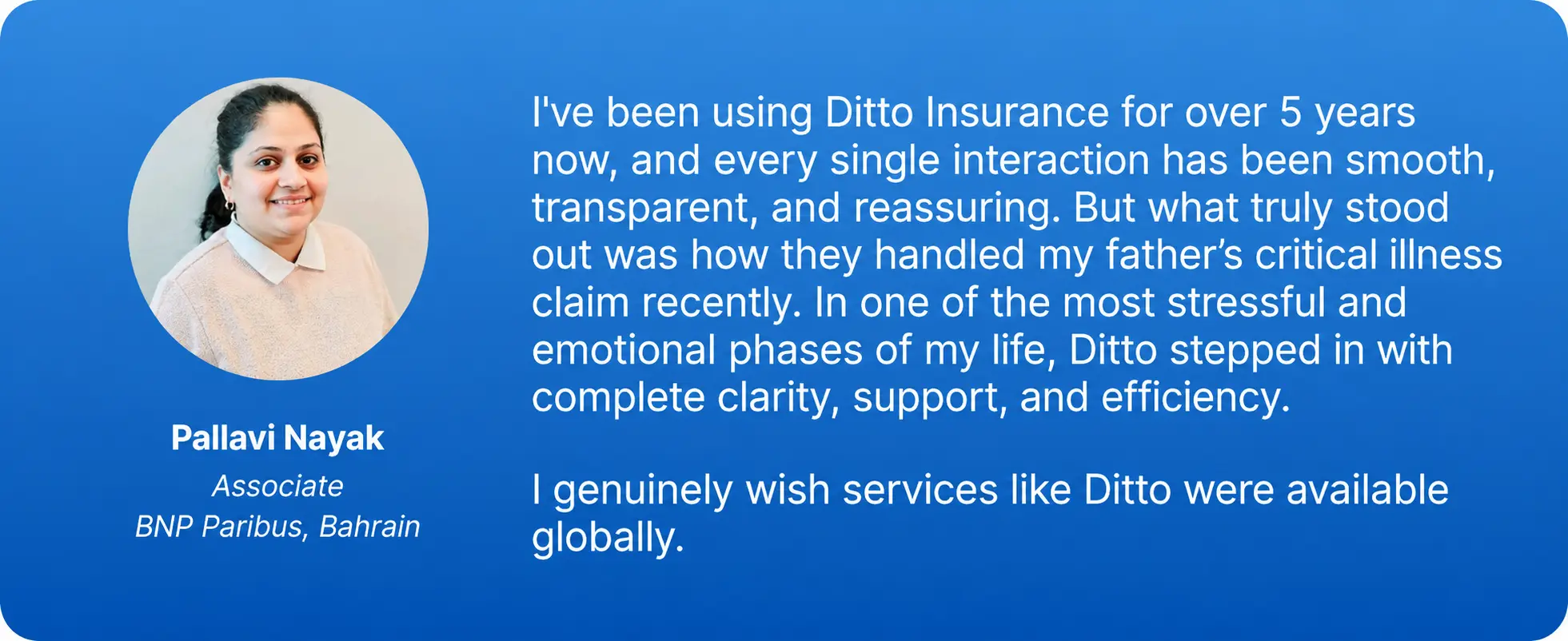
At Ditto, we’ve assisted over 12,00,000 customers choose the right insurance policy. Why customers like Pallavi love us:
- 100% Free Consultation
- No Spam. No Sales Pressure.
- Rated 4.9/5 on Google Reviews by 30,000+ Happy Customers
- Backed by Zerodha
- Dedicated Claim Support Team
- Compare Plans and Premiums with a Trusted Insurance Advisor
Confused about the right insurance? Speak to Ditto’s certified advisors for free, unbiased guidance. Book your call now or chat with us on WhatsApp. Slots fill up fast!
Conclusion
Health insurance is not just another financial product. It is a safety net that protects you from large and unexpected medical bills. But the right policy is not always the cheapest one or the one with the highest sum insured. You need to check the coverage, exclusions, waiting periods, hospital network, hidden limits, claim process, and insurer’s track record before buying.
If you are buying health insurance for the first time, start with a comprehensive indemnity-based plan that offers broad hospitalization coverage, fewer restrictions, and reliable claim support.
Frequently Asked Questions
Customer Reviews
Last updated on: