



Overview
Imagine you join a new company. On your first day, HR sends you a health card and says you are covered. Sounds great. But covered for what, for how much, and what happens if you change jobs?
This matters because group health insurance is a huge part of India’s health insurance coverage. As per IRDAI’s Annual Report FY 2024-25, 47.4% of all lives covered under health insurance were in group business, compared to 42.3% in government-sponsored schemes and just 10.3% in individual policies.
Group health insurance is one of the most valuable workplace benefits you can get, which is compulsory by law. But it works very differently from a policy you buy yourself. Understanding it can save you from a nasty surprise during a claim.
This guide explains group health insurance in India, including how it works, types, eligibility, coverage, exclusions, GST, tax benefits, claims, and whether you still need individual cover.
What Is Group Health Insurance and How Does It Work?
A group health insurance policy is issued to a defined group of people under a single master contract. IRDAI specifies that group insurance can only be offered to groups with a genuine, pre-existing relationship, not one formed just to buy insurance.
There are two broad types of groups that qualify:
- Employer-Employee Groups: Companies buy group health insurance for their employees. This is the most common type you will come across.
- Non-Employer-Employee Groups: Associations, cooperative societies, banks (for account holders), or other organizations with a common purpose beyond insurance can also offer group health insurance to their members.
How Does Group Health Insurance Work?
- The employer (or group administrator) picks a general insurer or standalone health insurer.
- The insurer prices the policy based on employee data: age distribution, number of dependents, city, and claims history from prior years.
- A single master policy is issued to the employer, and employees are enrolled and issued health cards.
- Claims are handled either directly by the insurer or through a Third Party Administrator (TPA), which manages cashless approvals and reimbursements on the insurer's behalf.
The key thing to understand here is that the employer has a lot of control. They decide the sum insured, which benefits to include, whether dependents are covered, and how much of the premium employees pay. As an employee, you get what is negotiated at the group level.
Popular Real-Life Examples of Group Health Insurance
Who Is Eligible for Group Health Insurance?
Eligibility rules are set by the employer and the insurer, but here are the general patterns you will see:
For Employees
- Full-time, permanent employees are included.
- Contract workers, interns, or part-time staff may or may not be covered depending on the company's policy.
- New joiners are typically enrolled at the time of onboarding. Some policies have a waiting period of 30 to 90 days before coverage begins.
For Dependents
- Spouse and dependent children (usually up to age 25) are commonly included.
- Parents or parents-in-law may be covered, but this is optional and usually adds a significant premium cost to the employer.
Note: Employees earning up to ₹21,000 per month (or ₹25,000 for persons with disabilities) in covered establishments with 10 or more workers are eligible for Employees’ State Insurance Corporation (ESIC) coverage. In such cases, employers often use group health insurance as a supplementary layer for employees above the ESIC wage threshold.
Key Features & Benefits of Group Health Insurance Policies
In our experience at Ditto, employees often underestimate what their group health insurance actually offers. Here is a quick breakdown of the key features:
For Employees
- No Medical Screening at Enrollment: You get covered regardless of pre-existing conditions, without any health check-up.
- No Waiting Periods: Unlike retail health plans that have 2- to 3-year waiting periods for specific illnesses and pre-existing conditions, many group policies waive these entirely or reduce them significantly.
- Dependent Coverage: In many cases, you can add your spouse, children, and sometimes parents under the same policy.
- Cost: Premiums are either paid in full by the employer or heavily subsidized.
For Employers
- Competitive Recruitment: A good health insurance benefit helps attract and retain talent.
- Tax Efficiency: Premiums paid by the employer are treated as a business expense.
- Pooled Risk Pricing: Covering a large group allows the insurer to offer better rates than most individuals would receive on their own.
What Does Group Health Insurance Cover?
Coverage under a group health insurance policy varies by employer and insurer. That said, here are the standard inclusions and exclusions you will find in most policies:
Note: These inclusions may vary from plan to plan.
Add-Ons and Enhancements in Group Health Insurance
Employers can enhance the base group health insurance policy with optional add-ons.
- Maternity and Newborn Cover: Covers delivery costs and newborn baby expenses up to a defined limit.
- Outpatient Department (OPD) Cover: Pays for consultations, diagnostics, and medicines without hospitalization, but up to a specified limit.
- Consumables Cover: Offers coverage for items that are normally excluded, such as gloves, syringes, and PPE kits. Can meaningfully reduce out-of-pocket costs at the time of hospitalization.
- Wellness and Preventive Health Checkups: Annual health checks are covered under the policy. Some insurers include this automatically, while others offer it as a separate benefit.
- Top-Up Sum Insured: Allows employees to purchase additional coverage beyond the employer-provided sum insured, usually at a subsidized group rate.
Questions to Ask HR Before You Rely on Your Group Health Insurance
- What is my base sum insured?
- Are my spouse, children, parents, and parents-in-law covered?
- Do I need to pay extra for parent coverage?
- Is there any co-payment for parents or senior citizens?
- Is there a room rent limit?
- Are pre-existing diseases covered from day one?
- Is maternity covered? What is the limit?
- Are consumables covered?
- Is OPD covered?
- What is the claim process and TPA contact number?
- When does coverage end if I resign?
- Can I buy a voluntary top-up?
- Can I continue or migrate the cover after leaving the company?.
Group Health Insurance vs. Individual Health Insurance
As per Ditto's interaction with clients, one of the most common questions we hear is: "I have group health insurance from my company. Do I really need a personal plan too?" And the answer is always yes. Let’s take a look at the comparison below to understand the answer in detail.
Talk to an expert
today and
find
the right
insurance for you.


Is Group Health Insurance Alone Enough for You?
The honest answer is: for most people, no, it is not enough on its own. Here is why:
Coverage Ends With Your Job
Group health insurance exists only as long as you are employed with that company. If you switch jobs, take a break, get laid off, or retire, coverage stops.
Sum Insured Is Often Too Low
Many employers offer a sum insured of ₹3 lakh to ₹5 lakh. For a metro-city hospitalization involving a serious illness, surgery, or ICU stay, this can be consumed quickly.
Benefits Can Change at Renewal
Since group health insurance is a cost to the employer, they can change the insurer, reduce the sum insured, add co-payments, or remove benefits such as maternity cover at each annual renewal. You have no control over this.
Parents Are Not Always Included
Even when parent coverage is available under the group policy, it usually comes with significant restrictions and extra premiums.
No Cumulative Bonus or History Builds Up
With an individual policy, staying claim-free earns you a no-claim bonus, growing your effective sum insured over time. Group policies reset every year. That long-term benefit does not exist here.
The Bottom Line: Group health insurance is a valuable short-term benefit. Still, your individual retail health insurance policy should be the permanent foundation that provides you with control and continuity in the long run.
A Real Example from Ditto
Tax Benefits of Group Health Insurance for Employers and Employees
For Employees
The premium your employer pays for your group health insurance coverage is a tax-free benefit. You do not have to pay income tax on it.
However, if you personally contribute any portion of the premium from your own salary (some companies have an employee-sharing arrangement), you can claim that amount as a deduction under Section 80D of the Income Tax Act (now Section 126), provided you are in the old tax regime.
For Employers
Premiums paid by an employer for group health insurance are treated as a business expense under the Income Tax Act. This means the company can deduct the premium amount from its taxable income, effectively reducing its overall tax liability.
GST on Group Health Insurance Premiums
This section is worth reading carefully, especially if you are an employer managing a group policy.
What Is the GST Rate on Group Health Insurance?
Group health insurance premiums are subject to GST at 18%. This applies to both employer-employee group policies and non-employer-employee group policies (such as association or bank group covers).
Is There Any Exemption?
In 2025, the GST Council announced an exemption on individual health insurance and term life insurance premiums. However, this exemption does not apply to group health insurance. Group health insurance policies continue to attract GST at 18% even after this announcement.
Note: Employers registered under GST can claim Input Tax Credit (ITC) on the GST paid for group health insurance, as it is a business-related expenditure. However, ITC eligibility depends on the nature of the business and applicable GST rules, so employers should confirm with a tax advisor.
How to Make a Claim Under Group Health Insurance?
Cashless Claim
- Confirm that the hospital is in the insurer's network. Check the insurer's website or call the helpline.
- Go to the hospital's insurance desk and share your health card and policy number.
- The hospital sends a pre-authorization request to the insurer or TPA with diagnosis details and estimated costs.
- The insurer reviews and either approves or requests additional information.
- After treatment, the hospital sends the final discharge documents for a final authorization.
- Once approved, the insurer pays the hospital directly. You pay only the non-covered amounts, such as co-payments, deductibles, or other out-of-pocket costs.
Note: If it is an emergency, go to the nearest network hospital and inform the insurer or TPA as soon as possible (within 24 hours of admission). But if it is a planned treatment, inform 2-4 days in advance.
Reimbursement Claim
- Receive treatment and pay the bills yourself.
- Collect all original documents: bills, receipts, discharge summary, prescriptions, and diagnostic reports.
- Fill in the reimbursement claim form provided by your insurer or TPA and submit it along with the documents.
- The insurer reviews the claim and pays the approved amount to your registered bank account.
Who Should Buy Group Health Insurance?
- Employers: Employers should buy group health insurance to provide employees with structured health coverage for hospitalization, maternity, and day care treatments. It improves employee benefits, retention, and overall workplace support.
- Professional Associations: Professional bodies such as doctors’ associations, lawyers’ associations, or CA networks can purchase group health insurance for their members. It gives members access to organized health coverage through a common group plan.
- Trade Bodies and Industry Associations: Trade groups, MSME associations, and business chambers can offer group health insurance to members. It helps small business owners and members access coverage through a collective arrangement.
- Alumni Associations: Large alumni networks and educational institution associations may offer group health insurance to members. It gives members continued access to health coverage through a trusted community network.
- Bank Customer Groups: Banks sometimes offer group health insurance to savings account holders, salary account holders, or premium banking customers. It gives customers convenient access to health insurance linked to their banking relationship.
- Credit Card Holder Groups: Credit card issuers may provide group health insurance benefits to select cardholders. It adds health coverage as a bundled financial benefit.
Why Choose Ditto for Health Insurance?
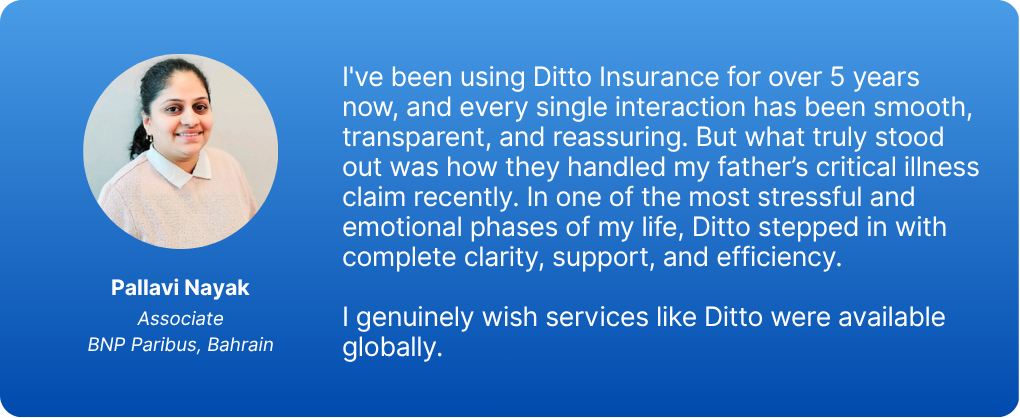
At Ditto, we’ve assisted over 8,00,000 customers with choosing the right insurance policy. Why customers like Pallavi below love us:
- No-Spam & No Salesmen
- Rated 4.9/5 on Google Reviews by 15,000+ happy customers
- Backed by Zerodha
- Dedicated Claim Support Team
- 100% Free Consultation
Confused about the right insurance? Speak to Ditto’s certified advisors for free, unbiased guidance. Book your call or chat on WhatsApp with us now!
Ditto's Verdict on Group Health Insurance
Group health insurance is one of the best workplace benefits you can get. It gives you affordable coverage, no health check requirements, and a waived or reduced waiting period. Used well, it can significantly reduce your healthcare expenses while you are employed.
But it is not a complete solution. Coverage ends with your job. Your employer controls benefits. And there is no long-term continuity built in.
Our Recommendation at Ditto: Do not wait for something to go wrong before realizing your group policy is not enough.
What to Do Next:
- Get a personal health insurance policy as early as possible, ideally in your 20s, when premiums are low and health conditions are few.
- Let your individual policy complete its waiting periods and accumulate bonuses while your group policy covers you in the meantime.
- Review your group policy terms every year. Know your sum insured, room rent limits, exclusions, and TPA contact.
- Check out our guide on the best health insurance plans in India as a starting point.
Group health insurance covers you at work. Individual health insurance covers you for life. You need both.
Frequently Asked Questions
Customer Reviews
Last updated on: