




Overview
According to Swiss Re Institute’s World Insurance in 2025 report, India was the world’s 10th-largest insurance market by nominal premium volume (basic premium paid for an insurance policy) in 2024, generating USD 141 billion in premiums and accounting for 1.8% of the global market.
However, a large insurance market does not necessarily mean that every family has adequate life cover. With several policies offering similar benefits, premiums, and riders, finding the best term insurance plan in India can be confusing.
In this guide, we've evaluated 10 of the top term insurance plans in India across insurer reliability, product features, and pricing, so you can pick the one that actually delivers when it counts.
Best Term Insurance Plan in India: Ditto’s Top 10 Choices
How Ditto Rates the Best Term Life Insurance in India
To find the true best term insurance plan, we run them through a proprietary scoring matrix. All plans included in this guide are rated using our transparent policy rating framework, which scores each plan across three dimensions:
- Insurer Reliability (60%): We average IRDAI data (Claim Settlement Ratio, Amount Settlement Ratio, Solvency, Complaints) over the last 3 years to ensure an insurer performs consistently, so a single good or bad year doesn’t skew the rating.
- Product Features (30%): We analyze the fine print of policy brochures to measure how comprehensive the policy is. Does the policy offer premium deferment? Is the terminal illness benefit built in or charged extra? Are the terms rigid or flexible?
- Pricing (10%): We compare quotes across various ages, genders, and smoking habits to see which plans offer the best value for your money.
Term Insurance Eligibility & Key Features
Insight: Term insurance in your 40s can help you lock in life protection before age and health risks push premiums higher, while term insurance in your 50s is much costlier and comes with stricter underwriting.
Best Term Insurance in India: Detailed Comparison

Axis Max Life Smart Term Plan Plus
Note

HDFC Life Click2Protect Supreme Plus
Did You Know?

ICICI Life iProtect Smart Plus

Aditya Birla Sun Life Super Term Plan
06. Tata AIA Sampoorna Raksha Promise
Overall Rating: 4.4/5
This is a feature-rich term plan with long coverage options, premium deferment, and an optional return-of-premium structure.
Key Features:
- Life cover that can extend up to age 100 under eligible options.
- A Life Promise option for pure term protection and a Life Promise Plus option that returns eligible premiums if the policyholder survives the term.
- An accelerated terminal illness payout equal to 50% of the base sum assured, along with waiver of future premiums.
- A FlexiPay Benefit that lets eligible policyholders defer premiums for up to 12 months while maintaining the cover. Deferred premiums must be repaid later.
- An advance payout of ₹3 lakh at claim intimation for eligible policies with a minimum sum assured of ₹1 crore.
- Optional riders for critical illness, accidental total and permanent disability, accidental death, hospitalization, and waiver of premium.
A 25-year-old non-smoking, healthy male covered until 65 for a sum assured of ₹1 crore has to pay around ₹897 per month.
07. Kotak Life e-Term Plan
Overall Rating: 4.0/5
Kotak Life e-Term is one of the more affordable plans in this comparison and offers multiple plan and death benefit payout options.
Key Features:
- An additional accidental death benefit of up to ₹1 crore under the Life Plus option.
- Waiver of future premiums if the policyholder develops a total and permanent disability under the Life Secure option.
- Immediate lump-sum, level recurring, and increasing recurring death benefit payout options.
- A Special Exit Value that returns eligible premiums when the policyholder exits around age 60, subject to policy-term conditions.
- Step-up and step-down options that allow the policyholder to adjust the life cover at specified stages.
- Optional critical illness and permanent disability riders.
- Wellness services and a free medical checkup every five years under the applicable terms.
A 25-year-old non-smoking, healthy male covered pays premiums starting from ₹808 per month for a sum assured of ₹1 crore until 65.
08. PNB MetLife Mera Term Plan Plus
Overall Rating: 3.48/5
PNB MetLife Mera Term Plan Plus offers several customization options, but buyers should carefully assess the additional premiums charged for spouse cover, increasing cover, critical illness benefits, and return of premium options.
Key Features:
- Life, Life Plus, and Life Plus Health benefit options.
- Coverage that can extend up to age 99 under eligible options.
- Spouse coverage within the same policy for an additional premium.
- A Step Up option that increases the sum assured by 10% (simple interest) each year for ten years, with additional premiums charged for the increased cover.
- Life-stage protection that can increase the cover after marriage, childbirth, or taking a home loan.
- A Child Education Support Benefit that provides an additional layer of protection for education expenses.
- Waiver of future premiums following accidental total and permanent disability or diagnosis of one of 50 listed critical illnesses.
A 25-year-old non-smoking, healthy male covered until 65 for a sum assured of ₹1 crore has to pay around ₹868 per month.
09. LIC New Tech Term Plan
Overall Rating: 3.46/5
This plan is relatively simple and may appeal to buyers who prioritize the LIC brand. However, it lacks several modern features available in leading private-sector plans, including comprehensive critical illness protection, premium breaks, life-stage cover increases, and waiver-of-premium options.
Key Features:
- A Level Sum Assured option under which the cover remains constant throughout the policy term.
- An Increasing Sum Assured option under which the cover remains level for the first five years and then rises by 10% (simple interest) of the original sum assured each year from the sixth to the fifteenth policy year.
- The increasing cover reaches 200% of the original sum assured from the fifteenth year and then remains level.
- Regular Pay, Single Pay, and selected Limited Pay options.
- An optional accident benefit rider that provides an additional payout if death occurs due to an eligible accident.
- An online-only purchase process without the need for an intermediary.
Premiums start from ₹840 per month for a 25-year-old, non-smoking, healthy male, covered for a sum assured of ₹1 crore until 65.
10. SBI Life Smart Shield Plus
Overall Rating: 3.35/5
This plan can be considered by buyers who prefer SBI’s brand familiarity and want an increasing-cover structure. However, compare its rider availability, customer service experience, and overall premium with more feature-rich alternatives before purchasing.
Key Features:
- A Level Cover Benefit under which the sum assured remains fixed throughout the policy term.
- An Increasing Cover Benefit that raises the sum assured by 5% each year from the first policy anniversary, up to 200% of the original cover.
- A Level Cover with Future Proofing Benefit that permits additional cover after events such as marriage, childbirth/ adoption, or purchasing a house.
- A Better Half Benefit that provides eligible spouse coverage within the policy.
- Single Pay, Regular Pay, and multiple Limited Pay options.
- Optional accidental death and accidental partial permanent disability riders.
- Whole-life coverage up to age 100 under eligible limited-premium structures.
Premiums start from ₹855 per month for a 25-year-old non-smoking, healthy, salaried male covered until 65, for a sum assured of ₹1 crore.
Ditto’s Watchlist: Term Insurance Plans From Up-and-Coming Insurers
Premium Comparison: Top 10 Term Insurance Plans
Note:
- That's the benchmark profile above. For your own age and cover amount, Ditto's term insurance premium calculator prices all four plans side by side in under a minute.
- For this comparison, we’ve considered healthy profiles of salaried (annual income: ₹10 lakh), graduate, healthy, non-smoker individuals living in a tier-1 city like Delhi (pincode: 110010), covered for a sum assured of ₹2 crore until age 65. These are illustrative premiums without first year discounts.
Term insurance for young adult smokers can cost 60% to 100% more than for non-smokers, as smoking significantly increases the insurer’s assessed mortality risk. For more details on who qualifies as a smoker, explore our guide on what counts as a smoker.
Key Insights
The premium you pay for a term insurance policy is determined by several factors that influence the insurer's risk assessment. Understanding these can help you choose the right cover at the best possible price.
- Policy Term: Longer policy terms typically have higher total premiums, although the annual cost may still remain affordable when purchased at a younger age.
- Occupation: People working in hazardous professions, such as mining, construction, seafaring, or aviation, may be charged higher premiums because of the elevated risk involved.
- Riders: Adding optional benefits such as critical illness cover, accidental disability benefit, or waiver of premium increases the overall premium but provides broader financial protection.
- Age: Premiums increase with age. Buying a policy early locks in a lower premium for the entire policy term, making it significantly more cost-effective over the long run. Term insurance in your 20s secures higher cover at affordable premiums, while term insurance in your 30s still offers affordable protection but may cost more as age and financial responsibilities increase.
- Sum Assured: A higher sum assured results in a higher premium, as the insurer takes on a larger financial liability. However, a key point to note here is that doubling your cover does not necessarily lead to an equally proportionate increase in the premium, as insurers offer bulk discounts due to economies of scale.
- Gender: Women generally pay up to 15% lower premiums than men because, on average, they have a longer life expectancy and lower mortality rates.
- Health & Medical History: Existing medical conditions, obesity, high blood pressure, diabetes, or a family history of critical illnesses can increase premiums or require additional underwriting. Term insurance for senior citizens with existing health conditions and medical history can have a greater impact on premiums and underwriting than they do for younger applicants.
- Lifestyle Habits: Smokers and tobacco users pay substantially higher premiums (60% to 100% more) than non-smokers due to the increased health risks. Frequent alcohol consumption or participation in high-risk activities may also affect pricing. Term insurance for senior citizen smokers is significantly more expensive than term insurance for middle-aged smokers, as higher age and smoking-related mortality risk combine to increase underwriting costs.
Ditto’s Key Takeaway: Most term plans are priced within 10%-20% of each other, so looking for the cheapest plan may not make much difference, considering inflation works in your favor here, and opting for a reputed insurer, even if premiums are slightly higher, makes more sense.
Best Term Insurance Plan for ₹1 Crore
Best Term Insurance With Return of Premium
Return of Premium (ROP) term plans return the eligible base premiums you paid if the policyholder survives the policy term. While there is no best term insurance with Return of Premium, popular ROP options include Axis Max Life Smart Term Plan Plus, HDFC Life Click2Protect Supreme Plus, ICICI iProtect ROP, Bajaj Life eTouch II, ABSLI Super Term Plan, and Tata AIA Sampoorna Raksha Promise.
However, we do not recommend ROP term plans.
- They can cost around 60%–100% more than comparable pure term plans, even though the higher premium does not increase your life cover.
- At maturity, you receive only the eligible base premiums paid, without any investment returns or compounding.
- Over a 30- or 40-year policy term, inflation can also substantially reduce the real value of the amount returned.
A more efficient approach is to purchase a regular term plan and invest the premium difference separately in an instrument suited to your goals and risk profile, like Public Provident Fund (PPF), Fixed Deposits (FDs), National Pension System (NPS) and mutual funds. This gives you the same life cover at a lower premium while allowing the additional money to earn potential returns and remain separate from your insurance policy.
Therefore, instead of choosing the “best” ROP plan, we recommend selecting a comprehensive pure term insurance policy with a reliable insurer, suitable features, and an affordable annual premium.
Best Term Insurance Company in India
Note: The Amount Settlement Ratio (ASR) is the average of FY 23-25 since the latest year’s data is not published yet in the IRDAI Statistics Handbook. These metrics reflect the overall life insurance portfolio of the insurer, which includes term insurance, Unit-Linked Insurance Plans (ULIPs), savings plans, etc.
These metrics listed above have been sourced from IRDAI Annual Reports and respective insurers’ public disclosures. For more data-driven comparison and details about other insurers discussed above, refer to Ditto Data Lab.
Key Takeaways
- Claim Settlement Ratio (CSR): It is the percentage of claims an insurer settles out of the total claims received. At Ditto, we recommend insurers with a CSR above 97%, and all five cross that benchmark, with Axis Max Life leading with consistently high performance.
- Amount Settlement Ratio (ASR): It is the percentage of total claim amount paid by the insurer compared to the total claim amount received. Since term insurance claims are either paid in full or rejected, it’s an important metric that tells us whether an insurer is treating high- and low-value claims fairly. At Ditto, we recommend insurers with an ASR above 90%.
- Complaint Volume: The number of customer complaints received per 10,000 claims, reflecting service quality during the claims process. At Ditto, we recommend choosing insurers with fewer than 20 complaints.
- Solvency Ratio: A financial metric indicating a company’s overall financial health. IRDAI recommends a minimum solvency ratio of 1.5x, but at Ditto, we recommend opting for insurers above 1.8x for a wider safety cushion. Bajaj Life stands out here with one of the highest solvency ratios in the industry.
- Annual Business Volume: A large business volume indicates scale. At Ditto, we recommend opting for life insurers with an annual business volume above ₹5,000 crore. LIC has the largest annual business, followed by SBI Life and HDFC Life.
How to Choose Term Insurance?
Choose the Right Coverage Amount
Two commonly used methods are the Human Life Value (HLV) approach, which estimates the financial value of your future income and the loss your family would face if you were no longer around, and the income-based approach, which recommends a cover that's a multiple of your annual income. However, at Ditto, we recommend the expense-based approach, as it focuses on your family’s actual needs. We’ll explain it in detail later in this article.
Note: As a broad rule of thumb, term insurers allow eligible applicants to purchase cover worth up to roughly 20–30 times their annual income, depending on their age, occupation, education, existing insurance, and financial underwriting. However, this should be treated as an eligibility range, not as the sole method for deciding your cover.
Ideal Policy Tenure
Your term insurance should ideally remain active until your family is no longer financially dependent on your income. For most salaried individuals, this means choosing coverage until the age of 60 or 70.
You may need a longer tenure if:
- You expect to work beyond the traditional retirement age (especially NRIs).
- You have young children or dependents who may require support for longer.
- You have long-term liabilities that extend beyond age 70.
- Your spouse or children are likely to remain financially dependent on you.
Avoid choosing a short policy term only to reduce the premium. If you need to purchase another policy later, the premium will be based on your higher age and updated health status. A new medical condition could also make the policy more expensive or affect your eligibility.
At the same time, whole-life coverage up to age 85 or 100 is not necessary for everyone. Term insurance is primarily meant to replace income during your working years, not to create an inheritance.
Choose Riders Carefully
Riders provide additional protection, but they also increase the premium and come with separate definitions, exclusions, and coverage periods. Add a rider only when it addresses a genuine protection gap.
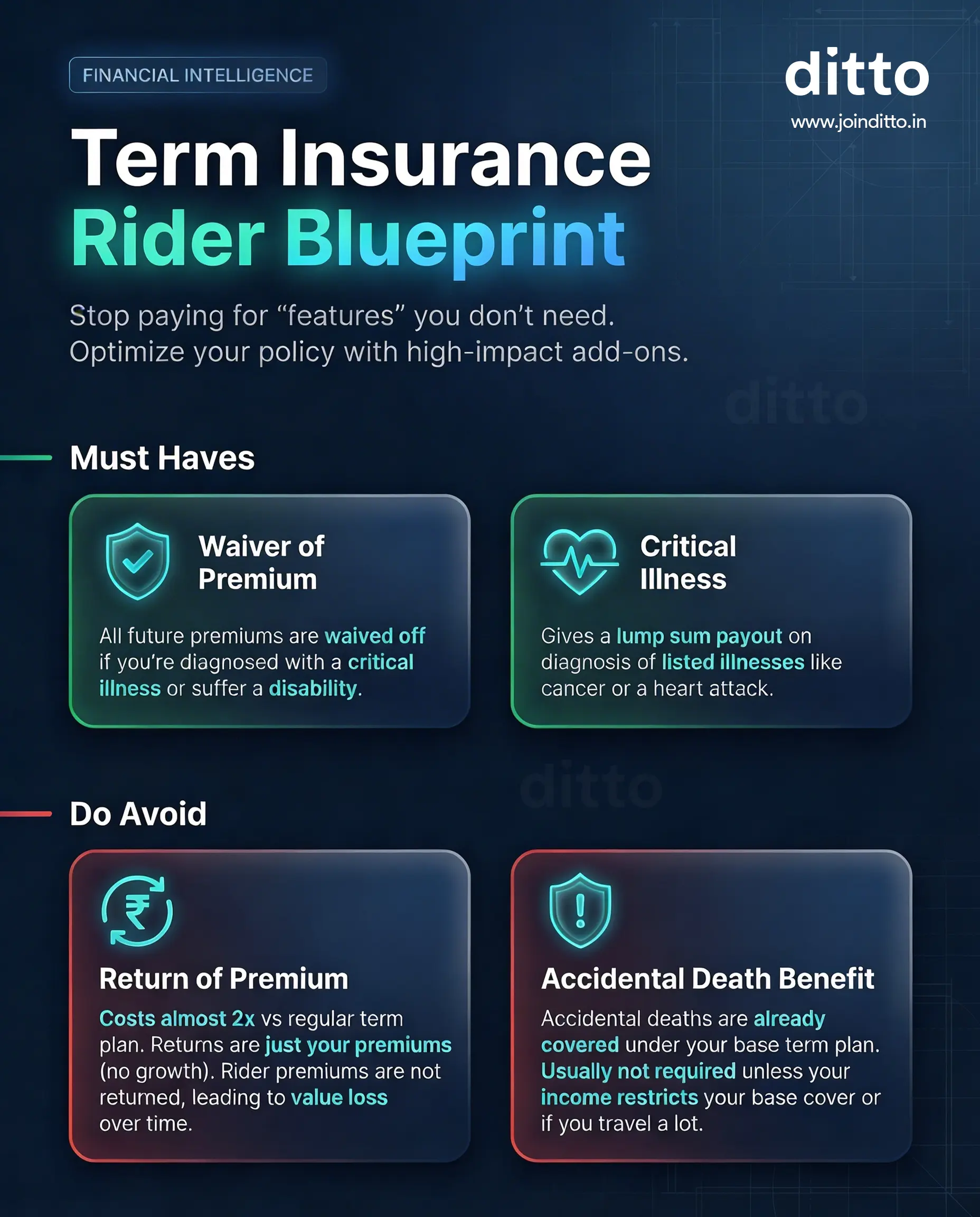
At Ditto, we primarily recommend opting for the following riders:
- Waiver of Premium: Waives future premiums after a specified disability or critical illness while keeping the base policy active.
- Critical Illness: Provides a lump-sum payout following the diagnosis of a listed critical illness, subject to survival and waiting periods and other policy conditions.
- Accidental Total and Permanent Disability Rider: Provides a lump-sum or periodic benefit if an accident results in total and permanent disability, as defined by the policy. This is a needs-based recommendation and can be valuable for individuals whose financial security would be significantly affected by the loss of earning capacity due to an accident.
You can also refer to the infographic attached below:
Compare Premiums and Features
Premium affordability matters because term insurance is a long-term commitment. However, the cheapest plan is not necessarily the best term plan.
Compare Plans Based On:
- The insurer’s performance across key operational metrics
- The policy’s exclusions and benefit definitions
- Premium payment flexibility
- Waiver-of-premium provisions
- Terminal illness and disability benefits
- Life-stage cover enhancement options
- Claim assistance and customer service
- The insurer’s underwriting terms for your profile
Always compare premiums using the same age, sum assured, policy tenure, premium payment term, smoking status, and rider selection. Otherwise, two quotes may appear comparable even though they provide different benefits.
A slightly higher premium may be worthwhile when the plan offers better insurer reliability, useful features, or stronger customer support. However, avoid paying substantially more for benefits such as return of premium, whole-life coverage, or bundled riders like accidental death benefit unless they serve a specific need.
How to Choose the Right Term Insurance Company?
Since term insurance is a long-term commitment, the insurer you choose matters just as much as the policy itself. You may purchase a plan today but not need to claim it for several decades.
That's why it's important to choose an insurer with a strong track record across key indicators such as Claim Settlement Ratio (CSR), Amount Settlement Ratio (ASR), complaint volume, solvency, and annual business performance.
A trustworthy insurer gives you confidence that your policy won't just promise financial protection on paper but also deliver when your family needs it most.
How Much Term Insurance Cover Do You Need?
Your term insurance cover should be large enough to maintain your family’s lifestyle, repay outstanding liabilities, and fund essential future goals if you are no longer around. Instead of relying only on a broad income multiple, we recommend using the expense and liabilities replacement method.
Start by Estimating:
- Your family’s current annual household expenses
- The number of years they may depend on your income
- The effect of inflation on future living costs
- Outstanding liabilities, such as home, personal, or education loans
- Major goals, including children’s education and your spouse’s retirement
- Any existing life insurance cover
For example, suppose your family currently spends ₹60,000 per month and would need financial support for another 25 years. You also have a ₹40 lakh home loan and expect to spend ₹30 lakh on your child’s higher education. Your required cover must account for all these needs.
You can use Ditto’s term insurance cover calculator to estimate the appropriate sum assured based on your age, required protection period, monthly expenses, outstanding loans, and existing cover.
Note: The amount you calculate and the amount an insurer approves may differ. Insurers determine your maximum eligible cover based on factors such as your income, age, education, occupation, existing insurance, and overall financial profile.
Why Choose Ditto for Term Insurance?
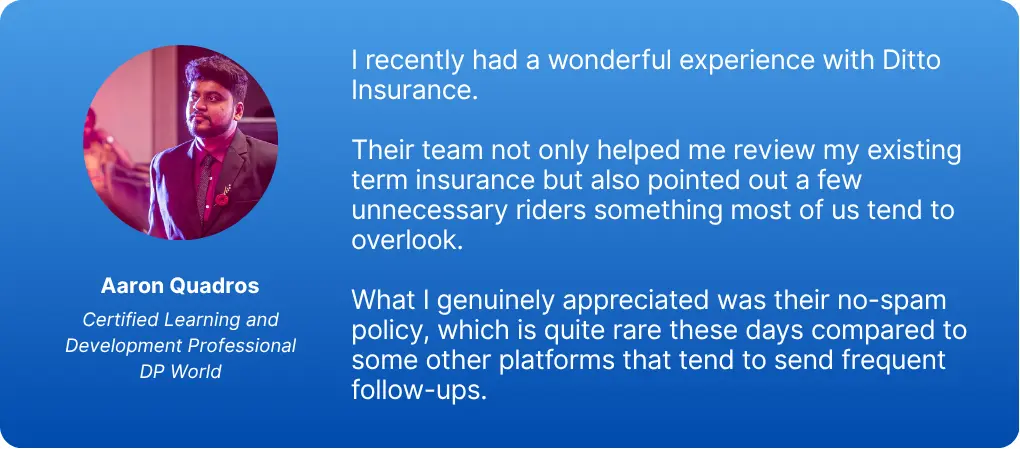
At Ditto, we’ve assisted over 12,00,000 people with choosing the right insurance policy. Why customers like Aaron below love us:
- 100% Free Consultation
- No Spam. No Sales Pressure.
- Rated 4.9/5 on Google Reviews by 30,000+ Happy Customers
- Backed by Zerodha
- Dedicated Claim Support Team
- Compare Plans and Premiums with a Trusted Insurance Advisor
You can book a FREE consultation. Slots are running out, so make sure you book a call or chat on WhatsApp now!
Steps to Buy Term Insurance Online Through Ditto
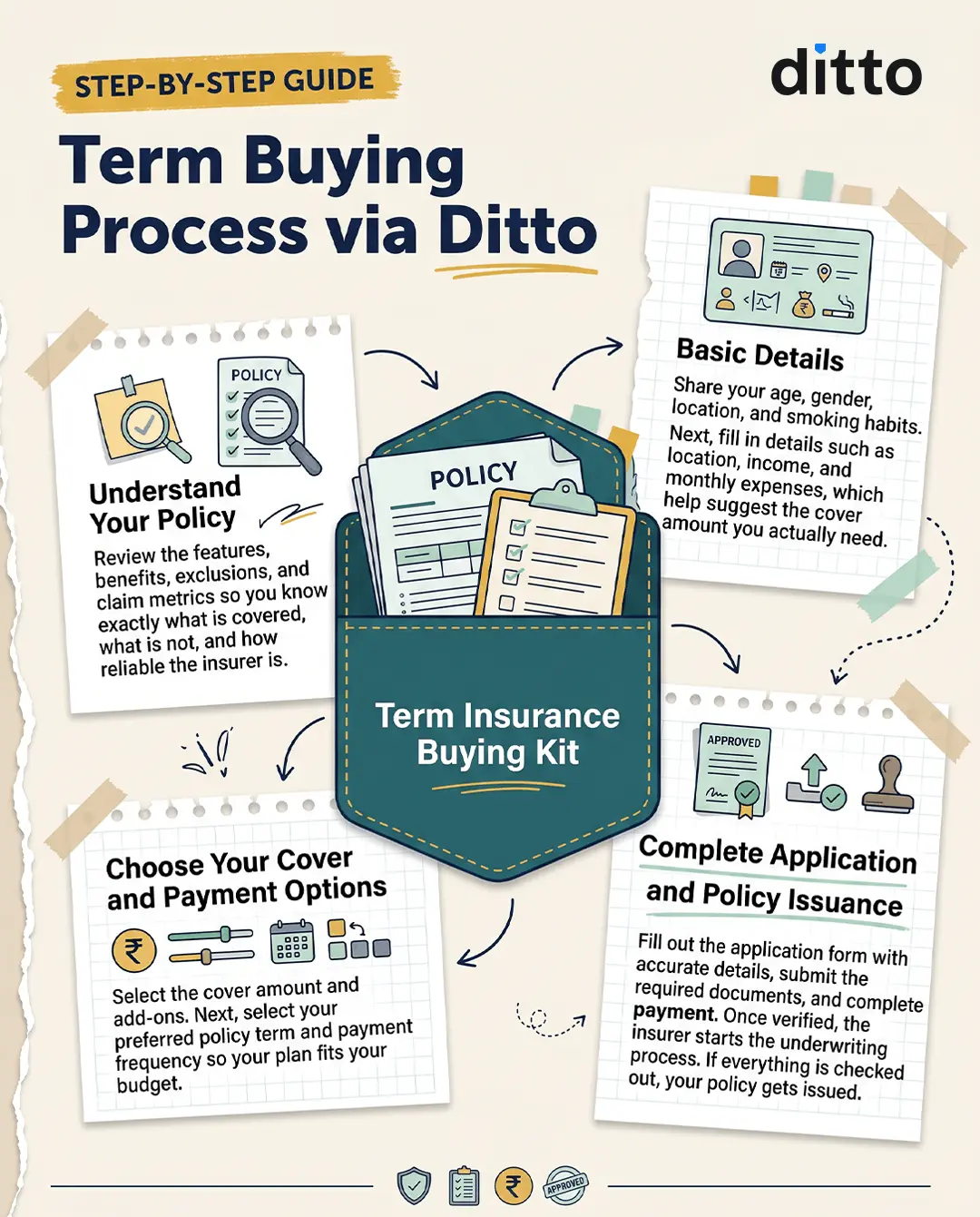
Step 1: Discuss Your Profile and Insurance Needs
Start by booking a call or chatting with a Ditto advisor on WhatsApp. The advisor will understand your age, income, occupation, health history, smoking habits, existing insurance, liabilities, and financial dependents.
Based on this information, they will help you estimate an appropriate cover amount and policy tenure. They will also explain which insurers and plans are likely to suit your profile.
Step 2: Finalize the Plan and Coverage
Your advisor will compare eligible plans based on factors such as insurer performance, policy features, premiums, customer service, and underwriting suitability.
Once you have reviewed the recommendations, you can finalize:
- The insurer and term insurance plan
- Sum assured
- Policy tenure
- Premium payment term and frequency
- Suitable riders or optional benefits
The advisor will also explain important exclusions, benefit conditions, and potential trade-offs before you proceed.
Step 3: Complete the Application and Payment
A Ditto advisor will schedule an application and payment call, which usually takes around 30–45 minutes. During the call, the advisor will help you complete the proposal form using the information and documents you provide.
You must accurately disclose your health conditions, medical consultations, nominee details and relationship, smoking or tobacco use, occupation, income, lifestyle habits, and existing policies. Once the application is complete, you can pay the premium directly through the insurer’s authorized payment channel.
Step 4: Complete Documentation and Underwriting
After receiving the application, the insurer may ask for documents such as:
- Identity and address proof
- Income proof
- Employment or business details
- Existing insurance details
- Medical records, where applicable
Depending on your age, health, cover amount, and profile, the insurer may also arrange medical tests (free of cost to you). It will then assess the application and may approve it at standard rates, offer revised terms with a loading charge (higher premium), request additional information/tests, postpone the decision, or decline the application.
Ditto’s team will help keep you apprised and ensure you understand and respond to any additional requirements raised during underwriting.
Step 5: Receive Your Policy
Once the insurer approves the application, it will issue the policy and send the policy document to your registered email address.
Review the document carefully to ensure that your personal information, nominee details, sum assured, policy tenure, premium payment details, and medical disclosures are recorded correctly. You can use the 30-day free-look period to raise corrections or cancel the policy if its terms do not match what you agreed to, subject to the applicable deductions (proportionate risk premium for the days on cover, medical examination costs and stamp duty).
Ditto’s support does not end after the policy is issued. You can contact the team later for help understanding your policy, updating nominee details, managing renewals, or assisting your family during a claim.
Rules for GST on Term Insurance
GST on term insurance in India has come down to 0% from the earlier 18% since September 22, 2025. The exemption applies to individual policies and their renewals, but not to group term insurance policies. GST paid before the effective date is not retrospectively refunded.
Ditto's Verdict: Which Is the Best Term Insurance Plan?
Based on Ditto’s current rating framework, Axis Max Life Smart Term Plan Plus is the best term insurance plan overall. It offers a strong combination of insurer reliability, competitive premiums, comprehensive features, and customer service.
However, there are two close alternatives:
- HDFC Life Click2Protect Supreme Plus is suitable for buyers who value extensive features, including premium breaks, life-stage cover increases, critical illness protection, and flexible payout options. However, its premiums may be higher and can vary with the applicant’s pincode.
- ICICI Life iProtect Smart Plus is a good choice for buyers looking for competitive pricing, a reputed insurer, and useful features without an overly complicated policy structure.
Bajaj Life eTouch II can be considered by price-conscious buyers and NRI profiles, while ABSLI Super Term Plan may appeal to someone specifically looking for an integrated accelerated critical illness benefit.
Ultimately, the best term insurance policy is one that gives your family adequate protection, is issued on reasonable underwriting terms, and has a premium you can comfortably sustain. We recommend choosing a pure term plan, calculating the cover through the expense-based method, staying covered until around age 65 or 70, paying annually where possible, and adding only genuinely useful riders.
Full Disclaimer
Frequently Asked Questions
Customer Reviews
Last updated on: