


Quick Overview
Are you unsure about what’s covered in your health insurance policy and what’s not? You’re not alone. At Ditto, our advisors get frequent calls from customers confused about these inclusions and exclusions. For instance, a dental procedure is covered only if it's due to an accident, not for routine treatments like cleaning or cosmetic work.
To help you avoid such last-minute surprises, we will walk you through the most common health insurance exclusions in this article.
What are the Common Health Insurance Exclusions?
They fall under two categories: permanent and temporary exclusions. Let’s explore them in more detail:
Permanent Exclusions In Health Insurance
These conditions or treatments are never covered by any health insurance policy.
Here’s a detailed list:
Note: You can find the list in the policy wordings section, as well as in the IRDAI’s standard list for permanent exclusions. Think of it as the fine print that governs what you’re really buying, not just what’s advertised.
Temporary Exclusions in Health Insurance
These conditions or treatments are excluded from a health insurance policy only for a specific period. The list includes:
- Specific Illnesses: Conditions such as hernia or cataract with a waiting period of 1-2 year
- Pre-existing conditions: Diseases like diabetes, asthma, or hypertension with a waiting period of 1-3 years
- Childbirth, Voluntary Abortions, and Other Expenses (unless the policy includes maternity cover either inbuilt or via a rider). It usually comes with a waiting period of 9 months to 4 years before claims are accepted.
- Any Hospitalizations won’t be covered for the first 30 days of the policy unless it’s an Accidental Hospitalisation (which are covered from day 1).
Note:
- Some insurers may include things like cancer in the specific illnesses list, which is a general no-no. Since cancer is (and should be covered) in most policies. Care Freedom is one such policy that includes this drawback as it only covers cancer after a 2-year waiting period and has a sub-limit on the disease’s treatment expenses. We consider this plan as a last resort when no other policy is available for the person due to a severe pre-existing condition.
- Exceptions may apply for complications like ectopic pregnancies which are generally covered under inpatient coverage itself.
- Search for sections titled “Exclusions,” “Waiting Periods,” ""Standard General Terms and Clauses"" and “Conditions Not Covered” to spot exclusions in policy wordings and prospectus documents.
Talk to an expert
today and
find
the right
insurance for you.


How Can Health Insurance Riders Override Exclusions?
Riders are the add-ons that you purchase along with your base policy to customize or improve your coverage. They can easily help cover or override certain exclusions in health insurance policies.
- Maternity Cover Rider: Covers maternity expenses, newborn baby care, C-section, and vaccination costs (after the waiting period). Available in plans like HDFC Ergo Optima Secure, ICICI Lombard Elevate, and Star Health Super Star.
- Pre-Existing Disease (PED) Waiver: Cuts down or removes the waiting period for pre-existing conditions like diabetes, hypertension, high cholesterol, asthma, coronary artery disease, obesity, and Chronic Obstructive Pulmonary Disease (COPD).
- Specific Illness Waiting Period Reduction: Insurers like ICICI Lombard Elevate and Star Health Super Star reduce the 2-year waiting period on certain illnesses to 1 year. Others like Acko Platinum Health and Manipal Cigna Sarvah Param remove it completely.
- Consumables / Non-Medical Expense Cover: Pays for non-payable hospital items like gloves, syringes, PPE kits, gauze, and surgical tape. These can make up 5–15% of your bill. Coverage varies—Care health insurance covers only 68 of 120 items, while HDFC Ergo covers all.
- Hospital Cash Benefit Rider: Gives a daily allowance to cover non-medical costs like travel, meals, or loss of income during hospitalization.
- OPD Cover Rider: Covers outpatient costs such as doctor visits, diagnostic tests, and medicines.
- Durable Equipment Cover: Pays for medically necessary equipment like ventilators, wheelchairs, prosthetic devices, and suction machines, up to a set limit.
- Global Cover Rider: Covers treatment expenses outside India for listed major illnesses.
Note: Some policies already include coverage for certain commonly excluded items as inbuilt features. So, coverage for some exclusions may be provided by the policy itself and not only through riders.
Best Health Insurance Plans With Minimal Exclusions
Note: To learn more about how we rank and rate policies, read our detailed policy rating framework.
Why Choose Ditto for Health Insurance?
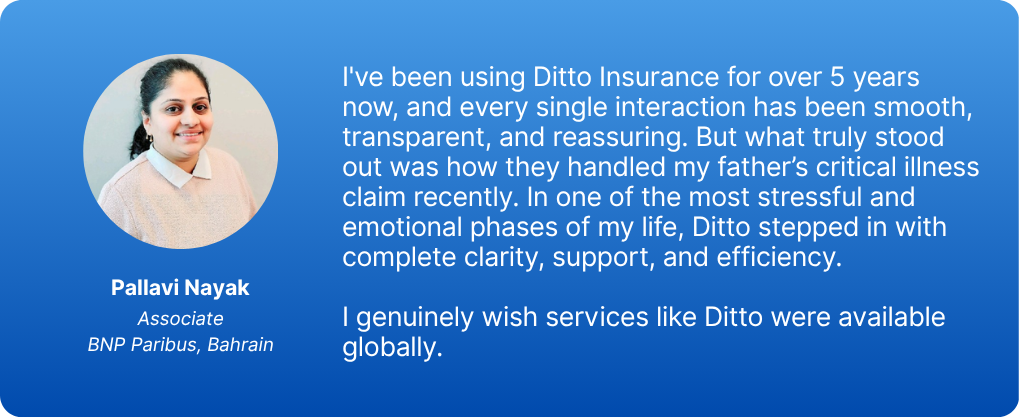
At Ditto, we’ve assisted over 8,00,000 customers with choosing the right insurance policy. Why customers like Pallavi below love us:
- No-Spam & No Salesmen
- Rated 4.9/5 on Google Reviews by 15,000+ happy customers
- Backed by Zerodha
- Dedicated Claim Support Team
- 100% Free Consultation
Confused about the right insurance? Speak to Ditto’s certified advisors for free, unbiased guidance. Book your call now or chat over WhatsApp, slots fill up fast!
Conclusion
Exclusions aren’t just fine print, they form the backbone of every health insurance policy. Always read them first, not last.
- Always check the “Exclusions,” “Waiting Periods,” and “Conditions Not Covered” sections for anything that clashes with your health history or needs.
- Boost your cover with riders like PED waivers, maternity, or consumables add-ons, which are often cheaper than increasing your base sum insured.
- Don’t just compare premiums. A plan with shorter waiting periods or coverage for modern treatments can save you more when you claim.
- Keep your policy up to date. Review exclusions every few years, especially after major life changes, to make sure your cover still works for you.
Frequently Asked Questions
Last updated on: