



Overview
Many customers now explore health insurance directly through their banks, including Axis Bank, because the process feels simple and familiar. According to the IRDAI Annual Report FY 2024–25, bancassurance contributed around 8.21% of India’s total health insurance premiums. Its presence was even stronger in group health insurance, where banks accounted for 11.25% of premiums.
As Axis Bank continues to distribute health insurance plans through partner insurers, it becomes important to understand how this model actually works. While buying a policy through a bank may seem convenient, the roles of the bank and the insurer are very different.
In this guide, you will see how Axis Bank Health Insurance actually functions, which insurers partner with it, and what factors you should carefully evaluate before choosing a plan.
Axis Bank Health Insurance: Overview
Axis Bank is registered with IRDAI as a corporate agent (reg. no. CA0069). This registration allows the bank to sell health insurance plans on behalf of partner insurers. The list of these partners is available in its insurance partnership disclosures.
As a corporate agent, the bank's role is limited to selling insurance policies. This means:
- The bank does not design insurance policies.
- Its role is to help you apply for a policy and connect you with the insurer.
- All underwriting decisions, policy rules, claim approvals, and coverage decisions are handled by the insurance company.
The bank's role is mostly administrative. It helps with paperwork, premium payments, and onboarding. Once your policy is issued, your relationship is with the insurer, not with Axis Bank.
Which Health Insurance Companies Partner With Axis Bank?
1. Standalone Health Insurers
2. General Insurers
Popular Health Insurance Plans Available Through Axis Bank
While availability varies by branch and insurer agreements, here are the plans customers commonly come across:
1. Niva Bupa Health Insurance
- ReAssure: Niva Bupa ReAssure is known for its ReAssure benefit, which restores the sum insured unlimited times for subsequent claims, including for the same illness, after the first claim.
- Senior First: Designed for senior citizens, Senior First comes with no sub-limits on common treatments like cataract surgery and joint replacement.
- Super Protect Plus: A super top-up plan offering high coverage at relatively lower premiums through a deductible structure.
2. Aditya Birla Health Insurance (ABHI)
- Activ Health Platinum Enhanced: Activ Health Platinum Enhanced offers coverage up to ₹2 crore, coverage for all daycare procedures, cashless home treatment, and a restoration of the sum insured up to 100% during the policy year.
- Activ Assure Diamond: Activ Assure Diamond is a value-oriented plan with coverage ranging from ₹2 lakh to ₹2 crore, along with HealthReturns that reward healthy behavior. Policyholders can earn back up to 30% of their premium by maintaining healthy lifestyle habits and completing wellness activities.
- Young Activ Health: Designed for younger individuals with simplified onboarding and minimal documentation requirements. The plan also offers affordable premiums, wellness benefits, and coverage for hospitalization expenses.
3. Tata AIG General Insurance
- MediCare & MediCare Premier: Comprehensive family floater plans. The Premier variant includes advanced treatments such as robotic surgery and offers travel assistance for accompanying family members.
Note: Plans available through Axis Bank health insurance depend on current insurer tie-ups. These can change by location, time, and campaign. Always confirm the latest options with your branch or relationship manager before you decide.

Benefits of Buying Health Insurance via Axis Bank
Convenience
You can buy a policy at your bank branch or through your relationship manager. The process is familiar, and they handle paperwork and onboarding.
Access to Trusted Insurers
Axis Bank partners with several well-known insurers such as Niva Bupa, Aditya Birla, ICICI Lombard, and Tata AIG. Having options is useful, but well-known does not always mean the right fit for you. Claim settlement ratios, hospital networks, and product terms vary across insurers. Always check these details before you choose a plan, regardless of the brand name.
Single Point of Contact
During the purchase process, the bank guides you through every step. This works well if you prefer support over researching multiple insurers on your own.
Talk to an expert
today and
find
the right
insurance for you.


Things to Keep in Mind Before Buying Health Insurance Through Any Bank
- The Bank Is Not the Insurer: Many buyers assume the bank is responsible for claims. That is not the case. The insurance company handles all underwriting, claim decisions, approvals, and rejections. The bank is only the distributor. It has no authority over claim outcomes.
- Limited Plan Options: A corporate agent can partner with only a limited number of insurers under IRDAI regulations. Because of this, Axis Bank can offer plans only from its partner insurers and not from the entire market. This is not a limitation from the bank’s side but simply how the corporate agent model works under IRDAI rules.
- Limited Depth in Suitability Assessment: Choosing the right health insurance depends on age, medical history, location, hospital preference, and existing employer cover. Bank branch interactions are usually short and process-focused. Because of this, plans may be suggested based more on basic eligibility than long-term healthcare needs.
- Lack of End-to-End Claims Support from Bank Staff: Your relationship manager can help you submit documents and redirect you to the insurer or Third-Party Administrator (TPA). But bank staff are not trained claim specialists. In an emergency, they cannot provide end-to-end support for claim filing, escalation, or hospital coordination.
- Risk of Errors in Application Filing: Forms at a branch are often completed quickly, and customers may end up signing without carefully reviewing every detail. Even small mistakes or missing information in your health declarations can lead to complications during the claim process. It is important to read every section carefully and confirm all details before signing.
- Watch Out for Group Plans: Axis Bank often includes group health insurance plans for account holders. These are linked to specific tie-ups between the bank and the insurer. If that tie-up changes or ends, the plan's terms, pricing, or availability may change at renewal. Group plans can be affordable for short-term needs, but they do not offer stable long-term protection.
How Axis Bank Earns Money by Selling Health Insurance?
The bank earns a commission from partner insurers for every policy it sells. IRDAI regulates this under its Expenses of Management (EoM) and commission guidelines.
A few important points to note:
- Your premium does not increase because of this commission. It comes from the insurer’s own expense budget, not from your payment.
- IRDAI regulates health insurance pricing, so premiums remain consistent across channels. Some insurers may offer small discounts, usually around 5–10%, for online purchases, but the base pricing stays the same.
- The way Axis Bank earns revenue as a corporate agent does not affect your policy terms, exclusions, or claim decisions. The insurer handles all of these independently.
Why Talk to Ditto for Your Health Insurance?
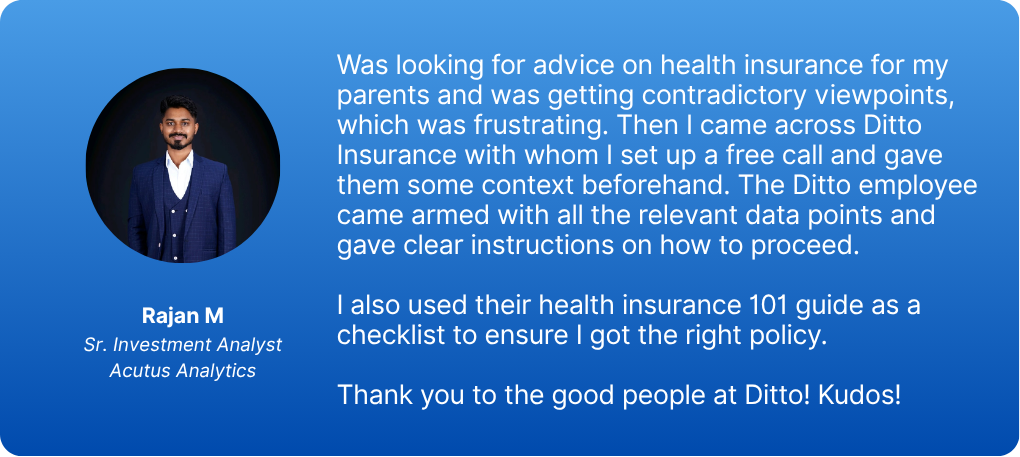
At Ditto, we’ve assisted over 8,00,000 customers with choosing the right insurance policy. Why customers like Rajan below love us:
- No-Spam & No Salesmen
- Rated 4.9/5 on Google Reviews by 15,000+ happy customers
- Backed by Zerodha
- Dedicated Claim Support Team
- 100% Free Consultation
You can book a FREE consultation. Slots are running out, so make sure you book a call or WhatsApp us now!
Conclusion
If you are considering Axis Bank health insurance, it helps to understand how the channel works. Axis Bank offers health insurance plans from a set of partner insurers. The policy itself is issued and managed by the insurer, while the bank supports the purchase process.
Before you decide, review key details such as plan type (individual or family floater), waiting periods, exclusions, hospital network in your location, and other policy terms carefully. A quick comparison with other available options can also help you make a more informed choice. You can start by reviewing the best health insurance plans in India to see how those available through Axis Bank stack up against the broader market.
Frequently Asked Questions
Last updated on: