



![Manipal Cigna Health Insurance Claim Settlement Ratio [2026]](https://stat.joinditto.in/images/2026/05/Manipal-Cigna-Health-Insurance-Claim-Settlement-Ratio-@2x-1.webp)
Overview
Choosing a health insurer is not just about premiums or coverage features. What matters just as much is whether the company actually settles claims smoothly when you need it the most.
That is where the Claim Settlement Ratio (CSR) becomes useful, as it offers a quick snapshot of an insurer’s claims reliability and consistency.
This guide breaks down what CSR means, how Manipal Cigna has performed over the past five years, how it compares with other leading health insurers, and how you can file a claim with them.
What Is Manipal Cigna’s Claim Settlement Ratio?
The claim settlement ratio shows how many claims an insurer pays out compared to the total number of claims it receives in a financial year. For example, if Manipal Cigna received 100 claims and settled 94 of them, the CSR would be 94%.
How to Read CSR
- 90% and above: The higher the better, but 90%+ usually indicates a dependable claims record.
- 85% to 90%: Broadly decent, but still worth checking complaint trends, ICR, and hospital network size.
- Below 85%: Signals that you should look more closely at the insurer’s claims experience and operational efficiency, and avoid them if possible.
A higher CSR generally suggests stronger claim reliability, but it should never be read in isolation. CSR also works best when viewed alongside the complaint ratio, incurred claim ratio, gross written premium, and network hospital count. Those metrics help fill in the gaps that CSR alone cannot address, such as service quality and approval speed.
How Is the Claim Settlement Ratio Calculated?
Claim Settlement Ratio = (Total Claims Settled / Total Claims Eligible for Settlement) × 100
Where:
- Total Claims Settled includes fully settled and partially settled claims.
- Total Claims Eligible for Settlement are the claims carried forward from the previous year + new claims reported during the year - claims closed without payment - claims still pending at the end of the year.
Note: IRDAI does not prescribe a single fixed method for calculating CSR. As a result, the numbers may vary slightly depending on the source, methodology, or reporting framework.
At Ditto, we believe that the 3-year average is more useful than a 1-year figure because it gives a steadier picture of how the insurer performs over time.
Manipal Cigna Claim Settlement Ratio: Year-Wise Data
Note: All this data is sourced from IRDAI annual reports and the insurer’s public disclosures.
Here’s how Manipal Cigna compares with leading health insurers in India based on the 3-year average performance for FY 2022–25:
Manipal Cigna Health Insurance Claim Settlement Ratio vs Other Health Insurers' Claim Settlement Ratio
Talk to an expert
today and
find
the right
insurance for you.


Key Takeaways:
- CSR: Manipal Cigna’s 3-year CSR is respectable, but it trails the strongest performers in the market. That means it is not the most aggressive claim-settling insurer in this comparison, though it still sits close to the industry average.
- Complaint Volume: Its complaint ratio is also worth watching. A higher complaint number can point to delays, document back-and-forth, or a claims experience that is less smooth than ideal.
- Incurred Claim Ratio: The ICR suggests the insurer is operating within a fairly balanced range, with enough payouts to remain relevant but not so high as to look unusually strained.
- Network Hospital Number: The hospital network is smaller than some of the larger players, and also Ditto’s benchmark of 10,000+, so cashless hospitalization may be a bit difficult to access in certain locations.
Where Can You Find Manipal Cigna’s Claim Settlement Ratio?
You can check Manipal Cigna’s CSR from:
- IRDAI handbook.
- Manipal Cigna’s public disclosures.
- Trusted insurance advisory platforms such as Ditto Insurance.
What Manipal Cigna's CSR Means for Policyholders
Manipal Cigna’s claim settlement ratio suggests that the insurer settles a fairly high share of claims, offering some reassurance to policyholders during medical emergencies. However, as discussed before, CSR alone does not reflect the complete claims experience.
At the insurer level, factors like the incurred claim ratio, complaint ratio, and hospital network size also play a major role.
Of course, there are also policy-level considerations, such as waiting periods, exclusions, co-payments, and pre-existing disease coverage. Ideally, we recommend looking for plans with no mandatory copayment, no disease-wise or room-rent sub-limits, unlimited restoration benefits, and at least 60/90 days of pre- and post-hospitalization coverage for broader protection.
Some insurers like Aditya Birla Health Insurance and HDFC ERGO report significantly higher CSRs while also offering strong policy features. In fact, their flagship plans feature in our list of the top 5 best health insurance plans in India.
How to File a Claim with Manipal Cigna
Cashless Claim
- Choose a hospital that is part of Manipal Cigna’s network.
- For planned treatment, inform the insurer at least 48 hours before admission. For emergency hospitalization, notify them within 24 hours.
- Show your Manipal Cigna health card at the hospital insurance desk.
- The hospital sends the pre-authorization request with the required medical papers.
- Manipal Cigna reviews the request and usually responds within about 1 hour after receiving complete documents. If internal checks are needed, it may take up to 48 hours.
- Once treatment is over, the insurer settles the approved amount directly with the hospital. Any non-payable expenses, copays, or deductions must be paid by you at discharge.
Note: As per IRDAI guidelines, insurers are required to decide on cashless authorization requests within 1 hour of receiving all necessary documents and issue discharge approval within 3 hours. If discharge approval extends beyond 3 hours, any additional charges levied by the hospital due to the delay must be borne by the insurer. However, timelines may still be delayed due to document gaps or additional queries, so it is important to promptly share any pending information requested by the insurer or hospital.
Reimbursement Claim
- Get treated at any hospital and pay the bill yourself at discharge.
- Collect all documents, including bills, prescriptions, discharge summaries, investigation reports, and the claim form. If the case involves an accident, include the MLC or FIR where applicable.
- Submit all necessary documents to Manipal Cigna within 30 days of discharge.
- The insurer reviews the paperwork. If something is missing, you will usually be informed by SMS or email and asked to provide it.
- Once all documents are received, the claim is generally processed within 15 days of the last document submission, per policy terms.
- Approved reimbursement is transferred to your bank account through NEFT.
For more information on how to make a health insurance claim, refer to the linked guide.
Tips to Reduce the Chances of Rejection
- Disclose pre-existing illnesses honestly when buying the policy.
- Check waiting periods and exclusions before raising a claim.
- Send complete and correct documents the first time.
To know more about how to avoid health insurance claim rejection, refer to the linked guide.
Top 10 Health Insurance Providers by Claim Settlement Ratio in 2026
If you are comparing claim reliability across insurers, Manipal Cigna can be assessed against the broader market, not just against one or two companies.
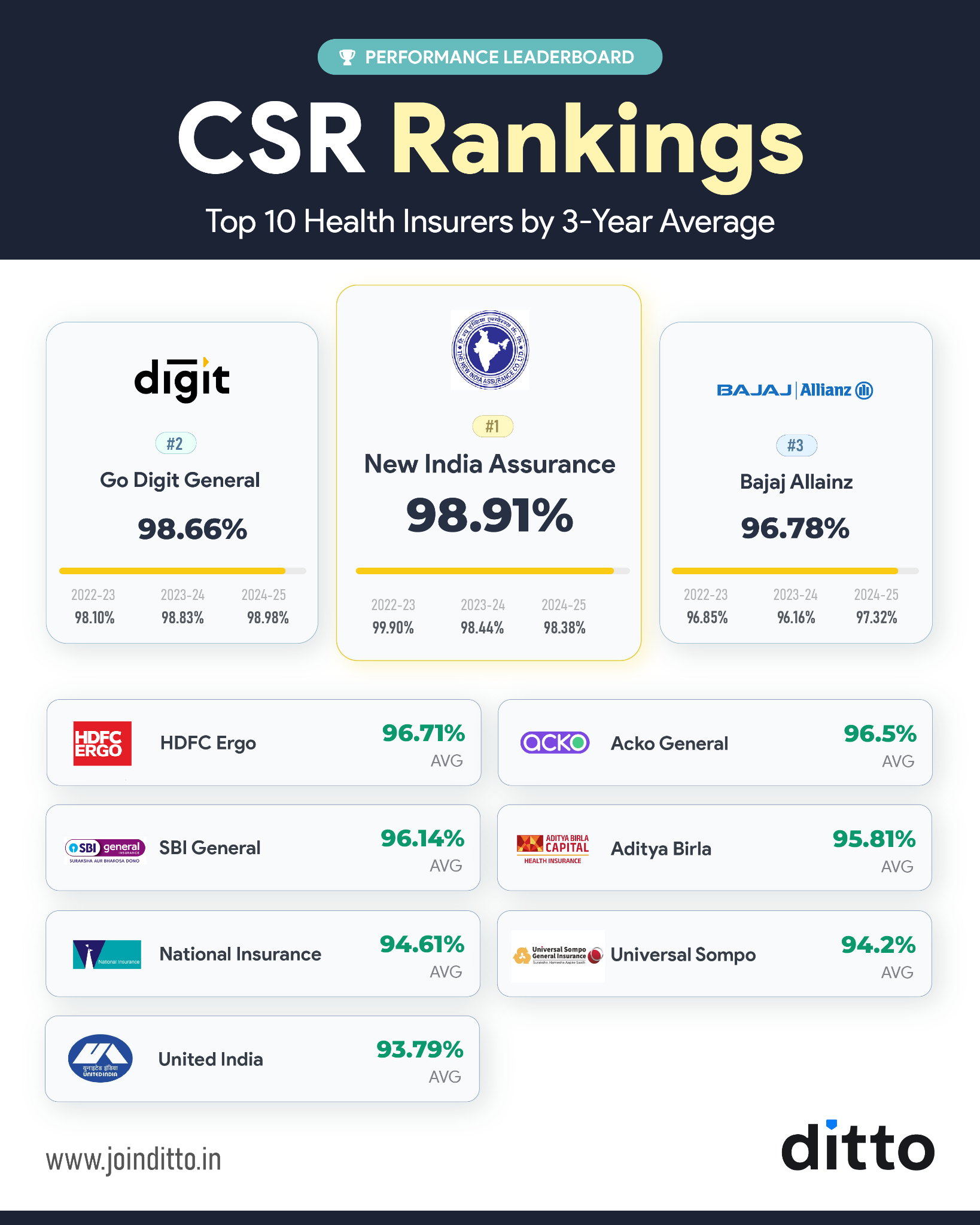
Key Insight: Manipal Cigna’s CSR places it in a workable range, but not at the very top of the chart. That makes it a decent option for buyers who want coverage from a known insurer while still being mindful of claim experience, hospital access, and complaint trends.
Note: If you'd like to explore the detailed figures reported by insurers and the IRDAI in their annual disclosures and public reports, visit Ditto Data Labs, our proprietary repository of health insurance data, meticulously compiled, verified, and maintained by the Ditto team over the years.
Why Talk to Ditto for Your Health Insurance?
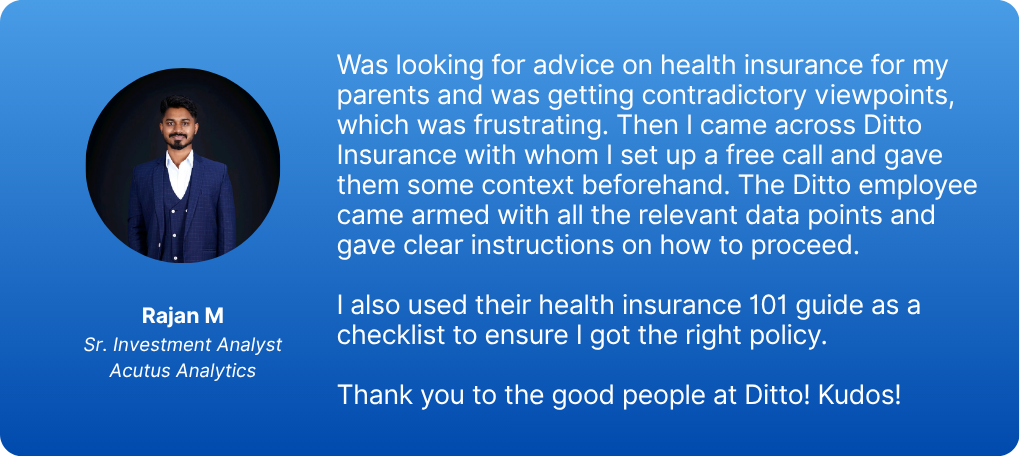
At Ditto, we’ve assisted over 8,00,000 customers with choosing the right insurance policy. Why customers like Rajan below love us:
- No-Spam & No Salesmen
- Rated 4.9/5 on Google Reviews by 15,000+ happy customers
- Backed by Zerodha
- 100% Free Consultation
You can book a FREE consultation. Slots are running out, so make sure you book a call or WhatsApp us now!
Conclusion
Manipal Cigna is a known health insurer with a decent claim settlement record, a moderate complaint profile, and a network that covers a good number of hospitals. The 3-year average of 90.80% suggests that it is reasonably dependable, but buyers should still check the fine print, especially if they value smoother claims handling and a wider cashless network.
On paper, Manipal Cigna looks like a practical insurer rather than an industry leader. That can still be perfectly fine, as long as the policy structure, coverage, and hospital access suit your needs.
Frequently Asked Questions
Last updated on: