


![Digit Health Insurance Claim Settlement Ratio [2026]](https://stat.joinditto.in/images/2026/07/Digit-Health-Insurance-Claim-Settlement-Ratio-@2x.webp)
Overview
Founded in 2016 by Kamesh Goyal, Digit Insurance started as a tech-driven general insurer. In 2019, it entered the health insurance space and, in 2024, became a publicly listed company, demonstrating rapid growth over a short period. Digit Health Insurance has gained strong visibility with brand ambassadors like Virat Kohli, reinforcing its customer-friendly image.
But what actually matters is whether your insurer will step up when you need them. Will they settle your claim without any hassles? That's where the claim settlement ratio comes in.
In this guide, we explain the Digit Health Insurance claim settlement ratio, how it is calculated, the other key metrics, and what they mean for you as a buyer.
What Is the Claim Settlement Ratio?
The Claim Settlement Ratio (CSR) is the percentage of claims an insurance company successfully settles out of the total it receives in a financial year.
For example, if an insurance company received 100 claims but settled only 91, its CSR will be 91%.
How to Calculate the Digit Health Insurance Claim Settlement Ratio?
CSR = (Total Number of Claims Settled/ Total Number of Claims Available to Settle) X 100Where:
- “Total Number of Claims Settled” includes partly and fully settled claims
- “Total Number of Claims Available to Settle” is (claims carried forward from the previous year) + (new claims reported) - (claims closed without payment + claims still pending at year's end)
Note: The Insurance Regulatory and Development Authority of India (IRDAI) doesn’t prescribe a fixed formula for calculating CSR. So, numbers may vary depending on the methodology used by insurers and platforms like ours.
Talk to an expert
today and
find
the right
insurance for you.

Our Approach at Ditto
- The formula above is used because it better captures delays in claim settlements.
- It’s recommended to look at the 3-year average CSR rather than a single year, as it smooths out year-to-year fluctuations and provides a more reliable, consistent view.
- Additionally, we also suggest reviewing other metrics like:
- Complaints per 10,000 Claims
- Incurred Claims Ratio (ICR)
- Gross Written Premium (GWP)
- Network Hospitals
This is because CSR alone doesn’t distinguish between partially and fully settled claims.
Digit Health Claim Settlement Ratio: Latest Figures and 3-Year Trend
- The Digit Health Insurance claim settlement ratio shows a strong upward trend in recent years. The 3-year average CSR is also Ditto’s recommended ratio of 90%.
- It’s worth noting that the complaint volume is higher than that of industry peers like HDFC Ergo and Bajaj General. This could indicate delays, communication issues, grievance escalation, and documentation friction.
- The ICR falls in the healthy range of 55-85%. However, the ICR for FY 2023–24 is listed as 93.87%, which is outside that range.
- Digit’s GWP has witnessed good growth, but not meaningful enough compared to larger peers. Hence, the insurer has lower annual business volumes and is still scaling.
In addition to the above metrics, another important factor to consider is the hospital network. Digit Health Insurance has 9,000+ network hospitals, which is slightly below the recommended range of 10,000+. You can use the insurer’s official Cashless Network Hospitals page to check the complete Digit Health Insurance hospital list.
How Digit Compares With Other Health Insurers
The Digit Health Insurance claim settlement ratio is strong. That is why the insurer makes it to the list of the top 10 claim settlement ratio health insurance companies. It also features among the best health companies in India, as showcased below:
Note: Digit ranks 7th in our top 10 health insurers list. Our methodology for identifying the best health insurance companies evaluates factors like CSR, GWP, and complaints to provide a balanced and comprehensive view.
Digit Claim Process and Timelines
Digit Health Insurance claims can be filed via the Digit Mobile App or their official portal, Go Digit Claims. You need to provide your policy number, date of birth, and policy start or end date to register your claim.
Quick Note:
- For planned hospitalizations, notify Digit 48 hours prior, and within 24 hours for emergencies.
- Cashless claims are usually processed in 30 minutes, and reimbursements are settled in 2 to 3 days.
Common Reasons for Claim Rejection
- Non-Disclosure: Hiding health conditions like diabetes, past surgeries, or smoking habits at purchase gives insurers grounds to reject claims later.
- Treatment During Waiting Period: Claims filed during the initial 30-day period, 2-year specific disease waiting period, or 3-year PED waiting period are always denied.
- Policy Lapsed: If you missed a premium payment and your policy expired, claims during that period will not be accepted.
- Non-Network or Blacklisted Hospital: Receiving treatment at a non-network hospital without prior notice, or at a blacklisted hospital, can result in outright claim rejection.
- Excluded Treatment: Cosmetic surgeries, infertility treatments, and other standard exclusions are not payable unless specifically added to your policy.
- Incomplete Documentation: Missing bills, incorrect details, or incomplete paperwork can delay or result in the rejection of an otherwise valid claim.
- Fraud or Inflated Claims: Fake bills, inflated expenses, or inconsistencies between discharge summaries, diagnoses, and medical records can trigger rejection and investigation.
- Medically Unnecessary Hospitalization: Claims for conditions such as fever or backache may be rejected if the insurer's clinical team determines that the admission was not medically justified.
- Cashless Claim on Hold: A cashless request may be temporarily declined if the insurer needs additional medical records or clarification before making a final decision.
- Complication Linked to Waiting Period Condition: Claims for complications arising from a pre-existing condition that is still within its waiting period can be rejected, even if the complication itself is covered.
For more details, refer to our guide on health insurance claim rejection reasons.
Should You Trust Digit for Health Insurance?
Digit Health Insurance is a newer, digital-first insurer and has steadily earned its place near the top. As we mentioned earlier, its CSR has also consistently improved over the years.
That upward trend is one of the best signals you can see from a growing insurer. It's a strong pick for tech-savvy buyers who want transparency and fast processing with minimal paperwork.
However, Digit’s premiums are currently very competitive and attractively priced. This may not always be sustainable in the long run, as it depends on future underwriting performance and claim experience.
Its relatively shorter track record is also an important consideration for potential buyers.
If you are looking for more specialized coverage, shorter waiting periods, or a longer track record, you may want to explore established insurers like HDFC Ergo.
Overall, Digit is growing quickly and showing promising performance, positioning it to become a major player in the coming years.
For more details, refer to our comprehensive guide on Go Digit Health Insurance review and plans.
Why Choose Ditto for Health Insurance?
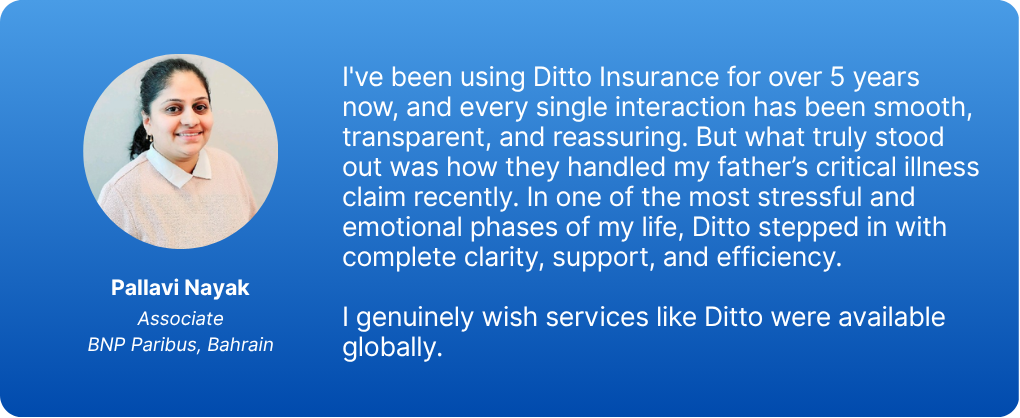
At Ditto, we’ve assisted over 8,00,000 customers with choosing the right insurance policy. Why customers like Pallavi below love us:
- No-Spam & No Salesmen
- Rated 4.9/5 on Google Reviews by 25,000+ happy customers
- Backed by Zerodha
- Dedicated Claim Support Team
- 100% Free Consultation
Confused about the right insurance? Speak to Ditto’s certified advisors for free, unbiased guidance. Book your call now or chat over WhatsApp with our advisors.
Conclusion
The Digit Health Insurance claim settlement ratio has steadily improved, reaching a strong 99.01% in FY 2024-26. When you look at the bigger picture, consistently improving CSR reinforces its reliability over time. Its wide network of hospitals and growing scale of operations also make it a convenient and accessible option for many policyholders.
However, Digit’s health insurance plans may offer fewer built-in coverage multipliers than those of peers like HDFC Ergo and Care, with more basic restoration benefits. Furthermore, non-medical expenses and consumables are not always included in the core coverage structure. Hence, if you are open to exploring other options, refer to our guide on the best health insurance plans.
Frequently Asked Questions
Last updated on: