




Overview
According to the Ministry of Civil Aviation, India issued 1,331 commercial pilot licenses in the first half of 2026, with 41% of newly licensed pilots trained abroad. As the aviation industry continues to grow, pilots increasingly seek financial protection that accounts for the unique risks of their profession.
Choosing the right term insurance for pilots involves more than simply comparing coverage and premiums. Insurers typically consider factors such as occupation, flying activities, aviation-related exclusions, underwriting requirements, and premium loading when assessing an application.
This guide breaks down how term insurance for airline pilots works, including underwriting, aviation exclusions, premium loading, plans, and riders.
Term Insurance for Airline Pilots: Does the Aviation Exclusion Apply?
For term insurance, pilots (whether full-time or part-time/hobby-based) must disclose their occupation and flying activities in the proposal form for proper underwriting assessment.
Next, the insurer decides whether to issue the policy and whether to apply premium loading (increase) based on the pilot's risk profile. If the insurer issues the policy, it covers deaths related to the declared occupation without a separate high-risk occupation exclusion.
Note: Do not assume that every rider offers the same level of aviation coverage. Accidental death, disability, and critical illness riders may have separate aviation-related exclusions or conditions. Pilots should review each rider's wording before purchase.
Plans Available
- Axis Max Life Smart Term Plan Plus: Smart Term Plan Plus offers an optional critical illness rider covering up to 64 illnesses for up to 30 years. It also provides an accelerated terminal illness benefit of up to ₹1 crore after a qualifying diagnosis, subject to policy terms.
- HDFC Life Click 2 Protect Supreme Plus: Click 2 Protect Supreme Plus offers a Life Stage Benefit that can increase your cover after milestones such as marriage or childbirth without a fresh underwriting. Its optional critical illness rider covers up to 60 illnesses for up to 15 years.
- ICICI Life iProtect Smart Plus: iProtect Smart Plus offers a Premium Break option that can defer premiums for up to 12 months after meeting specified conditions. Eligible policyholders with a high sum assured can also receive an instant partial payout of up to ₹3 lakh on claim, subject to policy terms.
- Bajaj Life eTouch II: eTouch II offers an accelerated terminal illness benefit of up to ₹2 crore for eligible policyholders. It also provides a premium waiver option on accidental disability, subject to the policy's terms, conditions, and exclusions.
- Aditya Birla Sun Life Super Term Plan: Super Term Plan offers an optional accelerated critical illness benefit covering 42 illnesses, with a payout of up to 50% of the base sum assured, subject to limits. It also provides an in-built terminal illness benefit of up to ₹1 crore.
Note: For pilots, term insurance can help replace lost income and repay major debts such as home loans if they pass away during the policy term. Depending on eligibility and policy terms, you can also opt for riders at an additional cost.
- Primary Riders (Ditto Recommended): You can consider the Waiver of Premium (WOP) rider, which waives future premiums if you meet the specified disability or critical illness conditions. You can also consider the Critical Illness (CI) rider, which pays a lump sum upon diagnosis of a covered critical illness. Both riders can provide additional financial protection during difficult times, subject to policy terms and conditions.
- Additional Riders: Accidental Death Benefit and Total and Permanent Disability can provide additional financial support after covered accidental events.
Talk to an expert
today and
find
the right
insurance for you.


How Insurers Underwrite Airline Pilots: DGCA Medicals, Flying Hours, and Premium Loading
DGCA Medicals
- Continuous Medical Fitness Checks: A valid DGCA Class 1 medical certificate is required to exercise the relevant commercial pilot privileges. The earlier age-40 threshold for medical validity has been revised, with the Ministry of Civil Aviation raising it to age 60. However, the validity period can vary based on the type of flying operation. Pilots should refer to the latest DGCA rules applicable to their license and operations.
- Temporary Unfitness Can Interrupt Income: Changes in blood pressure, blood sugar, or other health markers can result in temporary unfitness and a short-term loss of flying ability. Loss of License policies may apply a 60- to 90-day waiting period before benefits become payable.
- Permanent Unfitness Can End a Flying Career: Serious vision, cardiac, or neurological conditions can lead to permanent unfitness. For Loss of License Insurance, such a condition can create a major income loss and requires strict medical and occupational underwriting before policy approval.
Flying Hours

Total Hours vs. Recent Flying
Total flight hours show a pilot’s experience, but insurers may also assess hours flown during the past 12 months and experience with the current aircraft type. Recent, relevant flying experience can influence how insurers assess aviation risk.
Hours by Operation Type
Insurers assess flying hours based on the nature of the operation. Scheduled commercial airline flying generally receives different underwriting treatment from private, charter, or experimental flying because each involves different operational and safety considerations.
Recent Side-Flying Activities
A pilot’s additional flying outside regular airline duties can affect underwriting. Hours spent on gliders, experimental aircraft, aerobatics, or other recreational activities may receive separate risk assessment, even when the pilot has extensive commercial flight experience.
Note: When reviewing term insurance for high-risk occupations, insurers assess occupational risk before applying any premium loading. Commercial pilots face minimal loading due to strict safety standards, while private and student pilots may face higher loadings based on their flying activities.
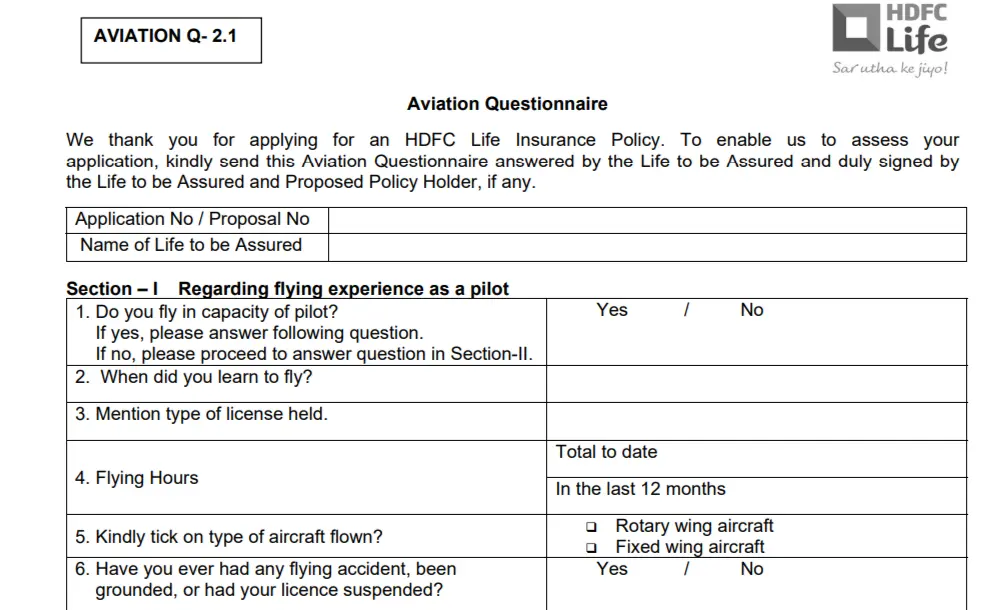
Insurers provide dedicated aviation questionnaires to assess a pilot’s occupation, such as:
- Whether the applicant flies as a pilot and when they learned to fly.
- Type of pilot license held.
- Total flying hours and flying hours in the last 12 months.
- Whether they fly rotary-wing or fixed-wing aircraft.
- History of flying accidents, grounding, or license suspension.
The questionnaire is completed by the Life to be Assured and signed by the relevant applicant/proposed policyholder. Here’s a snippet from the HDFC Life Aviation Questionnaire.
Loss of License and Personal Accident Cover: What Term Insurance Does Not Replace
Term insurance primarily pays the nominee after the policyholder’s death. It does not replace income loss from an accident that causes partial or permanent disability, even when the pilot can no longer fly or maintain a valid medical license.
A Personal Accident (PA) cover can address this gap through a lump sum payout for covered accidental disabilities. However, pilots should check whether the Personal Accident (PA) cover excludes active aviation activities. Aviation-specific personal accident policies are also available.
PA cover may be purchased as a standalone personal accident insurance policy or added as a rider to health or term insurance, subject to policy terms.
Note: Insurers such as New India Assurance offer Aviation Loss of License Insurance for named flight crew. It can provide financial compensation if pilots or co-pilots lose their flying license due to medical unfitness, illness, or bodily injury, subject to policy terms.
How Much Term Insurance Should an Airline Pilot Buy?
Your term cover should help your family maintain their lifestyle adjusting for inflation, repay outstanding loans, and fund future goals such as your children's education if your income stops.
Calculate your family's future financial needs, including living expenses, liabilities, and major goals, then subtract your existing personal life cover (if any). Use the Ditto cover calculator to help estimate the required cover.
Why Choose Ditto for Term Insurance?
At Ditto, we’ve assisted over 12,00,000 customers with choosing the right insurance policy. Why customers like Aaron below love us:

- 100% Free Consultation
- No Spam. No Sales Pressure.
- Rated 4.9/5 on Google Reviews by 30,000+ Happy Customers
- Backed by Zerodha
- Dedicated Claim Support Team
- Compare Plans and Premiums with a Trusted Insurance Advisor
Confused about the right insurance? Speak to Ditto’s certified advisors for free, unbiased guidance. Book your call now or chat with us on WhatsApp. Slots fill up fast!
Conclusion
For term life insurance for pilots, insurers assess the occupation before setting the terms of coverage. The outcome can vary based on flying duties, experience, and overall risk profile.
- Premium Loading: Additional premiums may apply, potentially ranging from 25% to 100% or higher, based on Ditto’s experience. However, once purchased, your premiums stay locked in for the entire coverage tenure.
- Policy Restrictions: Insurers may limit the cover amount, riders, or policy duration offered.
- Underwriting Outcome: Applications may be postponed or declined based on the assessed risk.
Airlines also provide group life insurance, but it should not be your only protection. Consider an individual term plan and compare the best term insurance plans available for your profile.
Disclaimer: Ditto currently offers advisory services only for term life and health insurance products. We do not currently advise on or offer Loss of License or Personal Accident insurance products.
Frequently Asked Questions
Last updated on: