




Overview
Most salaried employees learn about their group life insurance coverage somewhere between the onboarding paperwork and the first HR discussion. It sounds reassuring: your employer has you covered. But covered for how much, and for how long?
A group life insurance policy comes with limitations that most people only discover when they switch jobs, lose coverage, or realize the sum assured isn’t nearly enough for their family’s long-term needs.
This article breaks down how group term life insurance actually works, what it covers, where it falls short, and whether you should rely on it as your primary financial safety net.
What is Group Life Insurance?
Group life insurance is a policy issued to an organization or institution (called the master policyholder) that covers its members under a single contract. The organization could be a company, an NBFC, a bank, a credit cooperative, or even a professional association.
Endowment plans or ULIPs are rarely structured as group products. So when your employer says "you're covered under our group life policy," they usually mean a term plan that pays out only if the insured person passes away during the policy period.
There are broadly two kinds of groups these policies cover:
Employer-Employee Groups
The most common type. The employer buys cover for employees, often linked to their salary or CTC. Some employers also extend insurance to key persons whose loss could affect business continuity, but that is different from regular group term cover.
Non-Employer Groups
- This includes banks covering their borrowers (credit life insurance), NBFCs, credit card companies, and affinity or professional bodies, like the Institute of Chartered Accountants of India (ICAI), covering their members.
- PM Jeevan Jyoti Bima Yojana (life insurance) and PM Suraksha Bima Yojana ( personal accident insurance) are the most common examples of non-employer group schemes in India. Combined enrollment across both reached 74.6 crore people by April 2025, making government-backed schemes the single biggest driver of "group life" coverage in the country.
How Does Group Term Life Insurance Work?
- The organization negotiates coverage terms with an insurer and becomes the master policyholder.
- Eligible members are enrolled automatically or through opt-in, depending on the scheme.
- The employer or institution typically pays the premium, though some plans allow for partial employee contribution.
- Members can be added or removed through the policy year as people join or exit the organization.
- If a covered member passes away during the policy term, the insurer pays the sum assured directly to the nominee.
Note: Insurers set a Free Cover Limit (FCL), which is the maximum sum assured a member can receive without needing a medical test. Members who need coverage above the FCL may be required to undergo underwriting. This limit varies by group size, insurer, and policy design.
Premiums for a group term life insurance policy are calculated based on the group's age and gender mix, the nature of work, the sum assured structure (flat amount, salary multiple, or loan-linked), and the group's past claims history.
Key Benefits and Limitations of Group Life Cover
Benefits of Group Life Insurance
Low Premiums
No or Minimal Medical Tests
Tax Benefits
Optional Riders
Talk to an expert
today and
find
the right
insurance for you.


Limitations
Cover Ends When Your Employment Does
This is the biggest drawback. The moment you leave the organization, your group life cover lapses. Unless the insurer allows conversion to an individual policy (which usually costs more and requires fresh underwriting), you are left uninsured during and after the transition.
Low Sum Assured
The average payout on a settled group death claim in India was just ₹ 1.42 lakh in FY 2024-25, compared to ₹ 3.33 lakh for an individual death claim, according to IRDAI's Annual Report for FY 2024-25. That is less than half. This reflects the lower coverage amounts typical in employer-sponsored plans, which are often set at one or two times the annual salary.
No Personalization
You get what the organization has negotiated. You cannot change the insurer, the policy term, or the terms and conditions.
Limited or No Personal Tax Benefit
Since the employer usually pays the premium, you cannot personally claim a deduction under Section 80C (Old Regime) for it. If you are contributing to the premium yourself, that portion is still eligible.
If your employer or institution is evaluating a group term plan, here are three widely used options in the market:
What Are Some Group Term Life Plans?
ICICI Life Group Term Plus
The ICICI Life Group Term Plus plan covers both employer-employee and non-employer groups, including NBFCs, banks, and professional associations. It offers flexible payout structures, an optional spouse cover, a terminal illness benefit, and the ability for employees to top up their cover voluntarily.
HDFC Life Group Term Insurance Plus
The HDFC Life Group Term Insurance Plus policy is designed for organizations seeking straightforward, cost-effective group cover. It comes with optional riders such as group critical illness, making it a reasonable choice for employers who want to offer more than a basic death benefit.
Bajaj Life Group Term Life
Bajaj Life’s Group Term Life plan is a non-linked, non-participating group term plan suited for employers of varying sizes. It provides a death benefit to nominees and is designed for straightforward administration.
These are just a few examples. The right plan for a group depends on its size, average age profile, sum assured structure, and how the employer wants to fund it.
Is Group Life Insurance Enough or Do You Need More?
While there are certain undeniable group term life insurance benefits, for most people, the answer is no. It is not enough on its own.
- A working adult with dependents, a home loan, and long-term financial obligations needs coverage that doesn’t change with their employer. Group term cover does not do that. The day you switch jobs, take a career break, or get laid off is exactly the day you are most financially vulnerable and most likely to lose your group cover.
- There is also the coverage gap to consider. A standard group policy might offer coverage equal to 2 to 5 times your annual salary. Ditto advisors typically recommend coverage to account for your outstanding liabilities, future expenses, inflation, etc. You can use our term insurance cover calculator to find out what that number is for you.
Group life insurance works best as a bonus layer of cover, not the foundation of your financial safety net. It gives you extra protection at little to no cost, which is great, but tying your family’s future entirely to your employer is still a risky bet. Your real protection should come from an individual term plan that stays with you no matter where you work.
Why Choose Ditto for Term Insurance?
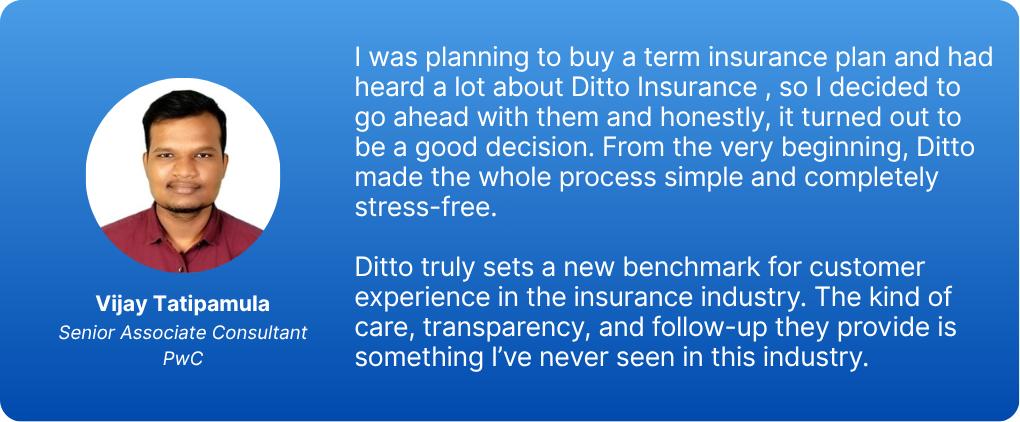
At Ditto, we’ve assisted over 8,00,000 customers with choosing the right insurance policy. Why customers like Vijay below love us:
- No-Spam & No Salesmen
- Rated 4.9/5 on Google Reviews by 15,000+ happy customers
- Backed by Zerodha
- Dedicated Claim Support Team
- 100% Free Consultation
You can book a FREE consultation. Slots are running out, so make sure you book a call now or chat with us on WhatsApp!
Conclusion
Group term life insurance is a good employee benefit, but a weak long-term financial plan on its own. The cover is usually inexpensive, easy to get, and useful while you have it. The problem is that it’s temporary. Your coverage is tied to your employer, the sum assured is often limited, and the policy terms are not really under your control.
That’s why group life insurance should be viewed as supplementary protection, not your primary safety net. An individual term plan gives you something employer cover can never provide: continuity. It stays with you through job switches, career breaks, layoffs, and every major life stage, when your family may depend on that protection most. This is also why the best term plans in India in 2026 are often shortlisted: they balance strong coverage features, operational reliability, and long-term flexibility.
Frequently Asked Questions
Last updated on: