



Overview
Many investors struggle to choose between insurance that protects their family and investments that help build long-term wealth. Smart Secure ROP by Bajaj Life Insurance addresses both needs in a single ULIP by combining life cover with market-linked investments and maturity benefits.
This guide breaks down the key Bajaj Life Insurance policy details, including features, premiums, benefits, returns, and key considerations before you buy.
What Is Bajaj Life Smart Secure ROP?
Bajaj Life Smart Secure ROP is a comprehensive unit-linked insurance plan that combines life insurance protection with market-linked wealth creation. While this plan offers higher life cover than traditional ULIPs and is marketed by the insurer as a Bajaj Life Insurance term plan, it remains a ULIP at its core.
It is a bundled solution that combines two underlying contracts. The Bajaj Life Invest Protect Goal Plus Elite Variant (UIN 116L215V01: unit-linked life savings) provides market-linked ULIP investment benefits, while the Bajaj Life Secure Plus Shield with ROP Variant (UIN 116N216V01: non-linked health) provides protection for specific events.
With 25+ fund options, you can choose between equity, debt and balanced funds based on your risk appetite and investment goals. The plan offers a digital purchase journey, making it possible to complete much of the application process online.
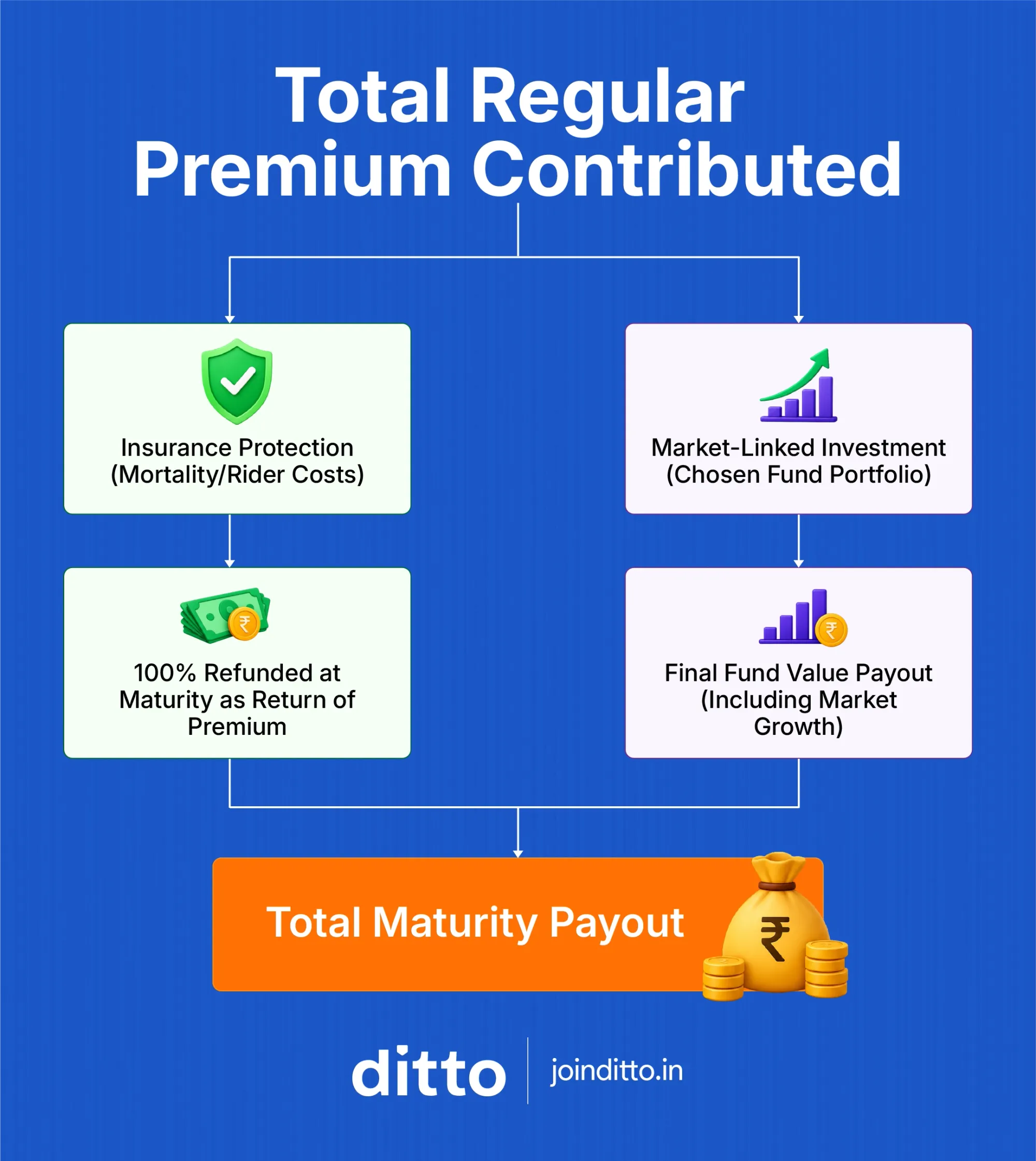
Take a look at the infographic below for a simple breakdown of the plan.
Key Long-Term Benefits
- Guaranteed Wealth Booster: Premium allocation charges deducted during the policy term are accumulated at a guaranteed 7% annual rate, compounded annually, and added to the fund value at the end of the 15th policy year. This benefit is not available after surrender, discontinuance, or conversion to paid-up status.
- Loyalty Additions: Loyalty additions reward long-term policy continuation and are credited from the 10th policy year onward at specified intervals. The additions are 1.25% in year 10, 2% in year 20, 3% in year 30, and 5% in year 40, subject to eligibility.
- Return of Mortality Charge: The plan progressively adds back a portion of the mortality charges deducted during the policy term to your fund value. The return is 20% by the end of Policy Year 10, 40% by Year 15, 60% by Year 20, 80% by Year 25, and 100% by Year 30. From Year 30 onward, including maturity, 100% of eligible mortality charges are returned, after adjusting for any amounts already returned. The returned amount is credited as additional units in the same proportion as your existing fund value.
Talk to an expert
today and
find
the right
insurance for you.


What Is the Benefit Enhancer?
The Benefit Enhancer is an additional amount credited to the ULIP fund value during the final years of an eligible policy. It is available when the policy term is 25 years or more and is calculated using the average regular premium fund value over the previous three years, including the current year.
The percentage depends on the number of years remaining until maturity and the life assured’s entry age.
What Does the Return of Premium in Bajaj Life Smart Secure ROP Actually Return?
Unlike a traditional ROP plan, Bajaj Life Smart Secure ROP does not refund all base premiums paid under the policy. Instead, it returns eligible protection premiums paid for specified benefits such as Accidental Death Benefit (ADB), Accidental Total Permanent Disability (ATPD), and Terminal Illness with Term Booster, along with the fund value at maturity, subject to the policy terms and conditions.
Protection Benefits in Bajaj Life Smart Secure ROP: ADB, ATPD, and Terminal Illness
- Accidental Death Benefit (ADB): If the life assured passes away due to an accident during the policy term while the policy is in force, Bajaj Life pays the life cover sum assured along with the higher of the Accidental Death Benefit sum assured or the guaranteed benefit. After this payment, all policy covers terminate.
- Accidental Total Permanent Disability (ATPD): If the life assured suffers Accidental Total Permanent Disability during the policy term, the insurer pays the higher of the ATPD sum assured or the guaranteed benefit. The ATPD cover then ends, while other policy benefits continue, subject to regular premium payments.
- Terminal Illness Benefit: The benefit provides a financial payout if the life assured is diagnosed with a covered terminal illness, helping meet treatment costs and family expenses. The benefit is subject to the policy's specific medical definitions, eligibility criteria, and claim conditions.
Charges That Reduce Your Bajaj Life Smart Secure ROP Returns
The plan includes standard ULIP charges, such as policy administration charges and mortality charges, which affect how much of your premium is invested, the growth of your fund, and your final maturity corpus.
While the Return of Premium (ROP) feature refunds specified protection premiums at maturity, it does not refund all ULIP charges deducted during the policy term. You can find the complete details of the applicable charges in the official policy leaflet on pages 3 to 5.
Eligibility and Premium Illustration for Bajaj Life Smart Secure ROP
Eligibility Criteria
Premium Illustration
Note: The sample premiums above are based on the policy leaflet, assuming an entry age of 40 years, a 30-year policy term, a 10-year premium payment term, and investment in the Pure Stock Fund II.
Scenarios
1) Natural Death: If the policyholder passes away at age 60 due to natural causes, his family receives a ₹1 crore death benefit. The death benefit is the higher of the sum assured on death or the investment fund value. The policy terminates once the death benefit is paid.
Note: This figure is based on the insurer’s sample illustration. The actual contractual death benefit may also include applicable top-up benefits and the terminal illness sum assured, subject to a minimum benefit of 105% of the total premiums paid.
2) Terminal Illness with Term Booster: If the policyholder is diagnosed with a covered terminal illness at age 60, he receives ₹10 lakh as a lump sum. The remaining ₹90 lakh death benefit is payable to his family after his lifetime, subject to policy terms.
3) Accidental Death: If the policyholder passes away due to an accident at age 60, his family receives the ₹1 crore death benefit plus ₹90 lakh Accidental Death Benefit, resulting in a total payout of ₹1.9 crore. The policy terminates after the claim payout.
4) Accidental Total Permanent Disability: If the policyholder suffers Accidental Total Permanent Disability at age 60, he receives a ₹90 lakh lump-sum benefit, while the policy continues. Future benefits remain subject to the applicable policy terms and premium requirements.
5) Maturity Benefit: At maturity, the policy pays the Fund Value accumulated under the Bajaj Life Invest Protect Goal Plus Elite Variant, along with the total eligible premiums paid toward Accidental Death, Accidental Total Permanent Disability, and Terminal Illness with Term Booster covers, subject to policy terms.
After accounting for the various ULIP charges, the official illustration translates to an overall effective return of approximately 1.9% per annum in the 4% fund-return scenario and 5.4% per annum in the 8% fund-return scenario. The 4% and 8% returns shown are prescribed by IRDAI for policy projections and should not be interpreted as guaranteed returns.
Note: The plan offers benefits such as the Guaranteed Wealth Booster, which accumulates premium allocation charges at 7% and credits them in year 15, along with scheduled mortality-charge refunds.
However, these benefits are conditional and may be lost if the policy is surrendered, discontinued, or made paid-up. Additional mortality charges due to adverse medical underwriting are excluded from the mortality-charge refund.
Bajaj Life: Performance Metrics
Note: The figures shown above represent Bajaj Life's overall insurer-level performance, based on Bajaj Life’s public disclosures and IRDAI annual reports. For more such data, explore the Ditto Data Lab.
Pros and Cons of Bajaj Life Smart Secure ROP
Pros of Bajaj Life Smart Secure ROP

Multiple Benefits in One Plan
Combines life cover with add-ons, market-linked investments, and return of eligible protection premiums. This can simplify financial planning, although each component should still be compared with standalone alternatives.
Market-Linked Fund Choices
The ULIP component offers equity, debt, and balanced funds, allowing policyholders to choose investments based on their risk appetite. Fund switching provides additional flexibility, although the eventual fund value depends on market performance and is not guaranteed.
Long-Term Loyalty Benefits
The plan offers benefits such as Guaranteed Wealth Booster, return of mortality charges, loyalty additions, and Benefit Enhancer for eligible policies. These features can improve long-term value, but they do not eliminate the other charges applicable to the ULIP.
Cons of Bajaj Life Smart Secure ROP
- ROP Does Not Create Investment Returns: In the official illustration, around ₹41,802 per year for 10 years goes toward eligible protection covers, totaling approximately ₹4.18 lakh. The illustrated ROP at maturity is also around ₹4.18 lakh. So, the refund should not be mistaken for investment growth or profit.
- Front-Loaded Allocation Charges: The plan deducts 12% of the premium as allocation charges in year one and 4% annually from years two to five, with no allocation charge from year six. Fund management, mortality, administration, and other applicable charges also apply.
- Requires Long-Term Commitment: Several attractive benefits depend on keeping the policy active for the required duration. Surrendering, discontinuing, or making the policy paid-up affects eligibility for benefits such as the Guaranteed Wealth Booster, return of mortality charges, and Benefit Enhancer.
- Five-Year ULIP Lock-In: The ULIP lock-in period is mandatory, and funds cannot be withdrawn for the first five policy years. If the policy is discontinued during this period, the fund value moves to the discontinued policy fund and is payable after the lock-in period, subject to applicable rules.
- ROP Is Conditional: The Return of Premium feature applies only to eligible protection premiums that have not already been claimed, subject to policy conditions. Therefore, ROP does not mean that every rupee paid under the policy will be refunded at maturity.
- Complex Product Structure: Combining ULIP investments with multiple protection benefits makes the product harder to evaluate. Customers need to understand fund performance, charges, protection conditions, claim implications, ROP eligibility, surrender rules, and discontinuance provisions before purchasing.
Who Should Buy Bajaj Life Smart Secure ROP? (and Who Should Avoid It)
Why Choose Ditto for Life Insurance?
At Ditto, we’ve assisted over 12,00,000 customers with choosing the right insurance policy. Why customers like Aaron below love us:

- 100% Free Consultation
- No Spam. No Sales Pressure.
- Rated 4.9/5 on Google Reviews by 30,000+ Happy Customers
- Backed by Zerodha
- Dedicated Claim Support Team
- Compare Plans and Premiums with a Trusted Insurance Advisor
Confused about the right insurance? Speak to Ditto’s certified advisors for free, unbiased guidance. Book your call now or chat with us on WhatsApp. Slots fill up fast!
Conclusion
The Bajaj Life Smart Secure ROP may appeal if you value bundled protection, investment, and premium-return features. But its complexity, charges, long commitment, and market-linked returns make it less compelling for straightforward wealth creation.
For higher life cover at a lower cost, consider a pure term plan such as eTouch II, while keeping investments separate through National Pension System (NPS), mutual funds, or Public Provident Fund (PPF). Bajaj Life is a trusted insurer we recommend at Ditto for term insurance. For more options, explore best term insurance plans.
Note: At Ditto, we do not recommend ULIPs or Return of Premium variants when the primary objective is affordable life insurance or long-term wealth creation. We prefer keeping insurance and investments separate, using pure term insurance for protection and appropriate investment products for building wealth.
Frequently Asked Questions
Last updated on: