


Overview

Unit-Linked Insurance Plans (ULIPs) have a mandatory 5-year lock-in period as mandated by  IRDAI under the master circular on life insurance products. You cannot withdraw funds (except in case of death or a covered event) during this period, but you can switch between funds. If you stop premiums early, the policy moves to a discontinued fund.

After year 5, you get liquidity, lower charges, and better compounding potential. However, ULIPs tend to reduce overall returns as they combine insurance and investment, both of which tend to underperform. A better approach is to buy a pure term insurance plan for protection and invest separately in low-cost, more liquid options, such as mutual funds. This guide is perfect for those who want to know how lock-in works in ULIP.

ULIPs promise life cover with market-linked returns in one plan. But behind this pitch lies a 5-year lock-in and limited access to your money. Do they really build wealth efficiently or restrict your flexibility? This article breaks down ULIP lock-in rules, exit options, long-term benefits, and how ULIPs compare with term insurance, so you can make a clear and informed decision.

Rules Around ULIP Lock-In Period

    • 5-Year Lock-In: ULIPs have a strict 5-year lock-in period that begins on the policy start date. During this period, you cannot withdraw or access your fund value, except in case of death or specific policy conditions. IRDAI sets the lock-in to encourage long-term financial discipline and wealth accumulation.
    • Minimum Term and Premium Commitment: ULIPs must have a minimum policy term of 5 years. For regular pay premium plans, you must continue paying premiums for at least 5 years, which creates a fixed financial commitment in the early years. For non-single-premium plans, the premium payment term must also be at least 5 years.
    • Withdrawals After Lock-In: Once the 5-year lock-in ends, you can make partial withdrawals from your fund value. This adds flexibility, but frequent withdrawals may reduce your long-term investment potential and overall returns.
    • Loan Facility: Loans are not allowed directly from insurers during the ULIP lock-in period. You cannot borrow against the policy within the first 5 years. After lock-in, loans may be taken via banks or Non-Banking Financial Companies (NBFCs) against surrender value, with limits based on fund type and value.
    • Top-Ups Have Separate Lock-In: Each top-up investment stays locked for 5 years from its own start date. This means newer investments may still be restricted even after the base policy completes its lock-in period.

Note: ULIPs require patience and long-term commitment. However, ULIP charges can reduce overall returns, and liquidity is limited in the first 5 years. Furthermore, restrictions on withdrawals can make them less suitable if you need flexibility or short-term access to funds.

Can You Exit a ULIP Before the Lock-In Period Ends?

Yes, you can surrender or stop your ULIP before 5 years, but you will not receive the money immediately. The insurer moves your fund value, after charges, to a discontinued policy fund. Your life cover stops, and the payout is released only after the 5-year lock-in ends. 

Here’s a summary of what the ULIP lock-in period  means:

ActionDuring the First 5 YearsAfter 5 Years
Full SurrenderYou can request it, but the money is not paid immediately.Proceeds are payable as per policy terms.
Partial WithdrawalNot allowed.Allowed as per policy terms.
Top-up WithdrawalLocked separately for 5 years starting from the date of each top-up.Allowed after that top-up’s 5-year lock-in, subject to terms.
Missed PremiumsPolicy can move to the discontinued policy fund.Policy may become reduced paid-up (smaller life cover) or can be revived/withdrawn as per the terms.
Death ClaimPayable as per policy termsPayable as per policy terms

Note: If you miss premiums in the first five years and do not pay within the grace period, the ULIP usually moves to discontinuance. The fund value shifts to a discontinued policy fund after applicable charges are deducted.

CTA

Benefits of Staying Invested Beyond the ULIP Lock-In Period

    • Better Liquidity: After 5 years, you can withdraw a portion of your fund value whenever needed. This gives you more control over your money compared to the strict restrictions in the initial years.
    • Lower Charges Over Time: ULIP charges are higher in the early years and reduce later. Staying invested helps you benefit from lower ongoing costs, which can improve your overall returns over time.
    • Stronger Compounding Effect: When you stay invested for 10 to 15 years, your money gets more time to grow. This helps offset early charges and improves the long-term wealth creation potential.
    • Flexible Fund Switching: You can switch between equity, debt, or balanced funds based on market conditions and your goals. This allows better risk management without exiting the policy.
    • Tax-Efficient Access: Withdrawals after 5 years are usually tax-free under Section 10(10D), subject to conditions like the premium-to-sum assured ratio being tightly regulated. It is capped at 20% for older policies and 10% for newer ones, ensuring a minimum level of meaningful life cover. This makes ULIPs more tax-efficient if you stay invested for the long term.

Note: Most other investment options also have lock-ins, but they usually offer better liquidity or clearer exit rules. This table helps you compare how easily you can access your money across these products.

ProductLock-In Period
Equity Linked Savings Scheme (ELSS)Shortest lock-in at 3 years, offers relatively quick access to funds compared to other tax-saving options.
National Savings Certificate (NSC) / Tax-Saving FDFixed 5-year lock-in with no early access in most cases and no insurance component attached.
Public Provident Fund (PPF)Long-term 15-year product with limited partial withdrawal options. After maturity, you can continue the account for additional 5-year periods, with no limit on the number of extensions.
National Pension System (NPS)NPS stays locked until age 60. Partial withdrawals are allowed after 3 years under certain conditions, while early exits are restricted and subject to limits on how much you can withdraw.
Background Image

Why the ULIP Lock-In Can Work Against You?

01

Your Money Is Not Easily Accessible

Once you invest, you lose flexibility. If your needs change or you face an emergency, you cannot access your money freely in the early years. This makes ULIPs unsuitable without strong backup savings.

02

Does Not Match Real-Life Needs

Life can change at any time. Job loss, medical expenses, or business issues can arise. A product that restricts access to your own money during such times adds pressure.

03

You Pay High Costs Upfront

Most charges apply in the initial years. If you exit early, you bear these costs but do not get enough time for your investment to recover or grow.

04

Hard to Exit a Wrong Decision

Many people realize later that the product does not suit them. The lock-in keeps you stuck, with limited options to correct the decision.

The lock-in does more than enforce discipline. It reduces flexibility, locks in early costs, and limits your choices. If you value control and clarity, ULIPs may not be the right fit.

ULIP vs. Term Insurance: Which Is Better?

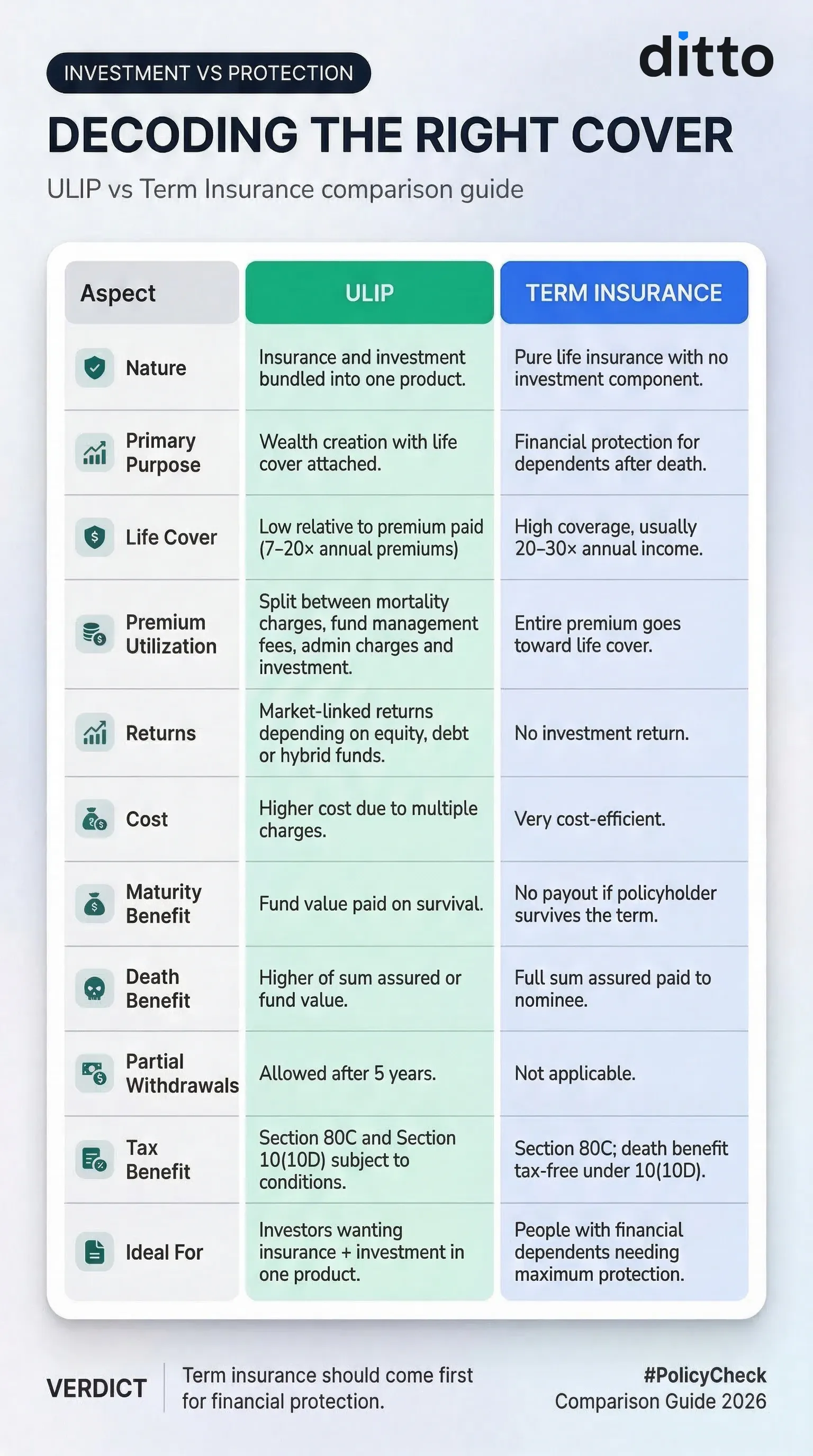
From a protection standpoint, term insurance is far more effective. An HDFC Life ULIP for a 25-year-old may cost around ₹1 to ₹2 lakh a year and offer about ₹20 lakh cover. In comparison, a pure term plan like HDFC Life Click 2 Protect Supreme Plus can provide ₹2 crore or more cover for roughly ₹19,000 to ₹22,000 annually.

From an investment perspective, ULIPs come with multiple charges that reduce long-term returns. Low-cost options like index funds or NPS usually perform better over time. Keeping insurance and investments separate gives you higher cover, better returns, and more flexibility.

For more information, you can check out our comprehensive guide on term insurance vs ULIPs or take a look at the infographic below:
ULIP Lock-in Period

Why Choose Ditto for Life Insurance?

At Ditto, we’ve assisted over 8,00,000 customers with choosing the right insurance policy. Why customers like Aaron below love us:

ULIP Lock-in Period
    • No-Spam & No Salesmen
    • Rated 4.9/5 on Google Reviews by 15,000+ happy customers
    • Backed by Zerodha
    • Dedicated Claim Support Team
    • 100% Free Consultation

You can book a FREE consultation. Slots are running out, so make sure you book a call or chat on WhatsApp now!

Conclusion

The 5-year ULIP lock-in is not just a rule. It shapes the entire product. You lose liquidity, access to your money stays restricted, and you commit to the long term even if your needs change.

If you are certain about staying invested for 10 to 15 years and understand the costs, a ULIP can work. But if you want flexibility, clear costs, and stronger protection, a term plan with separate investments is usually the better choice. Invest in suitable options such as mutual funds, NPS, PPF, and Fixed Deposits (FDs) based on your risk profile, investment horizon, liquidity needs, and tax planning requirements.

If you are looking for a term plan from established insurers, we recommend the best term insurance plans, which align with your future goals. 

Frequently Asked Questions

What is the ULIP policy lock-in period?

The lock-in period of ULIP is 5 years, mandated by the IRDAI master circular for all individual retail unit-linked insurance plans in India. During this time, you cannot withdraw or access your fund value, except in case of death. This rule applies across insurers, fund types, and premium sizes. The idea is to promote disciplined, long-term investing and allow market-linked funds enough time to absorb early charges and short-term volatility. It also reduces the risk of premature exits, which can harm returns due to front-loaded costs in the initial years.

What happens if I stop paying ULIP premiums during the lock-in period?

If you stop paying premiums during the 5-year lock-in, the insurer transfers your fund value to a discontinued policy fund after deducting applicable ULIP charges. At this point, your life coverage and any riders stop. The money remains invested in this fund, which earns a minimum guaranteed return of 4% per year, as per IRDAI. You do not receive the payout immediately. The accumulated amount is released only after the 5-year lock-in period ends. This structure ensures your money is preserved, but also highlights the lack of liquidity if you discontinue early.

Why do ULIPs have a 5-year lock-in period?

ULIPs have a 5-year lock-in to promote long-term investing and prevent misuse as short-term savings tools. Market-linked funds can fluctuate, so this period gives investments time to stabilize. It also supports product structure and cost recovery, since ULIPs combine insurance, fund management, and administration. Early exits can make the plan inefficient for both you and the insurer. Most importantly, the lock-in is part of a policyholder protection framework designed by regulators. It ensures that ULIPs are used for long-term financial goals, not as short-term options like liquid funds.

Do ULIP tax benefits get reversed if I exit early?

Yes, exiting a ULIP before completing 5 years can reverse the tax benefits you claimed earlier. Any deductions taken under Section 80C (old regime) in previous years are added back to your taxable income in the year you surrender the policy. You may also lose eligibility to claim deductions for that year. In some cases, the proceeds received may be taxable, depending on the policy conditions. This makes early exit costly, as it not only affects your investment returns but also increases your tax liability, which many policyholders overlook at the time of purchase. You should consult a tax expert before an early exit decision.

What is the minimum lock-in period for ULIP in India?

The minimum lock-in period for ULIPs in India is 5 years, as prescribed by the IRDAI. This rule applies uniformly across all insurers and ULIP variants. There is no maximum lock-in period, and most ULIPs are designed with policy terms ranging from 10 to 20 years or more. The 5-year minimum was introduced to strengthen investor protection, reduce mis-selling, and encourage long-term investing behavior. It ensures that policyholders stay invested long enough to offset early charges and benefit from market-linked growth.

Is ULIP a good investment, or should I buy term insurance instead?

ULIPs combine insurance and investment in a single product, but this often leads to compromises. The insurance cover tends to be low relative to the premium, and the investment component carries multiple charges that reduce returns. A pure term insurance plan offers significantly higher life cover at a much lower cost, making it more effective for financial protection. For investments, low-cost options like mutual funds usually deliver better long-term outcomes. Keeping insurance and investment separate gives you more flexibility, transparency, and efficiency in managing your finances.

What are the charges in a ULIP during the lock-in period?

ULIPs come with several charges, especially in the early years. These include premium allocation charges, policy administration charges, fund management fees, and mortality charges. Since many of these costs are front-loaded, a significant portion of your premium goes toward fees in the initial years. This reduces the effective investment amount and lowers early returns. These charges are capped by IRDAI Regulations 2024, which limit the maximum reduction in yield a ULIP can impose over the policy term. As the policy progresses, these charges tend to decline, allowing your investments to grow more efficiently. 

What is a discontinued policy fund in a ULIP?

A discontinued policy fund is a separate fund where your money is moved if you stop paying premiums or surrender your ULIP before completing the 5-year lock-in period. After deducting applicable charges, the insurer transfers your fund value to this fund. The money earns a minimum guaranteed return, usually around 4% per annum, as specified by regulations. You cannot access this amount immediately. It is paid out only after the lock-in period ends. This fund acts as a holding mechanism that preserves capital but offers limited growth potential.

Are ULIP maturity proceeds tax-free?

ULIP maturity proceeds can be tax-free under Section 10(10D) of the Income Tax Act, subject to certain conditions. For policies issued on or after February 1, 2021, the total annual premium across all ULIPs must not exceed ₹2.5 lakh in any year to qualify for tax exemption. If this limit is exceeded, the gains are taxed as capital gains. For older policies, the rule that the premium must not exceed 10% of the sum assured continues to apply. It is important to check these conditions before assuming tax-free maturity benefits.

Is a ULIP suitable for your financial needs?

A ULIP works only if your basics are in place. Do not put emergency money into it. Keep 6 to 12 months of expenses in liquid options for medical needs, job loss, or near-term goals. Use ULIPs only for long-term goals and choose a premium you can comfortably pay for at least 5 years. Understand what happens if you stop paying, since your money moves to a discontinued fund and stays locked. Be cautious with top-ups and read the benefit illustration carefully. Avoid ULIPs if you need flexibility, liquidity, or may discontinue premiums midway.

Last updated on: