


Overview
United India Insurance Company Limited has been around since 1938, making it one of India's oldest general insurers. This kind of legacy carries real weight, especially when it's backed by the Government of India. But here's something most buyers don't know before signing up: as of December 2025, UIIC reported a negative solvency ratio of -1.39x, well below the IRDAI-mandated minimum of 1.5x. That's a number worth paying attention to.
Does that mean you should avoid it entirely? Not necessarily.
This article walks you through UIIC's best plans, what the performance metrics really mean, and whether a government-backed insurer is still the right call in 2026.
United India Health Insurance: Performance Metrics
Source: IRDAI annual reports and United India's public disclosures
Note: The complaint numbers here aren't exclusive to health insurance. United India publishes a single complaint figure across all its products (health, motor, and others) combined.
Popular United India Health Insurance Plans
1) United India Family Medicare
Family Medicare is UIIC's flagship plan. It works as a family floater, covering people aged 18-60 with a sum insured (SI) between ₹3 lakh and ₹25 lakh.
Key Benefits
- The plan offers a 100% restoration benefit of the SI, once in a policy year. The restored SI can be utilized only for unrelated diseases.
- Your SI grows 20% for every claim-free year in the form of bonus for the first five years, then 10% per year after that, capping at 200% of the original SI. If you prefer a premium discount over a sum insured bump, you can opt for up to 50% off on your renewal premiums instead.
- Pre-and post-hospitalization expenses are covered for 30 and 60 days, respectively. The expenses are capped at 10% of the SI.
- Maternity cover is available as an add-on, covering up to 10% of the SI. Coverage is capped at ₹40,000 for a normal delivery and ₹60,000 for a C-section. It also has a 2-year waiting period.
Key Drawbacks
- Room rent is limited to 1% of SI or the cost of a single private AC room, whichever is higher.
- Disease-wise sub-limits apply to specific treatments. For instance, cataract is capped at 10% of the SI and is subject to a maximum of ₹50,000 per eye. These limits can significantly reduce your effective payout.
- There is no consumable coverage available.
2) United India Individual Plan
The Individual plan offers two age-based variants: the Platinum Plan for ages 18-35 and the Gold Plan for ages 36-60. Both are available only on an individual basis and cannot be purchased as a family floater. SI options range from ₹2 lakh to ₹20 lakh.
Key Benefits
- The Platinum Plan has no disease-wise sub-limits, so your full cover is available for conditions like cataract, hernia, or hysterectomy.
- Pre-and post-hospitalization expenses are covered for 30 and 60 days, respectively. The capping for the Gold Plan is up to 10% of SI.
- The plan covers domiciliary treatments. Coverage is available up to the SI and starts on the 4th day of treatment.
- The Platinum Plan also has no waiting period for most illnesses, giving you near-immediate coverage from day one. Standard waiting periods apply for the Gold Plan.
Key Drawbacks
- The Gold Plan imposes disease-wise sub-limits for conditions like cataract and hernia. These are precisely the conditions most common in the 36-60 age group, making this a meaningful gap in your coverage.
- The plan comes with no bonuses for staying healthy and no restoration benefit, which limits its long-term value.
- Room rent under the Gold Plan is capped at 1% of the SI, which can result in a large out-of-pocket bill in premium hospitals.
- Neither plan covers consumables and Outpatient Department (OPD) consultations, so out-of-pocket expenses can increase.
3) United India Medicare Super Top Up
The Medicare Super Top Up covers individuals and families, with a sum insured of up to ₹75 lakh and flexible deductible options to match your existing base plan.
Key Benefits
- Once your deductible threshold is crossed, the insurer pays 100% of admissible claims up to the SI. No copayment is applicable.
- You can choose any room category without affecting your claim amount.
- Pre-hospitalization expenses are covered for up to 30 days before admission if your SI is below ₹10 lakh, and up to 60 days if your SI is ₹10 lakh or more. On the other side, post-hospitalization expenses are covered for up to 60 days after discharge for an SI below ₹10 lakh, and up to 90 days if your SI is ₹10 lakh or above.
Key Drawbacks
- Disease-wise sub-limits apply to certain modern treatments, which can limit your payout for high-cost procedures even after the deductible is met.
- No coverage for consumables, OPD, or domiciliary treatment.
- The plan does not offer any bonus or restoration benefits.
Did You Know?
Now that we know the key plans, let’s have a look at the premiums.
Note: A stands for adult, and C denotes child. These are indicative premiums for a Delhi resident (pincode: 110001) for a ₹15 lakh SI. Your premium will vary based on age, city, medical history, add-ons, and applicable discounts.
Talk to an expert
today and
find
the right
insurance for you.


United India Health Insurance Contact Details and Address
- Toll-Free Number: 180042533333
- Email: customercare@uiic.co.in
- Website: http://www.uiic.co.in/
- Branch Locator: https://www.uiic.co.in/web/branch-locator
- Address: United India Insurance Co. Ltd., 24, Whites Road, Chennai - 600014
Top 10 Health Insurance Companies in India
United India is not on our list of the top 10 health insurance companies in India. We evaluate insurers across multiple parameters (CSR, complaint volume, network hospitals, etc.). When you factor all of that in, United India's high ICR, negative solvency ratio, and TPA-dependent claims process pull it below the threshold we set for a top-tier recommendation.
Note: If you'd like to explore the detailed figures reported by insurers and the IRDAI in their annual disclosures and public reports, visit Ditto Data Labs, our proprietary repository of health insurance data, meticulously compiled, verified, and maintained by the Ditto team over the years.
Government vs Private Health Insurance: Which Is Better For You?
Where Private Insurers Win
- Private insurers generally maintain healthier ICRs, which signals long-term financial stability.
- Their hospital networks are wider, often 10,000 or more, giving you more cashless options, especially in metros and Tier-1 cities.
- Most private plans come without room-rent limits, disease sub-limits, or copay clauses.
- Add to that in-house claims processing, faster settlements, wellness programs, and app-based support, and the overall experience is simply more modern and customer-friendly.
Where Government Insurers Stand Out
Government insurers have decades-long legacies and the backing of the Government of India, which offers a sense of long-term security. Their CSRs are competitive, and they tend to attract fewer complaints relative to their customer base.
Why Choose Ditto for Health Insurance?
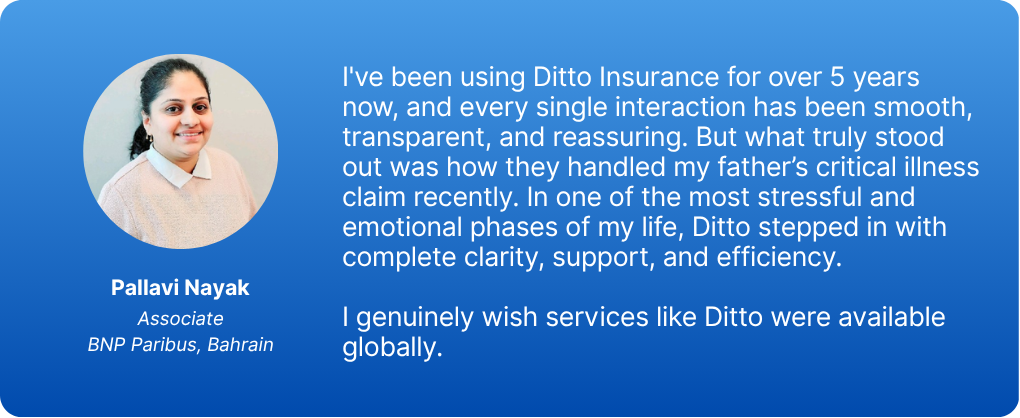
At Ditto, we’ve assisted over 8,00,000 customers with choosing the right insurance policy. Why customers like Pallavi below love us:
- No-Spam & No Salesmen
- Rated 4.9/5 on Google Reviews by 15,000+ happy customers
- Backed by Zerodha
- Dedicated Claim Support Team
- 100% Free Consultation
Confused about the right insurance? Speak to Ditto’s certified advisors for free, unbiased guidance. Book your call now or chat with our advisors on WhatsApp.
Conclusion
United India Health Insurance has a long-standing legacy and the security of government backing, but it falls short on several fronts that matter most to a modern health insurance buyer.
Government insurers are not bad, but they have not kept pace with what modern health insurance offers. Additionally, higher ICR and negative solvency ratios raise long-term concerns. This implies they will either need capital infusion from the government or raise premiums to balance their books. Unless you specifically need a Public Sector Undertaking (PSU) insurer or are not eligible for better plans, a private insurer will likely give you better coverage, a smoother claims experience, and stronger long-term value for your money.
That said, UIIC can still make sense if private insurers have declined your proposal or if you specifically prefer a PSU insurer.
For everyone else, there are better options, such as HDFC ERGO and Care Health. Check out Ditto's list of the best health insurance companies in India to find an insurer that actually fits your needs.
Frequently Asked Questions
Last updated on: