Health Insurance

Private Health Insurance in India: Plans, Costs, and Benefits

Aaryaa Nagpal Jambhulkar

Written by Aaryaa Nagpal Jambhulkar

Insurance Writer

Gaurav Bhat

Reviewed by Gaurav Bhat

IRDAI-Certified Expert at Ditto

SP0738578124

Certified
Private Health Insurance in India: Plans, Costs, and Benefits

Overview

Private health insurance in India offers dedicated medical coverage, access to large cashless hospital networks (which vary by insurer), and tax benefits under Section 80D (now 126) under the old tax regime.

Top Private Health Insurance Options

  • HDFC ERGO Optima Secure Plus: The insurer has a Claim Settlement Ratio (CSR) of 97.61%. The plan comes with 2X cover from day 1 and infinite bonus accumulation. 
  • Care Supreme: Care has a CSR of 95.45%. The plan lets you increase your total coverage without any limits through bonus and unlimited restoration.
  • Aditya Birla Activ One MAX: Aditya Birla has a CSR of 96.25%. The plan offers up to a 500% bonus regardless of claims and includes premium discounts for healthy habits.

Core Coverage and Benefits

  • Covers inpatient and day care treatments, including room rent, surgeries, and medical procedures.
  • Pre- and post-hospitalization expenses are often covered for 60 or 90 days before and 180 days after, along with benefits like a loyalty bonus.

Waiting Periods and Exclusions

  • Waiting Periods: 30 days initially, 2 years for specific illnesses, and 3 years for pre-existing conditions.
  • Exclusions: Cosmetic treatments, substance abuse, and self-inflicted harm.

IRDAI’s FY 2024–25 Annual Report reveals an interesting trend in health insurance in India. Out of the nearly 58 crore lives covered, only 10.3% were insured under individual health insurance policies. Meanwhile, 47.4% were covered through group insurance and 42.3% through government-sponsored schemes.

Why does this matter? Because group insurance is often linked to employment, while government schemes are restricted to eligible beneficiaries. An individual health insurance policy, on the other hand, gives you greater control over your coverage without depending on either.

But choosing the right private health insurance in India isn't always straightforward. With different plans, premiums, and benefits available, it's important to know what you're paying for. In this guide, we'll break down the options, costs, and features worth considering before buying.

What Is Private Health Insurance?

Private health insurance is a policy you buy on your own from an insurance company by paying a monthly or annual premium. In return, the insurer covers your hospitalization expenses up to a fixed amount, called the sum insured.

Since you pay for the coverage yourself, you have more flexibility to choose your insurer, plan, sum insured, and more. 

How It Works:

    • Insurer and Plan Selection: Compare plans by coverage, premiums, and exclusions, and compare insurers by claim settlement records and hospital networks. Choose one that fits your healthcare needs and budget.
    • Application Form: Fill out the application form with your personal details, medical history, and existing illnesses. Disclose all information accurately.
    • Premium Payment: Pay the premium to complete the purchase. Once approved, the insurer issues your policy with the coverage details and terms.
    • Claim Settlement: For cashless claims, the insurer settles eligible bills directly with a network hospital. For reimbursement claims, you pay first and submit the bills to the insurer for reimbursement.

What’s Covered:

    • Eligible hospitalization expenses (room rent, ICU, doctor fees, etc.).
    • Pre- and post-hospitalization costs (for example, tests before surgery and medicines after discharge).
    • Day care procedures that don’t require 24-hour admission.
    • Domiciliary treatment (treatment taken at home in specific cases).

Private health insurance mainly helps you manage large medical expenses without dipping into savings.

Top Private Health Insurance Companies and Plans in India

The insurer matters just as much as the policy because it handles claim approvals, settlements, and servicing. Here are Ditto's top health insurance companies in India.

Top 10 Health Insurance Companies in India: Ditto's Pick

Company NameDitto Score (Out of 5)Claim Settlement RatioComplaints per 10,000 ClaimsAnnual Business (In Crore)
HDFC ERGO4.9997.61%8.87₹6,596.53
Bajaj General4.9995.63%3.85₹7,900.76
Aditya Birla4.4996.25%18.67₹4,920.43
Care Health4.2395.45%42.67₹8,404.67
Niva Bupa4.2392.92%37.13₹6,985.24
SBI General3.7995.94%14.04₹4,974.56
Go Digit3.6999.01%19.08₹1,666.04
Generali Central (Formerly Future Generali)3.6693.50%11.68₹1,597.08
ICICI Lombard3.6586.81%15.05₹7,955.27
TATA AIG3.4388.94%11.47₹3,776.36

Note: The above metrics are for the financial year 2024-26.

For a deeper breakdown of how these insurers compare across metrics, explore Ditto Data Lab.

Which Health Insurance Plans Should You Consider?

For a detailed comparison of these plans, including features, premiums, and limitations, check out our full breakdown of the best health insurance plans in India. 

Note: We shortlisted these plans based on Ditto’s insurer rating framework, which evaluates policy features (45%), insurer quality (45%), and premium (10%). 

Private Health Insurance vs. Government Health Insurance

FeaturePrivate Health InsuranceGovernment Health Insurance Schemes
Sum Insured or Coverage LimitFlexible coverage options up to ₹1 crore or unlimited to manage rising medical costs.Fixed annual limits such as up to ₹5 lakh under PM-JAY and ₹1 lakh under Niramaya. CGHS and ESIS work on package rates instead of a fixed cap.
Pre-Existing DiseasesWaiting period of 2 to 3 years (reducible by paying extra) as per IRDAI guidelines.Covered from day 1 under PM-JAY, CGHS, and ESIS with no waiting period.
Hospital Room CategoryChoice of private rooms or plans with no room rent restrictions.Usually limited to general ward under PM-JAY package rules.
Hospital Choice and NetworkLarge network of private hospitals with both cashless and reimbursement options.Treatment is only available in empaneled hospitals. Referral process required in CGHS and ESIS systems.
Pre- and Post-HospitalizationLonger coverage periods, usually 30 to 90 days before and 90 to 180 days after hospitalization.Covered up to 3 days before admission and 15 days after discharge under PM-JAY.
Outpatient CareMostly not included in basic plans. Available through add-ons.Mostly not covered under PM-JAY but included in schemes like CGHS, ESIS, ECHS, and Niramaya.

Ditto's Take

Government schemes can be valuable for eligible families, but they are not direct substitutes for retail health insurance. If you can afford private coverage, use it to support any government or employer benefits rather than assuming one form of cover will handle every medical expense.

Sample Premiums for Private Health Insurance in India

Profiles for a ₹15 Lakh PolicyHDFC ERGO Optima Secure PlusCare SupremeAditya Birla Activ One MAXNiva Bupa ReAssure 2.0 Platinum+
(Individual Plan): Age 25₹13,458₹17,693₹11,671₹12,382
(Family Floater, 2 Adults): Ages (31, 32)₹21,128₹25,312₹18,743₹21,066
(Family Floater, 2 Adults, 1 Child): Ages (36, 35, 5)₹27,845₹36,632₹30,486₹28,475
(Family Floater, 2 Adults): Ages (60, 60)₹75,608₹75,033₹52,875₹54,310

The premiums are illustrative and calculated for adults living in Delhi (pincode: 110010) for a 1-year tenure with recommended add-ons. Your final premium will vary based on factors like age, medical history, location, selected add-ons, and discounts.

Talk to an expert
today and find
the right
insurance for you.
Ditto Advisor
Background Image

How to Choose the Right Private Health Insurance Plan?

01

Start With Your Needs

Consider your age, medical history, and family size. If you have existing conditions, look for plans with shorter waiting periods for pre-existing diseases.

02

Focus On Core Features

Prioritize plans with no room rent limits, no mandatory co-pay, and no disease-wise sub-limits. Also check for benefits like restoration of sum insured, consumables cover, and adequate pre- and post-hospitalization coverage.

03

Check the Coverage Strength

Go for a sufficient sum insured (often ₹15 to ₹25 lakh or more) so it can handle rising medical costs and multiple claims in a year.

04

Evaluate the Insurer

Look at metrics like CSR (ideally above 90%), low complaint volume, and a large hospital network (10,000+). Also check if claims are handled in-house or via a third-party administrator.

05

Compare Premiums Carefully

Don’t just choose the cheapest option. Lower premiums can come with restrictions like co-pays or sub-limits that reduce actual coverage.

06

Get Expert Advice if Needed

An unbiased advisor can help you shortlist plans based on your profile and support you during claims or policy changes later.

Pros and Cons of Private Health Insurance

Pros

    • Protects Your Savings: Helps you cover large medical bills without dipping into your savings or investments or taking on high-interest medical debt.
    • Wider Hospital Choice: Lets you choose private hospitals and more comfortable room options.
    • Cashless Treatment: The insurer pays the hospital directly for eligible expenses, so you don’t have to arrange large amounts upfront.

Cons

    • Premiums Increase Over Time: You’ll need to pay every year, and costs usually rise with age and medical inflation.
    • Waiting Periods Apply: Some conditions, especially pre-existing ones, are only covered after a few years, though this can sometimes be reduced with add-ons or riders.
    • Subject to Underwriting: The insurer assesses your health and other details before accepting your application, and may impose terms or decline coverage.

Why Choose Ditto for Health Insurance?

At Ditto, we’ve assisted over 12,00,000 customers with choosing the right insurance policy. Why customers like Pallavi love us:
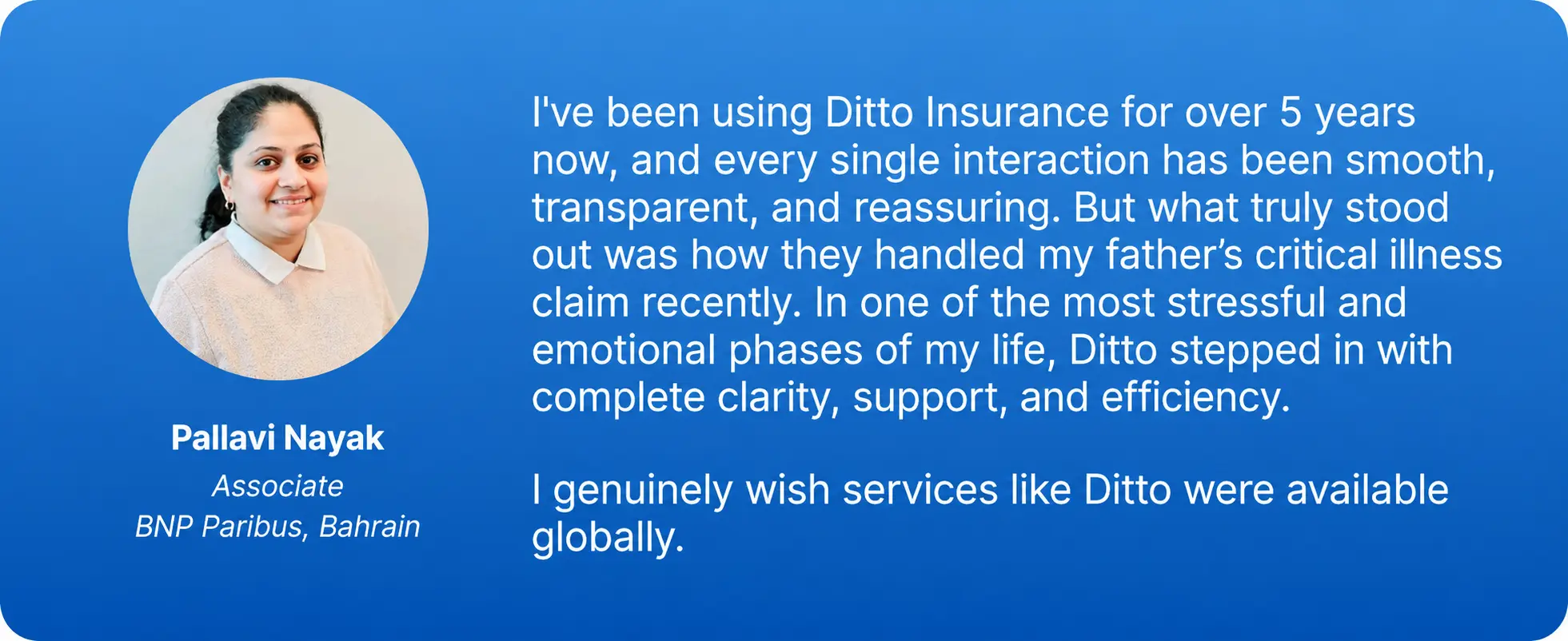
Pallavi Nayak LinkedIn Testimonial
    • 100% Free Consultation
    • No Spam. No Sales Pressure.
    • Rated 4.9/5 on Google Reviews by 30,000+ Happy Customers
    • Backed by Zerodha
    • Dedicated Claim Support Team
    • Compare Plans and Premiums with a Trusted Insurance Advisor

Confused about the right insurance? Speak to Ditto’s certified advisors for free, unbiased guidance. Book your call now or chat with us on WhatsApp. Slots fill up fast!

Conclusion

Private health insurance works best when you treat it as a long-term cover, not a last-minute purchase. Instead of focusing only on premiums, start by shortlisting 2 to 3 reliable insurers, then compare plans based on core features like room rent flexibility, waiting periods, and restoration benefits. Once you’ve narrowed it down, check if your preferred hospitals are part of the insurer’s cashless network.

Frequently Asked Questions

Is private health insurance India worth buying if I already have employer cover?

Yes, buying the best private health insurance policy independently is essential even if you have employer cover. When choosing the best private health insurance in India, look for adequate coverage and fewer restrictions. Corporate group insurance is tied directly to your employment. Employer health cover usually ends when your eligibility under the employer's group policy ends. These plans may have low sum insured limits, co-payments, or room rent caps, and you can't customize them with riders. A personal policy gives you coverage independent of your employer and lets you tailor it more closely to your needs.

Is GST charged on individual health insurance premiums?

No. Since 22 September, 2025, individual health insurance policies are exempt from GST, including individual, family floater, and senior-citizen health insurance plans. Before this change, eligible health insurance premiums attracted 18% GST. The exemption means policyholders no longer pay this GST on qualifying health insurance premiums, reducing the cost of buying and renewing these policies.

What is the moratorium period in private health insurance policies in India?

Under IRDAI guidelines, the moratorium period is 5 years of active policy coverage. Once you’ve renewed your policy without breaks for this duration, the insurer cannot reject a claim for non-disclosure or misrepresentation at the time of purchase, unless it can prove deliberate fraud. This rule offers strong long-term protection and reduces the risk of claim disputes after you’ve stayed covered consistently.

Can private health insurers in India raise premiums for senior citizens every year?

Premiums for senior citizens can increase over time, based on factors like age, policy terms, and overall pricing revisions. Under IRDAI guidelines, insurers cannot increase senior-citizen premiums by more than 10% annually based on their existing rate chart. Any increase beyond this, or any decision to withdraw a product, requires prior regulatory review and approval.

What is the difference between a cashless network hospital claim and a reimbursement claim in private health insurance?

In a cashless claim, the insurer settles eligible bills directly with a network hospital. In a reimbursement claim, you pay upfront and submit the bills for repayment. In FY 2024-25, 58% of settled health claims by number were cashless, while 66.35% of claim value was settled this way. The Cashless Everywhere initiative also allows eligible cashless treatment at some non-network hospitals, subject to guidelines.

Do private health insurance plans in India cover OPD expenses or only hospitalization?

Standard health policies primarily cover inpatient hospitalization requiring at least 24 hours of admission, along with day care procedures. However, many modern private health plans offer Outpatient Department (OPD) coverage, either as a built-in feature or an optional add-on rider. OPD coverage reimburses expenses incurred for outpatient doctor consultations, diagnostic tests, pharmacy purchases, and dental care that do not require hospital admission.

Can I buy a private health insurance policy in India without a medical test?

Yes, young applicants, typically under 45, with no pre-existing conditions may buy private health insurance without pre-policy medical tests. Older applicants or those with conditions such as diabetes or hypertension may need tele-underwriting or diagnostic tests. Depending on the insurer’s terms, the insurer may fully cover the cost of these tests or share it with the applicant.

How long do private health insurers in India take to approve a cashless request?

As per IRDAI guidelines, insurers and TPAs are expected to provide cashless pre-authorization within 1 hour and final approval within 3 hours of receiving complete documents. If delays go beyond this, the insurer should bear any additional hospital charges. As per Ditto’s experience, approvals usually take 2 to 4 hours once documents are complete, but may extend to 24 to 30 hours if further review is needed. Hospitals may also ask for a refundable deposit (around ₹10,000 to ₹25,000), though this is not standard.

Last updated on: