Group health insurance, also called Group Medical Coverage (GMC), helps startups cover employees' hospitalization expenses and strengthen their employee benefits.
Key Features for Startups
Flexible Eligibility: IRDAI does not set a minimum group size. Insurers often require 7 employees, but this may be negotiable.
Day-One Coverage: Startups can negotiate waiting-period waivers for pre-existing diseases and maternity benefits.
Cashless Hospitalization: Employees can access cashless treatment at the insurer's network hospitals.
Scalability: Startups can add eligible employees during the policy year through endorsements.
Cost and Coverage
Premiums: Depend on employee demographics, sum insured, and selected benefits.
Coverage Options: Include employee-only, family-floater, and parent coverage.
Tax Benefits for Startups
Business Expense: Eligible employer-paid group health insurance premiums can qualify as deductible business expenses under Section 30(c) of the Income-tax Act, 2025.
Input Tax Credit: The GST Council has recommended allowing ITC on group health insurance premiums, subject to the proposed change taking effect.
For startups, choosing group health insurance means balancing employee healthcare needs with a limited budget. While low-cost plans may seem attractive, coverage limits, exclusions, and other restrictions can affect how much of their medical expenses the insurer pays during a medical emergency.
Founders should look beyond premiums and compare policies based on their sum insured, hospitalization benefits, exclusions, claim processes, and overall costs. This guide explains the coverage options, premiums, and tax implications of group health insurance for startups.
Group Health Insurance Coverage and Key Features for Startups
01
Inpatient Hospitalization
Covers eligible expenses for hospital stays, including room charges, ICU expenses, nursing, surgery, and other related medical treatments.
02
Pre- and Post-Hospitalization
Covers eligible medical expenses incurred before hospital admission (typically 30 to 60 days) and after discharge (typically 60 to 90 days), provided they are related to an admissible hospitalization claim and prescribed by the treating doctor.
03
Waiting Period Waivers
Retail health insurance policies generally impose waiting periods of 24 to 36 months for Pre-Existing Diseases (PEDs). However, startups can negotiate a waiver to secure day-one blanket PED coverage under a group policy. This benefit depends on the insurer's agreement and must be included in the policy terms.
04
Room Rent Limits
Some policies cap the amount an employee can claim toward daily room rent. Exceeding these limits can also result in proportionate deductions from other associated hospital expenses, increasing the employee's out-of-pocket costs.
05
Maternity and Newborn Cover
Startups can opt for maternity benefits covering eligible delivery expenses and newborn care. However, these benefits can come with specific waiting periods, exclusions, and sub-limits, such as a ₹50,000 cap.
06
Customer Information Sheet (CIS)
Under IRDAI's 2024 Master Circular, insurers must provide a CIS to both the master policyholder (employer) and covered members (employees). It explains important policy details, including the sum insured, coverage limits, sub-limits, and exclusions.
Note: Group medical insurance primarily covers eligible hospitalization expenses. It does not replace Group Personal Accident (GPA) Insurance, which covers specified accidental death and disability benefits, or Group Term Life Insurance (GTLI), which provides life cover.
Eligibility Criteria and Minimum Employee Requirements
Not all group health insurance policies require a minimum of seven employees. The repealed IRDAI Health Insurance Regulations, 2016, prescribed a seven-member threshold. However, the IRDAI Insurance Products Regulations, 2024, removed this requirement, leaving the minimum group size to insurers' board-approved underwriting policies. Key eligibility criteria include:
Insurers may set separate minimum requirements for employees and total insured members. Dependents, such as spouses, children, and parents, may count toward the insured-member requirement but not the employee headcount.
Founders, Interns, and Contractors
Founders and directors on the company's payroll may qualify. Interns and contract workers require insurer approval to be included.
Types of Group Health Insurance Plans for Startups
Group health insurance plans fall into two broad categories: indemnity-based and fixed-benefit plans. Startups can also structure coverage and add benefits based on their budget and employees' needs.
Indemnity-Based Group Health Insurance
These plans cover eligible medical expenses during hospitalization, up to the available sum insured. Benefits may include room rent, ICU charges, surgeries, and other treatments, subject to policy terms.
Employers can choose between two coverage structures:
Individual Coverage: Each employee gets a separate sum insured. For example, if five employees have ₹15 lakh coverage each, one employee's claim does not reduce the others' coverage.
Family Floater Coverage: Employees and eligible dependents, such as spouses, children, and parents, share one sum insured. Including older parents can increase premiums, so startups should assess this option separately. For example, HDFC ERGO group health insurance offers family-floater coverage. However, a claim by one member reduces the remaining sum insured available to others.
Additional Coverage Through Corporate Buffers and Super Top-Ups:
Corporate Buffer: A shared pool of additional coverage that eligible employees can access after exhausting their base sum insured, subject to policy limits and approval.
Employer-Provided Super Top-Up: Covers eligible medical expenses above a specified deductible during the policy year, subject to the plan's terms.
Startups can also choose equal coverage, where all employees receive the same sum insured, or graded coverage, where coverage varies by employee category or job level.
Fixed-Benefit Group Insurance
These plans pay a predetermined amount when a specified insured event occurs. Payouts do not depend on actual medical expenses. Common options include:
Group Critical Illness Insurance: Pays a lump sum for a covered critical illness, such as qualifying cancer or a heart attack, subject to policy conditions. ManipalCigna's Lifestyle Protection group policy offers this cover.
Group Hospital Cash Insurance: Pays a fixed daily amount for eligible hospitalization days, subject to policy limits. SBI General's Group Mediclaim Policy offers an optional hospital daily cash benefit.
Ditto's Take
Early-stage startups should prioritize indemnity-based group health insurance to cover eligible hospitalization expenses. Choose adequate individual or family-floater coverage with reasonable restrictions. Corporate buffers, super top-ups, and fixed-benefit covers can supplement this protection as the team grows.
Talk to an expert today and find the right insurance for you.
Group Health Insurance Costs for Startups
Group health insurance premiums depend on employee age, sum insured, coverage options, and the insurer. The table below compares annual premiums under HDFC ERGO's Group Platinum Plan for different family compositions and sum insured options.
Sum Insured
Young Individual (1 Adult)
Young Couple (2 Adults)
Couple With 1 Child (2 Adults, 1 Child)
Two Parents (61 to 65 Years)
₹3 Lakh
₹3,379
₹4,704
₹5,732
₹21,091
₹5 Lakh
₹4,219
₹5,873
₹7,157
₹26,800
₹10 Lakh
₹5,784
₹8,054
₹9,550
₹40,550
₹15 Lakh
₹7,166
₹9,990
₹11,833
₹49,938
The young individual and family rates use the 18 to 35 age band.
Parent premiums assume both parents fall within the same age band. If their ages differ, the applicable premium may differ.
The rate chart lists premiums for two adults (2A), but does not specify whether the adults can be parents or parents-in-law. Confirm eligible relationships with the insurer.
According to Sushant Khosla, Senior Manager at Ditto Insurance, internal quotes suggest these indicative annual premiums per employee, before 18% GST:
Employee-Only Cover: ₹5,000 to ₹5,500 for ₹3 lakh to ₹5 lakh coverage.
₹5 Lakh Family Floater With Maternity: ₹5,200 to ₹13,800.
Teams Under 20: ₹8,000+ per employee.
₹10 Lakh Floater With Maternity and Outpatient Department (OPD): Around ₹17,500.
Adding Parents: Around ₹22,000, even for ₹3 lakh coverage.
High-Claim Renewals: Premiums may increase two to three times.
Actual premiums vary by team size, age, coverage, benefits, and claims history. These are indicative estimates, not fixed rates.
Mid-Term Employee Additions
Startups can add new employees to their group health insurance policy during the policy year through an endorsement. The insurer charges a pro-rata premium for the remaining policy period.
For example, based on HDFC ERGO's annual Platinum premium of ₹4,219 for a ₹5 lakh individual cover, adding an employee with 4 months remaining would cost approximately ₹1,659, including 18% GST.
Note: Actual premiums depend on the insurer's endorsement terms and the date of employee addition.
Tax Implications of Group Health Insurance for Startups
Employer Business Expense Deduction: Premiums a startup pays to insure its employees' health can qualify for a business expense deduction under Section 30(c) of the Income-tax Act, 2025 (formerly Section 36(1)(ib) of the Income-tax Act, 1961). To qualify, the premium must be paid through a non-cash payment mode toward an eligible health insurance scheme approved by the relevant authorities.
Employee Tax Benefits: Employees who personally contribute toward eligible health insurance premiums for themselves, their families, or their parents may claim deductions under Section 126 of the Income-tax Act, 2025 (formerly Section 80D of the 1961 Act). This deduction is available only under the old tax regime and is subject to prescribed limits and payment conditions. Employer-paid premiums do not qualify as personal deductions for employees.
GST and Input Tax Credit (ITC): Employer-sponsored group health insurance policies attract 18% GST. Under Section 17(5)(b) of the CGST Act, 2017, startups generally cannot claim ITC on these premiums. An exception applies when applicable law requires health insurance or when the insurance is used to make an eligible outward taxable supply, subject to the relevant conditions. However, at its 57th meeting on October 8, 2026, the GST Council recommended allowing ITC on health and life insurance premiums. Employers may be able to claim this credit once the change takes effect.
Why Choose Ditto for Health Insurance?
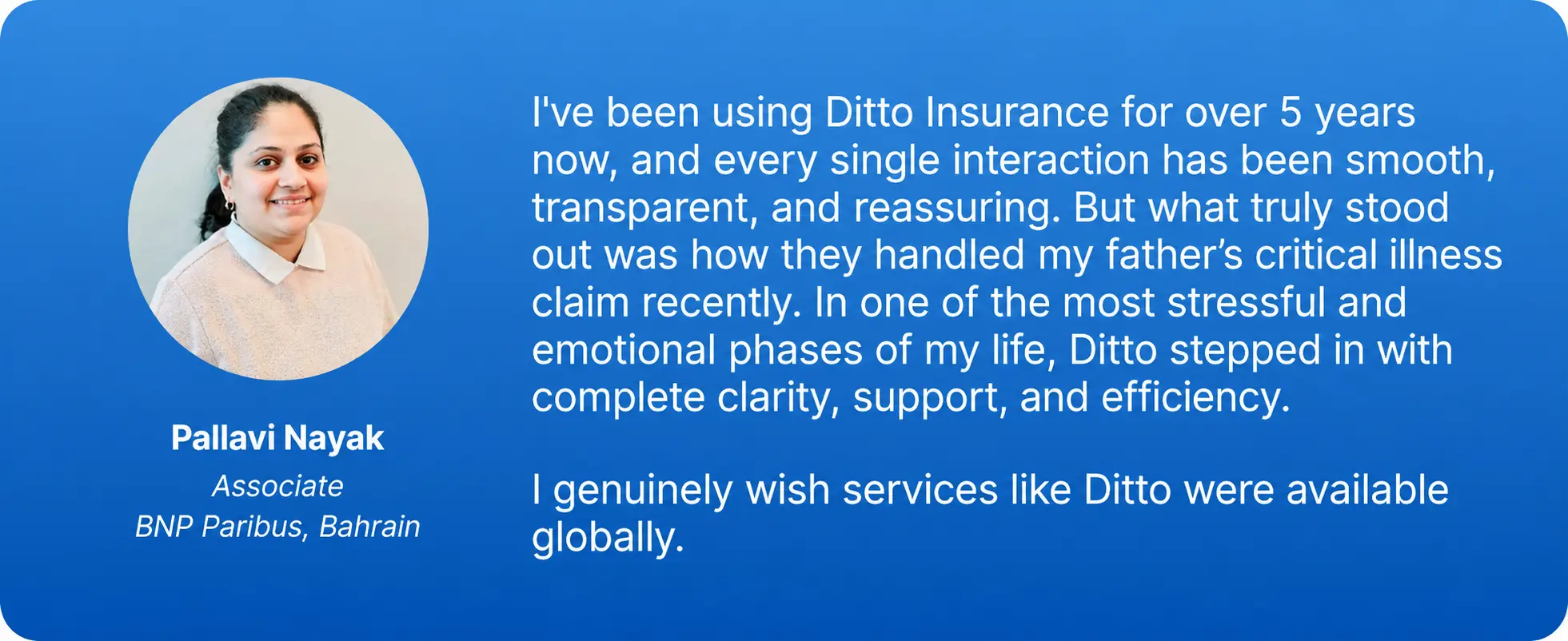
At Ditto, we’ve assisted over 12,00,000 customers with choosing the right insurance policy. Why customers like Pallavi love us:
100% Free Consultation
No Spam. No Sales Pressure.
Rated 4.9/5 on Google Reviews by 30,000+ Happy Customers
Backed by Zerodha
Dedicated Claim Support Team
Compare Plans and Premiums with a Trusted Insurance Advisor
Confused about the right insurance? Speak to Ditto’s certified advisors for free, unbiased guidance. Book your call now or chat with us on WhatsApp. Slots fill up fast!
Conclusion
A group health insurance policy helps startups provide health coverage to employees while managing their benefits budget. However, the cheapest policy may come with room rent limits, co-payments, exclusions, and other restrictions that increase employees' out-of-pocket expenses.
Before buying, compare quotes from different insurers. Check waiting periods, maternity benefits, the hospital network, and the Customer Information Sheet (CIS). Choose a policy your startup can afford as the team grows.
Frequently Asked Questions
Can a startup with fewer than 7 employees get group health insurance in India?
Yes. A startup with fewer than seven employees can get group health insurance if an insurer accepts its group size. The IRDAI Insurance Products Regulations, 2024, removed the earlier seven-member minimum under the 2016 regulations. Insurers now set their own minimum group-size requirements based on their underwriting criteria.
How much should an early-stage startup budget for group health insurance per employee?
Based on HDFC ERGO's Platinum rate chart, a startup can budget approximately ₹4,219 per employee annually for a ₹5 lakh individual cover in the 18 to 35 age band. Including 18% GST, this comes to around ₹4,978 per employee annually. This is an indicative rate from the insurer's chart. The final group premium may vary based on employee demographics, selected coverage, past claims experience (if any), and underwriting terms. Contact the insurer for a personalized quote.
Are pre-existing diseases covered from day one under a startup group health insurance policy?
Yes, provided the group policy includes a PED waiting-period waiver. Startups can negotiate this benefit with the insurer to ensure employees receive coverage for eligible pre-existing conditions from the policy's start date. However, day-one coverage is not automatic. Before purchasing the policy, employers should confirm the waiver is explicitly stated in the policy schedule or a relevant endorsement.
Can startups add employees mid-policy year, and how are premiums adjusted for it?
Yes. Startups can generally add eligible new employees during the policy year through a mid-term endorsement, subject to the insurer's terms. The additional premium is calculated pro rata for the remaining policy period. For example, if the annual premium is ₹12,000 and an employee joins with four months remaining, the additional premium would be ₹4,000 plus 18% GST.
Can a startup deduct group health insurance premiums as a business expense?
Yes. Employer-paid group health insurance premiums can qualify as deductible business expenses under Section 30(c) of the Income-tax Act, 2025. The deduction is subject to applicable conditions, including payment through non-cash banking channels and eligibility under an eligible health insurance scheme.
Can group health insurance for employees offer different coverage to founders and staff?
Yes. Startups can negotiate graded coverage structures with insurers, assigning different sums insured or benefits to predefined employee categories. For example, senior management may receive ₹10 lakh coverage, while other employees receive ₹5 lakh. However, these categories and benefits must be part of the insurer-approved policy structure. Employers cannot independently extend coverage beyond the agreed policy terms.
Can a group mediclaim insurance policy for employees include optional dependent coverage?
Yes. Startups can provide an employer-funded base policy for employees while allowing them to pay extra to cover eligible dependents. Depending on the policy, employees can include their spouses, children, parents, or parents-in-law. The additional premium and eligibility conditions will depend on the insurer's terms, including dependent age limits, permitted relationships, and enrollment deadlines.
Can startups raise the sum insured under a group mediclaim policy for employees as they grow?
Yes. Startups can increase the sum insured when renewing their group health insurance policy to accommodate a growing team or changing coverage needs. Mid-term increases may also be possible through a policy amendment, but they require the insurer's approval and involve additional premiums or underwriting. Any increase applies according to the revised policy terms and cannot be used to cover claims that arose before the enhancement.
Is group health insurance mandatory for startups in India?
No, private group health insurance is generally not compulsory for startups in India. However, some startups must provide Employees' State Insurance (ESI) coverage under the applicable rules. This depends on the establishment type, location, employee count, and wages. Buying a private group health insurance policy does not remove the requirement to provide ESI coverage if the startup falls under these rules.