


Overview
Imagine you run a company with 50 employees and want to provide them with health insurance. You come across two options, Employees’ State Insurance (ESI) and Group Health Insurance (GHI).
Both help employees manage medical expenses, so choosing the cheaper option might seem obvious.
But what if the cheaper option doesn't meet your employees' needs? Or what if you purchase a group health insurance policy and still have to contribute toward ESI?
That's where things get complicated.
In this guide, we'll compare ESI vs. group health insurance, explain their eligibility rules and costs, and help you understand which approach makes more sense for your business.
What Is Employees’ State Insurance (ESI)?
Employees’ State Insurance (ESI) is a government-backed social security scheme that provides eligible employees and their families with medical care and financial protection. It is administered by the Employees' State Insurance Corporation (ESIC) under the Ministry of Labour and Employment.
According to the Press Information Bureau (PIB), the ESI scheme began in 1952 with around 25,000 insured persons. Since then, it has expanded significantly, covering approximately 3.84 crore insured persons and 14.91 crore beneficiaries across India as of March 2025, according to ESIC's Annual Report 2024–25.
The scheme provides medical consultations, medicines, hospitalization, and specialist treatment through ESIC/ESIS facilities and authorized hospitals. Beyond healthcare, it also offers financial assistance during qualifying periods of sickness, maternity, employment-related disability, and unemployment, along with support for eligible dependents following an employment-related death.
Important: Since 21 November 2025, the Code on Social Security, 2020, has governed ESI, replacing the earlier Employees' State Insurance Act, 1948.
What Is Group Health Insurance?
Group health insurance is a single policy that covers multiple people belonging to an existing group, such as company employees or association members. The organization generally holds the master policy, while eligible members receive coverage under it.
Under the IRDAI Regulations 2024, group insurance arrangements fall into two categories.
- Employer-Employee Groups: Companies, startups, factories, and other organizations purchase health insurance for their employees, with the employer acting as the master policyholder.
- Non-Employer-Employee Groups: Professional associations, cooperative societies, banks, and other eligible organizations arrange health insurance for their members.
For employers, group health insurance for employees typically covers hospitalization, surgeries, ICU expenses, and other eligible medical treatments. Employers can also choose the sum insured, extend coverage to employees' dependents, and add benefits such as maternity coverage, outpatient consultations, and preventive health checkups.
Some group policies also cover pre-existing diseases from day one, depending on the terms agreed with the insurer. For example, ICICI Lombard’s group health insurance allows employers to opt for a waiver of the pre-existing disease waiting period, subject to the agreed policy terms.
Eligibility Criteria for ESI and Group Health Insurance
Eligibility Criteria for ESI
For Employers and Organizations
- Minimum Employees: ESI generally applies to establishments employing 10 or more people, excluding seasonal factories.
- Hazardous Occupations: Establishments engaged in occupations notified as hazardous or life-threatening may be covered even with a single employee.
- Voluntary Registration: Establishments with fewer than 10 employees can opt for ESI coverage under the applicable provisions.
- Geographical Coverage: The Code on Social Security, 2020, extended the ESI applicability framework across India, replacing the earlier district-based approach.
For Employees
- Monthly Wages: Employees generally qualify if their applicable monthly wages are ₹21,000 or less. The ceiling is ₹25,000 for persons with disabilities.
- Employment Status: Eligible employees working directly for an organization or through contractors can be covered.
- Wage Calculation: As clarified in an ESIC circular issued in December 2025, eligibility is determined using the revised wage definition under Section 2(88) of the Code on Social Security, 2020, rather than gross salary or CTC alone. This generally includes basic pay, dearness allowance, and retaining allowance, with adjustments for specified excluded salary components.
Important: If an employee's wages exceed the prescribed ceiling during an ongoing contribution period, coverage may continue until that period ends, subject to the applicable ESI rules.
Eligibility Criteria for Group Health Insurance
For Employers and Organizations
- Eligible Group: The organization must have a genuine employer-employee relationship or another recognized group relationship. A group cannot be created solely to purchase insurance.
- Minimum Group Size: Requirements vary by insurer and policy. For example, ManipalCigna FlexiCare requires at least seven members. This is a product requirement, not a universal IRDAI minimum.
- Group Registration: Employers purchasing a group mediclaim insurance policy for employees must provide documentation establishing their identity and the group's legitimacy.
For Employees and Members
- Eligible Members: Employees, directors, and other members may qualify depending on their relationship with the group and the insurer's policy terms.
- Entry Age: Minimum and maximum entry ages vary by policy. Some group plans have flexible age limits.
- Dependents: Spouses, children, parents, and parents-in-law may be included if permitted under the selected policy.
- Medical Tests: Insurers often waive medical examinations for eligible group members, though they may require them based on underwriting conditions.
ESI vs. Group Health Insurance: A Detailed Comparison
Talk to an expert
today and
find
the right
insurance for you.


ESI vs. Group Health Insurance: Cost and Contribution Differences for Employers
The main difference between ESI and group health insurance is how employers pay. ESI contributions are calculated as a fixed percentage of eligible employees' wages, while group health insurance premiums depend on the employees covered and the benefits selected.
Here's how the costs work.
1) ESI Contribution Calculation
Under the prevailing ESIC contribution structure, both employers and employees contribute a fixed percentage of the employee's applicable wages.
- Employer's Contribution: 3.25% of the employee's applicable monthly wages.
- Employee's Contribution: 0.75% of the employee's applicable monthly wages.
- Total Contribution: 4% of applicable wages, with the employer responsible for remitting both shares to ESIC.
The employer pays its share separately and generally deducts the employee's share from their wages. The employer must deposit both contributions with ESIC within the prescribed deadline.
2) Group Health Insurance Premium Calculation
Unlike ESI, group health insurance doesn't have a fixed contribution rate. Insurers calculate premiums based on several factors.
- Group Size: The number of employees and dependents covered under the policy.
- Age Profile: The age distribution of insured members, including older employees and dependents.
- Sum Insured: The coverage amount the employer selects.
- Coverage Benefits: Additional benefits such as maternity coverage, OPD consultations, or pre-existing disease waiting-period waivers.
- Claims History: The group's past claims experience, which may influence premiums, particularly at renewal.
Who Pays the Premium?
Employers can choose how to fund group health insurance premiums.
- Employer-Funded: The employer pays the entire premium for eligible employees.
- Shared Contribution: The employer and employees split the premium according to the company's benefits policy.
Important: Group health insurance continues to attract 18% GST, even though eligible individual health insurance policies became GST-exempt in September 2025. Employers should also review the applicable Input Tax Credit (ITC) rules before calculating their final insurance expenses.
For more details, read our guide on GST on Group Health Insurance.

How Should Employers Budget for ESI Contributions and Group Health Insurance Premiums?
Calculate ESI Contributions
Assess Employee Healthcare Needs
Compare Group Health Insurance Plans
Include Taxes and Additional Expenses
Plan for Employee Turnover and Renewals
Consider Offering Both ESI and Group Health Insurance
Why Choose Ditto for Health Insurance?
At Ditto, we’ve assisted over 12,00,000 customers choose the right insurance policy. Why customers like Pallavi love us:
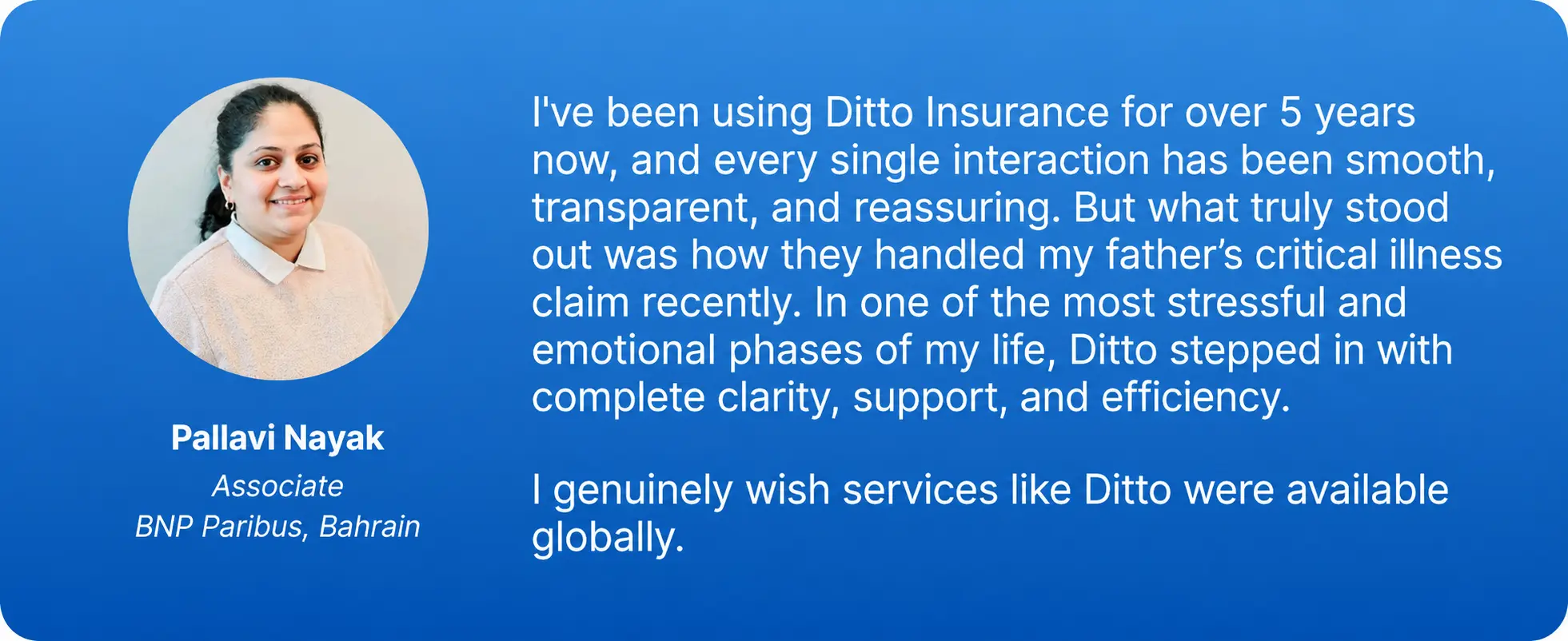
- 100% Free Consultation
- No Spam. No Sales Pressure.
- Rated 4.9/5 on Google Reviews by 30,000+ Happy Customers
- Backed by Zerodha
- Dedicated Claim Support Team
- Compare Plans and Premiums with a Trusted Insurance Advisor
Confused about the right insurance? Speak to Ditto’s certified advisors for free, unbiased guidance. Book your call now or chat with us on WhatsApp. Slots fill up fast!
Conclusion
ESI and group health insurance serve different purposes. While ESI provides statutory medical and financial benefits to eligible employees, group health insurance offers additional flexibility in coverage and hospital selection.
For employers, the priority should be meeting ESI obligations first, then assessing whether group health insurance can address employees' healthcare needs.
If you're considering additional coverage, explore our guide to group health insurance companies in India to compare insurers, their offerings, and important policy features.
Frequently Asked Questions
Last updated on: