Group personal accident (GPA) insurance covers employees or members under a single master policy for accidental death, disability, injury, and accident-related hospitalization. Ditto’s recommendation is a dedicated employer-bought GPA policy over bundled bank or loan-linked covers, because meaningful protection should ideally be 2-5x the employee’s annual salary.
A company covering a 30-year-old Bengaluru employee earning ₹10 lakh should ideally choose a ₹20-₹50 lakh GPA cover. We discuss GPA plans by reviewing coverage breadth, sum insured adequacy, the insurer's claim track record, exclusions, and whether benefits such as temporary disability, hospital cash, and child education support are included.
This guide is for employers, Human Resource (HR) teams, banks, associations, and employees who want to understand how group personal accident insurance works and where it fits.
Every year, India records over 4.8 lakh road accidents, according to the Ministry of Road Transport & Highways. That is almost one accident every minute. The financial fallout, from lost income and hospital bills to long-term disability, can hit hard, especially for employees who live paycheck to paycheck.
This is exactly the gap that group personal accident insurance is built to fill.
In this article, we will cover the group personal accident insurance meaning, what it covers, who needs it, and how to choose the right policy.
Not sure how the group personal accident insurance policy works? Book a free call or chat on WhatsApp with a Ditto advisor to find out.
What Is Group Personal Accident Insurance?
Group personal accident insurance, also called GPA insurance, is a single policy that covers a group of people, typically a company's employees, against accidents. The employer or organization acts as the master policyholder. Employees (and sometimes their families) are covered as members under that policy.
Think of it this way. Instead of 500 employees buying their own accident policy, a company buys a group plan that protects everyone at once. It is cheaper per person, faster to set up, and easier to manage.
It can cover accidental death, partial disability, ambulance, child education, funeral costs, and adaptation expenses.
Did You Know?
IRDAI-mandated insurers’ public disclosures (Form NL 47) show that group personal accident products dominate the overall personal accident insurance segment in India.
A big reason for this is bundling. Group personal accident insurance schemes are often packaged with bank savings accounts, debit cards, and loans, meaning many people already have some form of GPA coverage without realizing it.
Talk to an expert today and find the right insurance for you.
What Does Group PA Insurance Cover?
Benefit
What It Means
Accidental Death
Payout to the nominee if the insured dies in an accident
Permanent Total Disability (PTD)
Pays if an accident causes loss of both eyes, both limbs, one eye and one limb, both hands, both feet, or total paralysis.
Permanent Partial Disability (PPD)
A proportionate payout based on a defined schedule (e.g., loss of one hand = 50% of the sum insured)
Temporary Total Disability (TTD)
Weekly benefit if the insured cannot work temporarily due to an accident (often capped at 52-104 weeks)
Hospitalization Expenses
Covers medical bills arising directly from an accidental injury
Ambulance Charges
Cost of emergency transport to a hospital after an accident
Broken Bones Cover
Fixed payout for specific bone fractures (offered as an add-on in some plans)
Loan Protector
Helps cover outstanding loan EMIs if the insured is disabled due to an accident
Education Fund
One-time benefit for dependent children in the event of the insured's accidental death
Not all plans include all of the benefits above by default, some are optional add-ons. Always read the policy wording carefully so you know exactly what is covered.
What’s Not Covered?
Self-inflicted injuries
Death or disability caused by war
Injuries sustained while under the influence of alcohol or drugs
Pre-existing conditions directly causing an accident
Who Needs Group Personal Accident Insurance?
Employers and HR teams are the primary buyers. GPA should be considered supplementary coverage, not a standalone financial plan. Ideally, employees should already have:
Adequate term life insurance, which already covers accidental death as part of the base sum assured
A solid health insurance plan, which already covers accidental hospitalization costs
Group PA insurance fills a specific and valuable gap. It pays out for partial and temporary disabilities, broken bones, and situations where income is disrupted but no term or health claim is triggered. And because it is low-cost, there is very little reason not to include it in your employee benefits stack.
Non-employer groups can also use group PA cover. Banks, microfinance institutions, trade associations, and other organizations routinely use these policies to protect their members.
How to Choose the Best Group Accident Insurance Policy?
01
Coverage Breadth
A basic plan typically only covers accidental death, permanent total disability, and permanent partial disability. But for complete protection, your policy should also cover good policy, temporary disability, broken-bone coverage, loss-of-income benefits, and hospitalization benefits.
02
Sum Insured
A common mistake is under-insurance. The sum insured should ideally be 2-5x the employee’s annual salary to ensure meaningful coverage.
03
Insurer Track Record
Look at claim settlement ratios and complaint volumes from IRDAI's annual reports and insurers’ public disclosures. You want your employees' claims settled quickly and without unnecessary back-and-forth.
04
Bundled Plans vs. Dedicated Plans
Bundled GPA plans (offered with bank accounts or loans) are very affordable but usually carry a limited sum insured. If you are an employer looking for proper coverage, a dedicated group personal accident insurance policy for employees with a higher sum insured and comprehensive benefits is worth the extra cost.
05
PMSBY as a Baseline
For very cost-sensitive groups or to supplement employee coverage, the government's Pradhan Mantri Suraksha Bima Yojana (PMSBY) is worth knowing about. It offers ₹2 lakh cover for accidental death or total disability and ₹1 lakh for permanent partial disability at just ₹20 per year, auto-debited from a savings bank account. This does not replace a corporate GPA policy, but it is a strong baseline for informal or low-income groups.
06
Consider Saral Suraksha Bima
IRDAI has mandated a standard personal accident product called Saral Suraksha Bima, which all general and health insurers must offer. It has standardized base coverage, including accidental death, permanent total disability, and permanent partial disability, with optional temporary disability, hospitalization, and education grant benefits. If you want a simple, transparent option, this is a good starting point.
Why Choose Ditto for Insurance?
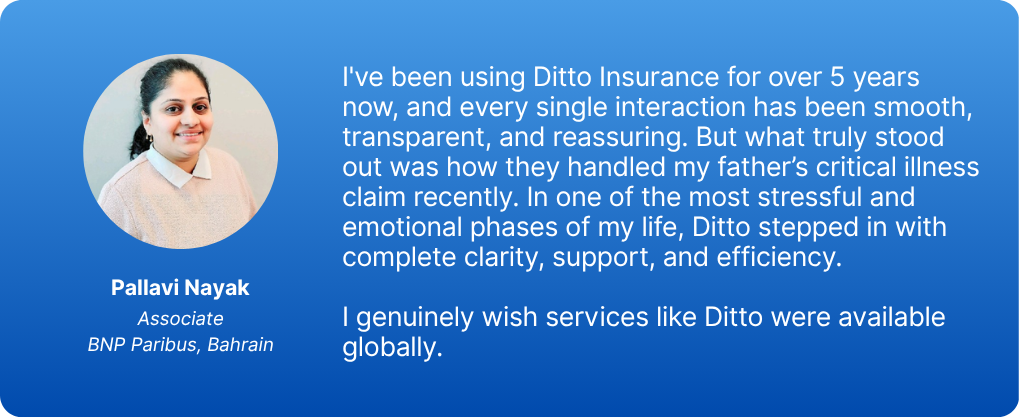
At Ditto, we’ve assisted over 8,00,000 customers with choosing the right insurance policy. Why customers like Pallavi below love us:
No-Spam & No Salesmen
Rated 4.9/5 on Google Reviews by 15,000+ happy customers
Backed by Zerodha
Dedicated Claim Support Team
100% Free Consultation
Confused about the right insurance? Speak to Ditto’s certified advisors for free, unbiased guidance. Book your call or chat on WhatsApp with us now!
Ditto's Take
Group personal accident insurance is one of those policies that is easy to overlook because it does not feel as urgent as term insurance or as visible as health insurance. But for employers, it fills a very real and specific gap in employee protection, one that your other policies leave open.
The smart move is to first ensure your employees have solid coverage on the two big pillars: A reliable term insurance plan and a health insurance plan that actually holds up at claim time.
Once those are in place, a GPA policy becomes a low-cost, high-value add-on that covers the scenarios other policies miss: temporary income loss, partial disabilities, broken bones, and loan protection after an accident.
Frequently Asked Questions
What is group accident insurance in simple words?
Group accident insurance, also called GPA insurance, is a policy purchased by an employer, bank, association, or other eligible organization to cover a defined group of people against accidental death and disability. Instead of each person buying a separate accident plan, the group is covered by a single master policy. A basic GPA plan usually covers accidental death, permanent total disability, and permanent partial disability. Stronger plans may also include accident hospitalization, hospital cash, or temporary disability benefits. For employers, GPA is best used as a low-cost employee benefit, usually with coverage of around 2-5 times the annual salary.
What is SBI General Group Personal Accident Insurance?
SBI General Group Personal Accident Insurance is SBI General’s GPA plan for eligible groups, including employers, associations, banks, and other organizations. It can cover accidental death, permanent total disability, permanent partial disability, and temporary total disability. Some policy versions may also offer add-ons like accident medical expenses, hospital cash, ambulance cover, and child education support. For example, an employer purchasing GPA for 100 employees can use this plan to provide accident-linked protection under a single master policy rather than issuing 100 separate personal accident policies. The exact benefits depend on the chosen cover and policy schedule.
What is covered under a GPA policy?
A GPA policy usually covers accidental death, permanent total disability, permanent partial disability, and, in better plans, temporary total disability. It may also include accident hospitalization expenses, ambulance charges, hospital cash, child education benefit, broken bones cover, funeral expenses, or a loan protector benefit. For example, if an employee with a ₹25 lakh GPA cover loses both limbs in an accident, the policy may pay the defined permanent total disability benefit. But not every benefit is automatic. HR teams should check whether temporary disability, income loss, and medical expenses are included or only available as add-ons.
Who can buy group accident insurance in India?
Group accident insurance can be bought by a genuine pre-existing group, such as an employer covering employees, a bank covering account holders or borrowers, an employee welfare association, a professional body, or a business covering customers. The group must already exist for a common purpose and cannot be created only to buy insurance. For example, a company with 50 employees can buy GPA for its workforce, but 50 unrelated people cannot form a group just to get cheaper premiums. This rule helps insurers price risk properly and prevents misuse of group insurance discounts.
Are all accidents covered under group personal accident insurance?
No, all accidents are not covered under group personal accident insurance. A GPA policy pays only when the event fits the policy definition of an accident and does not fall under exclusions. Insurers usually define an accident as sudden, unforeseen, external, violent, and involuntary. Common exclusions include self-inflicted injuries, alcohol or drug-related accidents, war, illegal acts, aviation risks, and adventure sports. For example, a road accident may be covered, but an injury during skydiving may be excluded unless specifically covered. Always check the exclusions before assuming a ₹10 lakh claim will be paid.
Is GPA insurance for employees worth it?
Investing in a group personal accident insurance policy for employees is highly recommended as a low-cost supplement to traditional benefits. While standard term life insurance covers accidental death, a GPA policy fills a critical gap by providing payouts for partial disabilities, broken bones, and temporary total disability (TTD) that may not trigger other insurance claims. It is suggested that, for meaningful protection, an employer should select a sum insured that reflects 2-5x the employee’s annual salary. This ensures that an employee earning ₹10 lakh is adequately protected by a ₹20- ₹50 lakh cover.
What is the difference between group health vs group personal accident insurance?
While both are common corporate benefits, they serve entirely different financial needs. Group health insurance primarily covers medical bills and hospitalization costs resulting from illnesses or injuries. In contrast, group personal accident insurance provides a fixed-sum payout directly to the insured or their nominee for accidental death or disability, regardless of hospital expenses. In India, where over 4.8 lakh road accidents occur annually, roughly one every minute, GPA insurance serves as an essential source of income replacement. It handles scenarios where an accident causes long-term disability but may not require extensive, high-cost medical treatment.
Why does group accident insurance premium change based on job type?
Group accident insurance premiums change because insurers price GPA based on occupational risk, not just age or sum insured. A desk-based IT employee and a factory-floor worker do not carry the same accident risk. Many insurers classify employees into risk categories, such as office-based, field-based, manual, or hazardous work. SBI General’s GPA prospectus states that the premium depends on the insured person’s occupation and the coverage chosen. So, an HR team buying GPA for 500 factory workers will usually face different underwriting than one covering 500 software employees.
What is occupational risk class in group personal accident insurance?
Occupational risk class is the category an insurer uses to judge how risky an employee’s work is. A sedentary office employee usually falls into a lower-risk class, while a driver, machine operator, construction worker, or factory worker may fall into a higher-risk class. This matters because it can affect both premium and claim treatment. For example, SBI General’s policy wording says that if someone changes to a more hazardous occupation than what was declared, the payable benefit may be reduced based on the premium that should have applied.