


Introduction
India is dealing with a massive lifestyle disease burden. According to the Indian Council of Medical Research, India Diabetes Study, roughly 10.1 crore (101 million) Indians live with diabetes, and an estimated 31.5 crore (315 million) people have hypertension. If you or someone in your family falls into either group, finding the right health insurance policy for Pre-Existing Diseases (PEDs) can feel overwhelming. Insurers may reject applications outright, apply heavy loading charges, or impose long waiting periods for chronic conditions.
With so many things to keep in mind, comparing a health insurance policy for pre-existing diseases on your own can quickly become overwhelming. That’s where Ditto Insurance can make a difference. As a free insurance advisory platform, Ditto helps people understand their options, compare plans objectively, and choose the right coverage, all without any spam.
This guide discusses whether your PED can get covered, how PED waiting periods work, the best health insurance plans for PED in India, why honest disclosure matters, and how Ditto helps you navigate all this.
Common Questions People Ask
Can You Get Health Insurance With Pre-Existing Diseases?
Yes, you can get health insurance if you have pre-existing diseases like diabetes, hypertension, or asthma. While insurers treat these as higher-risk cases, policies can still cover your conditions, depending on underwriting. Some possible outcomes are:
Waiting Periods
Loading Charges
Permanent Exclusion
Rejection
If you face a rejection or a steep premium loading, do not start to worry. Each insurer has its own underwriting guidelines. Therefore, rejection by one insurer does not mean that you will get rejected everywhere else. As an alternative, plans like Care Freedom or Arogya Sanjeevani are often offered as a “policy of last resort.”
Government health insurance schemes and group health insurance through an employer or bank can sometimes provide an alternative with little to no PED waiting period and lenient underwriting.
Moreover, IRDAI’s recent regulations have pushed the health insurance industry toward wider coverage, so a condition that was declined in your health insurance policy a few years back might get covered now. Reapplying periodically can make sense, but it's better to do so selectively by tracking which insurers have softened their stance on your particular condition, rather than reapplying everywhere.
How Waiting Periods for PEDs Work?
A PED waiting period is a set duration you must wait for before your health insurance covers treatments related to a pre-existing medical condition. During this time, the insurer will not pay claims for that specific illness (or anything related to that illness), which helps keep premiums manageable and prevents immediate, high-cost claims.
Under the IRDAI Insurance Products Regulations, 2024, the maximum PED waiting period an insurer can impose is capped at 36 months (3 years), down from the earlier 48 months (4 years) limit. Once you have completed 36 months of continuous coverage, the insurer cannot deny a claim for that disclosed condition.This same 36-month window also defines what counts as a PED in the first place. Legally, a condition only qualifies as “pre-existing” if it was diagnosed, treated, or showed symptoms within the 36 months before your policy started.
Here is an important nuance. Even if a condition falls outside this 36-month look-back, Ditto still recommends disclosing it. Say you had a major surgery five years ago. Disclosing it upfront protects you from the “fraud or intentional misrepresentation” clause, which insurers can use to cancel a policy at any time if they later discover a hidden link to a chronic illness.
There is also a longer-term safety net called the moratorium period. Once your policy has been continuously renewed for 60 months (5 years), the insurer cannot reject a claim on the grounds of a pre-existing disease or non-disclosure, except in cases of proven fraud. This is what makes staying with one insurer for the long haul genuinely valuable if you have a complex medical history.
Moreover, any condition diagnosed after you have bought the policy does not count as a PED and therefore does not come with any new waiting periods or loading charges. Newly diagnosed conditions are covered from day 1, after the 30-day initial waiting period is over.
Best Health Insurance for Pre-Existing Diseases
The best health insurance plans for pre-existing diseases (PEDs) depend on your specific condition, how severe it is, and your budget. At Ditto, we rate the plans using our proprietary policy and insurer rating framework, which scores each plan across three dimensions:
- Feature Rating (45%): Room-rent rules, co-pays, waiting periods (and options to reduce them), restoration, bonuses, consumables coverage, and more.
- Insurer Rating (45%): Assesses the insurer's reliability based on IRDAI data, including claim settlement ratio, complaint volume, business scale, hospital network, and servicing model.
- Premium Rating (10%): Evaluates affordability for a benchmark profile.
Based on that, the following are the best health insurance for pre-existing diseases in India:
Keep in Mind: These add-ons come at an extra premium, which must be paid for the entire policy lifetime, and they only cover the listed conditions. Care is the only exception where you only have to pay the additional premium for the first 3 years, and there are no separate loading charges.
Talk to an expert
today and
find
the right
insurance for you.


How Do Premiums Increase Because of Waiting Period Reduction Riders?
Note: Here, "A" stands for adult. These are indicative premiums for a Delhi resident (pin code: 110001) with a ₹15 lakh sum insured, including mandatory and recommended add-ons. Your premium can change based on age, city, medical history, plan variant, added discounts, and chosen add-ons.
Should I Pay Extra and Reduce Pre-Existing Disease Waiting Periods if I Have a Corporate Cover?
If you have corporate cover, you do not need to pay extra to reduce waiting periods on your personal policy. But this will only work if the corporate plan has a sufficient sum insured and no sub-limits. If your corporate plan has restrictions, it's highly recommended to pay an extra premium to shorten the waiting period on your personal policy and reduce out-of-pocket costs.
Will My Health Insurance Premiums Rise Every Year Because of My Pre-Existing Conditions?
No, your premiums will not rise every year solely because of a pre-existing condition. While insurers may charge an upfront loading fee for these conditions, long-term premium increases depend on broader factors such as your age, medical inflation, and insurer-wide re-pricing. The insurer cannot single you out based on your claim history to increase premiums.
Why Honest Disclosure Protects Your Claims
Honest disclosure protects your health insurance claims by satisfying the legal principle of "utmost good faith." It guarantees full coverage, prevents claim rejection, avoids policy cancellation due to misrepresentation, and protects your future insurability.Disclose everything honestly, including past medical records, prescriptions, and surgeries.
Why It Matters: Insurers thoroughly investigate claims. The insurer can investigate your medical history and may reject the claim, or even cancel the policy entirely, under the non-disclosure clause. When you are upfront, there are no surprise medical records or histories for them to uncover, allowing your claim to process and settle much faster.
Day 1 PED Cover and Reduced Waiting Options
Health insurance coverage from day 1 for pre-existing diseases is rare, but can be achieved through specialized plans and add-on riders. Insurers also provide options to drastically reduce standard waiting periods, such as 3 years down to 30 days, by utilizing PED buy-back riders or disease-management add-ons.Plans That Offer Riders to Reduce Waiting Period:
1) HDFC ERGO Optima Secure+
- Offers the ABCD Chronic Care Add-on, which reduces the waiting period from 3 years to just 30 days for select chronic conditions, including asthma, hypertension, high cholesterol, and type 2 diabetes.
2) Care Supreme
- The Instant Cover and Instant Cover Plus add-ons reduce the waiting period from 3 years to 30 days for conditions such as diabetes, hypertension, asthma, and high cholesterol. Instant Cover Plus also extends coverage to select additional chronic ailments, such as Chronic Obstructive Pulmonary Disease (COPD), obesity, or Coronary Artery Disease (PTCA performed within the past 1 year).
- The plan also offers a ‘PED Reduction’ add-on that can reduce the waiting period for all pre-existing diseases from 3 years to 2 years or 1 year.
3) Aditya Birla Activ One MAX
- Comes with the Chronic Care Add-on, under which the waiting period for chronic conditions such as diabetes, hypertension, asthma, high cholesterol, and certain other listed ailments can be reduced from 3 years to day 1 (0 days).
- It also offers a ‘Reduction in the PED’ add-on that can reduce the waiting period for all pre-existing diseases from 3 years to 2 years or 1 year.
4) Niva Bupa ReAssure 2.0 Platinum+
- Offers the Disease Management Add-on, which reduces the waiting period for diabetes and hypertension from 3 years to Day 1 (0 days), allowing coverage from policy start.
Other Plan Options That Offer Built-In Day 1 Coverage:
1) HDFC ERGO Energy Silver
- Enery Silver is specifically designed for individuals with diabetes and hypertension, providing coverage from day 1.
- All other PEDs are covered after 2 years.
2) Acko Platinum
- Acko Platinum is one of the few retail health insurance plans that offer a zero waiting period as a core feature.
- Depending on the underwriting and medical testing, it covers disclosed pre-existing diseases after a 0- to 3-year waiting period.
What Happens if a Person Has a Pre-Existing Disease, Which Is Also a Specific Illness?
When a pre-existing disease (PED) is also classified as a specific illness in a health insurance policy, the longer of the two waiting periods will apply to your coverage. For example, if a person has cataract as PED, any claim arising because of that will only be covered after 3 years, even though cataract also falls under the specific illness list, which only has a 2 years waiting period.
How Ditto Helps You Find the Right Cover
Ditto’s advisors start by reviewing your complete medical history, including any chronic conditions, medications, and past procedures, so they can match you with insurers whose underwriting is more favorable to your specific profile. From there, they:
- Identify add-ons like ABCD Chronic Care that can shrink your PED waiting period for specific conditions.
- Compare PED waiting periods, room rent limits, co-payments, and disease-wise sub-limits across insurers, not just the base premium.
- Help you calculate whether a premium loading, say 10% to 50% extra, is worth it over a 10 years horizon compared to your likely out-of-pocket costs.
- Prepare you for tele-medical calls or physical screenings so there are no surprises during underwriting.
- Guide you through portability if you have already served part of your PED waiting period with another insurer, since waiting period credits carry forward.
- Point you toward plans with wellness and Outpatient Department (OPD) benefits that offer renewal premium discounts, sometimes 30% to 100%, for tracking metrics like step counts or blood sugar levels, which can help offset a premium loading over time.
For policies bought through Ditto, support continues after purchase with claims assistance, including follow-ups with the insurer if any issues arise at the time of claiming.
Why Choose Ditto for Health Insurance?
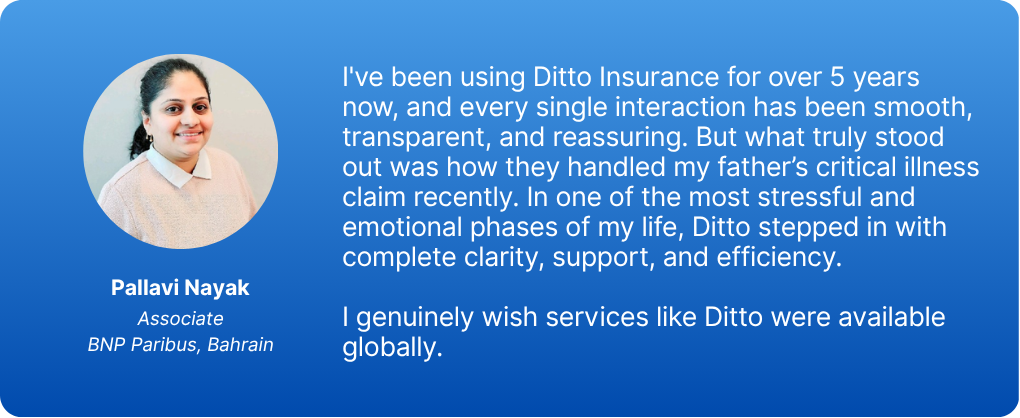
At Ditto, we’ve assisted over 8,00,000 customers with choosing the right insurance policy. Why customers like Pallavi below love us:
- No-Spam & No Salesmen
- Rated 4.9/5 on Google Reviews by 24,000+ happy customers
- Backed by Zerodha
- Dedicated Claim Support Team
- 100% Free Consultation
Confused about the right insurance? Speak to Ditto’s certified advisors for free, unbiased guidance. Book your call or chat on WhatsApp with us now!
Ditto’s Take
If you are living with a pre-existing condition, do not assume you are stuck with sky-high premiums or no cover at all. Disclose everything honestly, compare plans for PED waiting periods, room rent limits, and sub-limits, not just price, and check whether an add-on like ABCD Chronic Care fits your condition.
As an actionable next step, speak with a trusted advisor like Ditto before you buy, so your policy is structured around your actual health profile from day one, rather than being painfully adjusted after a rejected claim.
Last updated on: