



Introduction
According to the World Health Organization (WHO), more than half of people with diabetes may not even know they have it, and adults with diabetes have a two- to three-fold higher risk of heart attacks and strokes. So when diabetes is not detected or managed early, the risks can go far beyond fluctuating sugar levels.
But most standard health insurance plans treat existing diabetes as a pre-existing disease. This can mean higher premiums, stricter underwriting, or, in some cases, restrictions on what gets covered.
This is where Ditto helps. Our advisors explain your options based on your diabetes type, HbA1c levels, treatment history, and budget. We also help you read the fine print before you buy, so you know exactly what is covered and what is not.
This guide breaks down what health insurance for diabetics covers, what it can cost, and which plans are worth considering. We also explain how Ditto helps you find the best health insurance for people with diabetes in India.
Common Questions People With Diabetes Ask
What Is Health Insurance for People With Diabetes?
Health insurance for people with diabetes is either a standard comprehensive health insurance plan that covers diabetes after a waiting period, or a diabetes-specific plan/rider designed to cover the condition more quickly.
Types of Coverage Available
- Diabetes-Specific Plans: These are plans designed specifically for people with Type 1 or Type 2 diabetes. They may offer shorter waiting periods for diabetes-related claims and may include benefits such as doctor consultations, diagnostic tests, pharmacy support, or chronic care management.
- Standard Health Insurance Plans: Many comprehensive health insurance plans also cover people with diabetes, but diabetes is usually treated as a pre-existing disease. This means diabetes-related hospitalization may be covered only after the pre-existing disease waiting period is completed. Depending on your medical profile, the insurer may also apply a higher premium, exclusions, or specific underwriting conditions.
- Health Plans With Chronic Care Riders: Insurers offer chronic care riders or add-ons that enhance coverage for conditions such as diabetes, hypertension, or cardiac risk factors. These help to shorten the waiting period but are usually available only with select plans and at an additional cost.
Key Benefits
- Inpatient Hospitalization Cover: This covers hospitalization expenses, such as room rent, nursing charges, doctor's fees, ICU charges, medicines, and treatment costs, if you are admitted to the hospital.
- Pre- and Post-Hospitalization Cover: This covers medical expenses incurred before admission and after discharge, including consultations, diagnostic tests, medications, and follow-up care.
- Domiciliary Hospitalization: Some plans may cover treatment provided at home if hospitalization is medically necessary, a hospital bed is unavailable, or the patient’s condition prevents hospital admission.
Factors to Consider
- Pre-Existing Disease Waiting Period: Diabetes is almost always treated as a pre-existing disease if you already have it before buying the policy. Waiting periods can range from 0 days (in specialized policies) to 2-3 years (in standard plans).
- Medical Underwriting: Insurers usually ask for your medical history, current medicines, HbA1c levels, recent test reports, and details of any complications. Based on this, they may accept the proposal, increase the premium, add restrictions, or, in some cases, decline the policy application.
Can a Person With Diabetes Buy Health Insurance in India?
Yes, a person with diabetes can buy health insurance in India. However, since diabetes is treated as a pre-existing disease, the insurer will first assess your health profile before approving the policy.
Terms and Conditions to Expect
- Underwriting: Insurers may ask about your diagnosis date, current medications (oral or insulin), latest HbA1c and fasting glucose readings, and any other comorbidities such as hypertension or high cholesterol.
- Pre-Policy Medical or Telemedical Evaluation: Depending on your age and the sum insured you're applying for, insurers may require a telemedical call, a physical checkup, or both, usually including a blood sugar and HbA1c test.
- Premiums and Loading Charges: If your proposal is accepted but you're seen as a higher-risk applicant, the insurer may apply a loading charge on top of the base premium.
- Waiting Periods: Diabetes-related claims are usually covered only after a Pre-Existing Disease (PED) waiting period. Under current IRDAI rules, this waiting period cannot exceed 36 months, though diabetes-specific plans and riders can bring it down significantly.
- Cover Restrictions: The insurer may also offer a lower sum insured than requested, apply a co-payment, or add a disease-wise sub-limit specifically for diabetes-related treatments. They can also permanently exclude diabetes and any related claims.
- Rejection: If your diabetes is poorly controlled, recently diagnosed with complications, or paired with multiple comorbidities, the insurer may decline the proposal.
How to Apply and Improve Your Chances?
Disclose everything. Do not hide your diagnosis, current medication, HbA1c reports, or any complications. Non-disclosure may get your policy issued faster, but it creates serious problems at claim time. If the insurer later discovers an undisclosed diabetes diagnosis, your claim can be rejected or, worse, the policy can be canceled.
Instead, submit your latest HbA1c and blood sugar reports, show that your levels are reasonably controlled, and be transparent during the telemedical or pre-policy medical process. A policy with a slightly higher premium and genuine diabetes coverage is almost always better than a cheaper plan that excludes the very condition you're most likely to claim for.
Does It Matter Whether I Have Type 1 or Type 2 Diabetes?
Yes, the type of diabetes you have matters because insurers evaluate health insurance for diabetics Type 1 and Type 2 very differently, and your mode of treatment (oral medication versus insulin) plays a major role in how easily your application gets approved.
Type 2 Diabetes on Oral Medication
If you have Type 2 diabetes that is managed with oral medication and your parameters (HbA1c, fasting glucose, blood pressure) are well controlled, insurers generally find your application much easier to underwrite. Most comprehensive health insurance plans with a chronic care rider will accept this profile, often with a shorter waiting period and a moderate premium loading.
Type 1 Diabetes or Insulin-Dependent Type 2 Diabetes
If you are on insulin, whether you have Type 1 diabetes or insulin-dependent Type 2 diabetes, insurers tend to be far more cautious. This is because insulin dependency is often associated with a longer disease history, frequent blood sugar level changes, and a higher likelihood of complications down the line. You may face a higher premium loading, a longer waiting period, even on chronic-care riders, or rejection from some comprehensive plans altogether.
What This Means for Your Plan Choice
- If you are looking for health insurance for diabetics Type 2 on oral medication with controlled parameters, you have a wide choice of comprehensive plans with chronic care riders. For example, HDFC ERGO Optima Secure+ with the ABCD Chronic Care add-on, Care Supreme with Instant Cover or Instant Cover Plus, Aditya Birla Activ One MAX with the Chronic Care add-on, or Niva Bupa ReAssure 2.0 with the Disease Management rider.
- If you have Type 1 diabetes or are insulin-dependent, your realistic options narrow to plans built specifically to accept diabetics from day 1, such as Aditya Birla Activ One MAX with Chronic Care, Aditya Birla Activ One VYTL, and HDFC ERGO Energy Silver. If they decline your profile, Care Freedom can serve as a fallback option, though it has a 2-year waiting period and certain restrictions, including the possibility of permanent exclusions for pre-existing conditions.
What Is the Best Health Insurance for Diabetics?
There is no single best health insurance plan for diabetes in India. The right option depends on your diabetes type, HbA1c levels, medication history, age, budget, and whether you already have complications such as neuropathy, retinopathy, kidney issues, or heart-related concerns.
Broadly, you can look at two types of plans. The first is a comprehensive health insurance plan with a chronic care rider or add-on. These are better if your diabetes is reasonably well controlled and you want wider coverage for all illnesses, not just diabetes. The second is a dedicated or fallback diabetes plan. These may be more useful if you have Type 1 diabetes, insulin dependency, complications, or previous rejections.
Comprehensive Plans for People With Well-Controlled Diabetes
Talk to an expert
today and
find
the right
insurance for you.


Dedicated or Fallback Plans for Harder-to-Insure Profiles
What Pre-Existing Disease Waiting Period Applies to Diabetes?
For pre-existing diabetes, the health insurance waiting period generally ranges from 1 to 3 years. The maximum waiting period is capped at 3 years as per IRDAI guidelines.
- Immediate Coverage: Some specialized plans or riders may either waive waiting periods altogether or start covering you after 30 days for an additional premium.
- Newly Diagnosed Cases: If you are diagnosed with diabetes after purchasing your policy, it is not considered pre-existing. In these cases, only the policy's initial 30-day standard waiting period applies.
What Diabetes-Related Treatments and Procedures Does Health Insurance Cover?
Health insurance can cover hospitalization and medically necessary treatment for diabetes-related complications, but only in accordance with the policy terms, waiting periods, sub-limits, and exclusions. In standard health insurance plans, existing diabetes is usually treated as a pre-existing disease, so diabetes-related claims become payable only after the applicable waiting period. In diabetes-specific plans or chronic care riders, this waiting period may be shorter or, in some cases, waived for listed complications.
Coverage usually includes:
- Inpatient Hospitalization: If you are admitted for at least 24 consecutive hours, the policy covers room rent, ICU charges, nursing expenses, doctor's fees, medicines, investigations, and surgical expenses.
- Daycare Procedures: Certain procedures that do not require a 24-hour hospital stay are covered if they fall under the policy’s daycare list and meet the terms and conditions. For example, dialysis for diabetes-related kidney complications.
- Pre- and Post-Hospitalization: The policy can cover consultations, medicines, diagnostic tests, and follow-up expenses incurred before admission and after discharge for a fixed number of days.
- Diabetic Complications: Once the waiting period is complete, health insurance may cover eligible complications, including diabetic nephropathy, retinopathy, neuropathy, diabetic foot ulcers, infections, kidney issues, and cardiovascular complications.
- OPD and Diagnostic Benefits: Standard health insurance plans usually do not cover routine diabetes management unless OPD benefits are included. However, some diabetes-specific plans or chronic care riders may cover doctor consultations, HbA1c tests, blood sugar monitoring, pharmacy expenses, or wellness checkups.
- Consumables and Medical Supplies: Items like syringes, test strips, insulin needles, or monitoring devices are not automatically covered in every policy. They may be covered only if used during hospitalization and covered by the base policy or covered through a consumables add-on.
How Does HbA1c Affect Your Health Insurance Premium and Approval?
HbA1c is one of the most important numbers insurers check when you apply for health insurance if you have diabetes. Unlike a single-day blood sugar reading, HbA1c shows your average blood sugar control over the last two to three months. So, the better your HbA1c control, the easier it usually becomes for the insurer to approve your proposal on reasonable terms.
Insurers generally assess HbA1c in risk brackets, though the exact cut-offs and loading percentages vary from one insurer to another. For many diabetic applicants, premium loading can range from around 10% to 50% of the base premium, depending on the insurer, diabetes control, medication history, and overall health profile.
In higher-risk cases, such as poorly controlled HbA1c, long-standing diabetes, insulin dependency, or existing complications, loading can go as high as 100% to 150%.
Up to 7%–7.5%: Well-Controlled Diabetes
This is usually viewed more favorably. If your diabetes is stable, you have no major complications, and other health parameters are normal, the insurer may approve your application with standard terms or a small premium loading.
7.5%–8.5%: Moderately Controlled Diabetes
Coverage may still be available, but the insurer may apply a moderate loading on the base premium. They may also ask for additional reports, recent prescriptions, or a medical evaluation before issuing the policy.
9% and Above: Poorly Controlled Diabetes
This is usually considered higher risk. The insurer may charge a heavy loading, offer a lower sum insured, add a co-payment, restrict diabetes-related benefits, or reject the proposal if the risk is outside their underwriting limits.
Additional Underwriting Factors
- Type of Diabetes: Type 2 diabetes is usually underwritten more flexibly than Type 1 diabetes, especially if it is well controlled.
- Medication: Stable diabetes managed through lifestyle changes or oral medication is usually viewed more favorably than insulin dependency or frequent medication changes.
- Duration Since Diagnosis: A longer history of diabetes may lead to stricter underwriting, especially if it is paired with poor control or complications.
- Complications: Conditions like neuropathy, retinopathy, kidney issues, foot ulcers, or heart-related concerns can make approval harder and increase the premium.
- Other Health Conditions: Hypertension, high cholesterol, obesity, smoking, or cardiac risk can increase the overall loading because they compound diabetes-related risk.
- Requested Sum Insured: A higher sum insured may attract stricter checks, especially if your HbA1c is high or your diabetes history is long.
Can You Get Health Insurance After Diabetes Complications Like Neuropathy or Retinopathy?
Yes, you can get health insurance after diabetes-related complications like neuropathy or retinopathy, but approval depends on how severe the condition is and how well your diabetes is controlled. Insurers usually see these complications as signs that diabetes has already begun to affect the nerves, eyes, kidneys, heart, or blood vessels, so underwriting becomes stricter.
How Complications Impact Your Coverage
If you already have complications, the insurer may ask for recent HbA1c reports, prescriptions, specialist notes, eye- or nerve-related reports, and details of any hospitalization. Based on this, the insurer may accept your proposal with a higher premium, impose a waiting period, require a co-payment, offer a lower sum insured, or reject the application if the risk is deemed too high.
Plans You Can Explore
- Care Freedom
Care Freedom can be a fallback option for people with diabetes, hypertension, or high BMI. However, diabetes is still treated as a pre-existing condition and is covered only after the specified waiting period. Customers must also pay a 20% or 30% co-payment on admissible claims, so it is important to review the policy terms carefully. There is also a possibility of permanent exclusion of the pre-existing conditions based on the severity.
- Star Health Diabetes Safe
Star Health Diabetes Safe is a dedicated plan for people with Type 1 and Type 2 diabetes. Plan A requires pre-insurance screening and offers day 1 cover for listed diabetes-related complications such as eye disease, renal system issues, cardiovascular complications, diabetic peripheral vascular disease, and foot ulcers. Plan B does not require pre-insurance screening, but these diabetes-related complications are covered only after a 12-month waiting period.
What Should You Do?
Avoid applying randomly to multiple insurers, especially if your diabetes has already led to complications. Some insurers ask about previous rejections, and repeated declined proposals can make future underwriting harder. If retail plans are not accepting your profile right now, your employer’s or bank’s group health insurance, if available, can act as a temporary bridge while you explore individual plans with expert guidance.
What Happens if You Don't Disclose Diabetes While Buying Health Insurance?
Not disclosing diabetes when buying health insurance is considered non-disclosure or misrepresentation. Since insurance works on the principle of utmost good faith, you are expected to honestly share your diagnosis, medication history, HbA1c reports, and any diabetes-related complications.
Why Full Disclosure Matters
- Claim Rejection: If you are hospitalized later for a diabetes-related complication, such as kidney issues, foot ulcers, infections, or heart-related concerns, the insurer may review your past medical records. If an undisclosed diabetes diagnosis is found, the claim can be rejected.
- Policy Cancellation: If the insurer finds material non-disclosure or fraud, it may cancel the policy. This means you could lose coverage not just for diabetes-related claims, but also for other medical emergencies.
- Loss of Premiums: If the policy is canceled due to fraud or misrepresentation, you also lose the premiums already paid.
The 5-Year Moratorium Rule
After 60 months of continuous coverage (moratorium period), a health insurance policy generally cannot be contested on the grounds of non-disclosure or misrepresentation, except in cases of established fraud. But this does not mean you should hide diabetes while buying the policy.
The safer rule is simple. Disclose everything. A policy issued with an honest diabetes disclosure, even at a slightly higher premium, is far better than a cheaper policy that may fail when you actually need to make a claim.
Are There Dedicated Health Insurance Plans Specifically for Diabetics?
Yes, there are dedicated health insurance plans for people with diabetes. These plans are usually built for people with Type 1 diabetes, Type 2 diabetes, prediabetes, hypertension, or other lifestyle-linked conditions.
Coverage in Specialized Diabetes Plans
- Day 1 or Reduced Waiting Periods: Some plans cover diabetes-related complications immediately, while others reduce the waiting period compared to standard comprehensive health plans.
- Diabetes-Related Complication Cover: These plans cover hospitalizations linked to complications such as kidney issues, eye-related complications, cardiovascular concerns, foot ulcers, or diabetic peripheral vascular disease.
- Outpatient, Diagnostics, and Wellness Benefits: Depending on the plan, you may get benefits for HbA1c tests, health checkups, doctor consultations, wellness programs, or chronic care management.
Specialized Diabetes Plan Options
- HDFC ERGO Energy: A diabetes-focused plan for people with Type 1 diabetes, Type 2 diabetes, prediabetes, or hypertension. It offers day 1 coverage for hospitalization arising from diabetes and hypertension, along with wellness benefits and HbA1c test coverage.
- Star Health Diabetes Safe: A dedicated plan for people with Type 1 or Type 2 diabetes. Plan A offers day 1 coverage for specified diabetes-related complications after underwriting, while Plan B does not require screening but covers diabetes-related complications after a 12-month waiting period.
- Aditya Birla Activ One VYTL: A chronic-care-focused variant designed for people with lifestyle conditions. It offers day 1 inpatient hospitalization coverage for listed chronic conditions, including diabetes, along with Outpatient Department (OPD) linked benefits.
- Care Freedom: A plan designed for people with pre-existing conditions such as diabetes, hypertension, and high BMI. It has a 24-month pre-existing disease waiting period and includes benefits like annual health checkups. However, it also comes with a co-payment, room rent restrictions, and disease-wise sub-limits, so the fine print needs to be checked carefully.
That said, do not choose a plan only because it says “diabetes cover.” Compare it with a strong, comprehensive health plan plus a chronic care rider. A specific diabetes-focused product may help with acceptance and waiting periods, but it should still protect you well against unrelated illnesses, surgeries, and future medical expenses.
How Does Ditto Help People With Diabetes Find the Right Health Insurance?
Underwriting for diabetics in India varies widely across insurers, and getting it wrong can mean a claim is rejected months or years down the line, exactly when you need the money most.
This is where Ditto's advisors step in. Our IRDAI-certified team reviews your exact medical profile, including your diagnosis type, HbA1c levels, fasting glucose records, medication history, and any comorbidities such as hypertension, and maps it against underwriting rules across insurers to identify which plans are most likely to approve your application.
We help you navigate waiting periods that vary widely between plans and identify chronic care riders that can genuinely reduce or eliminate the PED waiting period for diabetes.
If you choose a plan, we also help you fill out the proposal form accurately, so your medical declarations are complete, and your future claims aren't put at risk over a technicality.
For policies purchased through Ditto, support doesn't end after the sale. Ditto also serves as a dedicated support partner during a medical emergency, coordinating with the hospital and insurer and providing claims assistance at no extra cost.
Ditto's Unique Insights on Health Insurance for People With Diabetes
Here are a few things we've learned from helping diabetics through this process that aren't always obvious from a policy brochure.
- Prioritize Your Base Sum Insured First
Don't get distracted by chronic care riders and wellness perks before locking in an adequate base sum insured. A shorter PED waiting period on a plan with an insufficient sum insured won't help much if a major hospitalization exceeds your cover.
- Compare the Exact Conditions Covered by Each Rider
Not all chronic care riders cover the same conditions or waiting periods. Some reduce the waiting for diabetes and hypertension only, while others extend to asthma, cholesterol, and obesity as well. Read the fine print rather than assuming "chronic care" means the same thing across insurers.
- Keep Your HbA1c Reports and Medication History Organized
Consistent, recent HbA1c readings and a clear medication history genuinely help with underwriting, whether you're buying a new policy, adding a rider, or later porting to a new insurer.
- Ask About Underwriting Practices Before Applying
Different insurers weigh diabetes duration, HbA1c trends, and complications differently. Asking your advisor about an insurer's specific underwriting approach before applying can save you from an unnecessary rejection.
Why Choose Ditto for Health Insurance?
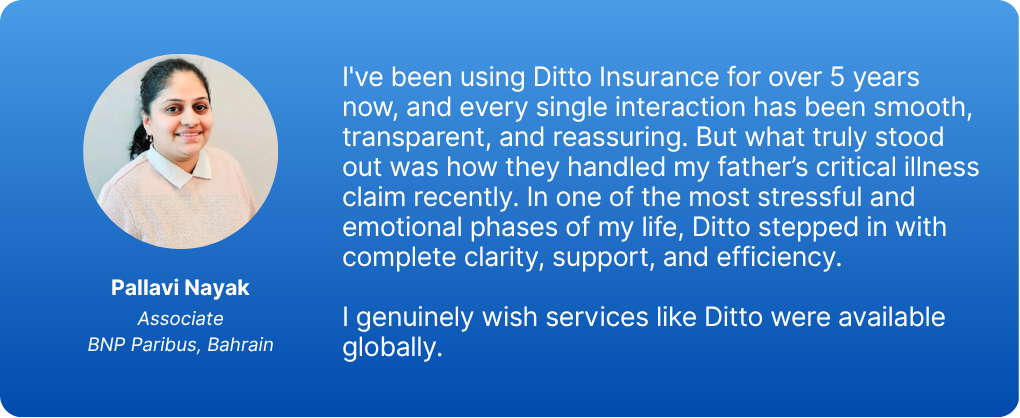
At Ditto, we’ve assisted over 8,00,000 customers with choosing the right insurance policy. Why customers like Pallavi below love us:
- No-Spam & No Salesmen
- Rated 4.9/5 on Google Reviews by 25,000+ happy customers
- Backed by Zerodha
- Dedicated Claim Support Team
- 100% Free Consultation
Confused about the right insurance? Speak to Ditto’s certified advisors for free, unbiased guidance. Book your call or chat on WhatsApp with us now!
Conclusion
Finding health insurance for diabetics in India takes more effort than a standard policy search, but it's not impossible. The right path depends on where you are in your diabetes journey.
If you have Type 2 diabetes on oral medication with well-controlled parameters, a comprehensive plan with a chronic care rider is usually your strongest and most cost-effective option.
If you have Type 1 diabetes, are insulin-dependent, or already have complications, look at diabetes-specific plans first, and treat fallback options as a safety net rather than a last resort.
No matter what, disclose your complete medical history honestly, keep your HbA1c and medication records handy, and prioritize adequate base coverage over add-on features you may not need yet. As India's health insurance market continues to evolve, insurers are steadily improving how they underwrite diabetics, so better options may become available to you over time.
Last updated on: