



Introduction
India recorded over 15.33 lakh new cancer cases in 2024, up from 14.61 lakh in 2022, according to ICMR-National Cancer Registry Programme data tabled in Rajya Sabha. This means buying term insurance for pre-existing medical conditions is no longer a niche concern. For many Indian families, it is a very real part of financial planning.
However, getting term insurance with a pre-existing disease is not always straightforward. A condition like diabetes, hypertension, thyroid disorder, asthma, heart disease, or a past surgery can change how insurers evaluate your application.
This is where Ditto helps. Instead of making you apply blindly, Ditto’s advisors help you understand how insurers may view your medical history, what you must disclose, which documents to keep ready, and how to compare counter-offers if an insurer increases your premium or changes the policy terms.
In this guide, we explain how Ditto helps you find the best term insurance for people with pre-existing diseases, what counts as a pre-existing condition, and why disclosure matters.
Common Questions People Ask
What Is a Pre-Existing Condition in Term Insurance?
In term insurance, a pre-existing condition is any medical illness, injury, or symptom that you have been diagnosed with or treated for before buying the policy. Common examples include diabetes, hypertension, asthma, heart disease, or cancer.
How It Impacts Your Policy
- It can increase the scrutiny on your application. The insurer may ask for additional reports, prescriptions, discharge summaries, specialist notes, or repeat tests.
- It can affect pricing. If the insurer believes your condition increases mortality risk, they may offer the policy with premium loading.
- It can affect the policy structure. In some cases, the insurer may reduce the sum assured, shorten the policy term, reject riders, or ask you to reapply later.
- If the condition is not accurately disclosed, it can create a claim risk for your family later.
- The insurer might postpone your application if they’re not ready to issue the policy yet and want to wait before making the final call. For example, if someone was diagnosed with diabetes last month and HbA1c is very high, the insurer may postpone the case and ask the applicant to return after better control is demonstrated.
For people who want term insurance for pre-existing medical conditions, Ditto can help identify whether postponement is reasonable or whether another insurer may be more suitable later.
Complete Disclosure Is Mandatory
Insurance works on the principle of utmost good faith between both parties (the insurer and the insured), with the expectation that the applicant must answer the insurer’s questions truthfully. You do not need to diagnose yourself or volunteer irrelevant information outside the proposal form, but you must not hide facts that are asked for.
A common mistake is assuming, “This condition is mild, so it does not matter.” That is risky. Materiality (which information is important) is not for the customer to decide. If the insurer asks about diabetes, blood pressure, hospitalizations, investigations, medicines, surgeries, smoking, alcohol, existing policies, or previous insurance applications, all questions must be answered clearly.
Ditto’s Key Insight: A pre-existing condition is not limited to a disease that is currently severe. Even a controlled condition can be material if the insurer has asked about it. For example, if you were diagnosed with hypertension two years ago but your blood pressure is now normal because you take medication, it is still a condition that should be disclosed.
How Old Does a Condition Have to Be to Be Considered a Pre-Existing Condition in Term Insurance?
Term insurance is pure life insurance. The insurer is not deciding whether to cover hospital bills. It assesses the risk of death over the policy term. Because of this, life insurers may ask broader questions about health history. Some proposal forms ask about conditions in the last few years. Others ask whether you have “ever” had certain serious illnesses, surgeries, cardiac issues, cancer, stroke, kidney disease, or other major medical events.
So the safest answer is to disclose what the proposal form asks for.
Do not assume that an old condition becomes irrelevant merely because it is older than three or four years. If the insurer asks about it, you should declare it.
Ditto’s Key Insight: A pre-existing condition does not need to be lifelong. Even if a chronic illness was diagnosed only a few months before applying, it is pre-existing because it existed before the policy application.
At the same time, an old condition should not be ignored automatically. For example, a gallbladder removal surgery 10 years ago with no complications may be viewed as low risk, but should still be disclosed if asked.
Can You Get Term Insurance With Pre-Existing Conditions?
Yes, you can get term insurance with pre-existing conditions. Many people with diabetes, hypertension, thyroid disorders, asthma, past surgeries, or controlled medical histories do get term plans.
However, the outcome depends on the condition and the insurer’s underwriting view. Your application can broadly result in one of these outcomes.
- Approved With Standard Premiums
This is the best-case outcome. The insurer reviews your condition and decides that the risk is acceptable at the normal price. This usually happens when the condition is mild, well-controlled, and there are no complications. - Approved With Premium Loading
Premium loading means the insurer agrees to issue the policy, but at a higher premium (usually 25% to 100%, sometimes more, depending on the insurer’s underwriting). This is not a rejection. In fact, for many applicants with medical histories, a loaded offer is still a good outcome because it gives the family claim protection after full disclosure. The loading amount depends on severity, age, cover amount, reports, and insurer underwriting rules. For example, for a cover of ₹2 crore until age 70, the base premiums can be around ₹16,000 per annum. Now, for someone with controlled type 2 diabetes, the loading can be around 50%, resulting in updated premiums of ₹24,000 per annum. The customer can choose to pay extra for the desired cover or modify the cover to match the existing premium in proportion (e.g., from ₹2 crore to ₹1.33 crore). - Approved With Rider Restrictions or Exclusions
Pure term insurance does not work like health insurance, where specific diseases have waiting periods and exclusions. The core death benefit is usually accepted or declined based on underwriting. However, term insurance riders can be treated differently. Critical illness riders, waiver of premium riders, accidental disability riders, or income benefit riders have stricter underwriting. For example, a person with diabetes may get the base term plan but may not get a critical illness rider. - Approved With Reduced Cover or Shorter Policy Term
Sometimes, the insurer may not be comfortable offering the requested cover amount or policy duration. Instead of issuing a ₹2 crore cover till age 70, the insurer may offer a ₹1 crore cover or cover till age 60. This can happen when the medical risk is acceptable only within a smaller exposure limit. It can also occur when the applicant has multiple risk factors, such as occupational and medical ones.
Ditto helps you evaluate whether the reduced offer is still useful and whether the remaining gap can be handled through another plan, employer cover, or future reapplication. - Application Postponed
The insurer may ask you to reapply after a defined period of 3 months to a year. Postponement is common after a recent diagnosis, surgery, hospitalization, abnormal reports, or unstable readings. At Ditto, our advisors help you understand what medical markers to stabilize before applying. - Application Decline
Decline usually happens when the insurer believes the risk is outside its underwriting appetite. This may happen for severe uncontrolled illness, major complications, multiple co-morbidities, advanced organ disease, recent cancer treatment, or high-risk cardiac history.
A decline from one insurer does not always mean every insurer will decline. But it does make future applications more sensitive, as insurance application records are stored in the Insurance Information Bureau of India (IIB) and are accessible to other insurers. This is why applying randomly to multiple insurers can backfire.
Will My Claim Get Rejected if I Don’t Disclose My Pre-Existing Condition?
It can be rejected, especially if the undisclosed condition was material to the insurer’s decision to issue the policy.
For example, suppose an applicant had diabetes for five years, was taking medication, and did not disclose it. If the person passes away within the early policy years and the insurer discovers the medical history during claim investigation, the insurer may argue that the policy was issued based on incorrect information. If the undisclosed fact had changed the underwriting decision, the claim may be repudiated.
The risk is not limited to intentional hiding. Even careless answers can create problems.
The Section 45 Nuance
Life insurance claims in India are governed by Section 45 of the Insurance Act, 1938. Broadly, the insurer has a three-year window from the policy issuance date, the commencement of risk, the revival date, or the rider addition date, whichever is later, to question a policy on grounds such as misstatement or suppression of material facts. After these three years, the insurer would need to prove intentional fraud to reject a claim on the grounds of non-disclosure.
Ditto’s Key Insight: This should not be treated as a shortcut to hide information. The right strategy is not “hide and hope three years pass.” The right strategy is “disclose properly so the family does not face a claim dispute at all.”
The emotional and financial cost of claim investigation is high. Your family may need to collect old records, respond to queries, and defend the claim at the worst possible time. Proper disclosure reduces this risk significantly.
What Pre-Existing Conditions Are Not Covered in Term Insurance?
In pure term insurance, the issue is usually not “which disease is not covered?” The issue is whether the insurer accepts your life cover application after evaluating your medical history.
If you disclose your condition and the insurer issues the base term policy, the death benefit is payable as per policy terms with coverage for death (even due to that disease starting from day 1). The insurer has already priced or accepted your risk.
However, problems arise in these situations:
- Undisclosed Pre-Existing Disease
If a pre-existing disease was concealed and the death is linked to it, the insurer may investigate and reject the claim within the legally permitted framework. For example, if a person hides a major cardiac history and dies of a cardiac event soon after policy issuance, the insurer may examine medical records and proposal-form answers closely. - Misstatement of Lifestyle Facts
Smoking, tobacco use, alcohol intake, high-risk hobbies, occupation, income, and existing insurance are not “diseases,” but they are material facts. Misstating them can also create claim risk. For example, a person who smokes but applies as a non-smoker may get a lower premium unfairly. If this is discovered later, it can lead to disputes and claim rejections. - Rider-Level Exclusions
Critical illness riders, disability riders, waiver of premium riders, or accidental benefit riders may have exclusions. A person can qualify for the base term plan but may not be eligible for certain riders due to their medical history. - Standard Policy Exclusions
Term plans have standard exclusions, such as suicide within the first policy year, depending on policy wording and regulations. These are separate from pre-existing disease issues.
Ditto’s Key Takeaway: Do not think of term insurance as “diabetes is covered” or “depression is not covered.” Instead, think of it this way: “Was my medical history honestly disclosed, properly underwritten, and accepted by the insurer?” If yes, your family is in a stronger position.
How Do Term Insurance Companies Know About Pre-Existing Conditions?
Many applicants assume that insurers will not find out about old medical issues. That assumption is risky. Insurers can identify pre-existing conditions through multiple channels.
- Proposal Form Declarations
The proposal form is the first and most important source. It asks about health history, surgeries, hospitalizations, investigations, medications, tobacco use, alcohol use, occupation, income, family history, existing policies, and previous applications. - Medical Tests
For term insurance, medical tests may include blood tests, urine tests, blood pressure checks, ECG, treadmill test, liver function test, kidney function test, lipid profile, blood sugar, HbA1c, HIV test, and other tests depending on age, sum assured, and medical disclosures. These tests can reveal conditions you may not have disclosed, such as high sugar, abnormal liver enzymes, kidney issues, high cholesterol, hypertension, or cardiac abnormalities. The insurer organizes and covers the cost of these tests, and for people with pre-existing conditions, there can be multiple rounds of testing. - Tele-Medical Examination Report (Tele-MER)
In a Tele-MER call, a medical professional asks about your health history. This is not a casual call. Your answers become part of the underwriting record. If you say one thing on the proposal form and another during Tele-MER, the mismatch can delay or complicate underwriting. For example, if the proposal form says “no medication” but you mention during Tele-MER that you take blood pressure tablets, the insurer will ask for clarification. - Medical Documents
Insurers may request the latest prescriptions, consultation notes, diagnostic reports, discharge summaries, surgical records, etc. These documents help the underwriter understand severity and control. - Previous Insurance Applications
If you previously applied for term insurance and were declined, postponed, or offered loading, that information is material and should be declared when asked. Trying to hide previous application history can create a mismatch. Insurers may use industry data-sharing systems, such as the Insurance Information Bureau of India (IIB), and internal checks to assess prior insurance activity. - Claim Investigation
If death occurs in the early policy years, insurers may investigate medical history more closely. They may ask hospitals, doctors, labs, employers, or family members for supporting records. If old medical records show that a condition existed before policy issuance but was not declared, it can become a problem.
Ditto’s Key Insight: Assume that anything material can surface later. The safer approach is not to hide but to disclose clearly and ensure that the application tells a single, consistent story.
The underwriting process, from application, medical tests, and telemedicals to the final underwriting decision, can take as little as 3 to 4 days or as long as a month. The timeline depends heavily on the complexity of your declared conditions, the completeness of your application, and the availability of medical appointments. It is a one-time process, so it is worth the wait.
How Does Underwriting Handle Medical Conditions?
Underwriting is the insurer’s risk-evaluation process. It decides whether the insurer will accept your application, at what price, for what cover amount, and with what terms. For pre-existing diseases, underwriting typically considers five broad factors.
- Type of Condition
Not all medical conditions are treated equally. For example, controlled hypothyroidism may be treated more favorably than uncontrolled diabetes with kidney complications. - Severity and Control
Insurers care about whether the condition is controlled. For diabetes, they may check HbA1c, fasting sugar, medication, duration, complications, kidney function, eye complications, neuropathy, BMI, and blood pressure. For hypertension, they may check recent BP readings, the number of medications, ECG, kidney function, cardiac history, and evidence of end-organ damage. - Duration Since Diagnosis or Event
The timing of the condition matters. A recent diagnosis creates uncertainty. A long-controlled condition with stable reports may be easier to assess. A recent surgery or hospitalization may lead to postponement because the insurer wants to see recovery and follow-up reports. - Complications and Co-Morbidities
A single controlled condition may be manageable. Multiple conditions together can increase risk. For example, diabetes, hypertension, and smoking together can increase risk. Underwriters look at the combined risk, not each condition in isolation. - Lifestyle and Financial Profile
Medical underwriting and financial underwriting often happen together. The insurer checks whether the requested sum assured is reasonable based on income, occupation, liabilities, dependents, and existing cover. A medically risky profile asking for very high cover without income justification may face more scrutiny. Lifestyle factors also matter. Tobacco use, alcohol intake, high-risk occupations like aviation, mining, armed-risk exposure, adventure sports, or dangerous hobbies can affect underwriting.
How Does Premium Loading Work in Term Insurance?
Premium loading is an extra premium charged because the insurer believes the applicant carries higher-than-standard mortality risk. Loading charges are percentage-based (mostly between 25% to 100%).
Loading vs. Rejection
Loading means the policy can be issued, but at a higher cost. On the other hand, rejection means the insurer cannot issue the policy. For someone with a medical history, a fair loading may be worth accepting because it creates immediate protection. Waiting for a perfect standard-rate policy may leave the family uninsured.
What if I Hide My Pre-Existing Disease in Term Insurance?
Hiding a pre-existing disease may reduce friction during purchase, but it increases risk during claim. The entire purpose of term insurance is to protect your family. If a claim is later questioned due to non-disclosure, the policy fails when it matters most.
Insurers may discover the condition through medical tests, Tele-MER, prior prescriptions, discharge summaries, doctors' records, prior application data, or claim investigations.
Even if the policy is issued initially, the risk does not disappear. It shifts to your family during the claim.
Ditto’s Advice: Disclose the condition, submit all documents, accept fair underwriting, and ensure the policy is issued based on accurate information. A loaded policy issued after full disclosure is far better than a cheap policy issued on incorrect declarations.
How Does Ditto Help in Buying Term Insurance?
Before applying, Ditto advisors discuss your health history and help you understand the possible underwriting outcomes. This gives a more realistic expectation before the proposal is submitted.
For severe or borderline medical conditions, Ditto advisors may also engage in informal pre-underwriting (or "pre-logging") discussions with insurers' underwriting teams. These discussions help understand an insurer's appetite for a particular risk profile before a formal application is submitted, reducing the risk of an official rejection on your insurance record.
Next, Ditto helps match you with suitable insurers. This is because different insurers can assess the same medical condition differently. One insurer may be stricter on diabetes, another may be more comfortable with well-controlled hypertension, while another may be stricter on high BMI or cardiac history. Ditto uses product knowledge and underwriting experience to help shortlist insurers where your profile is more likely to be accepted.
Moreover, Ditto also helps you prepare for your medical disclosures. Accurate and complete disclosure is one of the most important factors in ensuring a smooth underwriting process and avoiding claim-related disputes later.
If the insurer issues a counteroffer on your application, Ditto advisors help you decode what it means and whether accepting it is the sensible decision. For example, a 25% loading for controlled diabetes may be acceptable. On the other hand, a very high loading combined with reduced coverage may warrant comparison with other insurers.
If the first insurer declines or offers difficult terms, Ditto helps you decide the next step. Possible fallback strategies include applying to another insurer, waiting for better medical control, or reapplying with a reduced cover amount.
Most importantly, Ditto also provides claims assistance if the policy was purchased through us.
Ditto’s Insights on Term Insurance for People With Pre-Existing Diseases
- The Cheapest Policy Is Not Always the Best Policy
For healthy applicants, premium comparison may be a useful starting point. For applicants with pre-existing diseases, underwriting suitability matters more. A cheap quote is only a starting quote. It does not mean the insurer will issue the policy at that price after medical underwriting. The best term insurance for people with pre-existing conditions is the one that is issued with clear disclosures, an acceptable premium, and a stable claims footing. - Apply When Your Medical Markers Are Stable
If your condition is currently uncontrolled, it may be better to improve your markers before applying. This does not mean delaying forever. It means applying at the right time with the right evidence. - Documentation Is Important
A vague disclosure says: “I have diabetes.” A stronger disclosure says: “Diagnosed in 2020, on oral medication, latest HbA1c 6.7, no kidney/retina/neuropathy complications, regular follow-up, latest reports attached.” The second version gives the underwriter more confidence. - Do Not Apply to Every Insurer at Once
Multiple simultaneous applications can create avoidable complications. Sequential application is usually cleaner. Ditto’s typical approach is to identify the most suitable insurer first, apply there, wait for the underwriting result, and then move to a fallback only if required. - Do Not Ignore Previous Rejections or Loadings
If another insurer previously rejected, postponed, or loaded your application, mention it when asked. Trying to hide previous underwriting history can create mistrust. A declared rejection can be explained. A hidden rejection discovered later is harder to defend. - A Loaded Offer May Still Be a Win
Applicants often feel disappointed when they receive a loaded premium. But if the policy is issued after full medical disclosure, that is a meaningful outcome. For a family dependent on your income, a loaded ₹1 crore or ₹2 crore cover will be far more valuable than no cover. - Riders Are Useful, but Base Term Cover Comes First
Critical illness riders and waiver of premium riders can be helpful, but applicants with medical histories may not always get them. Do not reject a good base-term offer solely because a rider is unavailable. The primary goal is life cover. - Employer Group Cover Is Helpful but Usually Not Enough
Employer-provided group term life insurance does not require the same level of individual underwriting. This can be useful if retail term insurance is difficult to obtain. However, employer cover is usually linked to your job. It may end when you leave the company. It may also be much smaller than your family’s actual requirement. Use it as a backup, not a complete replacement for individual term insurance. - Severe Cases May Need a Different Strategy
Some applicants may not be eligible for standard retail term insurance immediately. This can happen in cases of advanced cancer, recent major cardiac events, severe kidney disease, uncontrolled diabetes with complications, major liver disease, or serious neurological conditions. In such cases, Ditto can help think through alternatives. - The Real Goal Is Claim Defensibility
The purpose of term insurance is not just policy issuance. Instead, it is a claim payout when the family needs it. That is why Ditto focuses so much on disclosure, documentation, and underwriting clarity. A policy bought with hidden medical facts is fragile. A policy bought after full disclosure is stronger.
Why Choose Ditto for Term Insurance?
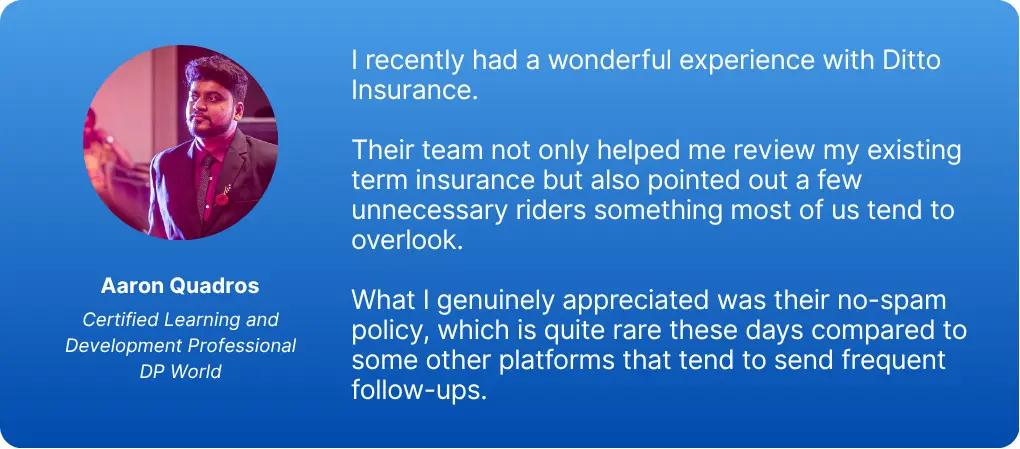
At Ditto, we’ve assisted over 8,00,000 customers with choosing the right insurance policy. Why customers like Aaron below love us:
- No-Spam & No Salesmen
- Rated 4.9/5 on Google Reviews by 24,000+ happy customers
- Backed by Zerodha
- Dedicated Claim Support Team
- 100% Free Consultation
You can book a FREE consultation. Slots are running out, so make sure you book a call or chat on WhatsApp now!
Conclusion
Getting term insurance with a pre-existing condition is possible, but it requires a more careful approach. The biggest mistakes are hiding medical history, applying to multiple insurers randomly, choosing only the cheapest quote, or rejecting a fair, loaded offer without understanding the trade-off. The smarter approach is to disclose honestly, apply to the right insurer, submit clean medical records, handle counteroffers calmly, and secure a policy your family can rely on.
Last updated on: