




Overview
According to the Labour Bureau, the Consumer Price Index (CPI) for Industrial Workers in Chennai reached 145.7 in July 2026, and living costs continue to shape family finances. So, how much term insurance do you need in Tamil Nadu?
This guide walks you through term insurance options, coverage needs, premiums, eligibility, and key factors to consider in Tamil Nadu.
What Are the Best Term Insurance Plans in Tamil Nadu?
The listed plans are evaluated using Ditto’s detailed policy rating framework, which compares features, insurer strength, and long-term value.
- Axis Max Life Smart Term Plan Plus: A feature-rich plan with useful protection benefits. It offers an optional critical illness rider covering up to 64 illnesses for 20 years. Axis Max Life Smart Term Plan Plus also includes an in-built accelerated terminal illness benefit of up to ₹1 crore, paid early on a qualifying diagnosis.
- HDFC Life Click 2 Protect Supreme Plus: A flexible term plan with features that can adapt to major life changes. Its Life Stage Benefit can increase your cover after marriage or childbirth without a fresh application. HDFC Life Click 2 Protect Supreme Plus offers a critical illness rider that covers up to 60 illnesses for 15 years.
- ICICI Prudential iProtect Smart Plus: A flexible option if your financial needs may change over time. The plan offers a Premium Break, which allows eligible policyholders to defer premiums for up to 12 months after completing the required payment period. ICICI Prudential iProtect Smart Plus offers an instant partial payout of up to ₹3 lakh for eligible high sum assured policies.
- Bajaj Life eTouch II: A relatively straightforward term plan with useful payout flexibility. Bajaj Life eTouch II offers an in-built terminal illness benefit of up to ₹2 crore. You can also opt for the in-built waiver of premium option for covered events such as accidental disability, subject to the rider terms.
- Aditya Birla Sun Life Super Term Plan: A term plan with additional protection features. Its optional accelerated critical illness benefit covers 42 illnesses and can pay up to 50% of the sum assured, subject to applicable limits. Aditya Birla Sun Life Super Term Plan offers an in-built terminal illness benefit of up to ₹1 crore for eligible policyholders.
Note: Term insurance in Tamil Nadu provides pure financial protection for your family if the life assured dies during the policy term. You can choose the sum assured and policy term based on your financial needs. Depending on the insurer, you can opt for optional riders such as critical illness and waiver of premium at an extra cost.
Talk to an expert
today and
find
the right
insurance for you.


How Much Term Insurance Cover Do You Need in Tamil Nadu?
There is no one-size-fits-all term insurance cover. Your ideal sum assured depends on your income, expenses, financial goals, liabilities, and existing assets. You can use the cover calculator to help you understand how much cover your family may need.
At Ditto, we estimate cover using the expense and liability replacement method. If you have a dual-income household, consider each person's share of household expenses and income to avoid leaving either income source underinsured.
How Much Does Term Insurance Cost in Tamil Nadu: Sample Premiums
Note: These premiums are for non-smoking applicants in Chennai (pincode: 600078) with ₹2 crore cover until age 65, excluding first-year discounts. They are indicative, and actual premiums may vary based on underwriting, health profile, and insurer-specific terms. Use Ditto’s term insurance calculator for rough estimates of your premiums.
Did You Know?
What Factors Affect Term Insurance Premiums in Tamil Nadu?
- Age: Premiums increase as your entry age rises. If you need life cover, postponing the purchase can mean paying more later. Term insurance in your 20s secures higher cover at affordable premiums than purchasing term insurance in your 30s. Your term insurance plan premiums get locked in when you're young and healthy.
- Tobacco and Smoking: Smokers pay higher premiums because tobacco use increases the insurer's assessed mortality risk. Term insurance for young adult smokers can cost 60% to 100% more than for non-smoking profiles.
- Health and Medical History: Conditions such as diabetes, hypertension, previous surgeries, or ongoing medication can affect underwriting. The insurer may offer standard rates, apply a loading, request further tests, postpone the application, or decline it based on the overall risk profile.
- Gender: Insurers offer different premiums for men and women based on their actuarial risk assessment. Term insurance for women can have premiums up to 15% lower than men’s.
- Occupation: Your occupation can affect premiums when your work involves higher physical or environmental risks. Jobs involving mines, hazardous chemicals, heights, or heavy machinery may require additional underwriting, premium loading, or different policy terms.
- Sum Assured: A higher sum assured means a higher premium. However, premiums do not always increase proportionately because some insurers offer high sum assured discounts.
- Policy Term: A longer policy term generally costs more because the insurer provides protection for a longer period. Moreover, extending the cover to age 85 or 99 is not necessary. At Ditto, we recommend coverage till age 65 or 70, as your policy term should broadly match your income-replacement and financial dependency period.
- Cover Structure: Level, increasing, and other cover structures can have different premiums. Increasing cover may help address rising financial responsibilities, but it is not free inflation protection. You pay an additional premium for the higher potential benefit under the selected structure.
- Riders and Add-Ons: Riders such as critical illness and waiver of premium can increase your premium. However, riders should not come at the expense of adequate base life cover. Prioritize the sum assured your family actually needs before adding optional benefits.

Common Term Insurance Mistakes Tamil Nadu Buyers Make
Buying ₹1 Crore Simply Because It Sounds Sufficient
₹1 crore term insurance may sound like a large cover, but it may not match your family's actual needs. Before choosing the sum assured, calculate your income replacement needs, outstanding loans, children's goals, dependent parents, existing investments, and other financial obligations.
Waiting Until Marriage or a Home Purchase
If you already have financial dependents, waiting can mean buying cover at an older age. Since age is an important premium factor, delaying the purchase can increase your future premium. Buy when you genuinely need life protection, not just when a specific life event happens.
Hiding Occasional Smoking or Tobacco Use
Do not decide that occasional smoking or tobacco use is insignificant. Answer the insurer's questions accurately about cigarettes, nicotine, and other tobacco products. Incorrect disclosure can create problems during claim assessment and may affect the policy terms.
Hiding Diabetes, Medication, or Old Surgery
Even conditions that appear minor can matter during underwriting. Disclose your medical history, current medication, previous surgeries, and diagnosed conditions accurately. The insurer uses this information to assess your risk and determine the applicable premium, medical requirements, or policy terms.
Counting Employer Life Insurance as Your Entire Protection
Employer-provided life insurance can provide useful additional protection, but it can end when you leave the job. Your personal term insurance should account for your family's long-term needs rather than relying entirely on employer-sponsored cover.
Buying Accidental Cover Instead of Sufficient Base Life Cover
Accidental death benefit is not a substitute for ordinary life cover. For example, ₹1 crore base cover plus ₹1 crore accidental cover does not equal ₹2 crore of regular life protection. The additional accidental benefit applies only when death meets the rider's specified conditions.
Buying Every Rider Because It Looks Comprehensive
Riders can add useful protection, but they also increase premiums. First, ensure that your base life cover is adequate. At Ditto, we recommend riders like critical illness and waiver of premium for genuine financial risks.
Choosing Return of Premium
Pure term insurance pays for financial protection, not investment returns. Return of premium plans cost more (60% to 100%) than pure term plans because they promise to refund base premiums with no interest earned. Compare the additional premium with the potential benefits of investing the difference separately.
Note: Buying term insurance online offers discounts, faster document submission, and easier application tracking. If you wish to purchase a term plan through Ditto, connect with us.
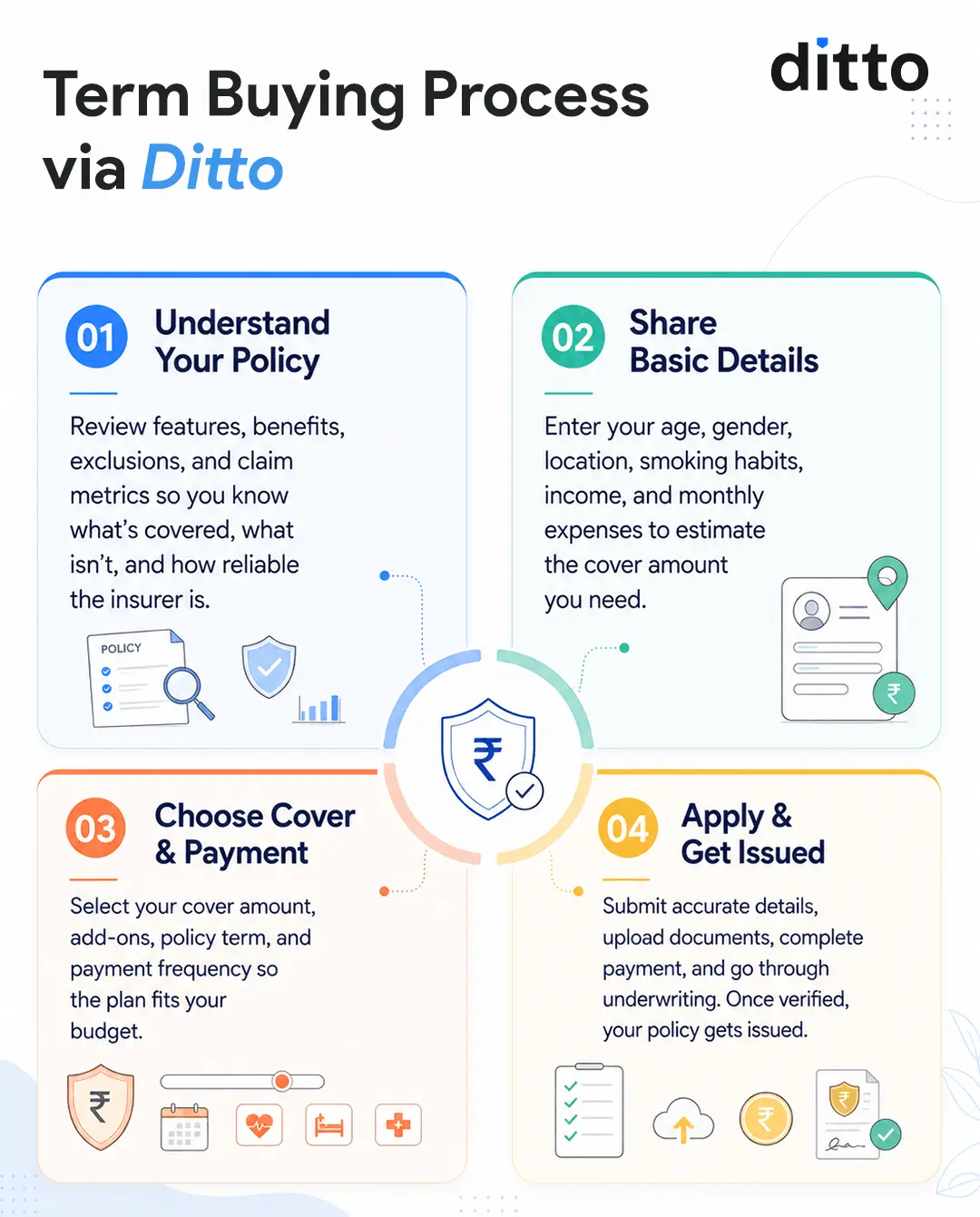
Start by reviewing the policy’s features and claim metrics. Share accurate details such as your age, income, location, and smoking status. Then choose your sum assured, policy term, payment frequency, and riders.
Finally, submit the required documents, complete underwriting and payment, and receive the policy after verification. Take a look at the infographic below to learn more about how the process works.
Why Choose Ditto for Term Insurance?
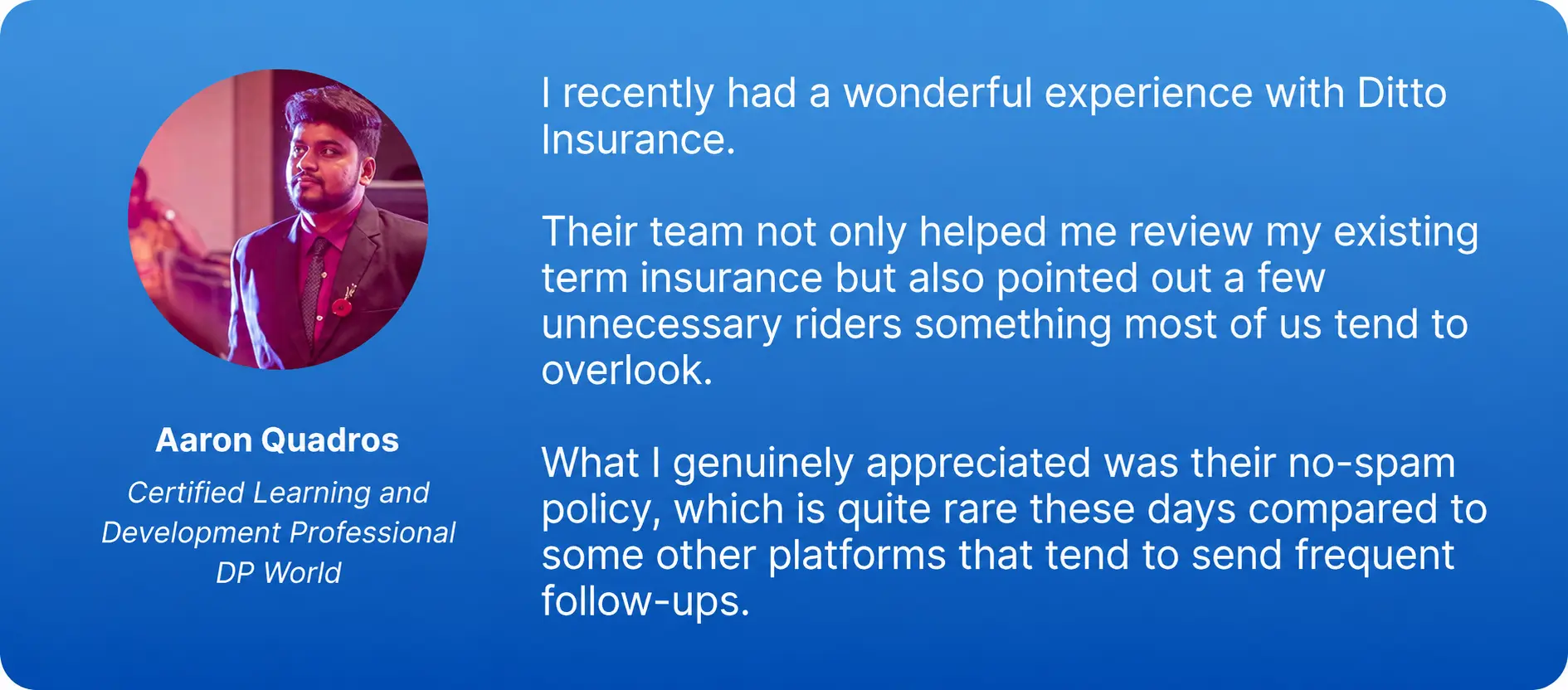
At Ditto, we’ve assisted over 12,00,000 customers with choosing the right insurance policy. Why customers like Aaron below love us:
- 100% Free Consultation
- No Spam. No Sales Pressure.
- Rated 4.9/5 on Google Reviews by 30,000+ Happy Customers
- Backed by Zerodha
- Dedicated Claim Support Team
- Compare Plans and Premiums with a Trusted Insurance Advisor
Confused about the right insurance? Speak to Ditto’s certified advisors for free, unbiased guidance. Book your call now or chat with us on WhatsApp. Slots fill up fast!
Conclusion
Tamil Nadu is a high-income, rapidly urbanizing, and aspirational state where families manage growing financial commitments, including housing loans, private education expenses, healthcare costs, and lifestyle needs.
Choosing term insurance in Tamil Nadu starts with assessing your family's financial needs, liabilities, and future goals. Compare the best term insurance plans based on coverage, premiums, insurer service, and policy terms to secure meaningful protection without overpaying.
Frequently Asked Questions
Last updated on: