



Overview
Your salary probably pays for more than you realize: the EMI, your parents' medical bills, maybe your child's school fees. Now imagine it stopped tomorrow. Many women assume a husband's policy or office group cover will handle it. Usually, it won't fully cover it.
That is where term insurance for working women comes in: an affordable plan that can help your family replace the financial contribution your income would have made.
In this article, we walk you through why you need your own cover, how much to buy, why women pay less, useful riders, the best plans, sample premiums, life-stage tips, and mistakes to avoid.
Why Working Women Need Their Own Term Insurance
Imagine you earn ₹12 lakh a year and pay half of the household EMI. If your income disappears, your family must either cut its lifestyle or sell assets. Your own term plan prevents that.
Here is why you need a separate policy:
- Your husband's policy only pays if he passes away. It does not protect the family if something happens to you first.
- Your income funds real goals like children's education, loans, and parents' care.
- Buying earlier can lock in a lower base premium because your entry age is lower, subject to underwriting and the policy terms.
If you’re not working yet, you can refer to our guide on term insurance for housewives.
Do All Working Women Need Term Insurance?
How Much Term Cover Should a Working Woman Buy?
At Ditto, we use the expense-liability approach when calculating the required sum assured. Consider your age, policy term, current expenses, outstanding loans and liabilities, and future goals, all adjusted for inflation.
Say you’re a 35-year-old spending ₹50,000 per month on household expenses and have a ₹40 lakh home loan. For coverage till 65 (when your financial responsibilities should ideally end), you’ll need a cover of ₹2.5 crore.
You can also use Ditto’s cover calculator tool for a personalized figure.
Why Term Insurance Premiums Are Lower for Women
Insurers price risk using life expectancy. In India, women live longer and have lower overall mortality than men, so insurers charge them less.
Note: The September 2025 removal of GST on term insurance is a separate benefit. Individual term plans moved from 18% GST to 0%, so a base premium of ₹10,000 that once cost ₹11,800 now costs ₹10,000. This applies to men and women equally, so the women's discount and the GST saving stack. However, group term plans still carry 18% GST.
Riders Worth Adding for Working Women
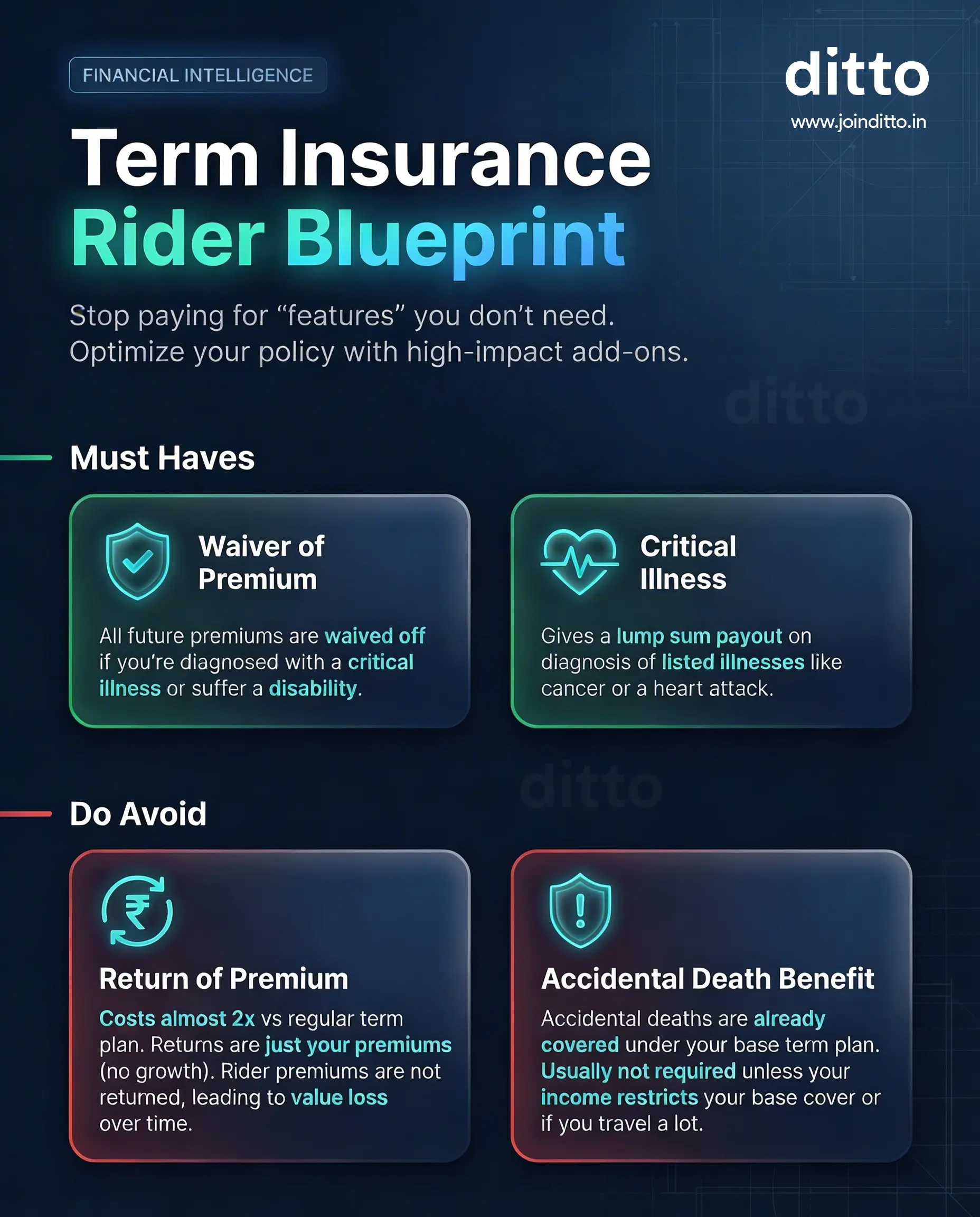
Riders are optional add-ons that cost extra. At Ditto, we generally recommend opting for:
- Critical Illness Rider: Pays a lump sum on diagnosis of covered conditions. Some plans also cover female-specific cancers.
- Waiver of Premium Rider: Future premiums are waived if the policyholder becomes disabled or gets diagnosed with a critical illness, as per policy wording.
Best Term Insurance Plans for Working Women
At Ditto, we’ve evaluated the best term insurance plans for women using our detailed policy-rating framework, which considers plan features, insurer rating, and premiums:
Note:
- ATPD stands for Accidental Total and Permanent Disability
- CI stands for Critical Illness
Ditto’s Key Insight: Several insurers now launch "women-focused" plans like Bajaj Superwoman, ABSL Her Care, and ICICI iProtect Smart Her.
Many are repackaged versions of existing plans. Always compare them with the regular plan, which already gives women lower rates.
You can also refer to our guide to term insurance for women.
Talk to an expert
today and
find
the right
insurance for you.


Sample Premiums for Working Women by Age and Cover
For this sample, we’ve considered profiles of healthy, salaried, non-smoking women, living in a tier-1 city like Delhi (pincode: 110010), and covered for a sum assured of ₹2 crore until age 65. These premiums are indicative and can vary based on age, sum assured, chosen riders, health conditions, lifestyle choices, and underwriting.
Ditto’s Key Insight: Don't pick a term plan because it is ₹2,000–₹5,000 cheaper a year. Once cover, policy term, and payment structure are comparable, prioritize a strong insurer and benefits you will actually use.
Term Insurance for Working Women at Different Life Stages
Term Insurance for Single Working Women
Term Insurance After Marriage
Term Insurance for Working Mothers
Term Insurance for Women Supporting Aging Parents
Note: Review your cover after marriage, a new loan, a child, a big raise, or every three to five years. The need is strongest if someone depends financially on you or you have debts that could fall on your family.
Common Mistakes Working Women Make When Buying Term Insurance
- Relying only on employer group cover. It usually ends when you leave the job, and the amount is often small.
- Buying too little. A ₹50 lakh plan rarely replaces 20 years of income.
- Waiting. Premiums rise with entry age, so delaying purchase can make the same cover more expensive.
- Choosing based on the "women's plan" label. Compare features and price instead.
- Hiding health or smoking details. This can lead to claim rejection.
- Forgetting to update the nominee after marriage or a child's birth.
Why Choose Ditto for Term Insurance?
At Ditto, we’ve assisted over 12,00,000 customers with choosing the right insurance policy. Why customers like Aaron below love us:

- 100% Free Consultation
- No Spam. No Sales Pressure.
- Rated 4.9/5 on Google Reviews by 30,000+ Happy Customers
- Backed by Zerodha
- Dedicated Claim Support Team
- Compare Plans and Premiums with a Trusted Insurance Advisor
Confused about the right insurance? Speak to Ditto’s certified advisors for free, unbiased guidance. Book your call now or chat with us on WhatsApp. Slots fill up fast!
Conclusion
Term insurance for working women is simple: your family should be able to manage without your paycheck. Today, term plans are cheaper than ever thanks to lower rates for women and zero GST.
Your Next Steps:
- Calculate your cover based on your income, loans, and goals.
- Compare two or three plans on price, claim record, and riders.
- Buy now, and review your cover after every major life change.
Frequently Asked Questions
Last updated on: