



Overview
According to a PIB press release, India has over 3.20 lakh active seafarers as of 2025, many of whom work away from their families for extended periods. For them, securing adequate life insurance requires attention to occupation-specific underwriting and coverage conditions.
Merchant navy personnel can buy term insurance in India, but insurers assess their rank, vessel type, cargo, and sailing routes before deciding premiums and coverage.
In this guide, we explain term insurance for merchant navy personnel, including plans, eligibility, premium loadings, required documents, medical tests, and how to apply for suitable coverage.
Best Term Plans for Merchant Navy Personnel
- Axis Max Life Smart Term Plan Plus: Offers an optional critical illness rider covering up to 64 illnesses for 30 years. Smart Term Plan Plus also includes an accelerated terminal illness benefit of up to ₹1 crore. Its optional waiver of premium rider covers 11 specified critical illnesses and four disabilities.
- HDFC Life Click 2 Protect Supreme Plus: Offers a Premium Break option that lets eligible policyholders defer premiums for up to one year. Its Life Stage Benefit allows cover increases after marriage or childbirth without a fresh application. With Click 2 Protect Supreme Plus, you get an optional critical illness rider that covers up to 60 illnesses for 15 years.
- ICICI Life iProtect Smart Plus: Offers a Smart Exit option that returns eligible premiums if you exit within the specified window. Its Premium Break feature allows eligible policyholders to defer premiums for up to 12 months after the required payment period. With iProtect Smart Plus, eligible high sum assured policies also offer an instant payout of up to ₹3 lakh.
- Bajaj Life eTouch II: Offers an optional critical illness rider covering up to 60 illnesses for 20 years, along with an accidental partial or total permanent disability rider. eTouch II includes a built-in terminal illness benefit of up to ₹2 crore and a waiver-of-premium option for specified events.
- Aditya Birla Sun Life Super Term Plan: Offers an optional accelerated critical illness benefit covering 42 illnesses. It can pay up to 50% of the sum assured, subject to applicable limits. The Super Term Plan also includes a built-in terminal illness benefit of up to ₹1 crore for eligible policyholders.
If you are exploring riders in term insurance, we recommend add-ons such as Critical Illness (CI), which pays a lump sum for a covered diagnosis, and Waiver of Premium (WOP), which waives future premiums if you suffer a qualifying total and permanent disability.
These plans are evaluated using Ditto’s detailed policy rating framework, which compares key features, insurer track record, and long-term value.
Note: There is no separate category called "Seafarers Insurance" in India. Merchant navy personnel, seafarers, mariners, and people who work on cruise ships can apply for regular term insurance plans. Insurers assess their occupational risks and offer standard coverage with an additional premium loading, subject to underwriting.
Talk to an expert
today and
find
the right
insurance for you.


How Do Insurers Assess Occupational Risk?
Insurers conduct in-depth underwriting and ask you about your job duties, work environment, sailing routes, safety measures, and exposure to hazards. Based on your responses, they can apply an additional premium loading or postpone or decline your application.
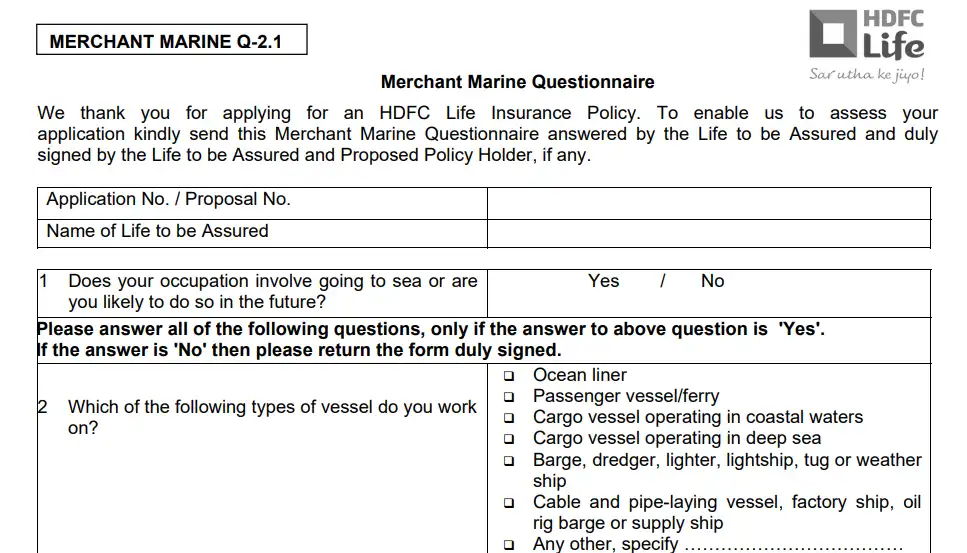
For example, HDFC Life’s merchant marine questionnaire asks whether your current or future occupation involves going to sea. If you answer yes, you must provide additional details about the vessels you work on.
These details include whether you work on ocean liners, passenger vessels, coastal or deep-sea cargo ships, dredgers, tugboats, oil-rig barges, or supply ships. Applicants who answer no can sign and submit the form.
Here’s a snippet of the questionnaire.
Why Seafarer Applications Need Closer Underwriting
Unlike office-based occupations, term insurance for seafarers involves risks that vary by vessel, duties, cargo, and sailing routes. Insurers assess these details to understand your occupational exposure and decide the applicable premium and policy terms.
- High-Risk Working Environment: Seafarers work around heavy machinery, changing weather conditions, and hazardous cargo such as oil, gas, or chemicals. Insurers assess your vessel type and onboard duties to understand these risks and determine whether an additional premium loading applies.
- Irregular Income: Seafarers often earn income through contracts rather than a fixed monthly salary. Insurers can review your employment contracts, Continuous Discharge Certificate (CDC), and bank statements to verify your annual income and assess whether the requested cover is financially justified.
- International Sailing Routes: Your work can take you across different countries and regions. Insurers may check your sailing routes and destinations to assess exposure to conflict-affected or piracy-prone areas. This exposure may require additional scrutiny or specialized underwriting approval.
Sample Premiums by Age and Cover
The annual premiums are for non-smoking healthy profiles residing in Delhi (pincode: 110010) with ₹2 crore cover until age 65, excluding first-year discounts. Use Ditto’s term insurance calculator for rough estimates of your base premiums.
Note: These are illustrative figures, and actual premiums can vary based on underwriting, age, and health profile.
Depending on your occupational risk, insurers can apply premium loadings of 25%–100%, based on Ditto’s experience. Even with these additional costs, term insurance remains a cost-effective way to protect dependents and cover financial liabilities.
Based on Ditto’s experience, premium loadings can reach 200% for high-risk occupations. Beyond that, insurers generally postpone or decline the application.
Important Documents and Application Tips for Merchant Navy Personnel
Based on our experience at Ditto, having the right documents ready can make the term insurance application process smoother. Insurers assess your employment, income, identity, and sailing history before deciding your eligibility and coverage.

Keep These Documents Ready
Sailing Contract Letter
Bank Statements
Continuous Discharge Certificate (CDC)
Passport
Note: Most seafarers apply for term insurance during shore leave rather than while they are onboard. This is practical because insurers require physical medical tests, such as blood tests and an ECG, at their authorized diagnostic centers. You can't complete these tests while you are at sea.
Although the application process can be digital, insurers can require you to be physically present at a designated location for medical evaluations, video consultations, or final declarations. Confirm these requirements with the insurer before you apply.
What Factors Affect Term Insurance Premiums for Merchant Navy Personnel
- Type of Vessel: Insurers assess whether you work on a passenger ferry, coastal cargo ship, deep-sea vessel, tug, dredger, oil-rig barge, or cable-laying vessel. Each vessel involves different operating conditions and occupational risks.
- Rank and Designation: Your rank, such as captain, chief officer, chief engineer, deck officer, or rating, helps insurers understand your responsibilities. Seniority alone does not determine risk. Your actual duties and level of operational exposure also matter.
- Nature of Duties: Insurers can review whether your work involves navigation, machinery maintenance, engine-room operations, cargo handling, or supervision. Duties with greater physical or hazardous exposure can attract closer scrutiny and affect your premium.
- Exposure to Hazardous Equipment: Working with high-voltage systems, heavy machinery, chemicals, toxic fumes, or at heights affects your occupational risk assessment. Insurers ask about these exposures before deciding the applicable premium and policy terms.
- Previous Onboard Accidents or Illnesses: Insurers ask about workplace injuries, occupational illnesses, and their consequences. A history of serious incidents affects both medical and occupational underwriting, depending on the condition and your recovery.
- Sailing Routes and High-Risk Regions: Insurers consider whether your voyages include conflict-affected or otherwise hazardous regions. Such exposure can lead to additional questions, a postponement, or specific underwriting terms, depending on the insurer's assessment.
- Sailing Frequency and Duration: Insurers review how often you sail, how long you stay offshore, and your voyage rotation pattern. These details help establish your overall exposure to occupational risks and may influence premium calculations.
- Contractual Income: Insurers assess your monthly sailing pay, the number of paid months, employment continuity, and foreign remittances. These details help verify your income and determine the term insurance cover you can qualify for.
- Upcoming Employment: Insurers ask about your next sailing assignment, employer, vessel, and expected itinerary. This information helps them assess your upcoming occupational exposure and decide whether they need additional documents before approving your application.
Note: Insurers understand that merchant navy employment follows a contract-based schedule. You spend four to six months at sea, followed by two to three months on shore. However, the premium depends on your specific occupational exposure, including your vessel, duties, cargo, and sailing routes.
Other factors that affect your life insurance premium include age, sum assured, riders opted for, policy term, medical issues, and smoking status.
It is best to buy term insurance as early as possible, as premiums are low and get locked in for the entire policy term. Premiums for term insurance in your 20s are less than when you buy term insurance in your 30s.
How Much Term Insurance Cover Do Seafarers Need?
Your term insurance cover should depend on your family’s financial needs, not your rank or designation. Common amounts like ₹1 crore or ₹2 crore may not be enough for everyone.
Use the Ditto cover calculator to estimate your required coverage. It considers your family’s monthly expenses, outstanding loans, and inflation to help you choose an appropriate sum assured.
Common Mistakes Seafarers Should Avoid When Buying Term Insurance
Concealing Maritime Employment
Giving Only the Job Designation
Hiding High-Risk Routes or Upcoming Assignments
Misstating Residency Status
Applying Just Before Sailing
Assuming Employer Cover Is Sufficient
Confusing Base Cover With Accident Riders
Choosing the cheapest Policy Regardless of Suitability
Why Choose Ditto for Term Insurance?
At Ditto, we’ve assisted over 12,00,000 people with choosing the right insurance policy. Why customers like Aaron below love us:

- 100% Free Consultation
- No Spam. No Sales Pressure.
- Rated 4.9/5 on Google Reviews by 30,000+ Happy Customers
- Backed by Zerodha
- Dedicated Claim Support Team
- Compare Plans and Premiums with a Trusted Insurance Advisor
You can book a FREE consultation. Slots are running out, so make sure you book a call or chat on WhatsApp now!
Conclusion
Buying term insurance as a seafarer requires careful planning because your sailing schedule and paperwork can affect underwriting. At Ditto, we have helped several seafarers navigate these requirements and find suitable coverage.
Our team can help even when your case is complex or certain documents are unavailable. We coordinate with insurer underwriting teams and help identify the most suitable options for your circumstances. You can proceed with two practical application windows.
- Apply Soon After Returning to Shore: Start your application during the first week of shore leave. Use documents from your most recent voyage. Since underwriting, medical tests, and verification can take 2–4 weeks, applying early gives you time to complete the process before your next assignment. Bajaj Life can accept your previous contract letter if it expired within the last six months, for cover up to ₹2 crore.
- Apply 2–3 Weeks Before Departure: If an insurer cannot assess your application using your previous sailing contract, apply as soon as you receive your next contract letter. This gives the insurer updated details to verify your income and occupational risk. Start early enough to allow time for any additional documents or medical tests.
We help you compare the best term insurance plans based on your occupation, income, documentation, and coverage needs.
Frequently Asked Questions
Last updated on: