




Introduction
Cardiovascular diseases are the leading cause of death globally, causing an estimated 19.8 million deaths in 2022, according to the WHO (World Health Organization). The WHO also notes that heart attacks and strokes account for most cardiovascular deaths, and that premature cardiovascular deaths are a major concern in low- and middle-income countries.
So, when it comes to term insurance for heart patients India, the honest answer is that approval is possible in some cases, but it is not easy.
At Ditto, we’ve seen that insurers treat controlled hypertension very differently from a recent heart attack, bypass surgery, heart failure, or serious arrhythmia. The key is to understand where your condition sits on the insurer’s risk scale before you apply.
In this article, we’ll explain what term insurance for heart patients means, which conditions may still get approved, which ones usually lead to rejection, and what medical reports insurers ask for. We will also discuss how premiums change and how Ditto helps you find the best term insurance for heart patients.
Common Questions Heart Patients Ask
What Is Term Insurance for Heart Patients?
Term insurance for heart patients is not a separate product. It is a regular term life insurance policy applied for by someone with a disclosed heart condition.
If the policy is issued and the life assured dies during the policy term, the nominee receives the death benefit. IRDAI explains term insurance as protection for a set period, where dependents are paid a benefit if death occurs during the term, and no benefit is normally payable if the life assured survives the term.
The difference is in underwriting. A heart patient will usually face more extensive medical checks, additional documents, possible premium loading, rider restrictions, or even postponement/rejection.
Ditto’s Key Insight: At Ditto, we tell heart patients not to start with the cheapest plan. Start with the insurer most likely to even consider your medical profile.
Is Term Insurance for Heart Patients the Same as Health Insurance for Heart Patients?
No. This is a common confusion.
Health insurance pays for hospitalization and treatment costs while you are alive. Term insurance pays your nominee if you pass away during the policy term. A heart patient may ideally need both health insurance to cover medical bills and term insurance to protect family income.
Ditto’s Advice: If you already have a serious heart condition and term insurance looks difficult, don’t ignore health insurance. In many cases, protecting against future hospitalization costs becomes the more immediate priority.
Can a Heart Patient Buy Term Insurance in India?
Yes, but approval is not automatic. It depends on the exact heart condition, when it happened, how severe it was, current reports, age, smoking status, diabetes, cholesterol, blood pressure, BMI, and follow-up history.
At Ditto, we broadly see heart cases in two buckets. The first bucket includes lifestyle-managed or risk-factor conditions such as controlled hypertension or dyslipidemia. These may still be insurable, usually with loading. The second bucket includes structural or ischemic heart disease, such as prior heart attack, angioplasty, bypass surgery, heart failure, or serious arrhythmia. These are much harder and often declined.
What Is the Best Term Insurance Plan for Heart Patients?
There is no single best term insurance plan for heart patients because the final outcome depends more on underwriting than on plan features. A plan can look excellent on paper, but if the insurer declines your cardiac profile, the features don’t matter.
That said, if a heart patient is eligible for individual term insurance, here are the plans you can consider:
Note: In the above table, the abbreviations used are:
- ADB: Accidental Death Benefit
- WOP: Waiver of Premium
- ATPD: Accidental Total or Permanent Disability
- TI: Terminal Illness
Ditto’s Advice: The right term insurance plan for heart patients is usually the one that gives you clean base cover approval at a reasonable loading. Do not overprioritize critical illness riders, waiver-of-premium riders, or fancy add-ons, as insurers often restrict these benefits for cardiac applicants.
Which Heart Conditions Can Still Get a Term Plan Approved?
At Ditto, we’ve seen relatively better chances in cases such as:
Even here, expect premium loading and possibly a request for additional tests before the insurer commits.
Ditto’s Key Takeaway: “Controlled” is the keyword. Insurers want to see stability, regular medication, clean follow-ups, and no evidence of heart damage.
Which Heart Conditions Lead to Outright Rejection in Term Insurance?
Severe and recent conditions almost always result in decline or long postponement, including:
At Ditto, we are careful not to create false hope here. Some cases may be reconsidered after years of stability, but many life insurers are not comfortable taking these risks.
How Does a Term Insurer Underwrite a Heart Patient's Application?
For heart patients, underwriting goes much deeper than a normal application. Insurers usually check the exact diagnosis, date of diagnosis, hospitalizations, procedures, current medications, cardiologist follow-up, BP and cholesterol control, diabetes status, smoking, BMI, age, income, and requested coverage amount.
Based on this, the insurer may approve the policy, approve it with loading, reduce the sum assured, shorten the policy term, exclude riders, postpone the decision, or reject the application.
Ditto’s Insight: Pre-underwriting matters here. Where possible, Ditto helps check whether an insurer is even willing to entertain the case before a formal proposal is submitted. This can help avoid unnecessary rejections on the record.
What Medical Reports Do Insurers Ask for From Heart Patients?
Expect to go through a more thorough medical check than a standard applicant would. Common tests include:
According to the WHO, raised blood pressure, raised blood glucose, raised blood lipids, and obesity are measurable risk factors that indicate increased risk of heart attack, stroke, heart failure, and related complications.
Ditto’s Advice: Do not wait for the insurer to ask. Keep your latest cardiologist note, Echo, ECG, TMT, lipid profile, and discharge papers organized before applying.
How Much Higher Is the Term Insurance Premium for a Heart Patient?
If approved, most heart patients should expect premium loading.
Based on Ditto’s experience, loading typically ranges from 25% to 100%, depending on the condition and insurer.
For example, if a healthy applicant pays ₹15,000 per year, a heart patient with a mild, controlled condition may be quoted ₹18,750 to ₹30,000 for similar cover. Severe profiles may not receive a loaded offer at all, as they may be postponed or declined.
Ditto’s Key Insight: A loaded premium is not always a bad outcome. For a heart patient, a cleanly issued policy with full disclosure is far better than a cheaper policy obtained through incomplete disclosure.
Talk to an expert
today and
find
the right
insurance for you.


Is There a Waiting Period in Term Insurance for Heart Patients Like in Health Insurance?
No, term insurance does not work like health insurance when it comes to waiting periods.
In health insurance, heart-related claims may be affected by pre-existing disease waiting periods or specific disease waiting periods. But in term insurance, there is no disease-specific waiting period after the policy is issued.
The real filter happens before issuance, during underwriting.
So, if you disclose your heart condition, the insurer reviews your medical reports, accepts the risk, and issues the policy. Death due to that disclosed heart condition is covered from day one, subject to policy terms, exclusions, and the policy being in force.
However, this does not mean you can hide a heart condition to get quicker approval or a lower premium.
Section 45 of the Insurance Act
Under Section 45 of the Insurance Act, a life insurance policy can be questioned within 3 years from the policy issuance, risk commencement, revival, or rider addition date, whichever is later, on grounds such as misstatement or suppression of material facts. After 3 years, a life insurance policy cannot be called into question on any ground whatsoever, unless in the case of proven fraud.
Ditto’s Advice: At Ditto, we always recommend full disclosure. If you had a heart attack, angioplasty, bypass surgery, arrhythmia, hypertension, cholesterol issues, or any cardiac investigation, declare it clearly. A loaded premium is still better than a claim that becomes vulnerable later.
What Happens if You Buy a Term Plan While Healthy and Then Develop a Heart Condition Later?
If you bought the term plan while healthy, disclosed everything accurately at the time, and the policy was issued, a later heart condition does not affect your existing cover. Your premium and sum assured remain the same as long as premiums are paid on time.
Ditto’s Takeaway: This is why buying term insurance early matters. Once a heart condition is diagnosed, the same policy can become more expensive, restricted, or unavailable.
Should Heart Patients Consider a Critical Illness Plan Instead of, or Alongside, Term Insurance?
If you are already a heart patient, getting a new Critical Illness (CI) rider or standalone critical illness plan can be very difficult. Insurers are cautious because many CI plans pay for conditions like heart attack, stroke, bypass surgery, and other major illnesses.
So, if you already have a cardiac history, your first goal should usually be to secure the base term cover if possible. CI riders can be explored, but don’t assume approval.
Ditto’s Advice: If you are healthy today, adding a CI rider early can make sense. Once a heart condition is on record, that window may close.
How Does Ditto Help Heart Patients Find the Right Term Insurance?
We First Understand the Exact Heart Condition
At Ditto, we do not treat every heart patient the same way. Controlled hypertension, dyslipidemia, a minor ECG abnormality, a past angioplasty, and heart failure are very different underwriting cases.
So we first need to understand your diagnosis, date of diagnosis, current medications, latest reports, and whether there has been any hospitalization or procedure.
We Check Which Insurers May Even Consider the Case
This is where advisor experience matters. Some insurers may be open to mild, stable cases. Others may decline faster. Ditto helps identify which insurers are more likely to evaluate your profile seriously before you apply.
We Help Organize Medical Reports
Heart-patient applications often get delayed because reports are missing or unclear. Ditto helps you prepare ECG, Echo, TMT, lipid profile, HbA1c, discharge summaries, prescriptions, and cardiologist notes so the insurer sees a complete picture.
We Set Loading, Rider, and Rejection Expectations Upfront
We clearly tell heart patients the likely outcome: loading, rider restriction, postponement, or rejection. This prevents weeks of confusion after medicals.
We Explore Alternatives if Term Insurance Is Not Possible
If an individual term plan is not possible, Ditto may help you evaluate other routes. For loan protection, group or credit life cover through a bank/NBFC may sometimes have more lenient underwriting. If pure term cover is not possible, some people may also consider Unit-Linked Insurance Plans (ULIPs) or endowment plans, though these should be chosen carefully, as they are not substitutes for term insurance.
We Provide Claims Assistance
Buying the policy is only one part of the journey. If you bought your policy through us and a claim ever needs to be made, Ditto helps your family understand the claims process, the required documents, and how to coordinate with the insurer. While the final claim decision always rests with the insurance company based on the policy terms and the facts of the claim, our team can help ensure the process is as smooth and well-organized as possible.
Ditto's Unique Insights on Term Insurance for Heart Patients
Do Not Hide a Heart Condition
This is the biggest mistake. Non-disclosure can put the entire claim at risk later. A higher premium is still better than a policy that may fail your family when they need it most.
A Recent Cardiac Event Usually Changes Everything
At Ditto, we’ve seen that timing matters. A recent heart attack, stent, bypass surgery, or hospitalization is usually treated far more strictly than an old, stable, well-documented condition.
Lower Cover May Sometimes Improve the Odds
If you ask for a very high sum assured with a serious cardiac history, the insurer’s risk increases. In some borderline cases, a lower cover amount may be more realistic.
Base Cover Comes First, Riders Later
For heart patients, the base death benefit is the priority. CI riders, waiver-of-premium riders, and disability riders may be declined even if the term plan is approved.
Loan Protection May Need a Different Route
If the goal is only to cover a home loan or business loan, individual term insurance is not the only route. Credit life or group life offered by lenders may sometimes be easier to obtain.
Why Choose Ditto for Term Insurance?
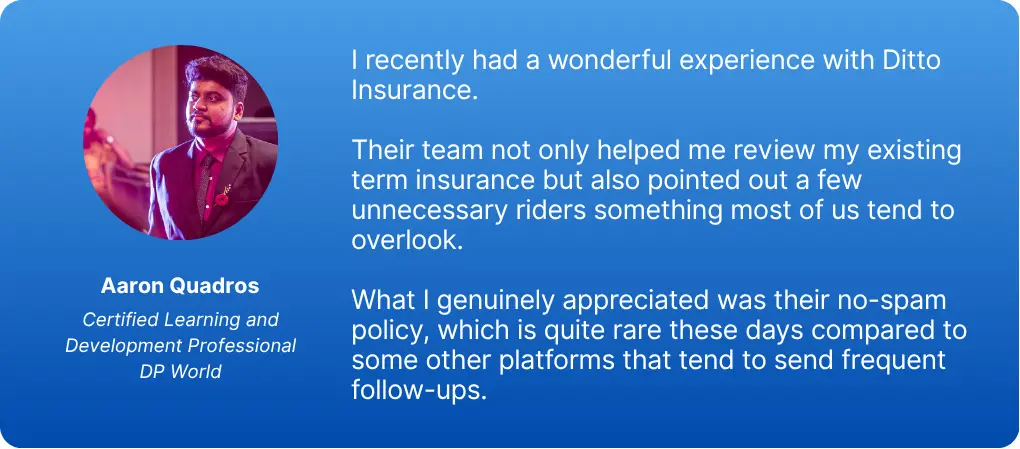
At Ditto, we’ve assisted over 8,00,000 customers with choosing the right insurance policy. Why customers like Aaron below love us:
- No-Spam & No Salesmen
- Rated 4.9/5 on Google Reviews by 25,000+ happy customers
- Backed by Zerodha
- Dedicated Claim Support Team
- 100% Free Consultation
You can book a FREE consultation. Slots are running out, so make sure you book a call or chat on WhatsApp now!
Conclusion
Buying term insurance as a heart patient is harder than a standard purchase, but for most conditions, it isn't impossible.
The key things to remember are simple: disclose your condition fully and honestly, get your medical reports in order before you apply, and understand that your premium will likely be higher because of the loading. If your condition is severe, don't lose hope either, because some insurers reconsider after a period of stability, and alternatives like credit life cover or ULIPs may still work for your goals.
The smartest first step is talking to someone who already knows how different insurers treat different heart conditions, so you're not applying blindly and risking an unnecessary rejection on your record.
Last updated on: