



Introduction
If you have diabetes, you’ve probably wondered whether you can even buy term insurance and how much extra you’d have to pay for it.
You’re not alone. India has one of the largest diabetes burdens in the world. The ICMR-INDIAB study, in 2021, estimated that 101 million Indians live with diabetes, while another 136 million are prediabetic.
The good news is that diabetes does not automatically close the door on term insurance. It simply makes the process more medical-driven.
Insurers want to understand your diabetes type, HbA1c levels, treatment history, complications, BMI, blood pressure, and lifestyle before deciding whether to approve, postpone, load, or reject your application.
In this article, we'll cover how insurers view Type 1 versus Type 2 diabetes, the role of HbA1c, how much more you might pay, and whether dedicated diabetic plans exist. We’ll also break down how Ditto helps you find the best term insurance for people with diabetes.
Common Questions People With Diabetes Ask
What Is Term Insurance for Diabetics?
Term insurance for diabetics is not a separate category of insurance. In most cases, it is a regular term insurance plan that a person with diabetes applies for, with the premium and approval decision based on their medical profile.
At its core, term insurance works the same way for everyone. You choose a sum assured and policy term, and pay premiums. The nominee receives the payout if the policyholder passes away during the policy term.
Ditto’s Key Insight: At Ditto, we’ve seen that diabetics should not look only for “diabetes plans.” Many Type 2 diabetics get covered under regular term plans, provided their health markers are stable and disclosures are made properly.
Can a Person With Diabetes Buy Term Insurance in India?
Yes. Diabetes does not automatically disqualify you from buying term insurance in India.
However, the application will go through stricter underwriting. Insurers will usually ask for your HbA1c reports, current medication, date of diagnosis, doctor consultations, and details of any complications. Based on this, they may approve your policy at a higher premium, postpone the application, reduce the cover/tenure, exclude certain riders, or decline the proposal.
At Ditto, we’ve seen well-controlled Type 2 diabetes cases approved, especially when HbA1c is stable, blood pressure is controlled, and there are no kidney, eye, nerve, or heart-related complications.
Does It Matter Whether I Have Type 1 or Type 2 Diabetes?
Yes, it matters a lot.
Type 1 diabetes is much harder to get covered under standard term insurance. Most insurers remain extremely cautious about Type 1 diabetes, even when the person manages it well. So, Type 1 applicants should know that approval is difficult, and expectations should be realistic.
On the other hand, Type 2 diabetes is different. If it is controlled with oral medication, maintained through stable lifestyle habits, and supported by recent good health markers, insurers are usually more open to issuing a policy.
However, the policy may come with premium loading, and health-based riders like Critical Illness or Waiver of Premium on illness may be restricted or declined.
Ditto’s Key Takeaway: Oral medication is usually viewed more favorably than insulin dependency. At the same time, insulin use does not automatically mean rejection, but insurers generally treat it as a higher-risk marker.
What Is the Best Term Insurance Plan for Diabetics?
There is no single best term insurance plan for diabetes. The right plan depends on your age, income, HbA1c, diabetes duration, medication type, BMI, smoking status, blood pressure, and whether you have any diabetes-linked complications.
At Ditto, we’ve seen that diabetic applicants should consider two things separately. First, whether the insurer is likely to underwrite their health profile fairly, and second, whether the plan itself offers the flexibility their family needs. A plan may look excellent on paper, but if the insurer is unlikely to approve your diabetes profile, it may not be the right fit for you.
Here are some plans that can be evaluated for people with well-controlled Type 2 diabetes:
Ditto’s Advice: A slightly higher premium with approval is often better than applying for the cheapest plan and later facing postponement, rejection, or unclear rider restrictions.
Also, Critical Illness, Waiver of Premium on illness, and disability-linked riders may be restricted or declined because diabetes increases the risk of many conditions these riders cover.
At Ditto, we usually prioritize getting the base term cover approved smoothly first, and riders are useful only if the insurer is willing to issue them after reviewing the full medical profile.
What Role Does My HbA1c Level Play in Getting Term Insurance Approved?
HbA1c is one of the most important markers insurers check because it reflects your average blood sugar control over roughly the past 3 months. The Centers for Disease Control and Prevention (CDC) explains that values below 5.7% are considered normal, 5.7%–6.4% fall in the prediabetes range, and 6.5% or above fall in the diabetes range.
For term insurance, insurers are not just checking whether you have diabetes. They are checking how well it is controlled and whether it has started affecting other parts of the body.
Note: These are general patterns based on Ditto's experience. Final decisions depend on each insurer's own guidelines.
How Much Higher Is the Term Insurance Premium for a Diabetic?
For well-controlled Type 2 diabetes, at Ditto we’ve typically seen premium loading ranging from 50% to 100% over the base premium, depending on the case.
So, if a healthy applicant pays ₹10,000 a year for a policy, a well-controlled Type 2 diabetic applicant may be quoted around ₹15,000 to ₹20,000 for similar cover. The final number can be higher if there are additional risk factors like high BMI, smoking, hypertension, cholesterol issues, insulin dependency, or a family history of heart disease.
Note: When you’re applying for a policy, you get an initial quote. However, loading/additional premium collection is done after underwriting happens, depending on your health conditions and history.
Ditto’s Key Insight: Loading is not always a bad outcome. For diabetic applicants, an approved policy with reasonable loading is often better than repeatedly applying to insurers that may postpone or reject the proposal.
What Other Health Factors Do Insurers Check Beyond HbA1c?
Insurers do not look at HbA1c in isolation. They also check BMI, blood pressure, cholesterol, duration since diagnosis, type of medication, insulin dependency, smoking status, alcohol use, family history, and signs of diabetes-related complications.
They may also look for neuropathy, retinopathy, kidney issues, heart history, abnormal ECG findings, or repeated hospitalizations.
At Ditto, we’ve seen that a person with HbA1c below 8% but uncontrolled blood pressure or kidney markers may face postponement, while someone with slightly elevated HbA1c but otherwise stable reports may still get a workable offer.
Can I Get Term Insurance if My Diabetes Is Uncontrolled or Has Led to Complications?
If diabetes is uncontrolled, recently diagnosed, insulin-dependent with unstable markers, or has already led to complications, insurers are usually reluctant to approve the policy immediately. In many such cases, the outcome is postponement or rejection, not just premium loading.
Ditto’s Advice: Don’t rush the application right after a bad report or medication change. If your doctor has recently adjusted your treatment, wait until your health markers stabilize and you have fresh reports showing improvement.
What Happens to My Term Insurance if My Diabetes Worsens After the Policy Is Issued?
Once the policy is issued, your sum assured and premium stay locked in as long as you disclosed your medical history honestly and continue paying premiums on time.
So, if your diabetes worsens later, the insurer cannot simply increase your premium because of that. This is one reason why applying early, while your health markers are still stable, matters.
Ditto’s Key Takeaway: The biggest risk is not the worsening of diabetes after issuance. The bigger risk is incomplete or inaccurate disclosure at the proposal stage.
Talk to an expert
today and
find
the right
insurance for you.


Are There Dedicated Term Insurance Plans Specifically for Diabetics?
Some insurers offer diabetes-focused term products from time to time, especially for Type 2 diabetes or prediabetes profiles with defined HbA1c limits. For example, Bajaj Life offers Bajaj Diabetic Term Plan. It is a dedicated protection plan for prediabetic customers with an HbA1c between 5.7% and 6.4%, or for Type 2 diabetic customers with an HbA1c of 8% or below.
However, most people with diabetes can still apply for regular term insurance plans and go through standard medical underwriting.
Should a Diabetic Add a Critical Illness Rider to Their Term Plan?
You can ask for a Critical Illness rider, but approval is not guaranteed.
Diabetes increases the risk of several illnesses that Critical Illness riders are designed to cover, including heart disease, kidney failure, stroke, and related complications. As a result, insurers may decline the rider even if they approve the base term plan.
At Ditto, we’ve seen that many diabetic applicants get the base term policy approved but do not get illness-linked riders like Critical Illness or Waiver of Premium on illness. So, treat these riders as a bonus if approved, not something to depend on.
How Does Ditto Help People With Diabetes Find the Right Term Insurance?
- We Review Your Diabetes History First
We check whether you have Type 1 or Type 2 diabetes, when you were diagnosed, your latest HbA1c, medication history, insulin use, doctor's records, and whether you have any complications.
This helps us understand whether you are a standard underwriting case, a loading case, a postponement risk, or a likely decline. - We Map Your Profile to Insurer Underwriting Appetite
Not every insurer views diabetes the same way. Some insurers may be more comfortable with controlled Type 2 diabetes, while others may be stricter if there is insulin dependency, high BMI, hypertension, or long diabetes duration.
At Ditto, we try to identify which insurers are more likely to evaluate your case fairly before you apply. This reduces the risk of avoidable rejections. - We Help You Time the Application Better
Timing matters a lot for diabetic applicants. If you apply right after a poor HbA1c result, a medication change, or hospitalization, the insurer may delay your application.
If your latest reports show stable sugar levels, controlled blood pressure, and no complications, your chances improve.
Ditto’s Key Insight: For Type 2 diabetics, applying with fresh, stable reports can make the difference between approval with loading and outright postponement. - We Help You Disclose Everything Correctly
Diabetes disclosure should not be vague. You need to accurately mention the year of diagnosis, medications, insulin use, HbA1c levels, complications, doctor consultations, and lifestyle habits.
At Ditto, we help applicants avoid incomplete answers that could create claim-stage issues later. A slightly higher premium is still better than a policy that becomes vulnerable because of poor disclosure. - We Set Premium and Rider Expectations Upfront
We tell diabetic applicants that premium loading is likely, riders may be restricted, and the insurer may ask for additional medicals. This keeps expectations realistic and avoids surprises after medical tests. - We Explore Alternatives if Term Insurance Is Not Possible
If getting an individual term insurance plan isn't feasible, Ditto can help you explore alternative options. For loan protection, group insurance or credit life cover offered by banks or NBFCs may have more flexible underwriting criteria. If pure term insurance isn't available, some people may also consider Unit-Linked Insurance Plans (ULIPs) or endowment plans. However, these should be evaluated carefully, as they are designed for different purposes and are not replacements for term insurance. - We Provide Claims Assistance
Buying an insurance policy is just the beginning of your journey. At Ditto, we continue to support you when it matters most by providing dedicated claims assistance to customers who purchase their policy through us.
Our team coordinates with the insurer on your behalf, guides you through every step of the claims process, and helps make the experience as smooth and hassle-free as possible.
Ditto's Unique Insights on Term Insurance for People With Diabetes
Type 1 Diabetes Is Still a Very Difficult Case
At Ditto, we’re upfront with Type 1 applicants: standard term insurance approval is extremely difficult right now. Even if the condition is well-managed, insurers are still cautious because Type 1 diabetes is lifelong, insulin-dependent, and can carry long-term complication risk.
That does not mean you should hide it or apply casually. It means you should speak to an advisor first and understand whether any realistic route exists.
Type 2 Diabetes Is More Manageable if It’s Controlled
Type 2 diabetes is the more common scenario. If your HbA1c is controlled, you are on oral medication, your BMI and blood pressure are stable, and there are no complications, insurers may approve the policy with loading.
We’ve seen many Type 2 diabetics get covered, but the success usually depends on how clean the overall medical profile looks.
HbA1c Alone Does Not Decide the Outcome
A common mistake is thinking, “My HbA1c is under 8%, so I’ll definitely get approved.” That’s not always true.
Insurers also consider kidney function, cholesterol, blood pressure, ECG/TMT results, BMI, smoking, alcohol use, and history of complications. If these markers are poor, even a decent HbA1c may not save the application.
Insulin Use Changes the Conversation
Insulin dependency usually makes underwriting tougher. It signals that the insurer needs to investigate the severity, duration, and stability of the diabetes more closely.
At Ditto, we prepare applicants for this up front so they don’t assume their case will be treated as a simple oral-medication Type 2 profile.
Riders Are Often the First Casualty
Even when the base term plan is approved, illness-based riders may not be. Critical Illness and Waiver of Premium on illness are commonly restricted for diabetic applicants because diabetes is linked to several illnesses that these riders cover.
So, Ditto helps you prioritize the base term cover first. Riders are useful, but the main goal is to secure the life cover cleanly.
Clean Disclosure Matters More Than a Lower Premium
Hiding diabetes, insulin use, smoking, hospitalization, or complications is not worth it. Medical records, prescriptions, discharge summaries, and lab reports can all surface during underwriting or claims.
We would rather help you get a policy with transparent loading than push you into a cheaper policy built on incomplete disclosure.
Why Choose Ditto for Term Insurance?
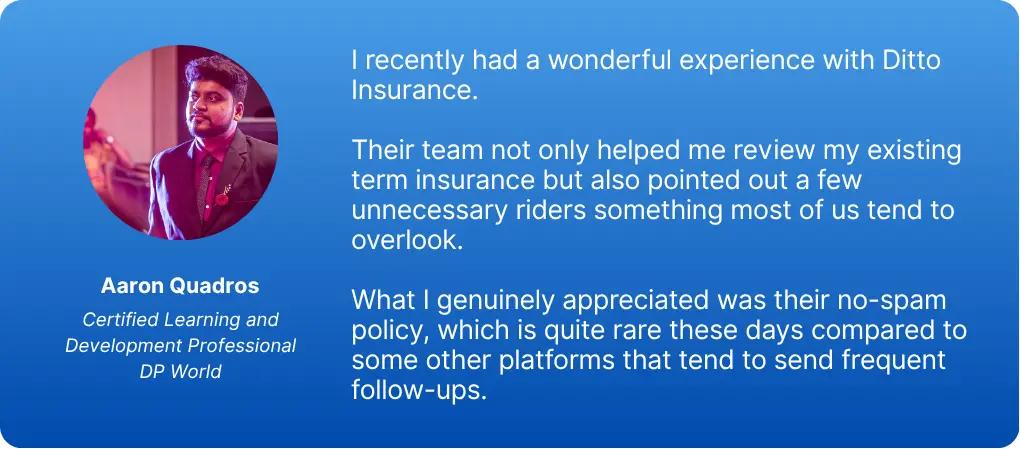
At Ditto, we’ve assisted over 8,00,000 customers with choosing the right insurance policy. Why customers like Aaron below love us:
- No-Spam & No Salesmen
- Rated 4.9/5 on Google Reviews by 25,000+ happy customers
- Backed by Zerodha
- Dedicated Claim Support Team
- 100% Free Consultation
You can book a FREE consultation. Slots are running out, so make sure you book a call or chat on WhatsApp now!
Conclusion
Diabetes changes how you look for term insurance, but it doesn't rule out the possibility of getting one. The best term insurance plan for diabetes is the one that matches your HbA1c, treatment history, and health profile, and finding it starts with knowing where you stand.
Last updated on: