



Introduction
Getting term insurance for cancer survivors in India is one of the toughest insurance journeys. We want to set the right expectations before you begin.
Based on Ditto's experience, we have not yet issued a standard term insurance for cancer patients or cancer survivors. Most applications are declined because insurers continue to view a past cancer diagnosis as a very high life insurance risk, even after remission.
In the few cases where insurers are willing to consider an application, the person usually has several years of clean remission, detailed medical records, and good overall health. Even then, approval is not guaranteed. If an offer is made, it often comes with a higher premium, a lower sum assured, or a shorter policy term.
Did you know that every year, thousands of Indians survive cancer and rebuild their lives? In fact, according to the Global Cancer Observatory (GCO) 2024 report, it is estimated that over 33 lakh people in India are living within five years of a cancer diagnosis. As the number of cancer survivors is steadily increasing each year globally, it is important to understand that there is no separate cancer survivor term insurance plan.
This guide explains how Ditto helps you find the best term insurance for cancer survivors, the common questions cancer survivors ask, and practical alternatives to consider if standard term insurance is not available.
Common Questions Cancer Survivors Ask
1) What Is Term Insurance for Cancer Survivors?
Term insurance for cancer survivors is life insurance designed for people who have completed cancer treatment and are in remission. While getting standard term insurance immediately after a cancer diagnosis is difficult, many survivors might qualify for coverage after meeting the insurer's eligibility criteria.
- Traditional Term Insurance After Remission: Many insurers consider term insurance applications 2 to 5 years after successful cancer treatment, depending on the type and stage of cancer. Your application is assessed through manual underwriting, where the insurer reviews your medical history, treatment records, and current health before deciding on coverage.
- Group Term Insurance Through Employers/Loan Providers/Banks: Employer-provided group term insurance is often easier to obtain because it may offer coverage with less stringent medical underwriting than an individual policy.
Important Things to Know
If your application is approved after cancer treatment, the insurer may charge a higher premium (known as premium loading) because cancer is considered a higher-risk medical condition. It is also essential to fully disclose your diagnosis, treatment history, pathology reports, chemotherapy, radiation, surgeries, and follow-up records.
2) Can a Cancer Survivor Buy Term Insurance in India?
A cancer survivor can try buying term insurance in India, but approval depends on the insurer's underwriting guidelines. The chances of getting coverage improve if you have completed treatment, have remained in remission for several years, and have no signs of recurrence. Most insurers assess each case individually rather than following a single rule.
Many insurers prefer applicants who have been cancer-free for around 5 years, along with other factors:
- Medical Underwriting: Insurers carefully review your medical records, including the type and stage of cancer, treatment received, follow-up reports, and current health status. A medical examination is usually required before a decision is made.
- Higher Premiums: If your application is accepted, the insurer may apply premium loading, meaning you will pay a higher premium than someone with no history of cancer.
- Policy Conditions: Some insurers may impose specific terms, such as restricted coverage, no riders, or a shorter tenure, depending on your medical history and overall risk profile. In most cases, applications can also be postponed or declined.
If standard term insurance is unavailable or your application is deferred, you can consider other protection options, such as endowment plans or Unit-Linked Insurance Plans (ULIPs), which provide some life cover along with savings.
You may also be eligible for group life insurance through your employer, lender-provided loan protection insurance, or the Pradhan Mantri Jeevan Jyoti Bima Yojana (PMJJBY) if you meet its eligibility criteria. These options may not fully replace term insurance, but they can still provide meaningful financial protection.
3) Which Cancer Survivors Are More Likely to Be Approved?
Cancer survivors might have a chance of getting approved for financial products if they were diagnosed at an early stage, were younger at the time of diagnosis, and have remained cancer-free for 5 or more years. People treated for cancers with very high cure rates, such as some thyroid or testicular cancers, face higher approval odds.
Approval also depends on what you're applying for, as insurers and lenders assess risk differently.
Life Insurance
- Higher Approval Chances: Survivors of Stage I or Stage II cancers who completed treatment several years ago might receive more favorable underwriting. People treated for high-survival cancers, such as thyroid, testicular, or certain kidney cancers, often have better approval prospects.
- International Perspective: Several countries, including Ireland and parts of Europe, have adopted "Right to Be Forgotten" laws, preventing insurers from considering a past cancer diagnosis after a specified remission period (typically 5–10 years). India currently has no equivalent regulation.
Home Loan & Mortgage Insurance
- Higher Approval Chances: Cancer survivors with stable employment, consistent income, and a strong repayment history are generally well placed to obtain home loans.
- Insurance May Be a Separate Challenge: While a home loan itself usually does not require medical underwriting, obtaining an accompanying home loan protection or credit life insurance policy may require it. If standard coverage is declined, these group options may still be available.
- Underwriting Inspection: In India, banks primarily assess income, credit score, repayment capacity, and debt-to-income ratio, rather than medical history.
What Underwriters Typically Review
Regardless of the product you're applying for, insurers generally look for complete medical records, including pathology reports, cancer stage, and treatment history. They also look into evidence of remission, along with regular follow-up reports from your oncologist or treating physician.
Talk to an expert
today and
find
the right
insurance for you.


4) Which Cancer Types or Stages Lead to Outright Rejection in Term Insurance?
In traditional term life insurance, insurers decline applications from people undergoing active cancer treatment or those with cancers that carry a high risk of recurrence or early mortality. Insurers don't publish rejection lists, and every application is assessed individually. However, certain medical conditions almost always lead to rejection.
- Advanced or Late-Stage Cancers: Stage III or Stage IV cancers, including cancers that have spread to nearby lymph nodes or distant organs, are rarely accepted for standard term insurance. Individuals with a terminal diagnosis or limited life expectancy of 12-24 months are declined by all insurers.
- Highly Aggressive Cancer Types: Certain cancers remain difficult to insure even after treatment because of their aggressive nature or high recurrence rates. These include advanced malignant melanoma, acute forms of leukemia, aggressive lymphomas, glioblastoma, and other high-grade brain tumors.
- Applications During the Waiting (Postponement) Period: Many insurers postpone applications until a survivor has remained cancer-free for a specified period. These include Stage I cancers (often require 6–24 months of remission), Stage II cancers (typically require 1–5 years of remission), and Stage III or IV cancers (may require 5 years or more, although approval remains uncertain).
Rare Exceptions
Some insurers may consider applicants who have recovered from low-risk, early-stage cancers, such as localized Stage I breast cancer, certain papillary thyroid cancers, and some non-melanoma skin cancers. These applications usually undergo manual underwriting, and approved policies often come with higher premiums (premium loading).
Alternative Options If Term Insurance Is Declined
If traditional term insurance is unavailable, you still have ways to build financial protection. While none fully replace term insurance, combining several options can reduce your family's financial risk.
1) Prioritize Cancer Health Insurance
This is often the most practical option for cancer survivors. Depending on your medical history, you may face premium loading, waiting periods, or permanent exclusions for your previous cancer, but coverage is generally more accessible than life insurance. If you already have a health policy purchased before your diagnosis, keep it active because renewing an existing policy is usually much easier than buying a new one.
2) Employer Group Life Insurance
Many employers provide group life insurance without individual medical underwriting up to a certain free coverage limit. This may be the only life cover available to some cancer survivors. However, the cover usually ends when you leave your job, and additional voluntary cover often requires medical underwriting.
3) Government Insurance Schemes
The Pradhan Mantri Jeevan Jyoti Bima Yojana (PMJJBY) offers ₹2 lakh life cover for eligible bank account holders aged 18–50, renewable annually until age 55. The Pradhan Mantri Suraksha Bima Yojana (PMSBY) provides accidental death and disability cover for individuals aged 18–70. While affordable, these schemes offer only limited protection and should not be viewed as substitutes for a full-term plan.
4) Personal Accident Insurance
Personal accident policies are generally easier to obtain because they cover accidental death or disability rather than illness. Although they do not protect against cancer-related death, they can still strengthen your overall financial safety net.
5) Protect Other Family Members
If one spouse cannot obtain life insurance, ensure the healthy earning spouse has adequate coverage. This simple step can significantly improve your family's financial resilience.
6) Build Your Own Financial Safety Net
Where insurance is unavailable, savings become even more important. Maintain a larger emergency fund, reduce high-interest debt, and invest consistently over time. While this cannot replace life insurance, it helps create financial security when coverage options are limited.
5) How Does a Term Insurer Underwrite a Cancer Survivor's Application?
Insurers evaluate cancer survivor applications through manual underwriting because risk varies from person to person. Approval depends on factors such as the type and stage of cancer, treatment history, remission period, and overall health.
While applications made during active treatment are declined, many survivors might become eligible once they have remained cancer-free for a sufficient period.
Key Underwriting Factors
Before approving a policy, insurers generally review:
Remission Period
Cancer Type & Stage
Treatment History
Medical Follow-Ups
Possible Underwriting Decisions
After assessing your medical history, the insurer may take one of the following decisions:
- Standard Premiums: Possible but very rare for survivors of low-risk cancers who have remained in long-term remission.
- Higher Premiums (Loading): The policy may get approved, but premiums are increased to reflect the additional health risk.
- Policy With Restrictions: In some cases, the insurer may issue the policy with specific restrictions on cover amount, policy tenure, and rider exclusions.
- Postponement: If remission is recent or your medical condition is still being closely monitored, the application may be deferred until greater stability is established.
- Decline: Applications involving aggressive cancers, active treatment, or very short remission periods may be rejected.
Tips to Improve Your Chances
- Disclose Everything: Always provide complete medical records, pathology reports, treatment summaries, and follow-up documents. Non-disclosure can lead to a claim being rejected later.
- Compare Multiple Insurers: Underwriting standards differ across insurers, so applying with more than one company can improve your chances of finding suitable cover.
- Start With a Moderate Sum Assured: Applying for a smaller life cover (Under ₹1 crore) initially may improve approval odds, especially if you are still relatively early in your remission journey.
6) What Medical Reports Do Insurers Ask for From Cancer Survivors?
When a cancer survivor applies for term insurance, insurers look for the type of cancer, stage, remission history, and the likelihood of recurrence rather than the diagnosis alone.
Key Medical Documents Required
Insurers usually ask for the following records:
- Diagnostic & Pathology Reports: Documents confirming the exact cancer type, stage, grade, and biopsy findings.
- Hospital Discharge Summaries: Records covering surgeries, hospital admissions, and treatment episodes.
- Treatment History: Details of chemotherapy, radiation, immunotherapy, medications, and treatment completion dates.
- Oncologist's Fitness or Remission Certificate: A letter confirming treatment is complete, remission status, and the current prognosis.
- Recent Follow-up Reports: Latest blood tests, tumor marker reports, PET-CT, MRI, or other scans showing there is no active disease.
During underwriting, insurers focus on the length of remission, current health status, and regular medical follow-ups. To improve your chances of approval, disclose your complete medical history, organize your medical records with your treating oncologist, and explore employer group insurance if available.
7) How Many Years in Remission Do Insurers Want Before Approving?
Most insurers prefer cancer survivors to remain cancer-free for around 2–5 years before considering them for standard term insurance. In some early-stage cancers, applications may be reviewed sooner (after 3 years), while advanced or aggressive cancers often require significantly longer remission periods (up to 10 years).
Insurers Typically Consider
- Length of Remission: A longer cancer-free period generally improves approval chances and may reduce premium loading.
- Cancer Type & Stage: Early-stage, low-risk cancers are usually viewed more favorably than advanced or metastatic cancers.
- Treatment History: Underwriters review the treatments received, recovery progress, and any ongoing complications or follow-up concerns.
If you are undergoing treatment or have only recently entered remission, standard term insurance will not be available immediately. More importantly, meeting the minimum remission requirement does not guarantee approval.
8) How Much Higher Is the Term Insurance Premium for a Cancer Survivor?
Term insurance premiums for cancer survivors are calculated individually. Key factors include the type of cancer, stage at diagnosis, treatment outcome, and the length of time you have remained in remission. Most insurers expect applicants to be cancer-free for around 2–5 years before considering standard term insurance.
If approved, insurers often charge a premium loading because cancer survivors are considered higher-risk applicants. Depending on the medical profile, premiums may increase by 25%–50%, while higher-risk cases can see significantly larger increases (100%-300%).
Insurers Generally Assess:
- Cancer Type & Stage: Early-stage, localized cancers usually receive more favorable pricing than advanced or metastatic cancers.
- Time Since Remission: A longer cancer-free period generally improves underwriting outcomes and may reduce premium loading.
- Treatment History: Underwriters review whether surgery, chemotherapy, radiation, or other treatments have been successfully completed and whether there are any ongoing medical concerns.
9) What Happens If You Don't Disclose a Past Cancer Diagnosis While Buying Term Insurance?
When buying term insurance, full medical disclosure is a legal requirement. Failing to disclose a previous cancer diagnosis is considered material misrepresentation and may result in serious consequences. Insurance contracts are based on the principle of utmost good faith, which requires applicants to provide complete and accurate health information.

Claim Rejection
If your family files a claim and the insurer discovers an undisclosed cancer history during claim investigation, the insurer may reject the claim. This means the death benefit may not be paid despite years of premium payments.
Policy Cancellation
If the non-disclosure is identified while the policy is still active, the insurer may cancel or void the policy in accordance with the policy terms and applicable law, leaving you without life insurance cover.
Future Insurance Difficulties
A policy canceled due to material non-disclosure can make it much harder to obtain life insurance in the future, as insurers may consider your underwriting history.
If you unintentionally omitted important medical information, contact your insurer as soon as possible. During the free-look period (30 days after receiving the policy), you may be able to request corrections, modify the policy, or cancel it, depending on the insurer's process.
Under Section 45 of the Insurance Act, 1938, insurers can investigate and reject a policy if they discover that the policyholder suppressed or misrepresented a material fact within the first three years of the policy being in force. After this period, an insurer cannot repudiate a policy unless it can establish fraud under the conditions specified in the act.
The Best Approach
The safest approach is complete and honest disclosure. Even if your cancer history results in a higher premium, additional medical tests, or temporary postponement, an insurer that knowingly accepts your medical condition provides a far stronger foundation for future claim settlement. Honest disclosure protects both your policy and your family's financial security.
10) Should Cancer Survivors Consider a Critical Illness Plan Instead of, or Alongside, Term Insurance?
Term insurance and Critical Illness (CI) insurance solve different problems. Ideally, both should be purchased before any cancer diagnosis. After a cancer diagnosis, getting either becomes much harder.
1) Term Insurance Protects Your Family
Term insurance pays a lump sum to your nominee if you pass away during the policy term. It is meant to replace your income and protect your family's finances. It does not pay for cancer treatment or hospital bills.
Most applications from cancer survivors are reviewed manually by an underwriter rather than receiving instant approval. In reality, most are declined. The few approvals usually come after several years of documented remission and may include higher premiums, lower coverage, or a shorter policy term. At Ditto, we have not yet placed a standard term insurance policy for a cancer survivor.
2) Critical Illness Insurance Protects You
A Critical Illness policy pays a fixed lump sum if you are diagnosed with a covered illness. The money can be used for treatment, rehabilitation, household expenses, or income replacement, subject to the policy's waiting period and other terms. Once you have a history of cancer, it becomes a pre-existing condition.
Most insurers decline new Critical Illness plans, cancer-specific plans, and Critical Illness riders for that reason. Even if an insurer issues a policy, it will usually permanently exclude any prior cancer, thereby removing protection for the condition you are most concerned about.
One Important Point
A Critical Illness Rider can only be added to a base term insurance policy. If your term insurance application is declined, you cannot buy the rider separately. This is why purchasing both term insurance and Critical Illness cover while you are healthy is usually the strongest long-term strategy.
11) How Does Ditto Help Cancer Survivors Find the Right Term Insurance?
Buying term insurance after cancer often requires careful planning because underwriting standards vary across insurers. Our role is to help you understand your chances upfront, avoid unnecessary rejections, and build the strongest possible application based on your medical history. We provide personalized guidance, help you compare available options, explore alternative solutions, and review rider options.
- An Honest Eligibility Assessment: We first evaluate whether term insurance is realistically achievable based on your cancer type, stage, treatment, and remission period.
- Applying to the Right Insurers: Each insurer has its own underwriting guidelines. We help you target those most likely to consider your profile, rather than applying blindly.
- Preparing a Stronger Application: We help organize your pathology reports, treatment records, and follow-up documents so that your application is complete and well supported.
- Explaining Every Outcome: Whether you receive standard rates, premium loading, reduced cover, postponement, or rejection, we explain exactly what it means and whether the offer is worth considering.
- Finding Practical Alternatives: If term insurance isn't currently available, we help you explore suitable alternatives such as health insurance planning, protecting existing policies, or other family protection strategies.
Note: Multiple rejections can become part of your insurance history, and future insurers may take them into account during underwriting. That's why a carefully planned application, submitted to the right insurer at the right time, is far more effective than applying to every insurer at once.
Ditto's Unique Insights on Term Insurance for Cancer Survivors
Finding term insurance after cancer requires realistic expectations, careful planning, and the right guidance. While approval is possible in some cases, it is far from guaranteed. Based on what we've seen across insurers and underwriting practices, here are the insights that matter most.
- Start With Realistic Expectations: Traditional term insurance for cancer survivors remains difficult to obtain. Understanding your chances upfront saves time and avoids unnecessary disappointment.
- Buy Term Insurance Before Any Diagnosis if Possible: If you are healthy today, even with a family history of cancer, this is the single most important financial decision you can make. A policy purchased before diagnosis continues to provide full protection for cancer-related death.
- Avoid Multiple Unnecessary Applications: Every rejection can make future underwriting more challenging. A targeted, well-prepared application is always better than applying to every insurer.
- Choose the Right Insurance Product: Term insurance protects your family's income after your death, while health insurance covers treatment costs. Critical illness insurance serves a different purpose altogether. Know what problem you're trying to solve before buying.
- Strong Documentation Improves Your Chances: Complete pathology reports, treatment summaries, and consistent follow-up records help underwriters assess your case more confidently.
- Always Disclose Your Medical History: Concealing a previous cancer diagnosis may result in claim rejection or policy cancellation. Honest disclosure is the only way to ensure your family receives the protection you intended to provide.
The reality is that not every cancer survivor will qualify for standard term insurance, but that doesn't mean you have no options. A thoughtful application strategy, complete medical documentation, and choosing the right type of protection can significantly improve your financial security, whether through term insurance or suitable alternatives.
Already Have a Term Insurance Policy?
If you bought a term insurance policy before your cancer diagnosis and answered all health questions honestly, your policy usually remains valid. Cancer is treated like any other cause of death, and your family can claim the sum assured if all policy conditions are met.
The most important thing is to keep the policy active. Never miss premium payments. If your policy lapses and you try to revive it after a cancer diagnosis, the insurer may ask for fresh medical information. The three-year review period ( or the 3 year clause in term insurance) under Section 45 of the Insurance Act, 1938, will be restarted from the date of the revival.
Be careful before adding new riders after your diagnosis. Some riders may require fresh underwriting and could trigger a new review period for that rider.
Finally, check your existing policy document carefully. Many modern term plans already include benefits such as a terminal illness payout, which allows part or all of the sum assured to be paid during your lifetime if you are diagnosed with a terminal illness. If you had added a Critical Illness Rider or Waiver of Premium Rider before your diagnosis, those benefits may also continue. Many policyholders already have valuable protection without realizing it.
Why Choose Ditto for Term Insurance?
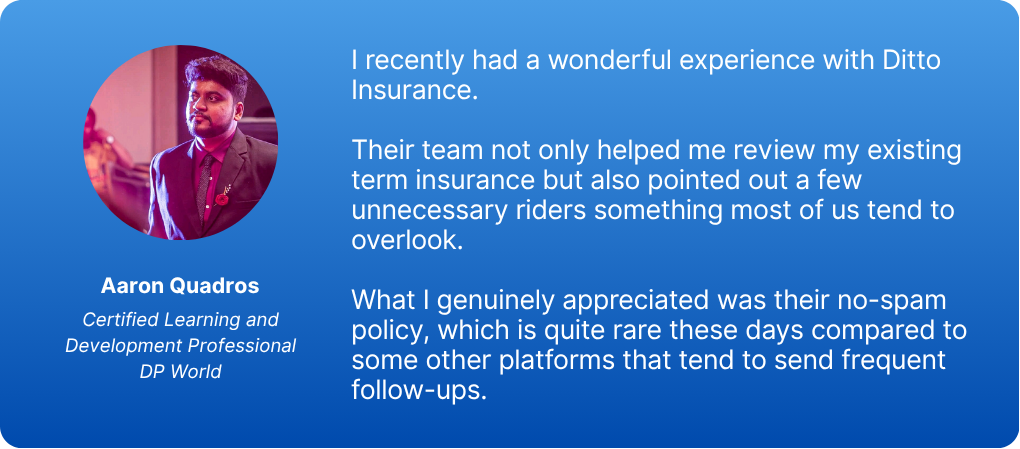
At Ditto, we’ve assisted over 8,00,000 customers with choosing the right insurance policy. Why customers like Aaron below love us:
- No-Spam & No Salesmen
- Rated 4.9/5 on Google Reviews by 25,000+ happy customers
- Backed by Zerodha
- Dedicated Claim Support Team
- 100% Free Consultation
You can book a FREE consultation. Slots are running out, so make sure you book a call now or chat over WhatsApp with our advisors.
Conclusion
The most important takeaway is to set realistic expectations. In practice, most applications are declined, making term insurance for cancer survivors extremely difficult and, in many cases, almost impossible to obtain. When approvals do occur, they usually follow several years of documented remission and may still entail higher premiums, reduced coverage, or shorter policy terms.
If term insurance is unavailable, focus on building financial protection through health insurance, protecting existing policies, and securing term insurance early for healthy family members whenever possible.
Cancer health insurance addresses hospitalization and treatment costs, while term insurance protects your family's finances if you pass away. They serve different purposes, and one cannot replace the other. Ideally, survivors should prioritize strong Cancer Health Insurance, then explore term insurance if they become eligible later.
Last updated on: