



Overview
Looking for a market-linked insurance plan that combines investing with life cover? Before you commit, it's worth understanding how the SIIP plan by Life Insurance Corporation of India (LIC) works, its returns, and whether it suits your long-term financial goals.
In the next few minutes, this guide explains the plan’s benefits, charges, tax treatment, and limitations.
Note: LIC SIIP Plan 852 was withdrawn on January 1, 2025. The currently available version is Plan 752, with UIN 512L334V02.
What Is the LIC SIIP Plan?
LIC SIIP (Plan 752 / UIN 512L334V02) is a non-participating, individual ULIP that combines life insurance with market-linked investments. Your premiums are invested in funds of your choice while providing life cover during the policy term.
Since it is a non-participating plan, it does not earn LIC bonuses or share in the insurer's profits. The plan can be purchased through LIC's offline distribution channels as well as online (cheaper) via the official LIC website. When you buy an LIC policy online, you may benefit from applicable premium rebates and avoid intermediary-related costs.
LIC SIIP Plan: Fund Options and Investment Choices
Talk to an expert
today and
find
the right
insurance for you.


Key Features of the LIC SIIP Plan
1) Death Benefit: If the life assured dies during the policy term, LIC pays the highest of the following:
- Basic sum assured (after reducing eligible partial withdrawals made in the two years before death)
- Unit fund value on the date the death claim is intimated
- 105% of total premiums paid, after reducing eligible partial withdrawals made in the two years before death
Note: The basic sum assured is the life insurance cover you choose, while the death benefit is the actual amount your nominee receives. Moreover, for children below age eight at entry, risk may start later. If death occurs before risk commencement, only the unit fund value is payable.
2) Maturity Benefit: If the life assured survives until maturity, LIC pays the unit fund value available on the maturity date.
3) Refund of Mortality Charges: If all due premiums have been paid and the life assured survives to maturity, LIC also refunds the total mortality charges deducted for the life insurance cover. This refund is paid in addition to the maturity benefit. Mortality charges are deducted only if the basic sum assured is more than the unit fund value.
4) Guaranteed Additions: LIC SIIP rewards long-term policyholders by adding guaranteed additions to the unit fund, provided all due premiums are paid, and the policy remains in force.
- End of 6th Policy Year: 5% of one annualized premium
- End of 10th Policy Year: 10% of one annualized premium
- End of 15th Policy Year: 15% of one annualized premium
- End of 20th Policy Year: 20% of one annualized premium
- End of 25th Policy Year: 25% of one annualized premium
5) Partial Withdrawals: LIC SIIP allows partial withdrawals after the 5th policy anniversary, provided all due premiums have been paid. If the life assured is a minor, withdrawals are permitted only after attaining 18 years of age.
You can withdraw either a fixed amount or a fixed number of units. The maximum withdrawal limit ranges from 20% of the unit fund (6th–10th year) to 35% (21st–25th year) in a policy year, as per the policy terms.
6) Fund Switching: You can switch your entire investment between LIC SIIP's four available funds at any time during the policy term. Up to four fund switches are free in each policy year, and applicable charges will apply thereafter. Fund switches within a ULIP are not treated as taxable events, so switching between funds does not trigger capital gains tax.
7) Settlement Option: Instead of receiving the death benefit as a lump sum, you can choose to have it paid in installments. This option can be exercised by the proposer while the life assured is a minor, or by the life assured after attaining 18 years of age.
Riders Available With the LIC SIIP Plan
The plan offers the Accidental Death Benefit Rider. This optional rider pays an additional lump sum if the life assured dies due to an accident during the rider term. It can be added on any policy anniversary, provided at least 5 years of the policy term remain, and the life assured is below 65 years at the time of opting.
Note: This rider cannot be added while the life assured is a minor. Additionally, the Accidental Death Benefit sum assured cannot exceed the policy's basic sum assured.
LIC SIIP Plan Premium Illustration and Charges
The illustrations below are sourced from the official LIC SIIP policy brochure and assume a 35-year-old purchasing a 15-year policy term offline. Your actual premiums, fund value, and benefits will vary based on factors such as age, sum assured, policy term, premium amount, fund performance, and underwriting. You can use the LIC SIIP plan calculator for rough premium calculations.
The 4% and 8% figures in the above table are IRDAI-mandated illustration rates, not guaranteed investment returns. Once policy charges are considered, the illustrative net returns are closer to around 2% and 6%, depending on fund performance and policy assumptions. Actual returns may be higher or lower based on market performance.
LIC SIIP is subject to standard ULIP charges, including premium allocation, policy administration, fund management, and discontinuance charges (where applicable). These charges are deducted as per the policy terms and can affect your overall investment returns, especially during the initial policy years.
For a detailed breakdown of all applicable charges, refer to pages 15 to 20 of the official LIC SIIP policy brochure.
LIC: Performance Metrics
Note: The figures in the table are based on LIC's overall insurer-level performance, sourced from LIC's public disclosures and IRDAI annual reports. They are not specific to its ULIP products. To know more about such statistics, visit Ditto Data Lab.
Pros of the LIC SIIP Plan
- Insurance + Investment in One Plan: Combines life insurance with market-linked investing, making it suitable for those who prefer managing both through a single policy.
- Choice of Investment Funds: Four fund options let you align your investments with your risk appetite and switch as your goals change.
- Flexible ULIP Features: Offers partial withdrawals, free fund switches, settlement options, and optional accidental death protection.
- Tax Benefits: Eligible for applicable tax benefits on premiums and maturity proceeds. However, ULIP tax benefits are subject to prevailing tax laws and policy conditions.

Limitations of the LIC SIIP Plan
Returns Depend on Markets
The maturity corpus depends largely on fund performance, so returns are not guaranteed like traditional LIC savings plans.
Multiple ULIP Charges
Premium allocation, fund management, mortality, policy administration, and other charges can reduce overall returns, especially in the initial years.
Long-Term Commitment Needed
Exiting the policy early can significantly impact the fund value due to discontinuance rules and charges.
Lower Life Cover Than Pure Term Plans
The insurance component is modest compared to dedicated term insurance available for a similar premium. A term plan usually offers a life cover of 20x-30x of annual income.
Requires Active Fund Selection
Choosing the wrong fund or failing to review allocations periodically can affect long-term performance.
Who Should Buy the LIC SIIP Plan?
- Investors seeking market-linked wealth creation with life insurance in one policy.
- Long-term investors comfortable staying invested for 10 years or more.
- Individuals who want flexibility to switch between debt and equity funds as market conditions change.
- Investors who may not be eligible for a pure term plan due to age, medical, or income reasons.
Who Should Avoid the LIC SIIP Plan?
- Investors seeking guaranteed or fixed returns without market risk.
- Those whose primary objective is maximum life cover, as a pure term plan is more cost-effective.
- People who need high liquidity or expect to withdraw money frequently.
- Investors unwilling to monitor or periodically review fund allocation.
- Anyone expecting ULIPs to consistently outperform mutual funds after accounting for policy charges.
LIC SIIP Plan vs. a Separate Standalone Term Plan
LIC SIIP and a standalone term plan serve very different purposes. SIIP combines life insurance with market-linked investing, while a term plan focuses purely on providing high life cover at a much lower cost.
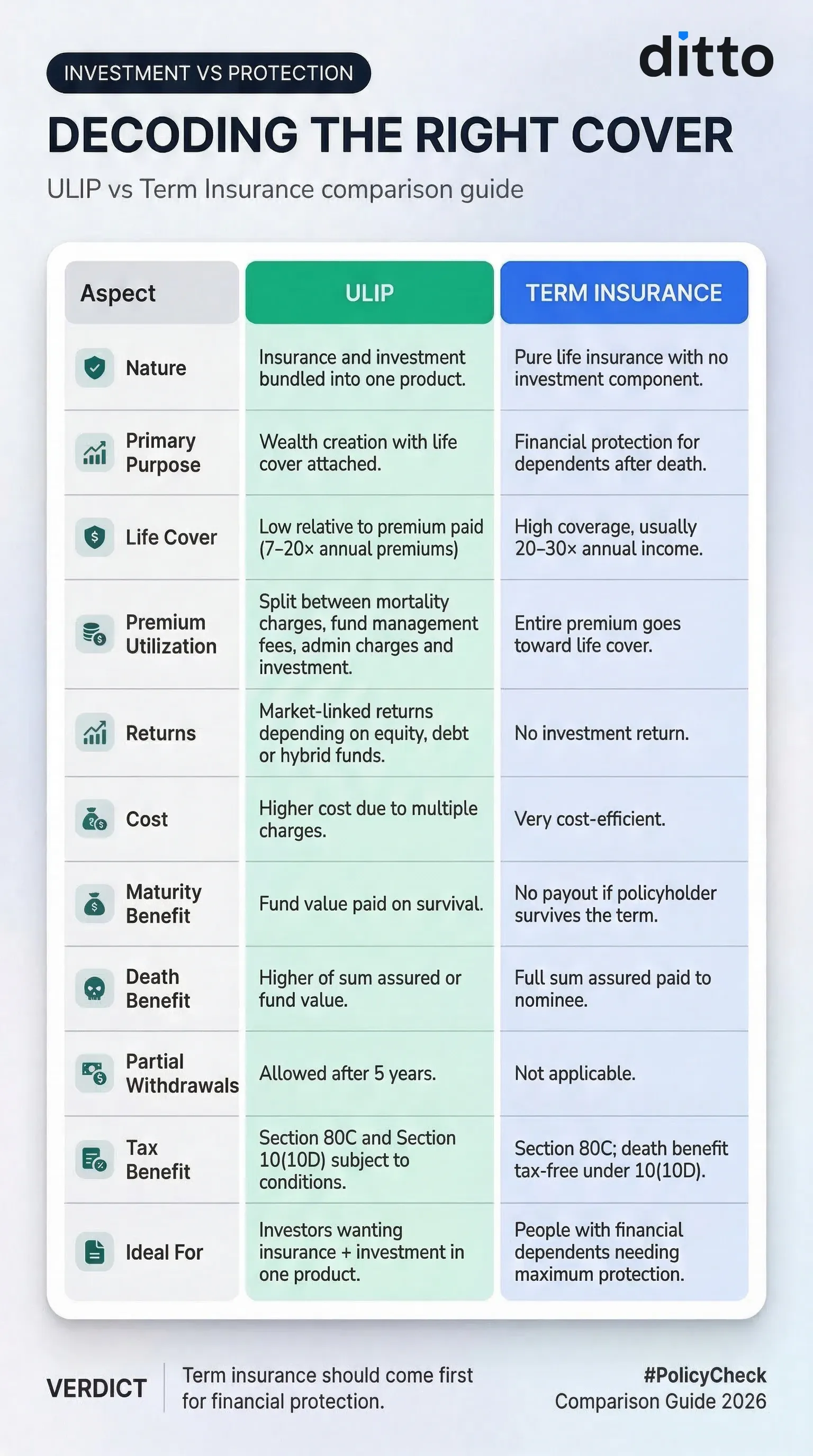
When it comes to ULIPs vs term insurance, if your priority is protecting your family's financial future, a standalone term plan is the more efficient choice. If you also want disciplined long-term investing within the same policy, SIIP may be worth considering.
Take a look at the infographic below, which compares a ULIP and a term plan across key parameters to help you understand the differences more clearly.
Why Choose Ditto for Life Insurance?
At Ditto, we’ve assisted over 8,00,000 customers with choosing the right insurance policy. Why customers like Aaron below love us:

- No-Spam & No Salesmen
- Rated 4.9/5 on Google Reviews by 30,000+ happy customers
- Backed by Zerodha
- Dedicated Claim Support Team
- 100% Free Consultation
You can book a FREE consultation. Slots are running out, so make sure you book a call or chat on WhatsApp now!
Conclusion
LIC SIIP can suit investors who specifically want a ULIP that combines life insurance with market-linked investing, but it may not be the most cost-efficient solution for most families. Multiple policy charges, a mandatory ULIP lock-in period of five years, and relatively modest life cover can reduce its overall appeal compared with buying insurance and investments separately.
If your primary goal is financial protection, explore LIC term insurance plans or compare them with the best term insurance plans available in India. For long-term wealth creation, evaluate separate investment options (such as Public Provident Fund (7.1%), mutual funds or bank fixed deposits (6% or higher)) alongside a pure term plan.
Frequently Asked Questions
Last updated on: