



Overview
Choosing a ULIP involves more than looking at the maturity amount shown on a calculator. You also need to understand where your premium is invested, how the chosen fund performs, investment flexibility, and how different charges can affect the final corpus.
This is where the HDFC Life ULIP calculator can be useful. It lets you model different investment scenarios and see how changes in your premium, tenure, or expected return can affect the projected corpus. But a calculator cannot predict your actual outcome. Market movements, fund performance, and applicable policy charges can cause the final value to differ from the estimate.
In this guide, we’ll break down how to use the calculator, the information you need, the charges that can affect your ULIP returns, and how to interpret the figures it shows.
What Is the HDFC Life ULIP Calculator?
The HDFC Life ULIP calculator is an online tool on the official HDFC Life website that estimates a ULIP's potential maturity value. It allows users to enter an investment amount, select a monthly or annual payment frequency, choose the policy tenure, and specify an expected rate of return. Based on these inputs, the calculator displays the total investment and estimated maturity value. It also shows HDFC Life funds based on their past 5-year returns for reference.
Note: Treat the maturity value generated by any such calculator as an illustration, not a guaranteed return.
How to Use the HDFC Life ULIP Calculator Step by Step?
The official HDFC Life ULIP calculator can be used to estimate the potential maturity value of a ULIP by following these steps:
1) Visit the HDFC Life ULIP Calculator: Go to the official HDFC Life website and select Investment Plans, ULIP, and then ULIP Calculator.
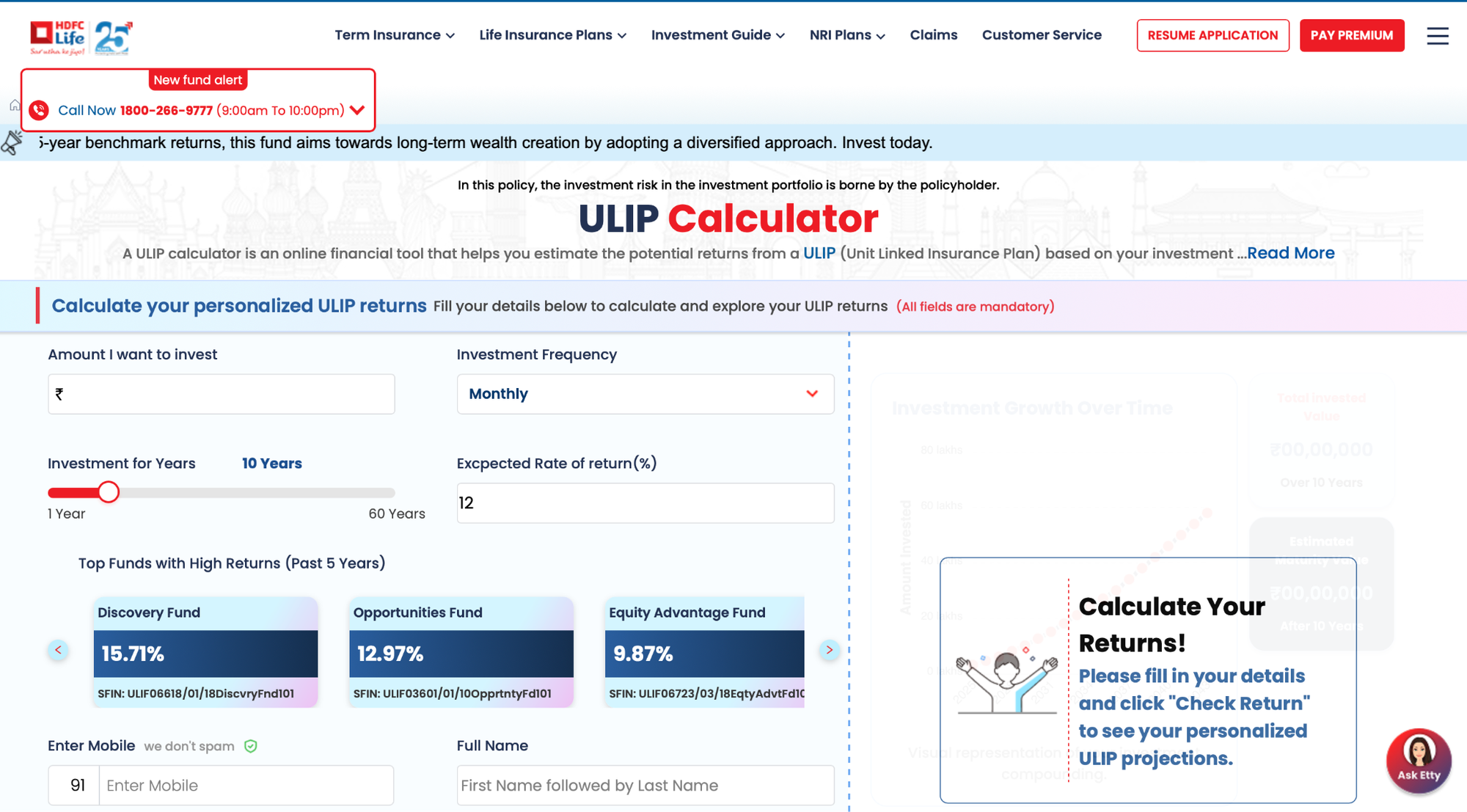
2) Enter the Investment Amount: Enter the premium amount that the policyholder intends to invest.
3) Select the Investment Frequency: Choose whether the premium will be paid monthly or annually.
4) Choose the Investment Tenure: Use the slider to select the investment term, ranging from 1 to 60 years.
5) Enter the Expected Rate of Return: Enter an assumed rate of return to generate the projected maturity value. Run the calculation at 4% and 8% to illustrate different return scenarios.
6) Complete OTP Verification: Enter your mobile number, full name, and date of birth, then complete OTP verification to view HDFC Life’s personalized calculator projection.
7) Review the Results: The calculator displays the total amount invested, estimated maturity value, and a growth chart based on the selected inputs.
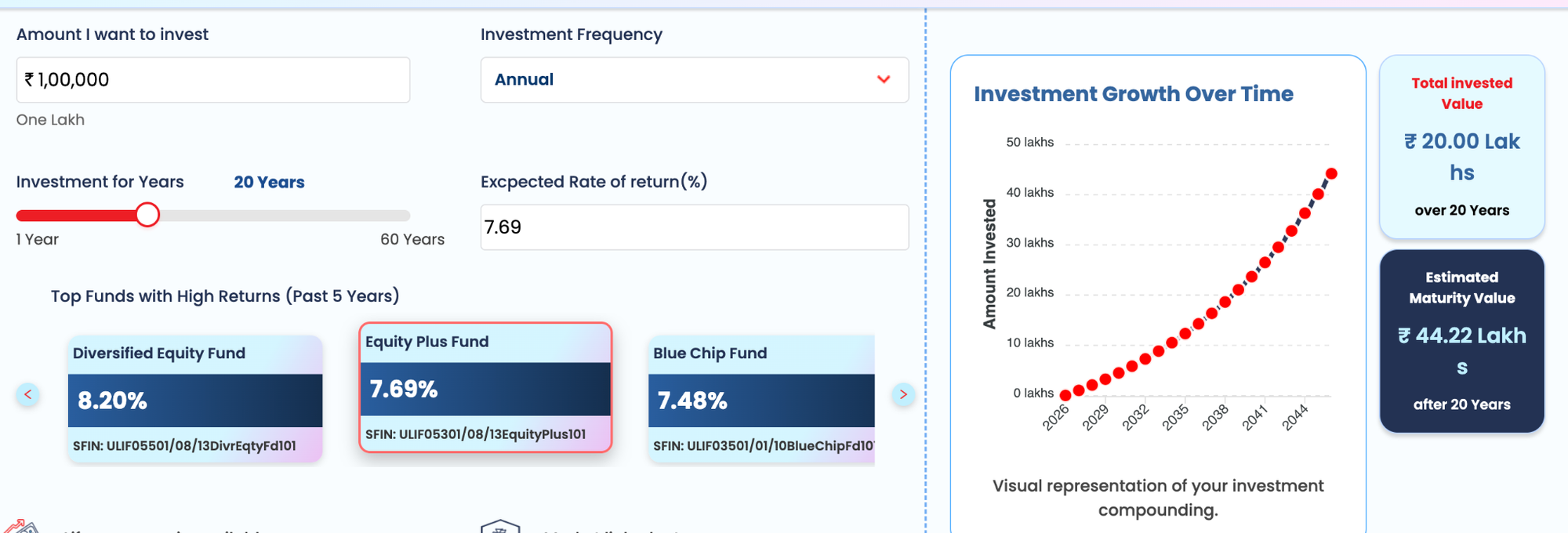
Let’s understand with an example. In the image below, we have taken an investment amount of ₹1,00,00 with an annual frequency, invested for the next 20 years. The expected rate of return is 7.69% (Equity Plus fund). Over the next 20 years, the estimated maturity value is ₹44.22 lakh, as per the HDFC ULIP calculator.
Disclosure: This article uses the official HDFC Life ULIP calculator and does not use third-party calculators for its return illustrations. All return figures shown in the article are illustrative and not guaranteed.
Note: This should not be confused with the policy-specific customized benefit illustration issued during the sales process. The official benefit illustration reflects the selected plan, policy details, applicable charges, and prescribed regulatory return assumptions.
Talk to an expert
today and
find
the right
insurance for you.


What Inputs Are Required to Calculate HDFC Life ULIP Returns?
To estimate the potential returns using the HDFC Life ULIP calculator, the following details may be required:
- Date of Birth: The policyholder’s age can affect factors such as the mortality charge and, for a personalized quote, the applicable sum assured.
- Investment Amount: The premium amount the policyholder plans to invest.
- Investment Frequency: The premium payment frequency, such as monthly or annually.
- Policy Tenure: The period for which the policyholder intends to remain invested. ULIPs typically have long-term investment horizons.
- Expected Rate of Return: While the public calculator lets you test an assumed return, customized benefit illustrations for non-guaranteed life insurance products use the IRDAI-prescribed 4% and 8% gross return scenarios
- Fund Choice: For a personalized illustration, the selected HDFC Life ULIP fund can affect the investment's risk profile and applicable Fund Management Charge.
What Factors Affect HDFC Life ULIP Returns?
HDFC Life ULIP returns depend on more than the rate entered into the calculator. The main factors include market performance, fund allocation, investment horizon, and applicable policy charges.
- Market Performance: ULIPs are market-linked, so returns depend on the performance of the underlying securities. The calculator's assumed return is for illustration only.
- Equity and Debt Allocation: The fund's allocation between equity and debt affects its risk and return potential. Equity funds have higher growth potential and volatility than debt funds.
- Investment Horizon: ULIPs have a mandatory 5-year lock-in. Staying invested longer gives the investment more time to compound.
- Policy Charges: Charges deducted during the policy term reduce the amount invested or the fund value, affecting the final maturity value.
Ditto’s Take: A higher projected return does not necessarily mean a higher actual maturity value. Charges are deducted at different stages and can reduce the amount available for investment and the overall corpus. Therefore, view the calculator's projection as an illustration rather than a guaranteed return.
Similarly, do not treat the historical returns of HDFC Life’s funds as the expected return from the ULIP. The fund's performance is market-linked, and applicable charges, including fund management charges and mortality charges, can reduce the policyholder's final maturity value.
Calculator vs. Official Benefit Illustration
HDFC Life ULIP Calculator vs SIP Calculator: What's the Difference?
Both calculators estimate the future value of an investment, but they apply to different financial products and account for different costs. A SIP calculator estimates the future value of regular mutual fund investments based on the investment amount, tenure, and assumed rate of return. It does not account for life insurance or mortality charges.
The HDFC Life ULIP calculator estimates the potential value of a market-linked insurance product that combines investment with life cover. ULIPs can include charges such as mortality, fund management, premium allocation, and policy administration charges, depending on the plan. Moreover, the investment is subject to a 5-year lock-in period.
ULIP fund management charges can be up to 1.35% a year, depending on the fund. Direct mutual fund expense ratios vary by scheme, so compare the total costs of both products rather than looking at a single charge. These differences can affect the net returns.
Therefore, don't use the two calculators interchangeably. When comparing products, consider both the potential investment value and the insurance component. An ULIP vs. mutual fund comparison can help assess the differences in costs, liquidity, and returns, while an ULIP vs. term insurance comparison can help evaluate the adequacy of the life cover.
HDFC Life ULIP Calculator: Sample Illustrations
The HDFC Life Click 2 Wealth brochure provides an illustration for a 35-year-old male paying an annual premium of ₹50,000 for 20 years, with 100% of the premium invested in the Liquid Plus segregated fund. The figures below are based on assumed gross returns of 4% and 8% and are illustrative, not guaranteed.
This is a mathematical illustration using the same ₹50,000 annual contribution schedule. It is not an HDFC Life policy illustration. It is shown only to help readers understand the gap between gross assumed returns and actual policy illustrations.
At Ditto, we evaluate ULIPs by going beyond the brochure’s 4% and 8% gross return illustrations. We use the illustrated premiums and maturity values to calculate the net return or IRR and assess how much of the assumed return reaches the policyholder after accounting for applicable charges. This helps show the net policy outcome after applicable charges and other plan features. To understand the fund’s performance, underlying investments, and asset allocation, investors can also refer to HDFC Life’s fund performance page.
Why Choose Ditto for Life Insurance?
At Ditto, we’ve assisted over 12,00,000 customers choose the right insurance policy. Why customers like Vijay love us:

- 100% Free Consultation
- No Spam. No Sales Pressure.
- Rated 4.9/5 on Google Reviews by 30,000+ Happy Customers
- Backed by Zerodha
- Dedicated Claim Support Team
- Compare Plans and Premiums with a Trusted Insurance Advisor
Confused about the right insurance? Speak to Ditto’s certified advisors for free, unbiased guidance. Book your call now or chat with us on WhatsApp. Slots fill up fast!
Conclusion
The HDFC Life ULIP calculator can help estimate a policy’s potential maturity value, but it does not predict actual returns. Since ULIPs are market-linked, the final value depends on fund performance, market conditions, and the charges deducted during the policy term.
The 4% and 8% illustrations should be treated as hypothetical scenarios, not expected or guaranteed returns. Consider the impact of mortality, fund management, and other applicable charges before evaluating the projected corpus.
If you want to combine life insurance with market-linked investments, consider an HDFC Life ULIP after assessing the policy's costs, fund options, and life cover. For long-term wealth creation, compare it with mutual funds and a standalone high-cover term insurance plan before investing. If reliable life protection is the priority, explore our guide on the best term insurance plans in India.
Frequently Asked Questions
Last updated on: