



Overview
Wondering how much you may get if you surrender your SBI Life policy before maturity?
An SBI Life surrender value calculator can help estimate the amount you may receive based on premiums paid, policy term, sum assured, and accumulated bonuses or guaranteed additions.
This guide explains how SBI Life calculates surrender value, the difference between Guaranteed Surrender Value (GSV) and Special Surrender Value (SSV), and the factors that can affect the final payout.
What Is the SBI Life Insurance Policy Surrender Value Calculator?
An SBI Life insurance surrender value calculator helps estimate how much you may receive if you surrender your policy before maturity. The calculation considers your policy type, sum assured, premiums paid, policy year, accrued bonuses or guaranteed additions, and applicable Surrender Value Factor (SVF).
For traditional SBI Life plans, the surrender value is determined using the Guaranteed Surrender Value (GSV) and Special Surrender Value (SSV). For example, an SBI Life Smart Platina Assure surrender value calculator or an SBI Life Smart Platina Plus surrender value calculator would use the applicable surrender value factors for those respective products.
For ULIPs, such as Smart Wealth Builder, the calculation works differently. An SBI Life Smart Wealth Builder surrender value calculator would consider the policy's fund value and applicable discontinuation charges, subject to the mandatory 5-year lock-in period.
How to Use the SBI Life Surrender Value Calculator Step by Step?
You can use an SBI Life insurance surrender value calculator to estimate your surrender value and then verify the actual amount with SBI Life.
- Identify Your Policy Type: Check whether you have a traditional savings plan, such as Smart Platina Assure or Smart Platina Plus, or a ULIP such as Smart Wealth Builder. The policy type determines how the surrender value is calculated.
- Gather Your Policy Details: Note your sum assured, annual premium, premium-paying term, policy term, and the number of years for which you have paid premiums.
- Check Surrender Eligibility: For traditional plans, check the minimum premium-payment requirement in your policy documents. ULIPs have a mandatory 5-year lock-in period.
- Calculate the Surrender Value: For traditional plans, calculate both the GSV and SSV using the applicable factors for your policy year.
- Compare the Values: The applicable surrender payout is based on the higher of the GSV and SSV.
- Verify the Amount: Check your personalized benefit illustration or SmartCare portal, or contact SBI Life directly, to confirm the actual surrender value before surrendering the policy.
Guaranteed Surrender Value vs. Special Surrender Value in SBI Life Policies
When an SBI Life traditional policy reaches a surrender value, the payout is determined by the Guaranteed Surrender Value (GSV) and Special Surrender Value (SSV), as applicable under the policy terms. The policyholder receives the higher applicable value.
1) Guaranteed Surrender Value (GSV)
The Guaranteed Surrender Value (GSV) is the minimum surrender value guaranteed under the policy terms once the policy becomes eligible for surrender.
A policy acquires GSV only after meeting the premium-payment conditions specified in the policy document. For example, under the SBI Life Smart Platina Advantage policy wording, the policy acquires GSV after at least two consecutive policy years' premiums have been paid.
The GSV is calculated using:
- Applicable GSV factors multiplied by eligible premiums paid
- Surrender value factors applied to accrued guaranteed additions, wherever applicable
The applicable GSV factors depend on the policy year, policy term, and product design. Since these factors vary across SBI Life plans, you can confirm the exact GSV only from the relevant policy document or SBI Life's records.
2) Special Surrender Value (SSV)
The Special Surrender Value (SSV) is a non-guaranteed surrender value calculated using product-specific surrender value factors. Under the SBI Life Smart Platina Advantage policy wording, SSV becomes payable after the first policy year, provided one full year's premium has been received.
The SSV calculation may consider premiums paid, policy duration, guaranteed additions or other applicable benefits, and the applicable SSV factors.
Unlike GSV, SSV factors are not fixed throughout the policy term. They may be reviewed periodically based on factors such as prevailing 10-year Government Security (G-Sec) yields and the insurer's underlying experience, subject to applicable regulatory requirements.
SBI Life Policy Surrender Value: Example Calculation
Consider a 30-year-old policyholder who purchases the SBI Life Smart Platina Advantage plan for a 30-year policy term, pays an annual premium of ₹1 lakh, and chooses a 10-year premium-paying term.
The benefit illustration shows the GSV, SSV, and surrender value payable at different policy years.
For example, in the first policy year, the GSV is not applicable, while the SSV is ₹36,754, making the surrender value payable ₹36,754. By the fifth policy year, the GSV increases to ₹2,56,080, while the SSV is ₹3,39,468. Therefore, the surrender value payable in that year is ₹3,39,468.
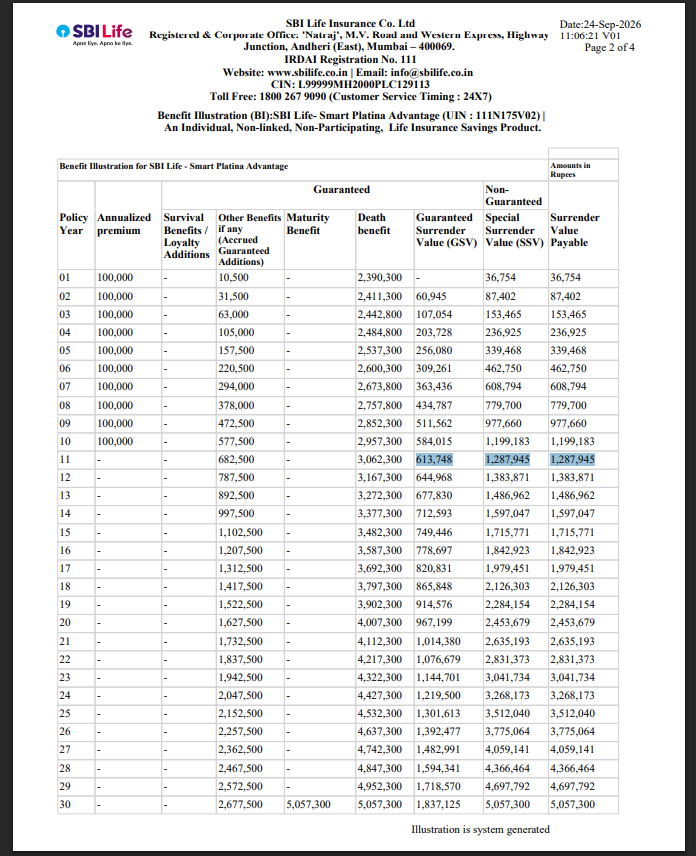
As shown in the benefit illustration, the surrender value increases as the policy continues:
In this example, the special surrender value is higher than the guaranteed surrender value, so the SSV becomes the surrender value payable. However, the actual surrender amount for your SBI Life policy will depend on your specific product terms, policy year, and applicable surrender value factors.
Note: These figures are specific to the SBI Life Smart Platina Advantage benefit illustration and should not be treated as representative of every SBI Life policy.
Talk to an expert
today and
find
the right
insurance for you.


Common Mistakes to Avoid Before Surrendering an SBI Life Policy
- Relying Only on Third-Party Calculators: Online calculators can provide an estimate, but they do not have access to your actual policy data. Always verify the final surrender value through the SBI Life SmartCare portal, your benefit illustration, or SBI Life customer service.
- Ignoring the Paid-Up Option: If you can no longer afford the premiums but do not need the money immediately, check whether your policy can be converted into a paid-up policy. This allows the policy to continue with a reduced benefit instead of surrendering it completely.
- Overlooking the Tax Impact: Surrender proceeds may be tax-free under Section 10(10D) if the applicable conditions are met. Otherwise, the proceeds may be subject to TDS under Section 194DA. Also, surrendering a policy within the applicable period may affect previously claimed Section 80C deductions (old regime). Consult a tax expert to understand the tax implications before surrendering your policy.
- Submitting Incomplete Documents: Make sure you have the required documents, such as the original policy document, canceled cheque or bank proof, identity proof, and duly completed surrender form. Missing documents can delay the processing of your request.
- Not Considering a Policy Loan: If your policy has acquired a surrender value and allows loans, check this option before surrendering. A policy loan may provide access to funds without terminating the policy altogether.
Important Update on IRDAI's Revised Surrender Value Rules
Why Choose Ditto for Life Insurance?
At Ditto, we’ve assisted over 12,00,000 customers with choosing the right insurance policy. Why customers like Aaron below love us:

- 100% Free Consultation
- No Spam. No Sales Pressure.
- Rated 4.9/5 on Google Reviews by 30,000+ Happy Customers
- Backed by Zerodha
- Dedicated Claim Support Team
- Compare Plans and Premiums with a Trusted Insurance Advisor
Confused about the right insurance? Speak to Ditto’s certified advisors for free, unbiased guidance. Book your call now or chat with us on WhatsApp. Slots fill up fast!
Conclusion
An SBI Life surrender value calculator can provide a useful estimate, but the actual amount depends on the specific policy, premium history, policy year, and applicable surrender value factors. Third-party calculators should be treated as estimates only. Before deciding, check your policy benefit illustration or contact SBI Life through its customer service portal, branch, or official support channel for the exact surrender value.
Before surrendering your SBI Life policy, check three numbers: the current surrender value, the future maturity benefit if you continue the policy, and the reduced paid-up benefit if you stop paying premiums. A policy that seems expensive today may still provide valuable benefits if it is closer to maturity.
If you decide to surrender, ensure you have adequate life insurance in place. A term insurance plan can provide significantly higher coverage at a much lower cost than traditional life insurance policies. You can also consider alternatives such as a paid-up policy or policy loan, depending on your financial needs.
Frequently Asked Questions
Last updated on: