

Health Insurance

Cashless Health Insurance: How It Works in India

Aaryaa Nagpal Jambhulkar

Written by Aaryaa Nagpal Jambhulkar

Insurance Writer

Gaurav Bhat

Reviewed by Gaurav Bhat

IRDAI-Certified Expert at Ditto

SP0738578124

Certified
Cashless Health Insurance: How It Works in India

Overview

Cashless Health Insurance lets you get medical treatment at network or empaneled hospitals without paying eligible hospital expenses upfront, as the insurer settles costs directly with the hospital.

How Cashless Claims Work

  • Submit your health insurance card or policy document and ID proof at the hospital insurance desk.
  • The hospital sends a pre-authorization form to the insurer or their Third-Party Administrator (TPA).
  • The insurer reviews and approves the treatment cost estimate.
  • The insurer pays the approved claim amount directly upon discharge.

Key Benefits

  • No Upfront Cash: Avoid arranging large sums during medical crises.
  • Minimal Paperwork: The process relies on pre-authorization forms rather than extensive post-treatment bills.
  • Cashless Everywhere: Access cashless facilities at non-network hospitals under specific terms with prior approval.

Common Exclusions

  • Non-medical expenses like registration fees, toiletries, and certain consumables.
  • Cosmetic or plastic surgery and self-inflicted injuries.
  • Expenses incurred beyond the permissible limits of your policy (room rent, copayments, disease-wise limits).

A hospital admission can create two immediate challenges: managing your health and arranging funds for treatment. And while the health impact is immediate, the financial stress often hits just as hard. Without a health insurance policy, you pay upfront, meaning you face medical and financial stress at the same time.

Cashless health insurance changes this. Instead of arranging large amounts during a crisis, you can get treated while the insurer settles eligible bills directly with the hospital.

In fact, according to the IRDAI Annual Report 2024–25, cashless settlements accounted for about 58% of total health insurance claims and 66.35% of the total claim amount paid (₹62,537.32 crore) by general and health insurers, highlighting how widely this model is now used.

In this guide, we explain how cashless works, when it applies, and the common mistakes that can delay your claim.

What Is Cashless Health Insurance and How Does It Work?

Cashless is a claim settlement mode, not a separate type of policy. Whether it’s an individual plan or family floater, the process remains the same.

Background Image

How the Cashless Process Works

01

Choose a Hospital and Inform Insurer

Go to a network hospital. Inform your insurer in advance for planned admissions, or within 24 hours of admission for emergencies.

02

Pre-Authorization Request

At the hospital third-party administrator desk, share your health card, ID, and medical details. The hospital sends a pre-authorization request with diagnosis, treatment plan, and cost estimate.

03

Insurer Review

The insurer checks coverage, waiting periods, and available sum insured, then approves, asks for more details, or denies cashless.

04

Treatment and Updates

If costs increase or treatment changes, the hospital sends an enhancement request for additional approval.

05

Discharge and Settlement

The insurer settles the eligible amount directly with the hospital. You pay only non-covered items, deductibles, or copayments.

IRDAI Timelines to Note:

    • Pre-Authorization: Decision within 1 hour of receiving a complete request
    • Discharge Approval: Within 3 hours of receiving a complete hospital submission.
    • If Delayed: The policyholder should not be burdened with costs arising solely because of that delay, subject to applicable regulations and circumstances.

What Happens in Practice

Timelines can vary slightly depending on document completeness and hospital coordination. As our claims manager, Akshat Bhatia, mentioned, approvals typically take around 2-4 hours once documents are complete and can extend to 24-30 hours if additional investigation is required. Hospitals may also sometimes ask for a refundable deposit of around ₹10,000-₹25,000 (or 5%-10% of the bill), especially for larger claims. Though this isn’t standard and ideally shouldn’t be required.

Cashless Denial vs. Claim Rejection

A cashless denial is not the same as a final claim rejection. Cashless approvals can be denied for practical reasons like missing documents, incomplete records during emergencies, or hospital-related delays, especially for early-stage claims under newer policies, even when the claim itself is valid. You can still proceed with treatment, pay the bill, and file a reimbursement claim by submitting all required documents.

Best Cashless Health Insurance Plans in India [2026]

Insurer and PlanClaim Settlement Ratio  (CSR) of the Insurer (Avg FY 2024 - 26)Network HospitalsDitto’s Score of the Insurer (Out of 5)
HDFC ERGO Optima Secure+97.61%16,000+4.99
Care Supreme95.45%11,400+4.23
Aditya Birla Activ One MAX96.25%16,500+4.49
Niva Bupa ReAssure 2.0 Platinum+92.92%10,000+4.23
SBI Super Health Platinum Infinite95.94%18,000+3.79

At Ditto, we shortlist insurers with a strong hospital network (10,000+ hospitals), Claim Settlement Ratio, and Incurred Claims Ratio (ICR).

For cashless claims, a larger network improves your chances of accessing treatment at a nearby hospital, especially if your preferred hospitals are in the network, while a consistent CSR reflects dependable claim handling during approvals and final settlement.

However, these are not the only selection criteria. We use a structured evaluation approach to shortlist plans that perform well in real-world scenarios. We assess insurers based on reliability and scale using our insurer rating framework, which looks at:

We use these benchmarks as an initial filter before a deeper evaluation of coverage and features. For a deeper breakdown, refer to our guide on the best health insurance plans in India.

This data reflects the insurer as a whole and is sourced from IRDAI annual reports and public disclosures of listed insurers. To explore more such insights, refer to Ditto Data Lab.

What Is Cashless Everywhere: Claims Outside Your Network Hospital

In January 2024, the General Insurance Council (GIC) introduced Cashless Everywhere, an industry initiative that extends cashless treatment beyond an insurer’s network hospitals. While IRDAI sets strict timelines for claim processing, this framework expands access to cashless care at non-network hospitals, subject to certain conditions.

How Cashless Everywhere Works:

    • Planned Admissions: Inform your insurer at least 48 hours before admission so the hospital and insurer can coordinate approvals in advance.
    • Emergency Admissions: Intimation should be done within 48 hours of admission, once the patient is stabilized.
    • Hospital Eligibility: The hospital must typically have 15 or more beds, be registered under the Clinical Establishments Act (or relevant local authority), and must not be blacklisted by the insurer.

Note: It works best for planned treatments, since both the hospital and insurer need time to verify costs and documents. Approval is not guaranteed and depends on policy terms, treatment eligibility, and whether the hospital agrees to the cashless arrangement. It’s a useful backup option, not a replacement for a strong hospital network.

Cashless vs. Reimbursement Health Insurance: What's the Difference?

FeatureCashlessReimbursement
Upfront PaymentInsurer pays hospital directly.You pay first, claim later.
AvailablityNetwork hospitals (or eligible non-network via Cashless Everywhere).Any recognized hospital (apart from blacklisted ones), subject to policy conditions and insurer approval.
Pre-AuthorizationRequired before treatment.Not required (intimation still needed).
DocumentationMostly handled by hospital desk.You submit all bills and reports.
Processing Timelines (IRDAI)1 hour pre-authorization, 3 hours discharge approval.15 days from final document submission.

Common Cashless Health Insurance Claim Mistakes to Avoid

Even with the best cashless health insurance plans, administrative mistakes can derail your claim. Here’s what to watch for:

    • Not Checking the Latest Hospital Network Status: Always confirm on your insurer’s website or with the hospital desk right before admission.
    • Late Intimation for Planned Treatment: Inform your insurer 48–72 hours in advance to avoid last-minute issues.
    • Incomplete Pre-Authorization Details: Ensure the doctor provides a clear diagnosis, history, treatment plan, and cost estimate. Missing info leads to delays.
    • Ignoring Enhancement Requests: If costs increase (longer stay, ICU, complications), ask the hospital to raise an additional approval request immediately, not at discharge.
    • Missing Room Rent Limits: Choosing a higher room than allowed can trigger proportionate deductions across the entire bill.
    • Not Keeping Records: Save bills, reports, discharge summary, and timestamps (emails/SMS). You may need them later for follow-ups or reimbursement.

Why Choose Ditto for Health Insurance?

At Ditto, we’ve assisted over 12,00,000 customers with choosing the right insurance policy. Why customers like Pallavi love us:
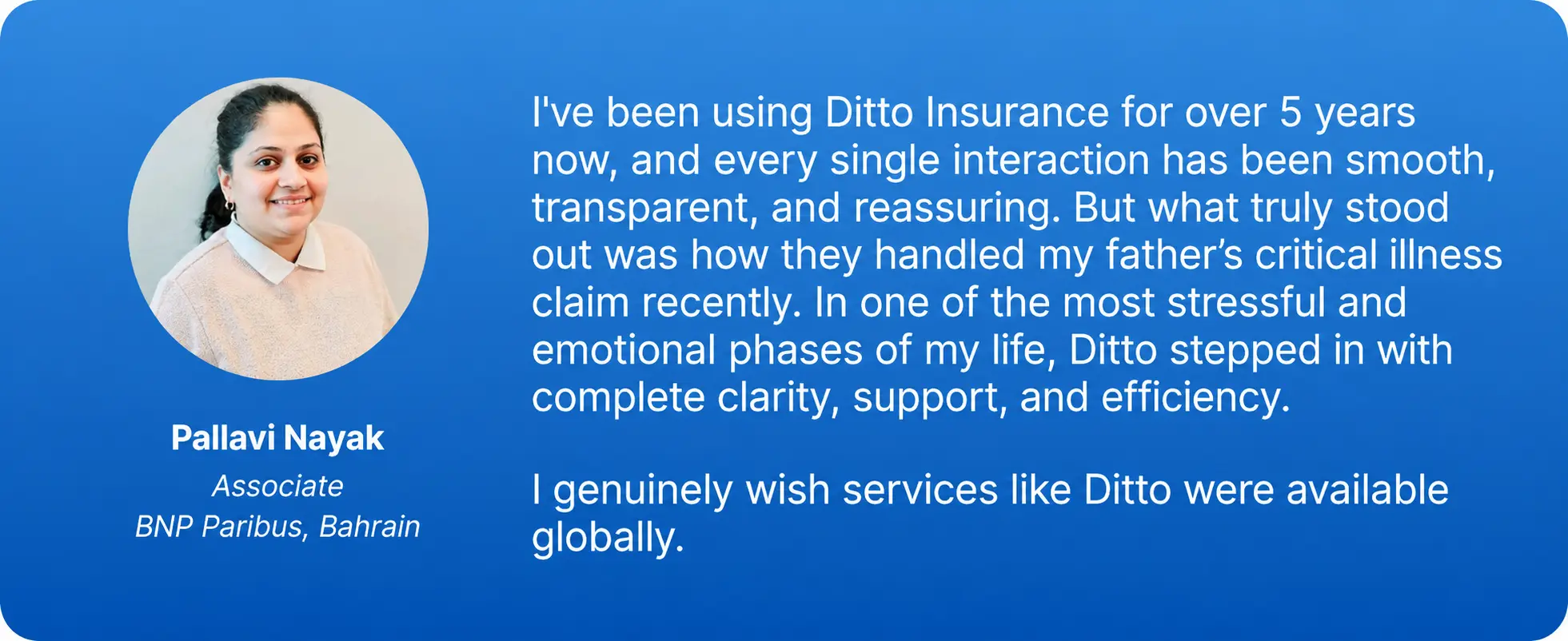
Pallavi Nayak LinkedIn Testimonial
    • 100% Free Consultation
    • No Spam. No Sales Pressure.
    • Rated 4.9/5 on Google Reviews by 30,000+ Happy Customers
    • Backed by Zerodha
    • Dedicated Claim Support Team
    • Compare Plans and Premiums with a Trusted Insurance Advisor

Confused about the right insurance? Speak to Ditto’s certified advisors for free, unbiased guidance. Book your call now or chat with us on WhatsApp. Slots fill up fast!

Conclusion

Understanding how cashless health insurance works can help you handle hospitalization without financial panic. While it simplifies the process, things still depend on basics like choosing network hospitals, informing your insurer on time, and knowing your policy limits.

This is where Ditto’s Rule of 5 comes in. Instead of relying on a long list of thousands of network hospitals, identify the 5 nearest cashless multispecialty hospitals covered under your policy and keep them easily accessible.

Here’s what you can do right now:

Write down the 5 closest cashless hospitals on a sticky note and save the list on your phone.

Keep separate lists for family members if needed:

    • 5 hospitals with pediatric care for children
    • 5 hospitals with geriatric care for elderly parents
    • 5 general hospitals for everyone else

Why 5? The nearest hospital may not have beds available, while another may not have the right specialist. In an emergency, backup options matter.

You can find these hospitals by opening your insurer’s app, searching “network hospitals near me,” and filtering for multispecialty hospitals.

Remember, a large hospital network looks impressive on paper, but the hospitals that actually matter are the ones you can reach quickly when you need them.

Frequently Asked Questions

Is cashless health insurance the same as a specific type of health insurance policy?

No, a cashless health insurance policy only changes how claims are settled, not what your policy covers. It is a claim settlement method in which the insurer pays eligible hospital bills directly to the hospital. Most health insurance policies include this feature, whether you choose an individual plan or a family floater. Your policy's coverage, benefits, and terms remain the same; only the claim settlement process differs.

Why do health insurers offer a cashless facility?

Health insurers offer cashless treatment to provide immediate financial support during medical emergencies by removing the need for upfront payments. It also allows insurers to manage costs more effectively through pre-negotiated rates with network hospitals. At the same time, digital verification streamlines the process, helping reduce fraud, lower administrative effort, and speed up claim approvals and settlements.

How much advance notice do I need to give my insurer for a planned cashless admission?

For planned hospitalization, you should inform your insurer 48 hours before admission. This gives the hospital and insurer enough time to review the treatment plan, verify coverage, and approve the cashless request. In emergencies, you should inform your insurer within 24–48 hours after admission, once the patient is stabilized and basic documentation is available.

What expenses do you pay even with cashless treatment?

Cashless approval only covers admissible expenses under your policy, not the entire hospital bill. You will still need to pay for non-medical items such as gloves, gowns, and toiletries, along with charges like registration or administrative fees. You must also pay any deductibles, copayments, room rent limit breaches, or expenses beyond your sum insured at discharge.

What documents does the hospital's insurance desk need for a cashless claim?

To process a health insurance cashless claim at the hospital insurance or TPA desk, you’ll need to provide your health card or policy details, a valid government ID (Aadhaar/PAN), the doctor’s admission note, and relevant diagnostic reports and medical history. The hospital uses these to complete a pre-authorization form with your diagnosis, treatment plan, and estimated costs, then sends it to the insurer for approval.

Can a hospital refuse to offer cashless treatment even if I have a cashless policy?

Yes, a hospital can refuse cashless treatment in certain situations. This may happen if the hospital is not part of your insurer’s network, if its empanelment has expired, or if there are disagreements on treatment tariffs. Even with top cashless health insurance plans in India, cashless depends on an active network tie-up. If cashless is declined, you can still proceed with treatment, pay the bill yourself, and later file a reimbursement claim.

How does the Cashless Everywhere initiative work at a non-network hospital?

Introduced by the General Insurance Council, Cashless Everywhere allows eligible policyholders to request cashless treatment at certain non-network hospitals, subject to insurer and hospital acceptance and applicable policy terms. The hospital must be registered with local health authorities and typically have at least 15 beds. For planned admissions, you need to inform your insurer 48 hours in advance, while emergencies require intimation within 48 hours of admission. Final approval still depends on the hospital agreeing to the insurer’s terms.

Will I still have to pay anything upfront on a cashless health insurance claim?

Yes, you may still need to pay some amount upfront even in a cashless claim. Many hospitals collect a refundable security deposit (often up to 10% of the estimated bill) to cover non-payable items or potential delays in approval. This is adjusted against the final bill after insurer settlement. You will still have to pay for exclusions like consumables, deductibles, copayments, or costs beyond the sum insured, with refunds processed after claim closure.

Should I keep reimbursement as a backup even with a cashless policy?

Yes, cashless claims can sometimes be denied because of practical issues like incomplete documentation, delays in emergency approvals, or disagreements between the hospital and insurer over treatment costs. However, this does not mean your claim is rejected. A cashless denial affects only the payment method. You can still go ahead with treatment, pay the bill yourself, and file a reimbursement claim by submitting all original bills, reports, and receipts for independent evaluation.

How do I choose the best cashless health insurance for family?

To choose the best cashless health insurance policy in India, compare key factors such as hospital network, claim settlement experience, coverage benefits, waiting periods, and exclusions. A strong cashless policy should give you easy access to quality hospitals in your area and a smooth, well-defined claim process. Instead of focusing only on network size, check whether the plan fits your family’s healthcare needs and usage patterns.

Last updated on: