


Health Insurance

Health Insurance After Divorce: What Changes and What to Do

Subhashish Banerjee

Written by Subhashish Banerjee

Insurance Writer

Gaurav Bhat

Reviewed by Gaurav Bhat

IRDAI-Certified Expert at Ditto

SP0738578124

Certified
Health Insurance After Divorce: What Changes and What to Do

Overview

Divorce can affect health insurance coverage, particularly when both spouses are covered under a family floater or employer-sponsored group policy. Health insurance after divorce is available across insurers like HDFC ERGO. 

Key Actions After Divorce

  • Notify the Insurer or Employer: Submit a written request with the divorce decree and any required forms. For employer-sponsored group insurance, contact the HR or benefits team.
  • Update the Policy: Ask the insurer to remove the former spouse from the covered-member list and issue an updated policy endorsement. 
  • Clarify Children's Coverage: Decide how children will remain insured based on the policy's eligibility conditions.

Coverage Options After Divorce

  • Individual Health Insurance: If you lose coverage under your former spouse's policy, consider an individual health plan promptly to avoid a break in coverage. 
  • Policy Migration or Portability: Eligible migration or portability may preserve continuity credits for waiting periods, subject to applicable rules and insurer approval.

Does divorce mean losing your health insurance along with your spouse? Not necessarily, but it can leave you with important coverage decisions. From removing your former spouse to protecting your children's coverage and preserving waiting period credits, a few timely steps can make a significant difference. 

This guide helps you manage your health insurance after divorce in India without leaving gaps in protection.

How Divorce Affects Your Existing Health Insurance

1) Separate Individual Policies

If both spouses have separate individual health insurance policies, they can continue independently after divorce. Neither policy automatically ends when the marriage ends. 

Both policyholders should update their personal details, contact information, payment arrangements, and nominee details where necessary.

2) Family Floater

If both spouses share a family floater health insurance plan, they may need to restructure the policy or arrange separate coverage. The available options depend on the insurer's terms. 

3) Employer-Sponsored Coverage

A former spouse covered under an employer-sponsored group plan may lose eligibility once the marriage ends. Check with the insurer or employer about the next steps.

Talk to an expert
today and find
the right
insurance for you.

Ditto Advisor
Background Image

Key Insights

01

You Can Request Changes Before the Divorce Is Finalized

You do not necessarily have to wait for the final divorce decree to request changes to your health insurance. You can approach the insurer at renewal and follow its prescribed process for removing a member or restructuring the policy.

02

You May Not Need Your Ex-Spouse's Signature

If your former spouse is the primary policyholder and you cannot coordinate with them, contact the insurer directly. Ask about removing yourself and applying for portability using your own Know Your Customer (KYC) documents, such as Aadhaar, and any other required records.

03

A Delayed Policy Update Does Not Automatically Invalidate Claims

Keeping your former spouse listed until renewal or delaying an endorsement does not usually give the insurer automatic grounds to reject a claim. However, inform the insurer and update the policy to avoid servicing or eligibility disputes later.

Can You Split a Family Floater Policy After Divorce?

Yes, you can explore ways to separate health insurance coverage after divorce. However, splitting a family floater does not create two identical individual policies. 

Option 1: One Spouse Retains the Policy While the Other Migrates

One spouse may continue with the existing family floater, while the other requests migration to an eligible individual policy. For example, if a couple has held a ₹10 lakh floater for five years, the departing spouse may be able to carry forward eligible waiting period credits to a new policy.

Option 2: Change the Policyholder 

If the spouse who purchased the policy does not need to retain it, ask the insurer whether it permits a policyholder change after divorce. Some insurers have specific procedures for such requests.

Option 3: Remove the Former Spouse and Arrange Separate Cover

The policyholder can request the insurer to remove the former spouse from the family floater. However, removal alone does not provide the departing spouse with independent health insurance. They should arrange separate coverage and confirm whether any continuity credits can be transferred.

What Happens to Your Children's Health Insurance Coverage After Divorce?

    • Children can remain on the existing family floater if they meet the insurer's eligibility conditions and the insurer approves the revised family composition.
    • The parent with custody does not automatically have to insure the child. Custody arrangements and insurance eligibility are separate matters governed by different rules.
    • Both parents may be able to insure the same child under separate policies, subject to eligibility. However, the same medical expense cannot be reimbursed twice.
    • A child's waiting period does not automatically restart after divorce. Eligible health insurance portability or migration can preserve continuity credits, while a completely new policy may have fresh waiting periods.

Documents Required to Split a Health Insurance Policy After Divorce

  • Existing Policy Documents: Keep your current policy copy and schedule handy. These confirm the policyholder, insured members, sum insured, coverage dates, and benefits.
    • Written Request and Application Forms: Submit a request for member removal or policy restructuring. Include the migration or portability application and a new proposal form, where required.
    • KYC and Medical Documents: Provide identity and address proofs, KYC details, medical history, and relevant reports to support the application and underwriting process.
    • Continuity and Claims Records: Previous policy copies, a continuity certificate, and claims history can help establish your insurance record and eligible continuity credits.

Note: After divorce, having independent health coverage becomes especially important for household women who previously relied on their spouse's corporate policy.

Explore suitable health insurance for women based on your age, medical needs, and budget. Choose a plan that offers adequate coverage and long-term financial protection.

Health Insurance Options After Divorce: Migration vs. Portability vs. New Policy

FeatureMigrationPortabilityNew Policy
InsurerRemain with the same insurer but move to another eligible health insurance product.Move your coverage to a different insurer, subject to its acceptance and underwriting requirements.Apply for a new policy with any insurer willing to accept your proposal.
Main PurposeMove to another product while retaining eligible continuity credits from the existing policy.Switch insurers while carrying forward eligible waiting period and other continuity credits.Obtain independent health coverage without relying on the previous family floater.
Waiting Period CreditsEligible waiting period credits from the existing policy carry forward to the new product.Eligible waiting period credits transfer to the new insurer, subject to applicable rules.Waiting periods begin afresh.
Moratorium CreditsEligible continuous coverage periods count toward the moratorium under applicable regulations.Eligible continuous coverage periods carry forward and count toward the moratorium.The moratorium period starts afresh under the new policy.
No-Claim BonusEligible accumulated no-claim bonus benefits may carry forward, subject to the product's terms.Eligible no-claim bonus benefits may transfer, subject to applicable portability rules and policy terms.Previous no-claim bonus benefits do not carry over to a new policy.
TimingUsually arranged around renewal. Midterm migration depends on the insurer's rules and policy terms.Apply within the prescribed portability window before renewal to allow the insurers to process the request.You can apply at any time, subject to the insurer's acceptance and policy issuance.

Why Choose Ditto for Health Insurance?

At Ditto, we’ve assisted over 12,00,000 customers with choosing the right insurance policy. Why customers like Pallavi love us:
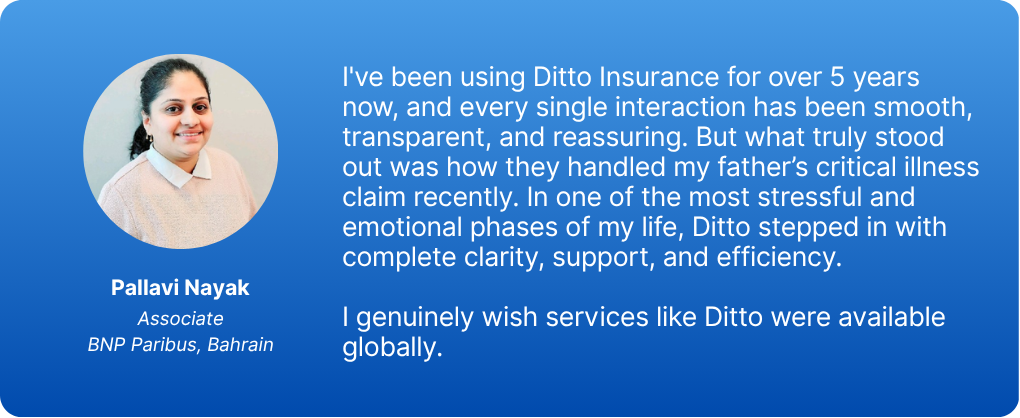
Pallavi Nayak LinkedIn Testimonial
    • 100% Free Consultation
    • No Spam. No Sales Pressure.
    • Rated 4.9/5 on Google Reviews by 30,000+ Happy Customers
    • Backed by Zerodha
    • Dedicated Claim Support Team
    • Compare Plans and Premiums with a Trusted Insurance Advisor

Confused about the right insurance? Speak to Ditto’s certified advisors for free, unbiased guidance. Book your call now or chat with us on WhatsApp. Slots fill up fast!

Conclusion

Divorce can change your health insurance needs, but it does not have to leave you without coverage. Notify your insurer or employer promptly and confirm the changes to your existing policy.

If you need a new policy, compare the best health insurance plans from insurers like HDFC ERGO and Care based on coverage, premiums, waiting periods, and eligibility. Prioritize continuity credits and adequate protection for yourself and your children.

Frequently Asked Questions

What is the ideal health insurance cover amount for a divorced woman in India?

There is no fixed amount that suits everyone. A cover of ₹15 lakh to ₹25 lakh can be a good starting point as it offers a much stronger buffer against medical inflation, depending on your age, city, medical history, and healthcare needs. You can also consider a super top-up plan for additional protection. If your wife was previously covered under your family floater, review her eligibility after divorce and explore separate health insurance for wife to ensure continued coverage. Factor in your existing employer coverage and financial responsibilities before choosing the sum insured.

Is an individual health insurance policy better than a family floater after divorce?

An individual policy often offers greater independence after divorce. You get a dedicated sum insured without sharing it with your former spouse. However, a family floater may still suit a parent and eligible dependent children. Compare premiums, coverage, waiting periods, and family composition before deciding. Your choice should reflect who needs coverage and their healthcare requirements.

Will my waiting periods restart if I move out of my husband's family floater policy after divorce?

Not necessarily. If you migrate to another eligible policy with the same insurer or port to a different insurer, applicable continuity credits can carry forward. These may include credits for pre-existing disease and specific waiting periods. A completely new policy may require fresh waiting periods. Confirm the transfer of credits before making the change.

Can my ex-spouse remain covered under my employer's group health insurance after divorce?

This depends on your employer's group policy and its definition of eligible dependents. Some schemes may end spousal coverage after divorce, while others may permit coverage under specific conditions. Inform your HR team and request written confirmation of the coverage end date. Your former spouse may also explore migration to an individual policy.

Can an insurer reject my claim if my ex-spouse remains listed on my health insurance policy after divorce?

Not automatically. Your former spouse's name does not necessarily invalidate the entire policy or lead to claim rejection. However, outdated membership details or incorrect declarations may create disputes. Inform the insurer about the divorce and request the required policy changes. Obtain an updated endorsement to avoid uncertainty during claims.

Can I change the proposer of a family floater policy to my name after divorce?

Yes, some insurers permit a change of proposer or policyholder after divorce, subject to their terms and approval. This change may be possible at renewal, depending on the insurer's process. You may need to submit the divorce decree, KYC documents, and a written request. Confirm how the change affects continuity credits and coverage.

Can I add my live-in partner to my health insurance policy after divorce?

This depends on the insurer's definition of eligible family members. Some insurers, including Aditya Birla, can offer coverage for live-in partners under eligible products. However, acceptance depends on the specific policy terms and documentation requirements. Check eligibility before purchasing or modifying your policy, as not every family floater allows this arrangement.

Can my children remain covered under my family floater policy if my ex-spouse has custody?

Yes, custody does not automatically determine a child's eligibility under a health insurance policy. The insurer's terms govern whether the child can remain covered under your family floater. You may need to submit the child's details and relevant documents. Confirm the revised family composition and preserve applicable waiting period credits when changing policies.

Last updated on: