

Health Insurance

Corporate to Individual Health Insurance After Retirement

Subhashish Banerjee

Written by Subhashish Banerjee

Insurance Writer

Gaurav Bhat

Reviewed by Gaurav Bhat

IRDAI-Certified Expert at Ditto

SP0738578124

Certified
Corporate to Individual Health Insurance After Retirement

Overview

You can migrate your corporate health insurance to an individual or family floater plan after retirement, subject to the insurer’s rules. 

How Migration Works

  • Same Insurer: Migration from a group health policy to an individual or family floater plan requires you to stay with the same insurer.
  • Continuity Benefits: Waiting periods already served for pre-existing diseases can carry over to the retail policy.

Corporate vs. Individual Health Insurance After Retirement

  • Ownership: A corporate or retiree group policy is managed by the employer/trust. An individual policy is owned directly by the policyholder.
  • Coverage Duration: Corporate coverage depends on the employer’s scheme and its terms. Individual policies are renewable for life.

Traps and Fine Print

  • Adding Dependents: Family members not covered under the group policy may face fresh underwriting when added to the retail plan.
  • Missed Migration Window: Missing the applicable deadline can affect your ability to migrate and retain benefits. 

Retirement brings a major change in your health insurance needs. Your corporate group policy may no longer protect you once you leave the organization. However, you can migrate it to an individual or family floater plan and retain eligible waiting period credits. 

This guide helps you understand how corporate to individual health insurance after retirement works, IRDAI portability guidelines, and how to convert your corporate health policy.

What Happens to Corporate Health Insurance After Retirement?

Your corporate health insurance does not always continue after retirement. What happens to your coverage depends on your employer’s group policy and post-retirement benefits.

    • Employer Coverage Ends: If the group policy does not include retiree benefits, your health insurance and your eligible dependents' coverage ends on the specified termination date.
    • Retiree Health Insurance: Some employers offer a separate group health policy for retired employees. Coverage continues under this scheme, subject to its terms and eligibility conditions.

Key Insights on Converting Corporate Health Insurance After Retirement

    • Apply Before Your Last Working Day: The migration deadline depends on your employer's group policy and the insurer's rules. Contact HR and the insurer well before retirement, and complete the formalities before your last working day wherever possible.
    • Porting to Another Insurer Is Possible: You can apply to port your corporate group health policy to another insurer, subject to applicable portability rules. However, the new insurer will assess your application and may apply fresh underwriting requirements.
    • A Two-Step Migration Is Not Always Necessary: Moving first to an individual plan with your existing insurer and porting later may not be required. The process depends on your medical history, continuity credits, and the new insurer's underwriting assessment.

Talk to an expert
today and find
the right
insurance for you.

Ditto Advisor
Background Image

Why Consider Converting Corporate Health Insurance to Individual Coverage?

01

Preserve Pre-Existing Disease (PED) Waiting Period Credits

Timely migration or portability can help carry forward eligible waiting period credits from your corporate policy. This is particularly valuable if you have conditions such as diabetes, hypertension, or heart disease.

02

Retain Credit Toward the Five-Year Moratorium

Eligible continuity credits can count toward the 60-month moratorium period. This helps you retain the protection built under your group policy, subject to the applicable sum insured and policy terms.

03

Gain Control Over Your Coverage

An individual policy lets you choose the insurer, sum insured, optional covers, and other policy features. You can select coverage based on your healthcare needs rather than your employer's group benefits.

04

Secure Long-Term Renewability

Individual health policies generally offer lifelong renewability. An insurer cannot refuse renewal solely because you made a claim, subject to policy terms and applicable regulations.

05

Reduce Dependence on Your Employer

Individual coverage remains independent of your former employer's decisions about group insurance. You can maintain protection even if the company changes its insurer, reduces benefits, or discontinues its retiree scheme.  Individual coverage remains independent of your former employer's decisions about group insurance. You can maintain protection even if the company changes its insurer, reduces benefits, or discontinues its retiree scheme.

IRDAI Guidelines for Health Insurance Portability in India

    • Health insurance portability is available for eligible indemnity-based individual, family floater, and group health insurance plans.
    • Apply for portability 30–60 days before your policy renewal date. Some insurers accept late applications, but delays can risk a coverage gap.
    • The new insurer has 15 days to review your application and decide after receiving all required documents.
    • The existing insurer must share the required policy and claims information within 72 hours of receiving the request. The acquiring insurer must communicate its decision within five days of receiving that information. 
    • If your existing insurer delays the transfer of information, your coverage must continue without interruption, subject to applicable IRDAI portability rules.

Steps to Convert Corporate Health Insurance Into an Individual Policy

1) Confirm When Your Corporate Coverage Ends

Contact HR or your benefits administrator to obtain the group policy certificate, Customer Information Sheet (CIS), and insurer details. Ask for written confirmation of your coverage end date and whether post-retirement benefits or continued group coverage are available.

2) Contact Your Existing Insurer

Inform your insurer about your retirement and request migration from the group policy to an individual or family floater plan. Ask for the available products, application forms, eligibility requirements, timelines, and premium quotations.

3) Collect Proof of Continuous Coverage

Gather your group insurance certificate, e-card, previous coverage records, retirement letter, KYC documents, and claims history. If your employer has changed insurers, collect records from earlier insurers to establish continuous coverage for each family member.

4) Choose a Suitable Individual Health Policy

Compare available plans based on premiums, room eligibility, co-payments, deductibles, disease-specific limits, restoration benefits, and hospital networks. Consider whether an individual policy or a family floater offers better coverage for your healthcare needs.

5) Submit Your Application and Disclose Medical History

Provide accurate details about existing illnesses, medications, surgeries, medical advice, and previous claims. Ask the insurer to explain how it will apply continuity credits and distinguish migration benefits from fresh underwriting requirements.

6) Review the Insurer's Offer Before Paying

Check the final premium, accepted sum insured, waiting periods, exclusions, co-payments, and any premium loading. If you choose a higher sum insured, confirm which portion receives continuity credits and which portion has fresh waiting periods.

7) Verify the Issued Policy and Continuity Credits

Once the policy is issued, check the schedule and endorsements for every insured member. Confirm the transferred waiting period and moratorium period credits, applicable sum insured, exclusions, and underwriting conditions. Keep the insurer's written approval for future reference.

Portability vs. Buying a Fresh Health Insurance Policy

FactorPortabilityFresh Policy
InsurerAllows you to move your existing policy to a different insurance company.Lets you choose any insurer that accepts your application.
Continuity CreditsEligible waiting period and moratorium credits carry forward to the new policy.Previous continuity credits generally do not carry over.
PED Waiting PeriodEligible time already served toward the pre-existing disease waiting period is credited.The new policy's applicable waiting period starts from the beginning.
UnderwritingThe new insurer assesses your application under its underwriting rules and can apply revised terms.The insurer conducts fresh underwriting based on your medical history and other details.
PremiumYou pay the premium quoted by the new insurer for the selected plan.You pay the premium quoted for the new policy and its chosen coverage.

Why Choose Ditto for Health Insurance?

At Ditto, we’ve assisted over 12,00,000 customers with choosing the right insurance policy. Why customers like Pallavi love us:
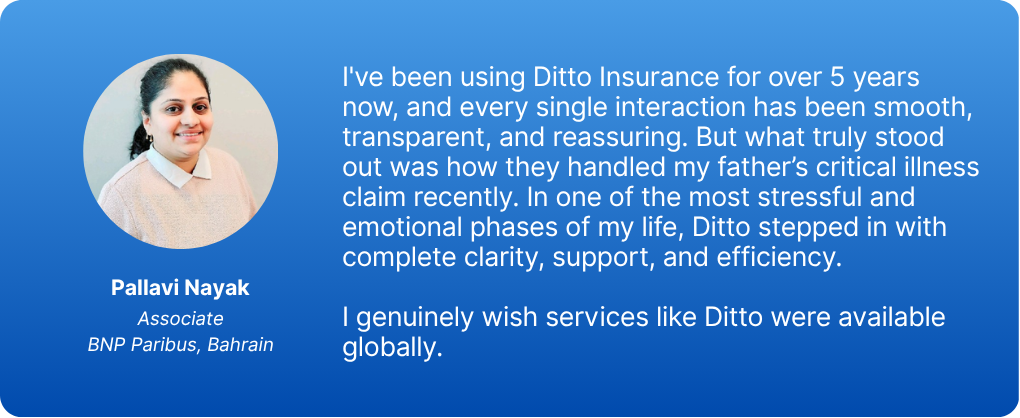
Pallavi Nayak LinkedIn Testimonial
    • 100% Free Consultation
    • No Spam. No Sales Pressure.
    • Rated 4.9/5 on Google Reviews by 30,000+ Happy Customers
    • Backed by Zerodha
    • Dedicated Claim Support Team
    • Compare Plans and Premiums with a Trusted Insurance Advisor

Confused about the right insurance? Speak to Ditto’s certified advisors for free, unbiased guidance. Book your call now or chat with us on WhatsApp. Slots fill up fast!

Conclusion

The biggest advantage of converting corporate health insurance after retirement is the ability to preserve eligible continuity credits. For retirees with years of uninterrupted coverage, these credits can be more valuable than small differences in annual premiums.

However, check your exact coverage termination date well before retirement. Your retirement date, the group policy's renewal date, and the date your employee coverage ends may not match.

Also, remember that migration preserves eligible continuity credits, not every benefit of your corporate policy. The new insurer can apply different room limits, co-payments, exclusions, and underwriting requirements. Review the final offer carefully before making the switch.

As retirement generally approaches around age 60, healthcare needs and medical expenses can rise. Explore health insurance for senior citizens to maintain adequate coverage after employer-sponsored benefits end.

Frequently Asked Questions

Is converted corporate health insurance sufficient to cover medical expenses after retirement?

It depends on the sum insured, your health needs, and healthcare costs in your city. With rising medical inflation, consider coverage of at least ₹15 lakh to ₹25 lakh because smaller policies (like ₹5 lakh to ₹10 lakh) quickly fall short against India’s high medical inflation, while upgrading to ₹25 lakh adds very little to your annual premium. Review your existing cover and explore a higher sum insured if it does not adequately protect you.

Can I convert my corporate health insurance into an individual policy with a different insurer after retirement?

Yes, you can explore portability from an employer's group health policy to another insurer under the applicable IRDAI rules. However, portability is generally exercised at policy renewal, and the new insurer may assess your application before accepting it. If you are retiring before the renewal date, contact your employer and both insurers early to understand the available options and avoid a coverage gap.

Will my pre-existing disease waiting period be waived when I convert my corporate health insurance after retirement?

No. Your pre-existing disease waiting period is not automatically waived when you migrate from a corporate group policy to an individual plan. However, eligible continuity credits from your previous coverage can carry forward, subject to applicable regulations and policy terms. Confirm the credited period with your insurer before accepting the policy.

Can I cover my spouse and dependent parents under a family floater policy when converting my corporate health insurance after retirement?

Yes, you can be able to cover your spouse and dependent parents under a family floater policy. However, this depends on the insurer's available products and eligibility rules. Check the maximum entry age, family composition rules, and premium before applying. Separate individual policies are also worth considering for older parents.

How long after my last working day can I apply to convert my corporate health insurance?

The application window depends on the insurer's migration process and the group policy terms. Contact your insurer and HR team well before retirement. Obtain written confirmation of the deadline to avoid losing eligible continuity benefits.

Do I need to undergo a medical check-up when converting my corporate health insurance into an individual policy after retirement?

Not necessarily. The insurer evaluates your age, medical history, existing conditions, and other risk factors before deciding whether medical tests are required. Depending on the assessment, it may request health check-ups, medical reports, or additional information before issuing the individual policy.

Can I port my converted corporate health insurance policy to another insurer after one year?

Yes. Once your corporate group cover has been migrated to an individual or family floater retail policy, you can generally apply for portability at renewal after completing one year of continuous coverage. The new insurer will assess your application under its underwriting rules. Eligible continuity credits can carry forward, subject to portability regulations.

Will the individual premium be the same as the corporate premium?

Usually not. Corporate health insurance premiums are based on group arrangements and include employer contributions or negotiated rates. Individual policy premiums depend on factors such as your age, sum insured, insured family members, selected benefits, and applicable underwriting or pricing rules. You therefore might need to pay more after retirement.

Last updated on: