



Overview
The term insurance market in India has seen growing awareness around Return of Premium (ROP) variants, especially among first-time buyers who like the idea of getting their premiums back at maturity. Many people searching for term life insurance with a maturity benefit assume it offers both protection and wealth creation. However, these plans are significantly more expensive than pure term insurance and are generally not recommended from a financial planning perspective, since the higher premiums do not translate into better returns or higher life cover.
This guide explains how term insurance with maturity benefits works and, more importantly, whether TROP is actually the right choice for you.
What is Term Insurance with Maturity Benefit (TROP)?
Term insurance with a maturity benefit, also called Term Insurance with Return of Premium (TROP), is a type of term plan that refunds your base premiums if you survive the full policy term.
For example, if you pay ₹25,000 annually for 30 years and complete the policy term without any claim, the insurer returns ₹7.5 lakh at maturity.
Unlike regular term insurance, where there is no payout on survival, TROP adds a refund feature. However, this refund is limited to the premiums you paid. There are no bonuses, investment returns, or profit-sharing benefits.
- What Gets Refunded: 100% of base premiums paid, excluding GST, rider premiums, and additional charges.
- What Does Not Get Refunded: Taxes, rider costs, and any extra charges. If a death claim is paid during the term, no maturity benefit is applicable.
- What To Watch Out For: If the policy lapses, is surrendered early, or becomes paid-up, the refund may be significantly reduced or not be payable at all.
How Does Return of Premium (ROP) Work in Term Plans?
Let’s use a real example. A 30-year-old non-smoker buying a ₹1 crore cover till age 70 gets the following:
- ROP variant premium of HDFC Life Click 2 Protect Supreme Plus: ₹30,306/year
- Pure term plan premium: ₹13,753/year
Over 40 years, the ROP plan returns:
- ₹30,306 × 40 = ₹12,12,240
There is no interest, bonus, or investment growth. It is simply your base premiums returned.
Now look at the cost difference:
- Total extra paid over 40 years = ₹6,62,120
- Extra premium paid for ROP = ₹16,553/year
If this ₹16,553 yearly difference is invested separately instead, the outcome changes significantly:
In comparison, the ROP plan returns only ₹12.12 lakh. More importantly, unlike TROP, where your money is locked in for the entire policy term, investing via mutual funds offers liquidity, flexibility, and potential for compounding, making it a more efficient way to build wealth while staying protected.
Talk to an expert
today and
find
the right
insurance for you.


Popular Term Insurance with Maturity Benefit Plans in 2026
Insurers typically structure Term Insurance with Return of Premium (TROP/ROP) in three ways, depending on how the benefit is integrated into the product:
- As a Variant Within a Flagship Plan: In this approach, ROP is offered as one of the built-in variants under a core term insurance plan. Buyers can choose the ROP version at the time of purchase, alongside other variants with different benefit structures.
Example: Bajaj Life eTouch II (Life Shield ROP variant) - As an Add-On or Optional Feature: Here, the ROP benefit is available within the same plan, allowing you to include it while customizing your base policy. This structure offers more flexibility in combining ROP with other features or riders.
Example: HDFC Life Click 2 Protect Supreme Plus (ROP option within the base plan) - As a Separate Standalone Plan: If the insurer’s flagship term plan does not include an ROP option, they may offer it as a completely separate product designed specifically with a return-of-premium benefit.
Example: ICICI Life iProtect Smart and its ROP counterpart, ICICI Life iProtect Smart Return of Premium
There is no single best term insurance with a maturity benefit for everyone. The right choice depends on your age, premium budget, policy term, eligibility, riders, and whether the refund feature is worth the extra cost. In most cases, Ditto still recommends comparing these ROP variants against pure term plans before making a decision.
1) HDFC Life Click 2 Protect Supreme Plus (With ROP Option)
Key Features
- ROP add-on returns 100% of base premiums if no claims are made till maturity, with a maximum possible policy tenure of 40 years
- Accidental Death Add-on
- Disability & Critical Illness Premium Waiver
- Income benefit on accidental disability
- Inflation-linked cover increase
- Critical illness cover (60 illnesses)
- Life stage increase option
- Terminal illness cover (up to ₹2 crore)
Drawbacks
- Premiums are higher compared to other ROP-enabled plans
2) Axis Max Life Smart Term Plan Plus (ROP Variant)
Key Features
- Returns 100% of base premium paid if no claims are made till maturity (including extra underwriting premiums or modal loadings, if any)
- Accidental Death & Disability Benefit Option
- Critical illness cover (up to 64 illnesses)
- Regular (Level) or Smart Cover (1.5x coverage for the first 15 years)
- Waiver of premium on disability or critical illness
- Terminal illness benefit (up to ₹1 crore)
- Zero-cost exit option and women-specific benefits (Lifeline Plus and discounts)
Drawbacks
- ROP premiums are high, often close to twice that of regular term plans
- Critical illness rider has term limits and is not available with all pay modes
- No top-up feature to increase coverage
3) Bajaj Life eTouch II (Life Shield ROP Variant)
Key Features
- Returns 100% of the base premium paid if no claims are made till maturity
- Accidental death benefit
- Life stage benefit (increased coverage after marriage or childbirth)
- Critical illness cover (60 illnesses)
- Waiver of premium on accidental total and permanent disability
- Terminal illness cover and zero-cost option
Drawbacks
- Does not offer an increasing cover variant
- Brand recall is lower compared to larger insurers like HDFC or ICICI
4) ICICI Life iProtect Smart Return of Premium
Key Features
- Flexible policy and premium payment terms, including Limited Pay (5, 7, 10, 12, or 15 years) and Regular Pay, with policy terms ranging from 20 to 40 years
- Multiple death benefit payout options: lump sum, income over 5 years, or a combination
- Optional riders such as Accidental Death Benefit and Accidental Total & Permanent Disability
Drawbacks
- Does not offer an inflation-linked cover increase
- Slightly higher complaint volume compared to some peers
5) Aditya Birla Sun Life Super Term Plan (ROP Variant)
Key Features
- Returns 100% of base premiums if no claims are made till maturity
- Accelerated critical illness benefit (42 illnesses)
- Waiver of premium on accidental total and permanent disability
- Life stage flexibility and terminal illness payout
- Cover continuance (premium deferment up to 12 months)
- Early exit value (available only in non-ROP variants)
Drawbacks
- Limited rider flexibility with the ROP option
- Some features are not available when ROP is selected, reducing customization
Note: These are ROP variants of some of the best overall term insurance plans in India. While the base plans are among our top recommendations for pure protection, the ROP versions come at a significantly higher cost. If your priority is maximum coverage at the lowest cost, you should also review pure term plans before deciding.
Return of Premium Variants or Base Plans: Which Is Better?
Note: The sample premiums above are for a 25-year-old male, non-smoker, opting for a ₹1 crore cover till age 60, without first-year discounts.
Key Insights: ROP variants cost 80–125% more than pure term plans, even though the life cover remains the same. For example, with Bajaj Life eTouch II, the ROP variant costs about ₹7,500 extra every year. Over 35 years, this difference can grow to roughly ₹10–11 lakh if invested separately at 7% returns. In comparison, the ROP plan simply refunds the premiums paid, without any growth.
Why Choose Ditto for Term Insurance?
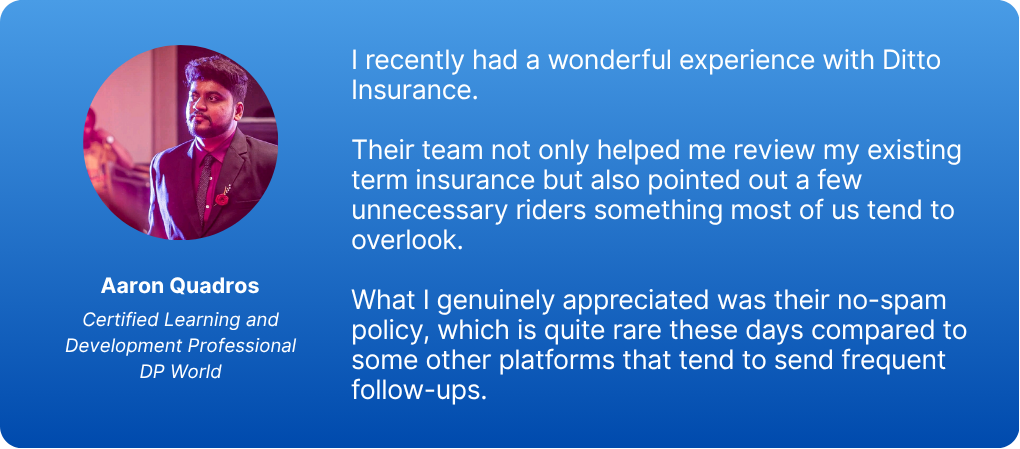
At Ditto, we’ve assisted over 8,00,000 customers with choosing the right insurance policy. Why customers like Aaron below love us:
- No-Spam & No Salesmen
- Rated 4.9/5 on Google Reviews by 15,000+ happy customers
- Backed by Zerodha
- Dedicated Claim Support Team
- 100% Free Consultation
You can book a FREE consultation. Slots are running out, so make sure you book a call now or chat over WhatsApp with our advisors.
Ditto’s Take
At Ditto, we generally do not recommend Return of Premium (TROP) plans. While the idea of getting your premiums back at maturity may sound attractive, these plans are usually far more expensive than pure term plans for the same life cover and do not generate any real returns.
For most buyers, it makes more financial sense to choose a pure term plan and use the premium savings to either increase the life cover or invest separately. While a term insurance plan with maturity benefit may feel emotionally reassuring, the math usually works against it because the refund does not include meaningful growth.
If the idea of recovering premiums is important to you, a zero-cost (smart exit) term plan can be a better alternative. It offers the flexibility to exit at a later stage and recover premiums without paying the significantly higher cost associated with TROP plans.
Before choosing any plan, compare options carefully and ensure that your life cover is adequate for your family’s needs. If you are evaluating term insurance options, you can also explore our detailed guide on the best term insurance plans in India.
Frequently Asked Questions
Last updated on: