



Overview
Despite rapid digital adoption, insurers’ online direct sales contributed just 0.87% of individual life insurance new business premiums in FY 2025, up from 0.65% in FY 2024. This clearly shows that most Indians still prefer buying term insurance offline through agents or advisors. So, when comparing term insurance plans, the real question is not just about price. It is about guidance, disclosures, trust, and how comfortable you are managing the process yourself.
In the next few minutes, we will walk you through the advantages of online buying, why some people prefer offline purchasing, and which mode is right for you.
Note: Term plans and most core features offered by the insurer remain the same regardless of how you buy them. There is no separate category called “online term insurance” or “offline term insurance.”
Online vs. Offline Term Insurance: Key Differences
Key Insights:
- Many people choose offline term insurance, assuming the agent will assist with claims years later. In reality, agents may switch careers, retire, or may not remain available throughout the policy tenure. Your nominee should always know how to contact the insurer directly.
- Buying offline does not improve approval chances or guarantee lower premiums. The insurer’s underwriting team follows the same medical, income, and risk assessment standards regardless of the purchase channel.
Advantages of Buying Term Insurance Online
- Easy Comparison Across Multiple Insurers: Buying term insurance online gives you the freedom to compare plans without pressure from insurance agents or sales teams. You can easily check the sum assured, policy term, premium payment options, and overall pricing across insurers. This helps you focus on the quality of protection instead of choosing a plan based on sales influence or personal relationships.
- Full Control Over Your Proposal Form: One major advantage of buying term insurance online is that you fill out the proposal form yourself. This reduces the risk of incorrect disclosures or missing information. Details related to smoking, alcohol use, medical history, occupation, income, and existing policies play a major role in claim approval. Honest disclosure is extremely important. Even small omissions can create problems during claim settlement later.
- Easier Access to Policy Documents: Online term insurance gives you direct access to important policy documents immediately after issuance. You can review the policy schedule, nominee details, rider information, and proposal form copy at your convenience. This makes it easier to spot mistakes early.
- Faster, Simpler, and More Convenient: For most straightforward cases, online buying saves time and reduces paperwork. You can compare term plans, upload documents, complete payments, and track your application without visiting branches or following up repeatedly with agents.

Why Some People Prefer Buying Term Insurance Offline?
Personal Guidance Helps Buyers Make Better Decisions
Many people are unsure about how much life cover they actually need, which payout option works best for their family, or whether riders are worth adding. Offline buying feels easier because an advisor can explain these details step by step. A good advisor helps buyers understand the policy clearly instead of simply pushing a sale.
Extra Support With Health and Income Disclosures
Term insurance approval depends heavily on accurate disclosure of medical history, smoking habits, income, occupation, and existing insurance policies. Buyers with medical conditions often prefer offline assistance because they want help filling out the proposal form correctly and avoiding mistakes that could create claim issues later.
Helpful for Self-Employed Buyers
Self-employed applicants usually face stricter income verification during underwriting. Insurers may ask for Income Tax returns (ITRs), bank statements, balance sheets, profit and loss statements, or CA-certified documents. Offline support can make this process smoother by helping buyers organize paperwork properly and respond to insurer queries more efficiently.
Trust Still Plays a Big Role
Many customers still feel more comfortable discussing a large financial decision with a known person. In India, insurance often remains relationship-driven. Purchasing through someone familiar often feels more convenient and reassuring, especially for people who are less comfortable with a fully digital process.
Families Often Prefer Claim Assistance
A term insurance claim happens when the policyholder is no longer there to guide the family. Because of this, many families value having an advisor who can help with claim paperwork, document submission, and communication with the insurer during difficult situations. Reliable post-sales support remains one of the strongest reasons some people still prefer offline buying.
Easier Understanding of Policy Terms
Policy documents can feel confusing for first-time buyers. Terms related to exclusions, riders, benefit illustrations, and payout structures are not always easy to understand. Offline guidance can simplify these details and help buyers understand exactly what the policy covers and what it does not.
How Does the Term Insurance Buying Process Differ: Online vs. Offline?
- Premium Cost: Online term plans are often more affordable because they involve lower distribution costs and no agent commissions. Offline plans may cost more due to agent commissions, branch expenses, or bundled recommendations.
- Transparency: Online platforms make it easier to compare premiums, riders, exclusions, claim settlement ratios, and policy features. Offline purchases depend more on the advisor's knowledge and how clearly they explain the policy terms.
- Ease of Comparison: Online platforms let you compare plans from multiple insurers quickly. Offline comparisons may be limited to the insurers and products represented by the advisor.
- Payment and Policy Issuance: Online purchases allow you to pay through Unified Payments Interface (UPI), net banking, or cards. Insurers usually issue the policy document digitally after underwriting. Offline purchases may offer cheque or demand draft payments, with printed policy documents dispatched to your registered address.
Do Online and Offline Term Plans Differ in Coverage and Riders?
No. Online and offline term insurance plans generally offer the same core coverage and rider options. Both are versions of the same underlying insurance product, although the purchase process, available discounts, and support channels differ.
However, some offline Point of Sale (POS) term insurance versions may offer fewer features than regular online plans. For example, Axis Max Life Insurance Smart Secure Plus POS does not include optional benefits like premium break, voluntary top-up, or additional riders.
Point of Sales Person (POSP) products are designed for simpler and wider distribution across mass-market channels. Because of this, insurers may restrict certain riders or coverage features in POSP versions compared to regular online plans.
Buyers should always compare the official brochure, Customer Information Sheet (CIS), Unique Identification Number (UIN), and benefit illustration carefully before assuming the POSP plan offers the same features as the insurer’s standard online product.
Note: Insurers do not differentiate between online and offline customers when it comes to claim settlement, policy servicing, or customer support. Once the policy is issued, the service standards remain the same across both purchase modes.
Online vs. Offline Term Insurance: Which Should You Choose?
If you wish to get expert advise on a term plan, connect with us.
Talk to an expert
today and
find
the right
insurance for you.
At Ditto, being an IRDAI licensed corporate agent, we offer the best of both worlds (expert guidance over the phone, along with online convenience). Premiums remain the same as the insurer’s direct online prices because available discounts are passed on to customers.
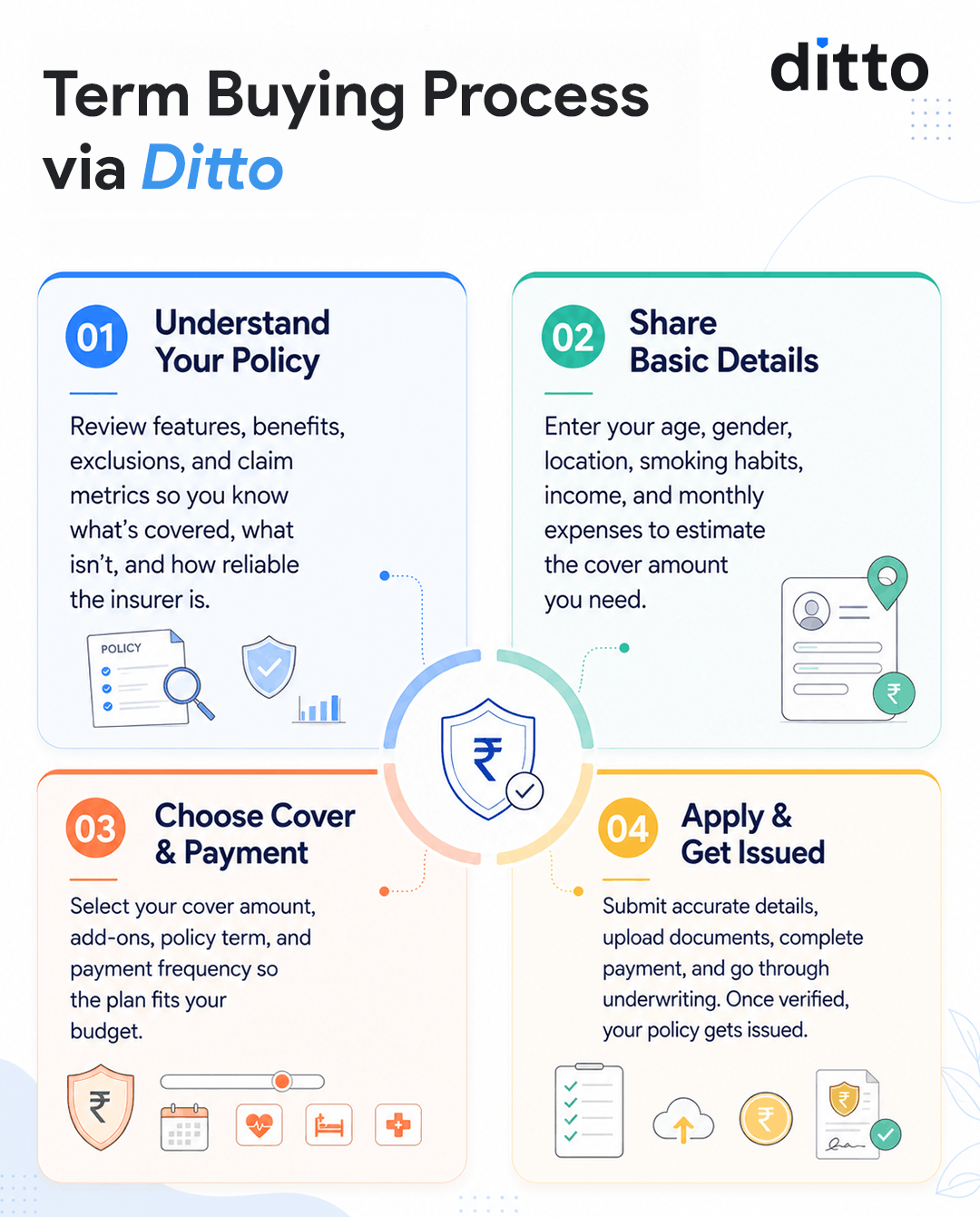
Along with digital convenience, buyers also get support with plan selection, documentation, underwriting, and claims assistance at no additional cost. This gives customers the flexibility and pricing advantage of online buying without losing access to personalized support when needed. Here's how the process works.
- Step 1: Review policy features, benefits, exclusions, and claim metrics to assess coverage and insurer reliability.
- Step 2: Provide age, gender, location, smoking habits, income, and monthly expenses to estimate the required coverage.
- Step 3: Select the cover amount, add-ons, policy term, and payment frequency based on your budget.
- Step 4: Submit accurate information, upload documents, complete payment and underwriting, and obtain policy issuance after approval.
Take a look at the infographic below to have a clear picture of how the process works.
Why Choose Ditto for Term Insurance?
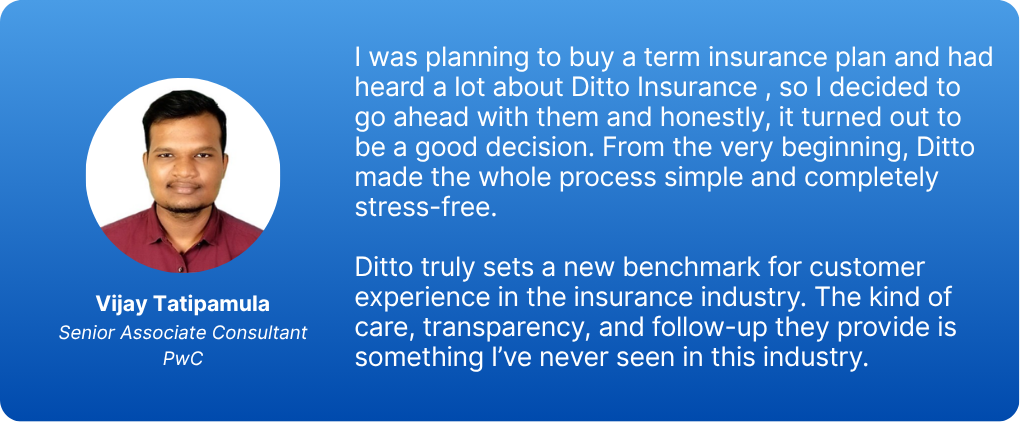
At Ditto, we’ve assisted over 12,00,000 customers with choosing the right insurance policy. Why customers like Vijay below love us:
- No-Spam & No Salesmen
- Rated 4.9/5 on Google Reviews by 30,000+ happy customers
- Backed by Zerodha
- Dedicated Claim Support Team
- 100% Free Consultation
- Compare Plans and Premiums with a Trusted Insurance Advisor
You can book a FREE consultation. Slots are running out, so make sure you book a call now or chat with us on WhatsApp!
Conclusion
Insurers increasingly prefer online and digital channels because the process is faster and more efficient. Digital applications simplify policy issuance, document verification, updates, and future modifications. They also improve communication with customers through quicker alerts, easier tracking, and smoother servicing throughout the policy term.
For most buyers, online term insurance offers better value, lower premiums, and greater transparency. Online buying makes it easier to compare the best term insurance plans side by side without sales pressure or unnecessary add-ons. However, offline buying can still be useful for people with complex medical conditions, higher cover requirements, or income documentation issues who prefer personal guidance throughout the process.
Frequently Asked Questions
Last updated on: