



Overview
According to the ICMR-INDIAB study, 11.4% of Indian adults aged 20 and older have diabetes, while 35.5% have hypertension. That's more than one in three adults living with high blood pressure, often without even knowing it. If you're one of them and want to buy term insurance now, you've probably wondered if your policy will even get approved.
In this article, we’ll walk you through term insurance for people with pre existing diseases, how insurers evaluate their applications, what must be disclosed, and the possible outcomes.
What Counts as a Pre Existing Disease in Term Insurance?
For term insurance, a pre existing medical condition generally means an illness, diagnosis, symptom, treatment, surgery, or hospitalization that occurred before you applied, which needs to be disclosed in the proposal form. Because proposal forms differ, declare your medical history as fully and accurately as possible.
1) Diabetes
Type 1 or type 2, tracked through fasting sugar and HbA1c.
2) Hypertension
High blood pressure, controlled or not.
3) Thyroid Disorders
Stable, uncomplicated thyroid disorders may receive more favorable underwriting than uncontrolled or complicated cases, but the decision remains insurer-specific.
4) Heart Disease
Angioplasty, bypass surgery, arrhythmia, or a past heart attack.
5) Asthma or Other Respiratory Conditions
Chronic asthma, COPD, or a history of tuberculosis.
6) Cancer (Treated or in Remission)
Any past diagnosis, even years ago and fully treated.
7) Kidney Disease
Chronic kidney disease or a history of kidney stones and related surgery.
8) Obesity or High BMI
Often assessed alongside diabetes, hypertension, or cholesterol.
9) Mental Health Conditions
Depression, anxiety, or other diagnosed conditions with a treatment history.
10) Past Surgeries or Hospitalizations
Any major or minor surgery, even an old one with no complications, if the form asks about it.
Note: Different insurers may assess the same medical profile differently. For example, two insurers can reach different decisions after reviewing the same HbA1c readings, cardiac history, treatment records, and lifestyle details. This is why insurer selection matters as much as the plan itself. Moreover, there is no fixed list of pre existing diseases.
You may also need to complete a telemedical interview as part of the underwriting process. Before the call, keep your diagnosis dates, medicine names, dosage details, treating doctor’s information, previous hospitalizations, surgeries, and recent test reports ready. Clear and consistent answers can reduce follow-up questions, but you should never guess or change details to make the application appear more favorable.
How Do Insurers Evaluate Term Insurance Applications With Pre Existing Diseases?
Imagine you're diabetic and applying for a ₹1 crore term plan. The insurer does not want you to just check a box that says “diabetic: yes/no.”
Instead, they're weighing five broad factors:
- The type of condition.
- Its severity and control (HbA1c, BP readings, organ damage).
- How long ago it was diagnosed.
- Whether other conditions or lifestyle habits like smoking add to the risk.
- Your income and requested cover amount relative to your medical profile.
For severe or borderline conditions, at Ditto, our advisors may first conduct an informal case check with the insurer, where available, before submitting a formal application. This can help identify insurers that are more open to your medical profile. However, it is only an initial indication. The insurer can still request medical tests, apply premium loading, change the cover, postpone the application, or decline it after full underwriting.
What Must You Disclose When Buying Term Insurance With a Pre Existing Condition?
Talk to an expert
today and
find
the right
insurance for you.


What Are the Possible Outcomes: Approval, Loading, or Rejection?
Note:
- A counter-offer may include loading, reduced cover, shorter term, rider rejection, or a combination of these.
- Before accepting a counter-offer, assess the overall outcome rather than focusing solely on the loading percentage. Check the revised annual premium, cover amount, policy term, payout option, and rider decision. A 25% loading with the full cover may be better than a lower loading accompanied by a major reduction in the cover amount or policy term.
- A loaded premium is not a rejection. For someone with well-controlled type 2 diabetes, a 50% loading on a ₹16,000 base premium works out to around ₹24,000 a year, still a small price for real protection.
- Counter-offers usually remain valid only for an insurer-specified period. Check the deadline mentioned in the communication before comparing alternatives. If the offer expires, the insurer may close the proposal or ask for updated documents or medical tests.
What Happens if You Hide a Pre Existing Disease From Your Insurer?
Hiding a condition might get your policy issued faster, but it puts the payout at risk exactly when your family needs it most.
Life insurance claims in India fall under Section 45 of the Insurance Act, 1938. Within three years of policy issuance, an insurer can question a claim on grounds of misstatement or suppression of a material fact. After three years, the insurer must prove the non-disclosure was deliberate and fraudulent.
So while the risk reduces over time, non-disclosure is never a safe strategy. Insurers routinely uncover undisclosed conditions through medical tests, tele-medical calls, old prescriptions, and claim investigations.
Ditto’s Key Takeaway: Full disclosure at the time of application is always the smarter route.
How to Choose the Right Term Insurance Plan With a Pre Existing Condition?
- Look beyond the base premium. A quote is only a starting point until underwriting is done.
- Check all performance metrics of the insurer such as the claim settlement ratio, amount settlement ratio, and complaint volume, not just the price.
- Proposal forms may ask about your existing cover and previous applications, including cases that were declined, postponed, or accepted on modified terms. Complete one application before moving to the next insurer and disclose the earlier outcome wherever requested.
- Keep documentation ready, including diagnosis dates, HbA1c or BP readings, and specialist notes.
- Separate the base plan from riders. You may still get life cover even if a rider is declined.
- Apply once your markers are stable, not during a recent flare-up.
Note: If your condition is well controlled, submit recent reports that clearly demonstrate this. These may include consistent HbA1c results, blood pressure readings, specialist follow-ups, treatment records, and evidence that there are no major complications. Positive health information does not guarantee approval, but it gives the insurer a more complete picture than a diagnosis alone.
If retail term insurance is not available, check whether your employer offers group term life insurance and whether voluntary top-ups are allowed. Group cover can provide useful protection, but it is linked to the employer and may end when you leave the organization. Treat it as a backup rather than a permanent replacement for personal term insurance.
Why Choose Ditto for Term Insurance?
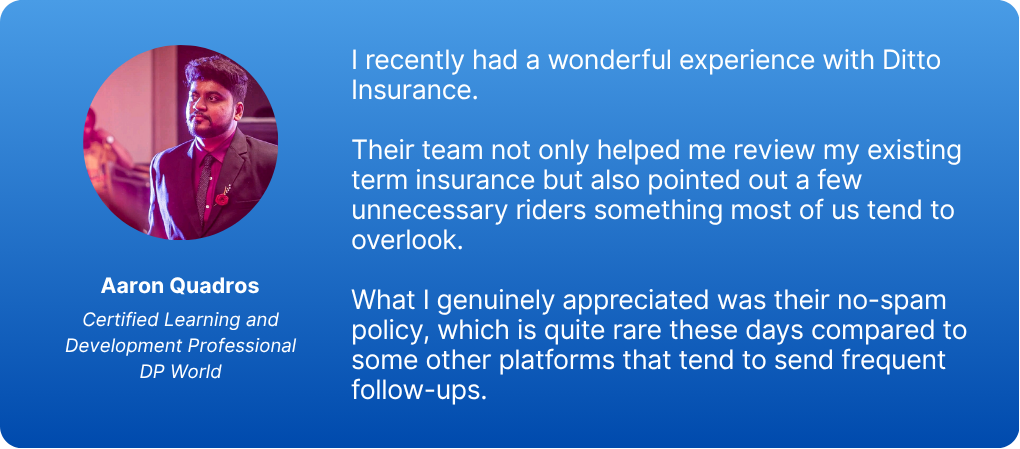
At Ditto, we’ve assisted over 8,00,000 customers with choosing the right insurance policy. Why customers like Aaron below love us:
- No-Spam & No Salesmen
- Rated 4.9/5 on Google Reviews by 30,000+ happy customers
- Backed by Zerodha
- Dedicated Claim Support Team
- 100% Free Consultation
If you’d like to learn more about how Ditto helps you find the best term insurance for people with pre existing diseases, you can check our detailed guide on the same.
You can book a FREE consultation. Slots are running out, so make sure you book a call or chat on WhatsApp now!
Conclusion
A pre existing disease changes how you look for term insurance, but it doesn't take you out of the market. The real mistakes people make are hiding their medical history, applying to five insurers at once, or picking the cheapest quote without checking whether it will actually get issued.
Our Advice: Disclose everything honestly, get your medical reports organized before you apply, apply to one well-matched insurer at a time, and treat a fair loaded premium as a win, not a loss.
Frequently Asked Questions
Last updated on: