



Overview
Your child's biggest dreams deserve a financial plan that grows with them. Before choosing SBI Life Smart Future Star, understand how its savings, protection, and bonus features work to see whether it aligns with your family's long-term goals.
This guide breaks down SBI Life Smart Future Star, explains its key policy features, premiums, benefits, returns, and helps you decide whether it's the right child insurance plan.
What Is SBI Life Smart Future Star?
SBI Life Smart Future Star is an SBI Life Insurance child plan that offers a guaranteed sum assured at maturity, along with non-guaranteed reversionary and terminal bonuses, if declared. At maturity, the proceeds can be received as a lump sum or through a deferred payout option, subject to the policy terms.
Under SBI Life Smart Future Star, the child is the life assured, while the parent, grandparent, or legal guardian purchases and manages the policy as the proposer.
SBI Life Smart Future Star: Waiver of Premium and Flexible Payout Options
- Waiver of Premium Benefit: The feature protects the policy if the proposer dies or suffers a qualifying accidental total permanent disability while the policy is in force. Once the claim is accepted, all future premiums are waived, and the policy continues with its applicable benefits without interruption. This protection remains available even if the child has already attained 18 years of age and become the policyholder.
- Flexible Maturity Settlement Options: You can receive the entire maturity benefit as a lump sum, defer the lump-sum payout for 1 to 7 years, opt for installments over 2 to 7 years, or take a portion immediately and receive the remaining amount in installments, subject to the policy terms.
Talk to an expert
today and
find
the right
insurance for you.


Key Features and Eligibility of SBI Life Smart Future Star
Eligibility Criteria

Key Features
Death Benefit
If the child (life assured) dies during the policy term while the policy is in force, SBI Life pays the higher of the sum assured on death (plus any vested reversionary and terminal bonuses, if declared) or 105% of the total premiums paid.
Bonus:
SBI Life Smart Future Star is a participating plan and may earn reversionary bonuses based on the insurer's annual surplus. Once declared, these bonuses become part of the policy. A terminal bonus may also be payable at death, surrender, or maturity, but both bonuses are non-guaranteed.
Maturity Benefit
If the child survives until the end of the policy term, SBI Life pays the sum assured on maturity along with any vested reversionary bonuses and, if declared, the terminal bonus. After the maturity benefit is paid, the policy terminates, and no further benefits are payable.
Policy Loan
A policy loan can be availed once the policy acquires a surrender value. The maximum loan amount is generally up to 50% of the surrender value, and interest is charged at SBI Life's prevailing policy loan rate.
SBI Life Smart Future Star Premiums and Maturity Value
In this illustration, a 35-year-old parent purchases SBI Life Smart Future Star for a 3-year-old child with an annual premium of ₹50,011. Premiums are paid for 10 years, while the policy runs for 20 years. The total premium paid is ₹5,00,110, and the policy provides a sum assured of ₹6,32,000, along with any applicable bonuses, if declared.
Maturity Benefit
Note: The figures above are based on the SBI Life Smart Future Star policy brochure and are purely illustrative. Actual premiums and benefits depend on factors such as the child's age, sum assured, policy term, and underwriting. You can calculate estimated premiums on SBI’s official website.
Based on this illustration, the estimated net annualized Internal Rate of Return (IRR) is approximately 2.3% under the 4% scenario and 6.4% under the 8% scenario. The actual return is lower than the illustrated growth rates because part of the premium covers insurance costs and policy expenses.
While the higher scenario may suit conservative investors, the lower scenario may not adequately beat long-term inflation for goals such as higher education. If you are planning for your child’s future education, explore child education insurance plans.
SBI Life Insurance: Performance Metrics
Note: The data is derived from SBI Life public disclosures and IRDAI annual reports. To explore these metrics in greater detail, refer to Ditto Data Lab.
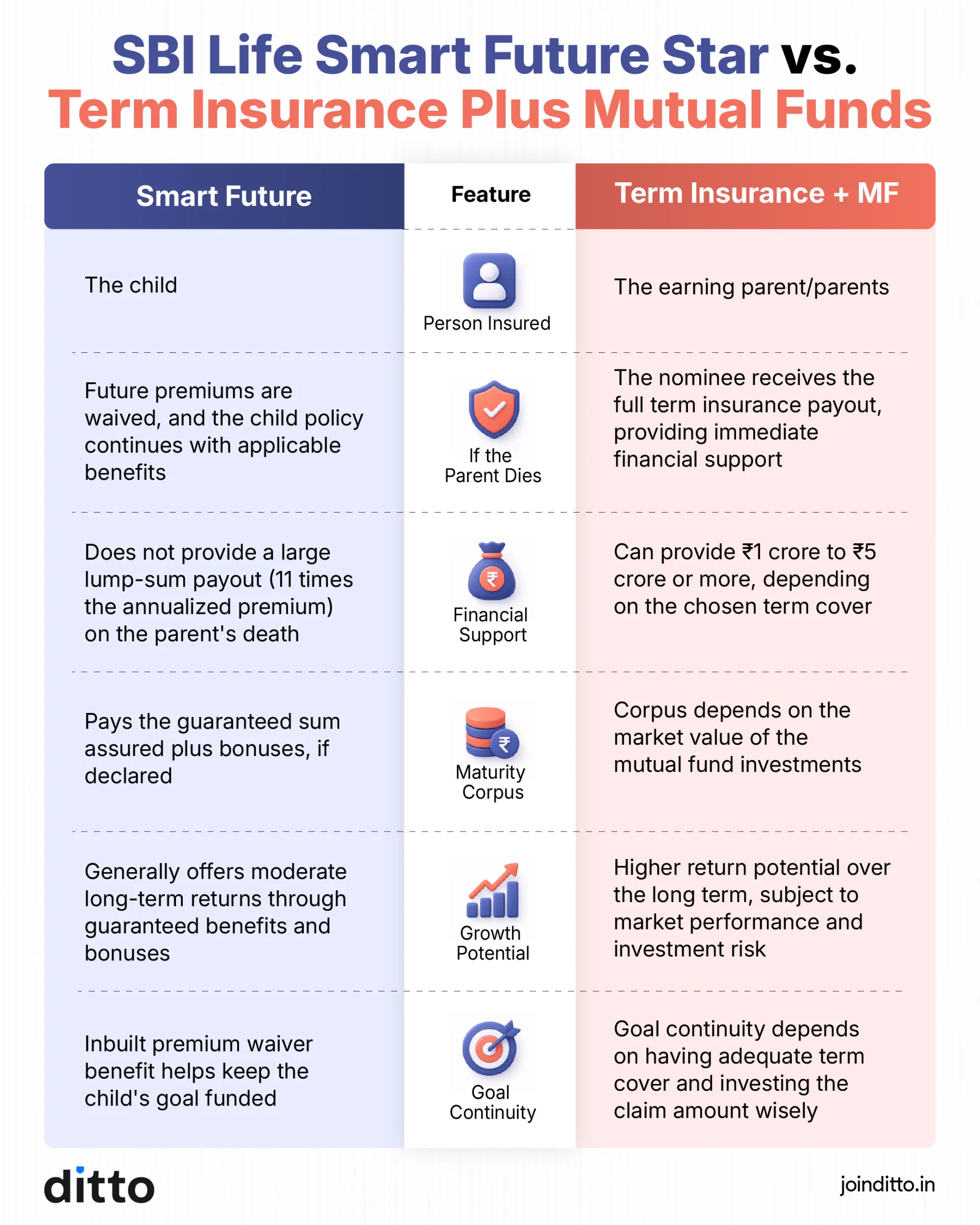
SBI Life Smart Future Star vs. Term Insurance Plus Mutual Funds
For most financially disciplined parents, a combination of adequate term insurance for the earning parent and diversified mutual funds is the more effective approach. It offers stronger income protection, greater liquidity, and higher long-term wealth creation potential than a traditional child savings plan.
Here’s an infographic that helps you compare the two.
Why Choose Ditto for Life Insurance?
At Ditto, we’ve assisted over 8,00,000 customers with choosing the right insurance policy. Why customers like Aaron below love us:

- No-Spam & No Salesmen
- Rated 4.9/5 on Google Reviews by 30,000+ happy customers
- Backed by Zerodha
- Dedicated Claim Support Team
- 100% Free Consultation
You can book a FREE consultation. Slots are running out, so make sure you book a call or chat on WhatsApp now!
Conclusion
SBI Life Smart Future Star can help create a dedicated corpus for your child's future, but it should not be the first financial product you buy. Before investing in a child plan, ensure the earning parent has adequate protection through the best term insurance plans and the family is covered by one of the best health insurance plans.
Once your protection needs are addressed, build your child's education or future corpus separately through investments such as mutual funds, the Public Provident Fund (current interest rate is 7.1%), or the Sukanya Samriddhi Yojana (current interest rate is 8.2%), depending on your goals and risk appetite.
Keeping insurance and investments separate provides higher life cover, greater flexibility, better liquidity, and stronger long-term wealth creation.
Frequently Asked Questions
Last updated on: