


Overview

The Axis Max Life High Growth Fund is an equity-oriented Unit-Linked Insurance Plan (ULIP) fund designed for investors seeking aggressive long-term wealth creation. It typically allocates 70%-100% of its portfolio to equities. The fund is best suited for investors with a high-risk appetite and an investment horizon of at least 10 years, as the returns will be locked in with the ULIP lock-in period. This Axis Max Life High Growth Fund review is suitable for those who wish to explore the fund's features and rules.

With a fund size of approximately ₹14,192 crore, as per the Axis Max monthly ULIP factsheet, it has delivered strong long-term performance, generating around 24.01% Compound Annual Growth Rate (CAGR) over 3 years and nearly 19.69% CAGR over 5 years.

Launched on 26 February 2008 and benchmarked against the NSE Nifty Midcap 100 Index, the Axis Max Life High Growth Fund is built for investors willing to embrace volatility in pursuit of long-term wealth creation. 

In the next few minutes, you'll discover how the Axis Max Life High Growth Fund works, where it invests, how it has performed across market cycles, and the risks and charges involved.

What Is the Axis Max Life High Growth Fund?

The Axis Max Life High Growth Fund is not a standalone mutual fund you can purchase. Instead, it is a ULIP segregated fund available within select Axis Max Life ULIPs. This means your money is invested through a ULIP structure, where the fund's performance is linked to its daily Net Asset Value (NAV). 

As with any market-linked investment, the fund value can rise or fall, depending on market conditions, and the investment risk is borne entirely by the policyholder. In simple terms, your returns depend on how the underlying fund performs, not on any guaranteed payout from the insurer.

Note: Not all ULIPs offered by Axis Max will offer this fund choice. The fund is currently available with plans like Max Life Fast Track Super. For more information, refer to the plan’s Fund Portfolio.

Latest NAV and Historical Performance

    • Latest NAV: The Axis Max Life High Growth Fund NAV stood at ₹119.64 as of 29 May 2026. This reflects the price of a single unit of the fund under the plan.
    • Strong Long-Term Track Record: Since its inception in February 2008, the fund has delivered a 14.55% CAGR, comfortably outperforming its benchmark's 10.14% CAGR.
    • Consistent Medium-Term Outperformance: The fund has beaten its benchmark over the 3-year (24.01% vs 22.30%), 4-year (22.83% vs 21.55%), and 5-year (19.69% vs 19.09%) periods.
    • Recent Performance Has Been Mixed: Over shorter horizons, the fund has lagged the benchmark, returning 5.10% over 1 year compared to the benchmark's 7.50%, highlighting the volatility typical of mid-cap investing.
    • Growing Investor Participation: Assets Under Management (AUM) increased from ₹10,580 crore in August 2025 to ₹14,192 crore in May 2026, indicating rising investor interest.

The above data are derived from the monthly ULIP factsheet. Here’s a graphical representation of the funds' return over the last 5 years.
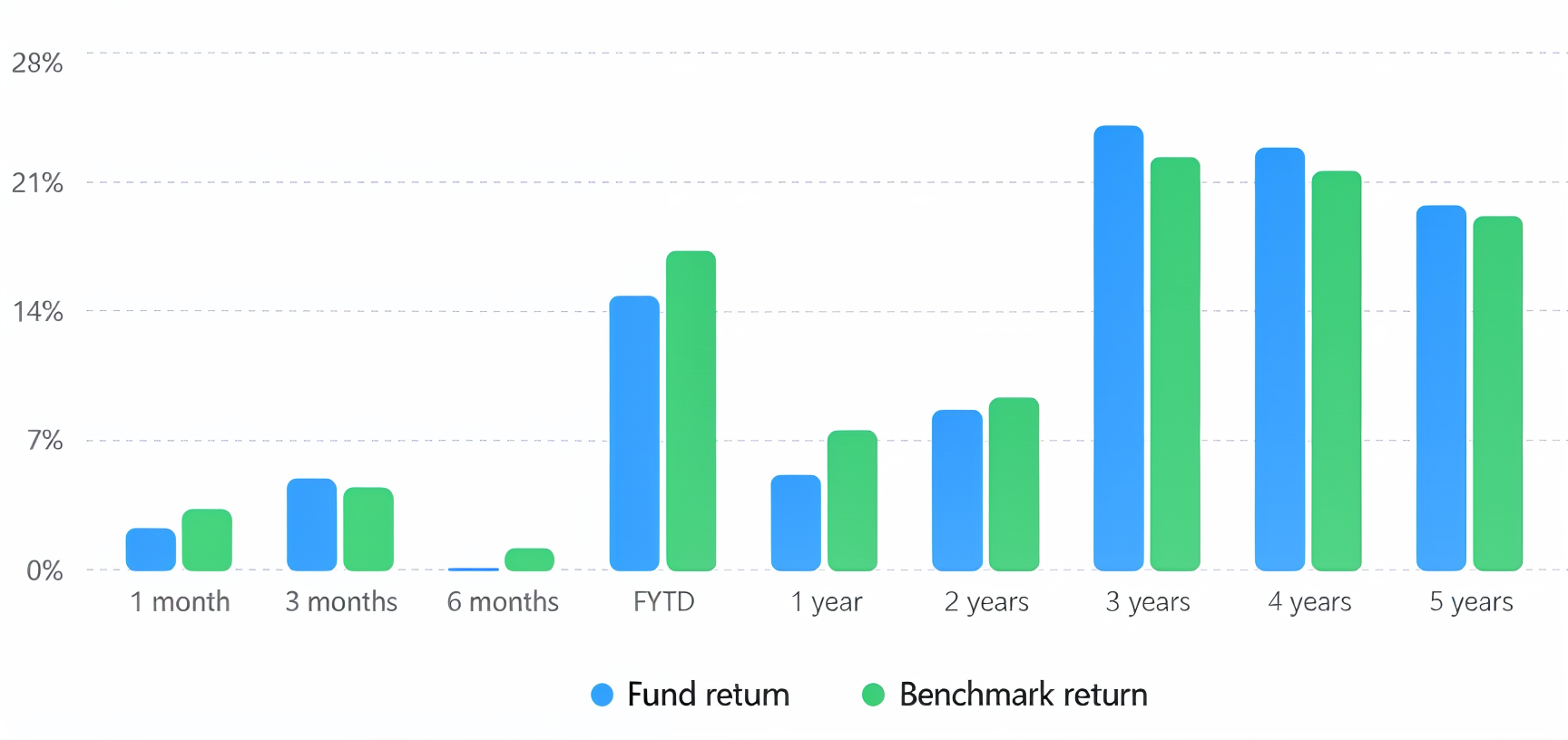
Axis Max Life High Growth Fund Return vs Benchmark Return

Note: The fund's strength lies in long-term wealth creation rather than short-term consistency. Investors should evaluate performance across full market cycles rather than focusing solely on recent returns.

Did You Know?

The new Axis Max Life High Growth Fund II, launched in January 2026, builds on the legacy of the original High Growth Fund. While both track the NSE Nifty Midcap 100 Index, Fund II takes a more aggressive stance with a minimum 80% equity allocation and carries a fund management charge of 1.35% per annum. This means potentially higher growth participation, but also higher volatility and costs.

CTA

Portfolio, Allocation, and Risk Level

The Axis Max Life High Growth Fund is an aggressively managed equity-oriented ULIP fund that focuses on high-growth and mid-cap opportunities. As of 29 May 2026, the portfolio held 97.19% in equities and 2.81% in money-market instruments, reflecting an almost fully equity-driven strategy aimed at long-term capital appreciation.

The fund's mandate requires a minimum allocation of 70% to equities, with the balance permitted in government securities, corporate bonds, and money-market instruments. 

However, the latest portfolio shows negligible debt exposure, highlighting the fund manager's strong conviction in equities and a clear preference for growth over capital preservation.

Top 5 Holdings

Security Name% of AUM
Multi Commodity Exchange of India Ltd4.19%
BSE Ltd3.81%
Fortis Healthcare Ltd3.40%
One 97 Communications Ltd3.03%
Indus Towers Ltd3.00%

Key Insights

    • The fund is actively managed rather than index-tracking, allowing the fund manager to make stock-specific bets across sectors such as financial-market infrastructure, healthcare, telecom, electricals, fintech, and automobiles.
    • Portfolio diversification remains healthy, with the largest individual holding accounting for only about 4.19% of assets. This helps reduce the risk of excessive stock concentration while maintaining exposure to multiple growth opportunities.
    • The fund can be high-risk due to its mid-cap orientation and near-total equity exposure. While this approach can deliver strong long-term returns, it also comes with higher volatility and sharper drawdowns.

Charges, Lock-In, and Surrender Rules

AspectWhat You Need to KnowInvestor Impact
Fund Management Charge (FMC)High Growth Fund charges 1.25% per annum, deducted through NAV adjustments.Official fund returns are shown after FMC, but not after all policy-level charges.
Other ULIP ChargesDepending on the plan, mortality, policy administration, surrender, and applicable taxes may apply.Actual policy returns can differ from the fund's published performance.
Lock-In PeriodULIP regulations impose a 5-year lock-in. Partial withdrawals are generally not allowed during this period.Limited liquidity compared to mutual funds or other market-linked investments.
Early Surrender RulesSurrendering within 5 years moves funds to the Discontinuance Policy Fund after applicable charges.Life cover ceases, and access to funds is deferred until lock-in completion.
After 5 YearsThe surrender value is generally equal to the prevailing fund value, with most discontinuance charges becoming nil.Greater flexibility, though policy benefits end permanently once surrendered.

Using the High Growth Fund Calculator

    • Use the Official Axis Max Life ULIP Calculator: The official Axis Max Life ULIP Calculator is the most relevant tool for prospective policyholders. It estimates potential maturity values based on your premium, policy term, and investment horizon, providing a more realistic picture of how a ULIP may perform within the insurance product structure.
    • Use NAV Calculators for Fund Analysis Only: Third-party calculators like Moneycontrol returns calculator can be used as Axis Max Life High Growth Fund calculator, which are useful for tracking historical NAV growth and fund performance. However, they do not account for policy-level factors like mortality charges, premium payment terms, lock-ins, or ULIP-specific benefits, making them less suitable for estimating actual maturity proceeds.

Is Axis Max Life High Growth Fund ULIP Right for You?

    • Suitable for investors with a high risk appetite who are comfortable with equity-market volatility and temporary declines in fund value.
    • Can be a good fit if you want market-linked wealth creation within a life insurance wrapper rather than a standalone mutual fund.

However, it is not ideal for short-term goals, emergency funds, or money you may need access to within the next five years. Additionally, returns are not guaranteed and depend on market performance, fund management decisions, and the overall ULIP structure. For better returns and more efficiency, a term plan with separate investments in mutual funds can be considered. 

Note: If your total annual ULIP premium remains within ₹2.5 lakh, the maturity proceeds can qualify for tax exemption under Section 10(10D), subject to prevailing tax rules. Once you receive the maturity corpus, you can move your investment from the aggressive High Growth Fund to a debt or liquid ULIP fund without triggering capital gains tax, allowing portfolio reallocation within the policy while maintaining tax efficiency.

Why Choose Ditto for Life Insurance?

At Ditto, we’ve assisted over 8,00,000 customers with choosing the right insurance policy. Why customers like Arun below love us: 

Axis Max Life High Growth Fund Review
    • No-Spam & No Salesmen
    • Rated 4.9/5 on Google Reviews by 24,000+ happy customers
    • Backed by Zerodha
    • Dedicated Claim Support Team
    • 100% Free Consultation

You can book a FREE consultation. Slots are running out, so make sure you book a call now or chat over WhatsApp with our advisors.

Conclusion

The Axis Max Life High Growth Fund can be a compelling option for investors seeking aggressive, equity-driven wealth creation within a ULIP and comfortable staying invested for the long term. Its strong historical performance, high equity allocation, and mid-cap growth orientation make it suitable for those seeking higher return potential and who can tolerate market volatility.

That said, a ULIP combines investments, insurance, charges, lock-ins, and policy rules into a single product. Investors who prefer simplicity, greater liquidity, and a clearer separation between protection and wealth creation may explore other options. A term insurance plan for life cover, plus mutual funds or fixed deposits for investing, is a more transparent and flexible approach. 

If you prefer Axis Max, explore comprehensive options like Smart Term Plan Plus. The policy is one of the best term insurance plans in India, offering advanced features and affordable pricing. 

Frequently Asked Questions

How has the Axis Max Life High Growth Fund performed historically?

The High Growth Fund Axis Max Life has delivered strong long-term performance since its launch in February 2008. As of May 2026, it generated a 14.55% CAGR since inception, outperforming its NSE Nifty MidCap 100 benchmark, which returned 10.14% over the same period. It has also outperformed the benchmark across 3-year, 4-year, and 5-year periods. However, recent short-term performance has been relatively weaker. Investors should evaluate returns over full market cycles rather than relying on one-year performance, especially for mid-cap-focused funds, where volatility can be significant.

What is the lock-in period for Axis Max Life High Growth Fund?

The fund itself does not impose a lock-in. However, since it is available only through ULIP products, it is subject to the mandatory 5-year ULIP lock-in period prescribed by regulations. During this period, liquidity is significantly restricted, and partial withdrawals are generally not permitted. If a policy is surrendered early, the proceeds are held in the Discontinuance Policy Fund until the lock-in period ends. You should invest only if you are confident you will remain invested for at least five years, preferably much longer.

What are the top holdings in Axis Max Life High Growth Fund?

The fund's portfolio includes a diversified mix of growth-oriented companies. Recent top holdings include MCX, BSE Ltd, Fortis Healthcare, One97 Communications (Paytm), and Indus Towers. No single stock accounts for an excessively large share of assets, with the largest position remaining around 4% of the portfolio. This helps reduce concentration risk while maintaining exposure to high-growth sectors. However, investors should remember that many holdings operate in sectors that can experience substantial volatility.

What charges apply to Axis Max Life High Growth Fund?

The fund carries a Fund Management Charge (FMC) of 1.25% per annum, which is already reflected in the published fund returns. However, investors should remember that a ULIP's overall cost extends beyond the FMC. Depending on the specific policy, mortality charges, policy administration charges, and other ULIP charges may apply. Investors should assess the complete cost structure rather than focusing only on the FMC, since actual policy returns can differ from standalone fund performance.

Which ULIP plans offer the Axis Max Life High Growth Fund?

The fund is available as an investment option within selected Axis Max Life ULIP products, like Fast Track Super, rather than as a standalone investment vehicle. Availability may differ depending on the specific policy and product version being considered. Fund options can also change over time as insurers revise their offerings. You should verify the latest fund options of the specific ULIP before purchasing, rather than assuming the High Growth Fund is available across every Axis Max Life unit-linked plan.

What is the benchmark index for Axis Max Life High Growth Fund?

The fund is benchmarked against the NSE Nifty MidCap 100 Index, reflecting its strong mid-cap orientation. Since its inception, the fund has outperformed this benchmark by a meaningful margin, delivering a higher CAGR than the index over the long term. Benchmark comparisons are important because they show whether active management is adding value beyond simple market exposure. You should be evaluating Axis Max Life High Growth Fund performance relative to this benchmark rather than comparing it directly with large-cap indices such as the Nifty 50 or Sensex.

Should I choose a ULIP fund or a term plan plus a mutual fund instead?

Both approaches can work, but they serve different preferences. A ULIP combines insurance and investing into a single structure, while a term plan plus mutual fund separates protection and wealth creation. The latter generally offers greater transparency, more flexibility, and easier access to money. ULIPs may appeal to investors seeking a bundled solution and long-term investing discipline. At Ditto, we often find that term insurance combined with mutual funds is easier for most investors to understand and manage, though the final choice depends on personal priorities.

What happens if I surrender the Axis Max Life High Growth Fund early?

If you surrender the associated ULIP within the first five policy years, the fund value is typically transferred to the Discontinuance Policy Fund after applicable charges. Life cover generally ceases, and access to the money remains restricted until the ULIP lock-in period expires. After five years, surrender becomes significantly simpler, with proceeds usually based on the prevailing fund value. You must avoid early exits whenever possible because the combination of lost insurance benefits, reduced liquidity, and potential charges can materially impact overall outcomes.

What is the closest mutual fund equivalent to the Axis Max Life High Growth Fund?

There is no exact mutual fund equivalent because the Axis Max Life High Growth Fund operates within a ULIP structure. However, its investment style closely resembles an active multi-cap fund with a strong mid-cap bias or an aggressive mid-cap fund. The fund is benchmarked against the Nifty Midcap 100 Index and maintains a predominantly equity-oriented portfolio focused on high-growth businesses. Investors looking for a similar market exposure outside a ULIP may consider diversified multi-cap or mid-cap mutual funds. The key difference is that mutual funds offer greater liquidity and transparency, while ULIPs combine investing with life insurance and a mandatory 5-year lock-in.

Last updated on: