

Overview
Accidental risks are often underestimated until they disrupt income, EMIs, or long-term financial stability. This article explains how SBI personal accident insurance works, what each plan covers, and whether it meaningfully addresses disability and income-loss risks, not just accidental death.
What Is SBI Personal Accident Insurance?
SBI General Insurance offers personal accident insurance plans designed to provide financial protection against income loss caused by accidental injuries, disability, or death. While term insurance may cover accidental death and health insurance typically pays for hospitalization expenses, personal accident insurance focuses on offering a fixed lump sum payout when a covered accident leads to death or disability.
Unlike health insurance, these plans do not primarily reimburse medical bills. Instead, the payout is predefined and triggered directly by the insured accident event, helping individuals manage income disruption and financial obligations during recovery. Personal accident insurance plans are commonly offered by both general insurers and standalone health insurers.
SBI General primarily offers:
- Retail Personal Accident Plans: Individually purchased policies for people generally aged between 18 and 65 years
- Group Personal Accident Plans: Policies commonly bundled with State Bank of India banking products, loan accounts, or debit cards
The ₹500 SBI Personal Accident Insurance Plan: What You Actually Get?
Plans and Coverage Under SBI Personal Accident Insurance Policy
1. Individual Personal Accident Insurance Policy
The Individual Personal Accident Policy is the most comprehensive retail offering from SBI General Insurance. It is designed to provide end-to-end protection against accidental death as well as a wide spectrum of disabilities. The policy can be purchased for an individual and extended to cover family members.
Coverage Breakdown
- Accidental Death: The nominee receives 100% of the sum insured in the event of the insured’s accidental death.
- Permanent Total Disability (PTD): The policy pays 100% of the sum insured if the insured suffers a permanent total disability.
- Permanent Partial Disability (PPD): A specified percentage of the sum insured is paid, depending on the nature and severity of the injury as defined in the insurer’s disability table.
- Temporary Total Disability (TTD): If the insured is temporarily unable to work due to an accident, the policy offers weekly income support as an optional benefit.
- Child Education Benefit: On accidental death or permanent total disability, up to two dependents (children or spouses) receive ₹50,000 or 1% of the sum insured, whichever is lower, per person, subject to proof of enrolment in a government-approved institution.
- Home or Vehicle Adaptation Allowance: Included under PTD, this benefit helps cover expenses for necessary modifications following a severe disability.
- Hospital Confinement Allowance: An optional add-on that provides ₹1,000 to ₹3,000 per day for up to 15 days during hospitalization.
- Ambulance Charges (including air ambulance): Covered as an add-on up to 10% of the sum insured, with a maximum limit of ₹1 lakh.
Key Highlights
- Sum insured options range from ₹1 lakh to ₹1 crore
- The maximum coverage allowed is capped at 120 times your monthly income or 10 times your annual income. Income proof is typically required for a sum insured above ₹25 lakh
- Family coverage includes spouse, dependent children aged 3 months to 23 years, dependent parents, and parents-in-law
- A cumulative bonus of 5% is added for every claim-free year, up to a maximum of 50% of the sum insured
- Coverage is available worldwide on a 24x7 basis
- No medical tests are required at the time of purchase
- Entry age is 18 to 65 years, with lifetime renewal allowed if there are no claims
- Premiums start from approximately ₹53 per month for low-risk occupations such as desk or office roles in metro cities, and vary based on occupation category, location, and chosen sum insured
Takeaway: This plan is best suited for individuals looking for a detailed and structured accident cover that goes beyond basic death benefits and meaningfully addresses disability-related financial risks.
2. Saral Suraksha Bima (SBI General)
SBI General Insurance offers the standardized Saral Suraksha Bima, which was mandated by the Insurance Regulatory and Development Authority of India (IRDAI) from April 2021. The core product structure and base cover definitions are standardised across insurers, making comparison easier. However, premiums and servicing aspects may differ between insurers.
Coverage Structure
Base Cover (Mandatory)
- Accidental death is covered with 100% of the sum insured paid to the nominee.
- Permanent total disablement is covered with 100% of the sum insured.
- Permanent partial disability is covered based on a defined percentage of the sum insured, depending on the nature of the injury.
Key Highlights
- The sum insured ranges from ₹2.5 lakh to ₹1 crore, available in multiples of ₹50,000.
- Entry age is 18 to 70 years, with dependent children covered from 3 months to 25 years.
- A cumulative bonus of 5% is added for every claim-free year, up to a maximum of 50% of the sum insured.
- No medical tests are required at the time of purchase.
- The policy term is one year, with flexible premium payment options including annual, half-yearly, quarterly, or monthly installments.
- Claims are admissible even if death or disability occurs after the policy period, as long as the accident took place during the policy term and the outcome occurs within 12 months of the accident.
- May include temporary total disablement cover for income support during recovery, accident-related hospitalization expenses, and education grants for dependent children.
Takeaway: This plan is best suited for individuals looking for a standard, no frills personal accident cover with clearly defined benefits and easy comparability across insurers.
3. Group Personal Accident Insurance
The Group Personal Accident Policy from SBI General Insurance is the most widely accessible and commonly purchased option, especially among State Bank of India account holders. It is bundled with savings accounts, current accounts, and loan products such as home loans, car loans, and personal loans at the time of disbursement.
Key Highlights
- Provides lump sum compensation in case of accidental death
- Some variants may also cover permanent total disability
- Optional benefits can include child education support, ambulance charges, funeral expenses, repatriation expenses, and home or vehicle modification allowance
- Comes without a waiting period
- Offered at relatively low annual premiums through banking relationships
Premium vs Coverage
Beyond accidental death, the variant with Child Education Cover may include additional benefits such as permanent total disability cover, child education benefits, repatriation and funeral expenses, home and vehicle adaptation allowance, and ambulance cover. There is typically no waiting period under this plan.
Eligibility
- Available to permanent Indian residents aged 18 to 70 years
- The individual must hold a savings or an individual current account with the State Bank of India or its associate banks
Note: The above premium figures are indicative and based on earlier published rate structures. Actual premiums, benefits, and eligibility may change over time. It is advisable to check the latest details with your State Bank of India branch or through the YONO SBI app before opting for the cover.
Important Note on Debit Card Cover
Ditto’s Take: If disability protection is important, especially for salaried or self-employed individuals, it is usually better to opt for more comprehensive accident cover instead of relying only on basic accidental death policies.
- Individual Personal Accident Policy: Offers broader and more customizable protection, with optional add-ons such as air ambulance cover, home or vehicle modification allowance, hospital confinement benefits, and disability-related payouts.
- Saral Suraksha Bima: A standardized personal accident plan with uniform features across insurers, making it easier to understand and compare. However, it offers relatively less flexibility and customization.
Key Takeaway: Always compare the disability benefits carefully, as coverage can vary significantly across plans and variants.
Talk to an expert
today and
find
the right
insurance for you.
SBI Personal Accident Insurance Premiums and Plans
Premiums for retail plans offered by SBI General Insurance are not fixed. They are calculated based on a combination of risk and coverage factors.
1. Occupation Category: Your profession plays a key role in determining the premium.
- Category I includes low-risk, desk- or office-based jobs and has the lowest premiums
- Category II includes moderately hazardous roles such as geologists or fitness trainers
- Category III includes high-risk occupations such as machine operators or jockeys and attracts the highest premiums
2. City of Residence: Premiums also vary based on location. Metro cities such as Mumbai, Delhi, Bengaluru, Chennai, Hyderabad, Pune, Kolkata, and Ahmedabad typically have different pricing compared to non-metro cities.
3. Sum Insured and Add-ons: The higher the sum insured, the higher the premium. Similarly, opting for additional benefits such as hospital confinement allowance or ambulance cover increases the premium proportionately.
Illustrative Premium Examples
Note: These figures are illustrative and based on published rate tables from SBI General Insurance. Actual premiums may vary depending on occupation category, city classification, selected add-ons, and specific policy terms.
How to Buy and Claim SBI Personal Accident Insurance
How to Buy
You can purchase a policy from SBI General Insurance through multiple channels, depending on your preference and eligibility:
- Online: Visit the official SBI General Insurance website. The Individual Personal Accident Policy and Saral Suraksha Bima can be purchased directly using a debit card, a credit card, net banking, or UPI. The Group Personal Accident plan is also available through the YONO SBI app.
- Offline or Branch Visit: You can walk into any State Bank of India branch, fill out a proposal form, submit Know Your Customer (KYC) documents, and pay the premium. A bank representative or agent can guide you in choosing the right plan.
- Via Loan Bundling: If you are taking a home loan, car loan, or personal loan from the State Bank of India, check whether a group personal accident cover is being bundled. It is important to confirm whether the policy includes disability benefits and not just accidental death, as many bundled covers are limited.
- Check Existing Debit Card Cover: Before purchasing a new policy, verify whether your State Bank of India debit card already includes complimentary personal accident coverage for accidental death. Also, confirm the sum insured and activation conditions to avoid duplication.
How to Claim
- Inform the Insurer Immediately: Inform SBI General Insurance as soon as possible after the accident. You can call the toll-free number 1800 102 1111 or email claims@sbigeneral.in.
- Fill out the Claim Form: Download the claim form from the SBI General Insurance website and provide complete details about the accident, insured person, and nominee or payee bank information.
- Collect Required Documents:
- For Accidental Death Claims: Submit the filled claim form, death certificate, First Information Report or police panchnama, post mortem report if applicable, identity proof of the deceased and claimant, and a cancelled cheque of the nominee’s bank account.
- For Disability Claims: Submit the claim form, medical certificates from the treating doctor, hospital discharge summary, First Information Report if applicable, and identity proof.
- Submit the Claim: Documents can be submitted online through the claims portal, via email, or physically at an SBI General Insurance office.
- Claim Settlement: Once all documents are verified and found complete, claims are generally processed within 30 days.
Note: For Group Personal Accident policies linked to State Bank of India debit cards or loans, the insurer handling your claim may not always be SBI General Insurance. The insurance can vary depending on the policy batch or year. Before filing a claim, confirm the exact insurer with your bank branch, as submitting documents to the wrong insurer is a common reason for claim delays.
Why Choose Ditto for Insurance?
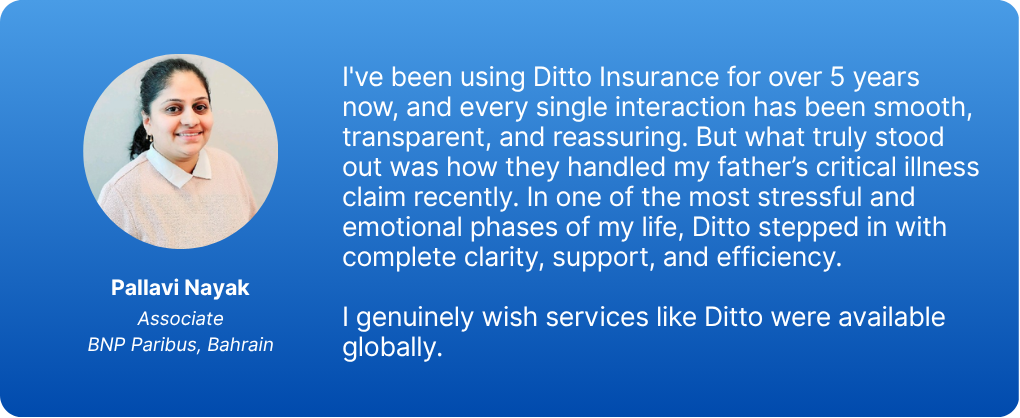
At Ditto, we’ve assisted over 8,00,000 customers with choosing the right insurance policy. Why customers like Pallavi below love us:
- No-Spam & No Salesmen
- Rated 4.9/5 on Google Reviews by 15,000+ happy customers
- Backed by Zerodha
- Dedicated Claim Support Team
- 100% Free Consultation
Confused about the right insurance? Speak to Ditto’s certified advisors for free, unbiased guidance. Book a free call or chat on WhatsApp now!
Ditto’s Take
Personal accident insurance is useful, but only after you have adequate health and life insurance in place. A comprehensive health insurance policy already covers accident-related hospitalization expenses from day one, while a term insurance plan financially protects your family in case of accidental death. A personal accident policy mainly fills the remaining gaps, such as disability-related financial losses that standard health or term plans may not fully cover.
Its biggest value lies in covering temporary total disability, permanent partial disability, and income loss during recovery. It can also help manage ongoing financial commitments, such as loan EMIs, if an accident affects your earning capacity. If you are still evaluating your base protection, you can also explore our guide on the best health insurance plans in India.
Frequently Asked Questions
Last updated on: