



Quick Overview
Navi General Insurance (IRDAI Reg. No. 155) was founded in 2016 by Sachin Bansal and Ankit Agarwal, soon after Bansal’s well-known $1 billion exit from Flipkart. They wanted to use technology to reduce complexity and keep costs low.
But if you’re thinking of buying a Navi health insurance plan, one question matters above all else. How reliable are they at the time of claims and if the insurer is among the top 10 health insurance companies by CSR in India?
That’s where CSR comes in. CSR shows the percentage of claims an insurer settles in a year and is one of the clearest indicators of reliability.
In this article, we break down Navi’s claim settlement ratio, explain what it actually means, compare it with competitors, and help you decide whether Navi is the right choice for you.
How to Calculate the Navi Health Insurance Claim Settlement Ratio?
Claim Settlement Ratio (CSR), while not the only metric, is one of the most important ways to assess an insurer’s performance. Here’s how it’s calculated:
CSR = (Total claims settled / Total claims available to settle) X 100
Where:
‘Total Claims Settled’ includes partly and fully settled claims
‘Total claims available to settle’ = (Claims carried forward from the previous year) + (New claims reported) - (Claims closed without payment + Claims still pending at year's end)
Note: The IRDAI doesn’t have any specific formula for calculating the Claim settlement ratio. Hence, these numbers can differ depending on the formula used by different platforms and insurers.
We, at Ditto:
- Use the formula mentioned above, as it better captures long delays in claim settlement by insurers.
- Recommend looking at the 3-year average CSR, since a single year’s data isn’t enough to judge an insurer’s long-term stability.
- Suggest reviewing the 3-year averages of other key metrics as well, such as average complaints received per 10,000 claims, the Incurred Claims Ratio (ICR) and Gross Written Premium (GWP). This is important because CSR alone doesn’t differentiate between partially and fully settled claims, and cannot give the full picture of an insurer’s performance.
Navi Health Insurance: 3-year Claim Settlement Ratio and Other Metrics
Note:
- The complaint numbers shown above reflect all of Navi’s products (health, motor, and others), as the insurer does not publish product-wise complaint data separately.
- In the table above, ICR refers to Incurred Claims Ratio.
Key Insights:
- CSR: Navi’s 3-year average Claim Settlement Ratio stands at 71.44%, making it the lowest among all insurers in the market.
- Complaints: Navi received an average of 239.36 complaints per 10,000 claims over the last three years. This is the highest in the industry and almost 9 times the industry average of 27.06.
- ICR: The insurer’s ICR averages 49.08%, which is the second-lowest across insurers and well below the industry average of 83.93%.
- Annual Business: It has a relatively small gross written premium of just ₹26 crore, which places it among the smaller players in the industry. For comparison, this works out to only around 0.6% of the industry average of ₹3,969 crore.
Top 10 Health Insurance Providers by Claim Settlement Ratio
Why Choose Ditto for Health Insurance?
At Ditto, we’ve assisted over 8,00,000 customers with choosing the right insurance policy. Why customers like Pallavi below love us:
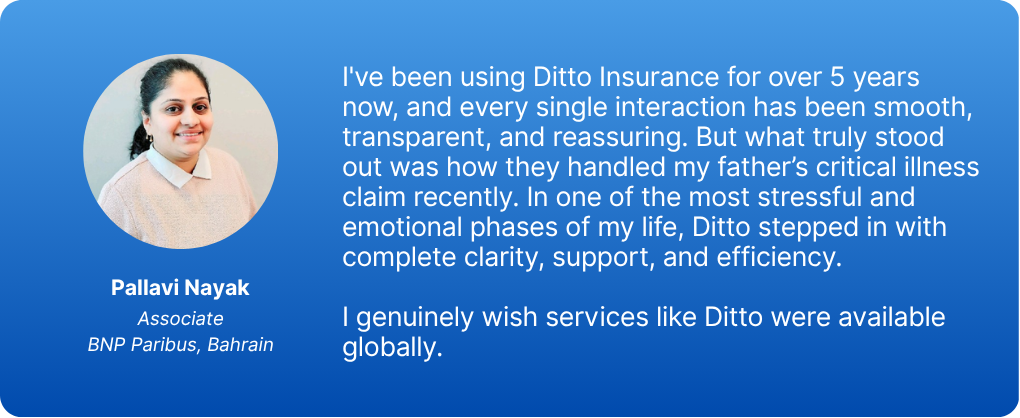
- No-Spam & No Salesmen
- Rated 4.9/5 on Google Reviews by 15,000+ happy customers
- Backed by Zerodha
- Dedicated Claim Support Team
- 100% Free Consultation
Confused about the right insurance? Speak to Ditto’s certified advisors for free, unbiased guidance. Book your call now, slots fill up fast!

Ditto’s Take on Navi Health Insurance
Consistently weak performance across key metrics
Navi has repeatedly scored poorly on important indicators such as CSR, ICR, complaints, and annual business. Based on this data, it becomes difficult to recommend the insurer with confidence
TPA Usage
Navi relies on TPAs. This can sometimes lead to delays or inefficiencies in the claims process.
Higher Premiums
Navi’s plans are generally priced slightly higher than many peers, especially when viewed against its overall performance. For example, the premium for the ‘Navi Health’ plan for a 25 year old male residing in Delhi is ₹ 13,034
Read the Fine Print
Always go through the policy wording carefully so you’re clear about what’s covered, what’s excluded, and any limits that may apply.
Conclusion
Navi’s performance has remained consistently weak across most key metrics in recent years. To become more competitive, the insurer must significantly improve its claims experience and operational efficiency. Until that happens, it is wise to compare other health insurance options and choose a plan that best fits your individual needs.
Notes:
- To know the methodology behind why the above plans are recommended, refer to Ditto’s Cut and Framework
- Our assessment here is completely independent and based solely on publicly available data and the evaluation framework we use for all insurers. If you want to understand how Ditto reviews insurers across claims, complaints, business strength, and product suitability, read our methodology here.
The information provided is for general awareness and should not be used for financial or legal decisions. Please refer to the official website for the latest details.
Frequently Asked Questions
Last updated on: