Health Insurance

Health Insurance for Housewife: Plans, Cover and Costs

Ann Tresa Jais

Written by Ann Tresa Jais

Insurance Writer

Ishita Jain

Reviewed by Ishita Jain

IRDAI-Certified Expert at Ditto

SP0738675913

Certified
Health Insurance for Housewife: Plans, Cover and Costs

Overview

Housewives in India can purchase individual health insurance or join a family floater without earning a salary. Benefits depend on policy terms.

Types of Health Insurance for Housewives

  • Individual Health Insurance: Provides a separate sum insured for the housewife, without sharing it.
  • Family Floater Insurance: Covers spouses and children under one shared sum insured, which claims can exhaust.
  • Women-Centric Health Plans: Star Women Care and ICICI Lombard Elevate with Elevate HER offer maternity, fertility, and preventive benefits.

Key Benefits Included

  • Hospitalization Expenses: Covers eligible hospital bills, subject to specific policy restrictions.
  • Pre- and Post-Hospitalization: Covers eligible expenses before and after hospitalization.
  • Maternity & Newborn Care: Selected plans cover delivery and newborn expenses, subject to waiting periods and limits.
  • Tax Benefits: Under the old tax regime, eligible spousal premiums qualify for Section 80D (now 126 of the Income-tax Act 2025).

A housewife takes care of everyone in the family, but her own health can sometimes take a back seat. And when an unexpected illness or hospitalization occurs, the medical bills can strain the family's finances. So, can a housewife get health insurance without earning a monthly salary?

Yes, housewives can buy health insurance in India even without a salaried job. They can purchase an individual policy or join a family floater. However, choosing the right coverage means understanding its benefits and limitations.

In this guide, we'll explain how health insurance for housewife works, the plans available, sample premiums, and what to consider before buying.

How Can Housewives Be Covered Under Health Insurance?

A housewife doesn't need an independent income to get health insurance. She can buy an individual policy, with her husband paying the premiums, or be covered alongside her family. However, premiums must be paid on time to maintain uninterrupted coverage. So, which option offers the right protection?

Coverage OptionsHow It WorksWhat to Keep in Mind
Family FloaterA housewife shares the sum insured with her husband and children under one policy.Usually a practical choice for relatively healthy families with spouses of similar ages.
Individual PolicyShe gets a separate sum insured that isn’t shared with any family members.Worth considering when one spouse has significant medical needs or the shared coverage isn’t sufficient.
Husband’s Employer PolicyShe can be covered as a dependent under her husband’s group health insurance if the employer offers this benefit.Coverage, benefits, and continuity depend on the employer’s policy and employment status.

While a husband's employer policy can be useful, we don't recommend relying on it alone. It may not be comprehensive since the sum insured could be insufficient, and coverage ends if he changes jobs, retires, or loses employment.

If a housewife develops a medical condition, buying a new policy later could be difficult because of underwriting restrictions.

That's why we recommend maintaining a personal health insurance policy, either individual or family floater, for long-term continuity and to complete applicable waiting periods.

Best Health Insurance Plans Available for Housewives in India

Housewives can choose a comprehensive individual policy or family floater based on their healthcare needs. Using Ditto's health insurance rating framework, here are five plans worth considering:

HDFC ERGO Optima Secure+

    • Optima Secure+ offers sum insured options from ₹10 lakh to ₹2 crore for individuals and families. 
    • Its Secure Benefit provides 2X coverage from day one.
    • Infinite Benefit increases coverage by 100% of the base sum insured every year, with no maximum cap, regardless of claims. 
    • It also covers consumables, unlimited restoration, domiciliary treatments, daycare procedures, organ donor expenses, and AYUSH treatments.

Care Supreme

    • Care Supreme offers sum insured options from ₹5 lakh to ₹1 crore for individuals and families.
    • It provides unlimited automatic restoration of the sum insured for both related and unrelated illnesses.
    • The plan has no standard room-rent restrictions or mandatory co-payment.
    • Optional add-ons offer benefits such as reduced waiting periods for pre-existing diseases, OPD coverage, and coverage for specified non-payable expenses.

Aditya Birla Activ One MAX

    • Activ One MAX offers sum insured options from ₹5 lakh to ₹2 crore for individuals and families.
    • Its Super Credit benefit increases the sum insured by up to 500%, capped at ₹3 crore.
    • The plan provides unlimited restoration of the sum insured from the second claim during the policy's lifetime.
    • It also includes Claim Protect for specified non-payable expenses and HealthReturns, which can offer renewal premium discounts of up to 100% for meeting eligible wellness criteria.

Niva Bupa ReAssure 3.0 Black

    • ReAssure 3.0 Black offers sum insured options of ₹5 lakh, ₹10 lakh, and Unlimited for individuals and families.
    • The plan has no room-rent restrictions, mandatory co-payment, or disease-wise sub-limits.
    • Its Booster+ benefit carries forward unused coverage up to 10X the base sum insured.
    • ReAssure Forever provides unlimited restoration for any illness, except under the Unlimited variant.
    • It also offers Live Healthy wellness discounts of up to 30% and an optional Claim Safeguard+ add-on for specified non-payable expenses.

SBI Super Health Platinum Infinite

    • SBI Super Health Platinum Infinite offers sum insured options from ₹50 lakh to ₹2 crore for individuals and families.
    • The plan provides unlimited reinstatement of the sum insured and up to 3X coverage for 37 specified serious illnesses through its Health Multiplier benefit.
    • It offers global coverage for 16 listed conditions, along with built-in OPD and consumables coverage.
    • The plan includes maternity coverage up to ₹2 lakh, newborn coverage up to the maternity sum insured, and child vaccination expenses up to ₹10,000 annually, subject to policy terms.
    • It also has a shorter pre-existing disease waiting period of two years.

For a detailed comparison of these plans, including their features, benefits, and limitations, check out our best health insurance plans in India guide. 

What About Women-Specific Health Insurance Plans?

PlanKey Benefits
Star Women CareOffers ₹5 lakh to ₹1 crore in coverage, with maternity benefits up to ₹1 lakh, assisted reproduction treatments up to ₹3 lakh, newborn care, antenatal care, and age-specific preventive health checkups, subject to opted sum insured, applicable limits, conditions and waiting periods. 
ICICI Lombard ElevateOffers the optional Elevate HER add-on with four variants, supporting PCOS, hormonal health, maternity, fertility, and menopause, plus consultations, diagnostic credits, and maternity cover up to ₹2 lakh. 

Talk to an expert
today and find
the right
insurance for you.

Ditto Advisor

Sample Premiums for Homemakers by Age

ProfilesHDFC ERGO Optima Secure+Care SupremeAditya Birla Activ One MAX
(Individual Plan): Age 25₹13,459₹16,294₹11,671
(Individual Plan): Age 35₹15,204₹16,294₹12,941
(Individual Plan): Age 45₹18,960₹22,118₹19,451
(Individual Plan): Age 55₹38,257₹36,434₹33,153
(Family Floater, 2A): Ages (31, 32)₹21,128₹23,153₹18,743
(Family Floater, 2A 1C): Ages (35, 34, 5)₹26,017₹29,257₹24,700
(Family Floater, 2A): Ages (62, 63)Not available due to the 60-year entry age limit ₹86,069₹73,156

Note: Here, A stands for adult and C for child. These are indicative premiums for a Delhi resident (PIN code: 110010) for ₹15 lakh cover and include recommended add-ons and discounts. Your premium can change based on age, city, medical history, plan variant, added discounts, and chosen add-ons.

For individuals aged 60+, HDFC ERGO Optima Secure is an option, as it allows entry up to age 100.

Background Image

What Should Housewives Consider Before Buying Health Insurance?

01

Adequate Sum Insured

Aim for at least ₹15 lakh to ₹25 lakh in coverage, depending on your age, medical history, family size, city, and preferred hospitals. With rising treatment costs and medical inflation, choosing a lower sum insured simply to save on premiums could leave you with substantial out-of-pocket expenses.

02

Maternity and Newborn Coverage

If you're planning a family, check whether the policy covers deliveries, pregnancy-related complications, and newborn hospitalization. Maternity benefits often come with waiting periods and payout limits. You can explore our maternity insurance guide for more details.

Ditto's Advice: We don't recommend expensive maternity add-ons solely for delivery expenses, as the additional premiums and limited payouts may outweigh the benefits. Instead, check your spouse's employer-provided coverage or consider saving separately for delivery expenses.

03

Waiting Periods and Pre-Existing Conditions

Look for plans with shorter waiting periods for pre-existing conditions like thyroid disorders or PCOS. While most policies have an initial 30-day waiting period, pre-existing diseases can have waiting periods of up to three years. Always disclose your complete medical history when applying.

04

Room Rent, Co-Payment, and Disease-Wise Limits

Prioritize policies without room-rent restrictions, mandatory co-payments, or disease-wise sub-limits. These restrictions can increase your out-of-pocket expenses during hospitalization, even if you have sufficient coverage.

05

Restoration and Bonus Benefits

Choose plans that restore your coverage after claims, preferably with unlimited restoration for both related and unrelated illnesses. Cumulative bonuses can also increase your available coverage over time.

06

Preventive Health Checkups

Check whether the policy includes annual health checkups and women's health screenings, such as Pap smears, mammograms, or thyroid tests. Coverage depends on the insurer and may require specific add-ons.

07

Insurer's Claim and Service Record

Evaluate the insurer's claim settlement record, complaint volumes, cashless hospital network, and customer support. Prioritize insurers with reliable claim servicing and a strong network of hospitals near you.

Ditto's Take: When choosing the best health insurance for women, including housewives, prioritize comprehensive hospitalization coverage, adequate sum insured, minimal restrictions, and reliable claims support. Women-specific benefits are worth considering, but they shouldn't compromise the base policy's quality. For a broader comparison, refer to our guide to the best health insurance for women in India.

How Can Housewives Buy Health Insurance Online?

    • Book a Free Consultation: Connect with Ditto's IRDAI-certified advisors through a call or WhatsApp to shortlist 2 or 3 plans based on your age, medical history, and family needs.
    • Compare Plans: Review premiums, coverage, waiting periods, exclusions, and optional benefits before selecting a policy.
    • Complete the Proposal Form: Fill out the online application with your personal details and information about the family members being covered.
    • Disclose Your Medical History: Accurately declare pre-existing conditions, past surgeries, medications, and relevant lifestyle habits.
    • Pay the Premium Online: Pay through UPI, net banking, or a credit or debit card.
    • Complete Medical Tests, If Required: The insurer may request a tele-medical consultation or physical medical tests based on your age, health, and chosen coverage.
    • Review the Insurer's Decision: The insurer may approve, reject, or offer modified terms, such as premium loading or specific exclusions. Ditto can help you evaluate any counteroffer.
    • Receive Your Policy Document: Once approved, you'll receive the policy by email. Review the terms and keep a copy where your family can access it.

For more details, read our guide on how to buy health insurance online.

Why Choose Ditto for Health Insurance?

At Ditto, we’ve assisted over 12,00,000 customers choose the right insurance policy. Why customers like Pallavi love us:
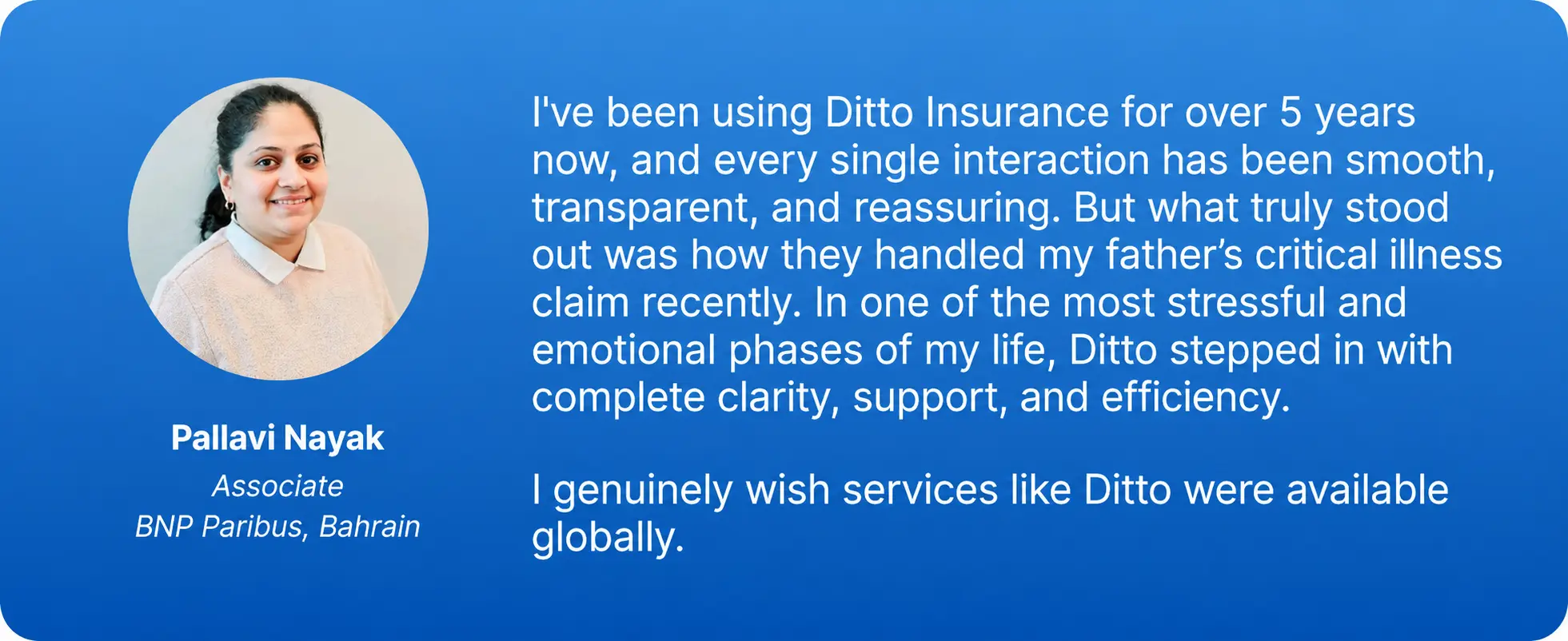
Pallavi Nayak LinkedIn Customer Testimonial
    • 100% Free Consultation
    • No Spam. No Sales Pressure.
    • Rated 4.9/5 on Google Reviews by 30,000+ Happy Customers
    • Backed by Zerodha
    • Dedicated Claim Support Team
    • Compare Plans and Premiums with a Trusted Insurance Advisor

Confused about the right insurance? Speak to Ditto’s certified advisors for free, unbiased guidance. Book your call now or chat with us on WhatsApp. Slots fill up fast!

Conclusion

A housewife doesn't need a regular income to get health insurance, but choosing the right policy matters. Whether you opt for an individual plan or a family floater, prioritize adequate coverage, fewer restrictions, and reliable claim support. Maternity and women-specific benefits can be useful, but they shouldn't come at the expense of comprehensive hospitalization coverage.

Most importantly, don't depend entirely on your husband's employer-provided insurance. Having a personal policy ensures greater continuity and helps you complete applicable waiting periods, so you're better prepared for unexpected medical expenses.

Frequently Asked Questions

Is health insurance for a housewife worth buying if her husband already has a corporate policy?

Yes. Corporate health insurance is a useful benefit, but it shouldn't be your family's only coverage. The sum insured may be insufficient, certain treatments may be restricted, and coverage can end when your husband leaves his job or retires. A personal individual policy or family floater provides greater continuity and lets you complete applicable waiting periods while you're covered, reducing the risk of underwriting difficulties later.

Can a housewife with no income buy a health insurance policy in her own name?

Yes. A housewife doesn't need a salary, employment certificate, or independent income to purchase standard health insurance in India. She can buy an individual policy in her own name, with her husband paying the premium if needed. Alternatively, she can join a family floater. The insurer will assess factors such as her age, medical history, and requested coverage. Approval remains subject to underwriting and the insurer's eligibility requirements.

How long is the maternity waiting period in health insurance plans for housewives?

Maternity waiting periods typically range from 9 months to 4 years, depending on the plan. For example, Niva Bupa Aspire Titanium+ has a 9-month waiting period, while HDFC ERGO Optima Secure+ with the Parenthood add-on requires 24 months. Some employer-provided policies cover maternity from day one. Before buying, check the waiting period, delivery sub-limits, and newborn coverage. Read our maternity insurance guide for more details. 

Are women-specific illnesses like cervical or breast cancer covered in a homemaker's health insurance plan?

Yes. Comprehensive health insurance plans cover medically necessary hospitalization and eligible cancer treatments, including surgery, chemotherapy, and radiation therapy for breast or cervical cancer. However, coverage depends on the policy's exclusions, waiting periods, and any condition-specific restrictions. If cancer was diagnosed before purchasing the policy, you must disclose it during underwriting. The insurer can impose specific terms or decline the application. Routine cancer screenings are covered only when included in the policy's preventive or outpatient benefits.

Does a housewife lose cover on a family floater if another family member exhausts the sum insured?

Not permanently, but she could have no coverage left for additional claims during that policy year. A family floater shares one sum insured among all insured members. If her husband exhausts the entire amount, her subsequent hospitalization expenses won't be covered unless an applicable restoration benefit replenishes the coverage. Restoration benefits have conditions, including when they activate and whether they cover the same illness. The shared sum insured resets at renewal under the policy terms.

Can a husband claim a Section 80D deduction for a health insurance premium paid for his wife?

Yes, under the old tax regime, provided he pays the premium through a non-cash payment method. The deduction is available even if the policy is in his wife's name. The combined limit for self, spouse, and dependent children is ₹25,000 annually, increasing to ₹50,000 if an insured family member is a senior citizen. These limits are shared across eligible family premiums, not available separately for each person.

Last updated on: