



Introduction
Choosing health insurance for your family is tricky because each family member has a different health risk. According to the National Sample Survey on Health 2025, conducted by the Ministry of Statistics and Programme Implementation, illness reporting was highest among people aged 60 and above at 43.9%, followed by those aged 45-59 at 22.5%, while children aged 0-4 reported an illness rate of 9.9%.
This is why a family health insurance plan cannot be chosen based solely on the premium. You need to check the cover, hospital network, cashless claims, room rent limits, co-payments, sub-limits, and waiting periods.
With so many variables to consider, comparing family health insurance plans on your own can quickly become overwhelming. That’s where Ditto Insurance can make a difference. As a free insurance advisory platform, Ditto helps families understand their options, compare plans objectively, and choose the right coverage, all without any spam.
In this guide, we explain family floater plans, compare them with individual plans, estimate cover needs, shortlist good options, and show how Ditto simplifies the entire process.
Common Questions People Ask
What Is Family Floater Health Insurance?
A family floater health insurance plan covers your entire family under a single policy, allowing all members to share a common sum insured amount. Rather than buying separate policies for each person, you pay one premium, making it a highly cost-effective and convenient way to manage hospitalization expenses.For example, if you buy a ₹20 lakh floater for a family of four, any one member, or all of them combined, can use up to ₹20 lakh in a policy year.
The Upside: It is usually more affordable than buying separate individual plans.
The Downside: If one member exhausts the cover, the rest of the family is left with nothing for that year.
Should I Buy a Family Floater or Individual Plans for My Family?
Choose a family floater if you are a young, healthy nuclear family seeking an affordable, easy-to-manage policy. Opt for individual plans if you have a significant age gap between members, senior citizens, or members with chronic illnesses, to prevent one person from exhausting the shared coverage pool.Family Floater Plans
- The Pros: Generally more cost-effective (cheaper combined premium), easier to manage with a single renewal date, and flexible enough that any member can use the whole cover if an emergency strikes.
- The Cons: The premium is calculated based on the age of the eldest member. If one person exhausts the sum insured, the rest of the family is left without coverage for the remainder of the year.
Individual Plans
- The Pros: Guaranteed coverage for each person (one person's claims don’t impact another's). Ideal for family members with diverse healthcare needs, serious pre-existing conditions, or advanced age.
- The Cons: Can become significantly more expensive overall, and tracking renewals or claims for multiple policies can be tiring.
Ditto’s Advice: Many families blend both. For example, you can buy an affordable family floater for your core nuclear family and purchase separate individual plans (or dedicated senior-citizen plans) for aging parents.
How to Choose Family Health Insurance?
Choosing the right health insurance plans for family involves comparing family floater plans with individual plans, evaluating coverage for specific needs such as pre-existing conditions, checking the number of network hospitals near you, and securing an adequate sum insured to protect your savings against rising medical costs.
What to Look for When Comparing Plans:
- Sum Insured: Should match healthcare costs in your city. An ideal range is ₹15 lakh to ₹25 lakh.
- Claim Settlement Ratio: Aim for insurers at 90% or above, because a higher ratio is better.
- Network Hospitals: Check that your preferred hospitals are included in the insurer’s network. At Ditto, we recommend a minimum network of 10,000+ hospitals.
- Waiting Periods: Pre-existing conditions typically have a 2- to 3-year waiting period before coverage begins. If you want immediate coverage, look for plans that allow you to add riders to reduce the waiting period.
- Sub-Limits and Co-Pays: These can significantly reduce your actual payout, so look for a plan with no co-payment, no room-rent limits, and no disease-wise sub-limits.
Which Health Insurance Is Best for Family?
There is no single best plan for everyone. The "best" family health insurance depends on your family's specific needs, such as your family’s age, health history, and budget.
At Ditto, we rate the plans using our proprietary policy and insurer rating framework, which scores each plan across three dimensions:
- Feature Rating (45%): Room-rent rules, co-pays, waiting periods (and options to reduce them), restoration, bonuses, consumables coverage, and more.
- Insurer Rating (45%): Assesses the insurer's reliability based on IRDAI data, including claim settlement ratio, complaint volume, business scale, hospital network, and servicing model.
- Premium Rating (10%): Evaluates affordability for a benchmark profile.
Based on the framework, the best health plans in India include:
1. HDFC Ergo Optima Secure+ is Ditto’s strongest family pick, offering reliable claims support, high cover options, 2x cover from day one, and consumables coverage.
2. Care Supreme is a value-for-money family plan with unlimited restoration, flexible add-ons, consumables support, wellness discounts, and options to reduce PED waiting periods.
3. Aditya Birla Activ One MAX suits families wanting modern benefits, affordable premiums, unlimited restoration, strong service, and wellness-linked renewal discounts.
4. Niva Bupa ReAssure 2.0 Platinum+ is a flexible family plan with unlimited restoration, age-lock benefits, Booster+ carry-forward, and useful safeguard (consumables) add-ons.
5. SBI Super Health Platinum Infinite is ideal for families seeking high coverage, unlimited restoration, global cover, OPD benefits, consumables cover, and serious illness protection.
Talk to an expert
today and
find
the right
insurance for you.


How Much Health Insurance Cover Does My Family Actually Need?
For families in metro areas like Delhi, Mumbai, and Bengaluru, a base health cover of ₹15 lakh to ₹25 lakh is recommended. Healthcare costs are rising rapidly, and a severe illness at a top-tier private hospital can easily exceed ₹10 lakh.
The exact cover you need depends on your specific family profile and location.
- For young couples (ages 25–35) without kids, ₹10 lakh to ₹15 lakh provides a solid baseline while leaving room for future dependents.
- For a family of 3 to 4 (parents + 1-2 kids), ₹15 lakh to ₹25 lakh protects against multiple recurring claims and covers your children until they are financially independent.
- With senior parents, ₹25 lakh+ is a good starting point since older adults are prone to chronic conditions and require larger cushions.
Note: Additional features like bonus and restoration offer strong support, but ultimately, they are not a replacement for an adequate sum insured.
How to Get Health Insurance for Family?
Getting family health insurance involves comparing family floater and individual policies, customizing your coverage limit, and purchasing the plan online. Compare quotes from top insurance companies using Ditto or major insurers’ websites like HDFC Ergo, Care Health, or Niva Bupa.

Determine Your Coverage Needs
Choose between floater and individual plans, select a suitable sum insured, and take add-ons only if they align with your family’s health risks.
Compare Insurers and Plans
Compare network hospitals, waiting periods, claim settlement record, cashless experience, and policy terms before selecting a family health insurance plan.
Purchase and Finalize
Keep family details ready, review quotes and exclusions carefully, pay securely, and verify the policy documents once issued.
Ditto’s Recommendation: Always disclose accurate medical history and lifestyle habits during the application to avoid claim rejections in the future.
Should I Buy Health Insurance or Term Insurance First?
Health insurance should be your first priority. While both are crucial, medical emergencies happen far more often than deaths. Health insurance protects your immediate savings from large medical bills, and requires a 2- to 3-year waiting period for pre-existing conditions, which means the sooner you buy, the sooner you are fully covered.
The Core Differences
- Health Insurance: Covers hospitalization costs (like an emergency surgery or illness). You use this during your lifetime to protect your personal savings from being wiped out by high healthcare costs.
- Term Insurance: A pure life insurance product that provides a large payout (sum assured) to the dependents or nominees in the event of the policyholder’s untimely death. You use this to replace lost income and secure your family's future.
Ditto’s Key Takeaway: Once your health cover is in place, move on to term insurance. But do not delay it too long either. The younger you buy term insurance, the lower the premium you lock in for the entire policy tenure. Contrary to health insurance, where the premiums keep rising with an increase in age and medical inflation.
Which Health Insurance Company Is Best?
The best health insurance company depends on your specific needs. But we can distinguish them by looking at strong claim settlement histories, massive hospital networks, and minimal customer disputes. The right insurer depends on your family’s age, health history, budget, preferred hospitals, and the kind of claim support you expect.
At Ditto, we do not judge insurers only by popularity or premium. We evaluate them using our proprietary insurer rating framework, which looks at key factors such as claim settlement record, complaint volume, network hospitals, business scale, and servicing model.
Based on this, the best health insurance companies in India include:
- HDFC Ergo General Insurance has a 96.71% CSR, 9.28 complaints per 10,000 claims, an annual business volume of ₹6,118 crore, and 13,000+ network hospitals.
- Bajaj General Insurance has a 96.78% CSR, 3.07 complaints per 10,000 claims, an annual business volume of ₹6,119 crore, and 12,000+ network hospitals.
- Aditya Birla Health Insurance has a 95.81% CSR, 18.67 complaints per 10,000 claims, an annual business volume of ₹3,290 crore, and 12,000+ network hospitals.
- Care Health Insurance has a 93.13% CSR, 42 complaints per 10,000 claims, an annual business volume of ₹ 6,775 crore, and 11,400+ network hospitals.
- Niva Bupa Health Insurance has a 91.62% CSR, 42.85 complaints per 10,000 claims, ₹5,481 crore in annual business volume, and 10,000+ network hospitals.
Note: CSR, complaints volume, and annual business are taken as an average of 3 years (FY 2022-25)
How Can Ditto Help in Finding the Right Family Health Insurance?
Ditto helps families choose health insurance by first understanding the complete family profile, including each member’s age, health history, existing illnesses, budget, preferred hospitals, and whether a family floater or individual plan makes more sense.
Based on this profile, Ditto advisors compare plans across the factors that actually matter during claims, such as sum insured, hospital network, waiting periods, room rent limits, co-payments, sub-limits, restoration benefits, and exclusions.
They also help families avoid common mistakes such as choosing the cheapest plan, underinsuring, adding senior parents to a shared floater without checking the risk, or overlooking hidden policy conditions.
For policies purchased through Ditto, support does not end after purchase. Ditto also provides claims assistance and follows up with the insurer if your family needs help during the claim process, at no extra cost.
Is GST Applied to Family Health Insurance Premiums?
Individual and family floater health insurance policies are exempt from GST, meaning the applicable tax rate is 0%. However, group health insurance policies (such as those provided by employers) still attract the standard 18% GST.
From September 22, 2025, GST on health insurance in India for individual policies was reduced to 0%, including family floater and senior citizen health policies. Earlier, insurers charged 18% GST, so a ₹25,000 base premium became ₹29,500. Now, that extra ₹4,500 GST component is gone for retail family policies. For families buying their own cover, this change makes a personal family floater more cost-efficient.
Is Family Health Insurance Tax-Deductible?
Yes, family health insurance is tax-deductible. Under Section 80D (old regime) of the Income Tax Act, you can claim deductions on health insurance premiums paid for yourself, your spouse, your dependent children, and your parents.
Under this, premiums for self, spouse, and children qualify for a deduction of up to ₹25,000 per year. You can claim another ₹25,000 for parents, or ₹50,000 if they are senior citizens. The new tax regime does not offer this deduction. Under the next tax framework, this benefit moves under Section 126, but the old 80D rules still apply for current filings.
Is My Employer’s Group Health Insurance Enough for My Family?
In most cases, an employer’s group health insurance is not enough to fully secure your family. While these corporate plans offer excellent immediate benefits (like covering pre-existing conditions from day one), they usually have lower coverage limits and terminate if you switch jobs.
But it is tied to your job. If you resign, get laid off, retire, or your employer changes benefits, the cover can shrink or stop. Many plans also come with lower sum insured, room rent caps, co-payments, and limited customization. That is why employee health insurance should ideally work as a bonus layer, while your personal family floater remains the main safety net.
Can I Switch My Family Floater to Another Insurer Without Losing Waiting Period Benefits?
Yes, you can easily port your family floater policy to another insurer without losing your accrued waiting period benefits. Under IRDAI guidelines, the new insurer must give you credit for the time you have already served for pre-existing diseases and specific illnesses under your current plan. You should apply to the new insurer around 30–45 days before renewal. If accepted, the waiting period credits you have already served for pre-existing diseases and specific illnesses can be carried forward, usually up to your existing sum insured. The new insurer can still underwrite the proposal, ask for documents, reject it, or offer modified terms. Freshly added members or extra cover may face fresh waiting periods. Health insurance portability is still preferable to buying a new policy from scratch when your current plan offers poor service or restrictive limits.
What Waiting Periods Apply When I Buy a New Family Health Policy?
When buying a new family health policy, you will typically encounter four standard waiting periods before you can make specific claims.
- Initial Waiting Period: Usually, the first 30 days from the policy start date. No claims are accepted during this time except for accidental hospitalizations.
- Pre-Existing Disease (PED) Waiting Period: A 1- to 3-year waiting period applies to any medical conditions you or your family members have at the time of plan purchase.
- Specific Illness/Procedure Waiting Period: Certain common ailments and surgeries (e.g., cataracts, hernia, joint replacements) usually require a 1 to 2-year waiting period, regardless of whether they were pre-existing.
- Maternity Waiting Period: If covered, pregnancy, childbirth, and newborn care typically have a waiting period ranging from 9 months to 4 years.
Ditto’s Unique Insights on Family Health Insurance
1. Know How Proportionate Deduction Works
Room rent limits do not just affect the room charges. If you choose a room above your eligibility level, the insurer can also reduce other linked hospital expenses, such as doctor visits, nursing charges, and procedure-related costs.
For example, suppose your policy allows a room of ₹5,000 per day, but you choose a room that costs ₹10,000 per day. The insurer will not just ask you to pay the extra ₹5,000. It can also apply a proportionate deduction on associated medical expenses.
Ditto’s Take: Prefer plans with no room rent limit or at least “any room up to a single private room.” If your policy has a limit, check your eligible room category before admission.
2. Watch Out for Disease-Wise Limits
Some policies cap specific treatments, such as cataract surgery, knee replacement, hernia repair, and other modern procedures. So even if your total sum insured is ₹20 lakh, the insurer may pay only up to the disease-wise limit mentioned in the policy.
Ditto’s Take: Always check the policy wording for treatment-wise caps before buying, especially if your family has a history of recurring or planned procedures.
3. Understand the “Reasonable and Customary Charges” Clause
This clause allows insurers to question hospital charges if they seem unusually high compared to standard rates in that city or area.
For instance, if a procedure typically costs around ₹80,000 at a particular location, but the hospital bills ₹1.5 lakh without a clear reason, the insurer may approve only what it deems reasonable.
Ditto’s Take: Choose insurers with stronger claim support and a better track record of handling partial claim disputes fairly. During hospitalization, also ask the hospital for an early cost estimate so there are fewer surprises later.
4. If You Buy a Super Top-Up, Prefer the Same Insurer as Your Base Plan
A super top-up can be a smart way to increase your total coverage without paying the premium of a very large base policy. But claim coordination can become complicated if your base policy and super top-up are from two different insurers.
Ditto’s Take: If two options are similarly priced and similarly good, choose the super top-up from the same insurer as your base plan. It can reduce paperwork and back-and-forth during claims.
5. Keep an Emergency Fund for Hospital Deposits
Even with a cashless policy, hospitals may ask for a deposit at the time of admission. This is common during emergencies, especially if pre-authorization is still pending or if the hospital needs time to confirm policy details.
Ditto’s Take: Keep a small emergency buffer separate from your health insurance.
6. Check for Zone-Based Co-Pay
Some policies price premiums based on zones. For example, a plan bought for a smaller city may be cheaper, but if you get treated in a metro city, the insurer may apply a co-pay.
This can hurt during a claim because you will have to pay a fixed percentage of the approved bill from your pocket.
Ditto’s Take: If your family may use hospitals in metro cities, avoid policies with zone-based co-pay or choose the right zone from the start.
7. Do Not Ignore Consumables
Consumables include gloves, syringes, masks, cotton, bandages, and other single-use hospital supplies. These may look small individually, but together, they can add up to a meaningful part of the bill.
Some modern plans cover consumables either built in or through an add-on. Others exclude them.
Ditto’s Take: If the price difference is reasonable, consider plans that cover consumables. It can reduce out-of-pocket expenses during hospitalization.
8. Intimate the Insurer Early for Cashless Claims
For planned hospitalization, inform the insurer 48-72 hours in advance and get the pre-authorization process started early. For emergencies, the hospital usually sends the cashless request after admission, but your family should still inform the insurer or advisor within 24 hours of admission.
Ditto’s Take: Save the insurer helpline, policy number, TPA or claims desk details, and Ditto claims support contact in one shared family folder.
9. If the Insurer Offers Loading or an Exclusion, Understand the Trade-Off
Sometimes, after reviewing your medical history, an insurer may offer the policy with a premium loading or with an exclusion.
A loading charge means you pay a higher premium, but the condition may still be covered as per policy terms. An exclusion means the insurer may not cover a specific disease or condition at all.
Ditto’s Take: In many cases, a reasonable loading may be better than a permanent exclusion. But this depends on the condition, the load amount, and the exact wording of the exclusion. Do not accept either without understanding the long-term impact.
10. The Grace Period Keeps the Policy Alive, but It May Not Cover You
A grace period (30 days for annual payment, 15 days for all other modes) gives you extra time to renew your policy without losing continuity benefits, such as waiting-period credits and a no-claim bonus. But it should not be treated as free extra coverage.
Ditto’s Take: Renew before the due date. The grace period is a safety net for continuity of renewal, not a smart way to extend your coverage.
Why Talk to Ditto for Health Insurance?
At Ditto, we’ve assisted over 8,00,000 customers with choosing the right insurance policy. Why customers like Abhinav below love us:
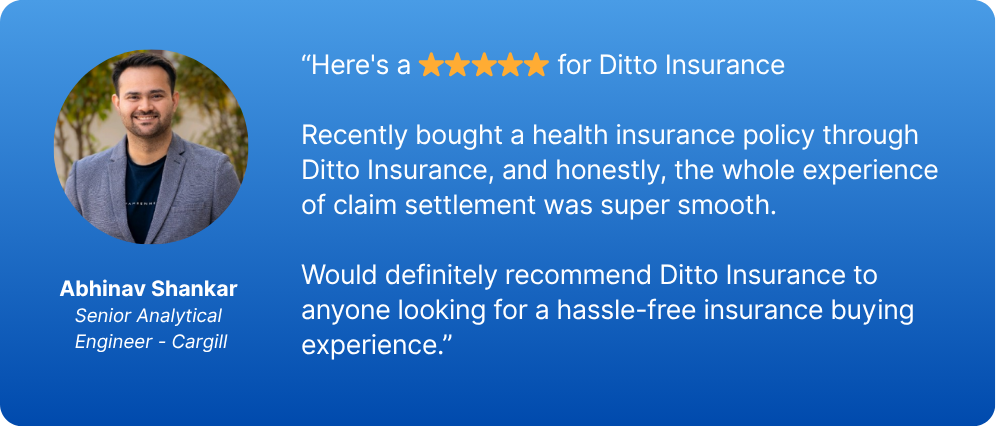
- No-Spam & No Salesmen
- Rated 4.9/5 on Google Reviews by 24,000+ happy customers
- Backed by Zerodha
- Dedicated Claim Support Team
- 100% Free Consultation
Confused about the right insurance? Speak to Ditto’s certified advisors for free, unbiased guidance. Book your call or chat on WhatsApp with us now!
Ditto’s Take on Finding the Best Health Insurance Plan for Your Family
The right family health insurance plan is not always the cheapest, the most popular, or the one with the most promising marketing claims. It is the plan that fits your family’s profile (age mix and health risks), includes your preferred hospitals, and likely meets your claim needs.
Before buying, take three practical steps.
- Decide whether your family needs one shared floater, separate individual plans, or a mix of both.
- Read the policy wording for room rent limits, co-payments, sub-limits, waiting periods, and restoration rules.
- See if a super top-up can increase your overall cover more affordably instead of buying a very large base plan.
Once the policy is issued, save the policy document, cashless claim contacts, insurer helpline details, and intermediary information in one place, so your family knows exactly what to do during a medical emergency.
Last updated on: