



Introduction
When parents buy health insurance, children are usually added to the family floater by default. But they need to pay more attention than that.
Children’s hospitalizations can be sudden and expensive. A fever can worsen overnight. A sports injury may need surgery. And in private hospitals, these bills can quickly run into lakhs.
That’s why child health insurance should not be treated as a checkbox. Parents need to choose the right cover structure, check sub-limits and restrictions, and ensure the plan will actually work when a claim is made.With so many things to consider, comparing child health insurance plans on your own can quickly become overwhelming. That’s where Ditto Insurance makes a difference. As a free insurance advisory platform, Ditto helps parents understand their options, compare plans objectively, and choose the right coverage, all without any spam.
In this guide, we'll cover when to buy, how to structure cover, what to watch out for, and how Ditto helps you find the best health insurance for children.
Common Questions Parents Ask
What Is Children's Health Insurance?
Children’s health insurance is a medical insurance policy designed to cover the healthcare needs of minors. It provides financial protection against the costs of hospitalizations, surgeries, daycare treatments, emergencies, and, in some cases, check-ups and vaccinations for your child. Coverage Structure Options
- A family floater, with a shared sum insured for the family. It is the most cost-effective option for parents.
- An individual plan, the child has their own dedicated policy with a parent as the proposer. For example, the Care Advantage plan offers individual policies for children starting at age 5.
- A multi-individual plan where each member has a separate sum insured under the same policy. Plans like HDFC ERGO Optima Secure Plus and Aditya Birla Activ One MAX support the multi-individual setup.
Why It Is Important
Children are particularly vulnerable to sudden illnesses and everyday accidents. A child's health insurance policy prevents you from dipping into your long-term savings or taking out a loan to cover unexpected medical emergencies.
At What Age Can You Buy Health Insurance for a Child?
In most retail plans, you can buy health insurance for a child after 91 days of birth and add them to your existing family floater. While coverage from birth is possible in certain plans, the standard minimum entry age is 91 days since the first three months are medically high-risk, so insurers exclude that window.
Exact Age Rules for Insuring a Child
- Newborns (Day 1): Selected policies cover babies from birth, particularly if the child is added to a parent's active maternity plan or an existing family floater plan. For example, Niva Bupa Aspire Titanium+ offers newborn cover from day 1 as part of its maternity setup. The best part is that it provides newborn coverage up to the full base sum insured, whereas other insurers offer it only within the maternity limit. Many corporate (group) plans also allow day 1 addition for newborns, making employer coverage a useful short-term bridge right after delivery.
- Infants (91 Days+): The vast majority of insurance providers and standardized health insurance plans require a baby to be at least 91 days old to become a covered member.
- Minors (Under 18): Children can be covered under an individual plan or a parent's family floater policy. However, because minors cannot legally sign contracts, a parent or legal guardian must act as the "proposer" (the policyholder paying the premium).
- Young Adults (Up to 25 Years): Under family floater plans, children can generally remain covered dependents until age 25. Once they cross this threshold, they are typically required to purchase an individual health insurance policy (insurers offer the option to switch to a separate individual plan, with all benefits, including waiting periods, carried forward). One of the exceptions is Niva Bupa’s ReAssure2.0 plan, which has no exit age for kids.
Can You Buy a Standalone Health Plan Just for a Child?
Yes, you can buy a standalone health insurance plan just for your child. But minors cannot legally sign a policy for themselves, so a parent or legal guardian must act as the “proposer” to purchase the plan.
- How It Works: The parent manages the paperwork and premiums on the child's behalf, and the child gets their own individual sum insured.
- Who Offers Them: Options are limited, but several leading insurers, such as Aditya Birla Health Insurance and HDFC ERGO, allow for multi-individual policies for children. Care Advantage offers an individual plan that allows standalone child policies from age 5, with the parent as the proposer.
- Coverage Details: These policies typically cover hospitalization due to critical illnesses or emergencies, daycare procedures, and anything that a standard health insurance plan covers.
The Alternative: Family Floater Plans
If you also need coverage for yourself and your spouse, a family floater is often more affordable and convenient. These policies group all family members under one shared sum insured. Children can typically remain as dependents on a family floater until they reach ages 21 to 25, at which point they will need to migrate to their own independent policy (waiting periods are carried forward).
When to Choose Which?
- Standalone/Multi-Individual Plan: Best if you want a separate, dedicated medical buffer for your child, or want to avoid claims from adults eating into your child's coverage pool.
- Family Floater: Best for comprehensive, cost-effective coverage for the entire household, since premiums are lower than buying separate policies.
Standalone Child Plan vs. Family Floater: Which Is Better?
A family floater health plan is generally better for a young, healthy nuclear family. It covers all members under a single, shared sum insured, usually costing 30%–50% less than multiple individual plans. A standalone child plan, however, is better for dedicated, lifelong coverage focused entirely on the child's independent needs.
Family Floater Health Plan
A family floater pools a single sum insured amount that can be used by any member, such as you, your spouse, or your children, in a given policy year.
- Pros: Highly cost-effective; all members are covered by a single, manageable premium, renewal date, and policy document.
- Cons: If one family member faces a massive medical emergency and exhausts the entire sum insured, the remaining family members are left with no coverage for the rest of the year.
- Best For: Small, healthy nuclear families with young children and similar health profiles.
Standalone Child Plan (Individual Cover)
A standalone policy provides a dedicated sum insured specifically for the child.
- Pros: The child has a 100% exclusive sum insured pool, so their medical claims do not impact your or your spouse's coverage.
- Cons: Higher premiums overall and more paperwork, as you are managing separate policies for each family member.
- Best For: Families with children who have a known pre-existing medical condition, or parents looking for independent medical and financial coverage for their child into adulthood.
What Is the Best Health Insurance Plan for Children in India?
The best health insurance for children in India is a comprehensive family floater plan rather than an exclusive child policy. At Ditto, we evaluate plans based on coverage features (room-rent rules, sub-limits, co-pays, waiting periods), insurer reliability (claims track record, hospital network), and premium value using our unbiased policy and insurer rating framework. Plans like HDFC ERGO Optima Secure Plus, Care Supreme, Aditya Birla Activ One MAX, and Niva Bupa ReAssure 2.0 Platinum+ consistently score well for their robust coverage and features.
Best Child Health Insurance Plan in India
- HDFC ERGO Optima Secure Plus: A strong pick for families that want high coverage from day one. It offers 2X cover from the start, unlimited restoration, no room-rent cap, no co-pay, and built-in consumables cover, which is useful when a child’s hospital bill includes several non-medical expenses.
- Care Supreme: A value-for-money family floater with no room-rent limit, no co-pay, no disease-wise sub-limits, unlimited automatic recharge, and optional add-ons like Claim Shield Plus for consumables coverage. This works well for parents who want comprehensive coverage without paying for a very expensive plan.
- Aditya Birla Activ One MAX: A good option for families looking for affordable coverage with strong core benefits. It has no room-rent restrictions, no co-pay, unlimited reload of sum insured, and a 500% renewal bonus that can help the cover grow over time, irrespective of claims.
- Niva Bupa ReAssure 2.0 Platinum+: A feature-rich plan for parents who want long-term cover stability. It offers unlimited restoration, Booster+ benefits, no room-rent restrictions, daycare coverage, and the Lock the Clock feature, which can help keep premiums stable until the first claim.
Talk to an expert
today and
find
the right
insurance for you.


Key Features to Look For
Newborn CoverageMost retail health plans allow children to be added only after 91 days. So if you’re planning a baby, check whether the plan has an explicit newborn benefit, especially for NICU expenses.
Sufficient Family Floater CoverA ₹5 lakh to ₹10 lakh floater may look fine on paper, but it can get stretched quickly once a child is added. Pick a sum insured that can realistically cover the entire family.
No Room Rent Limits or Co-Payment These restrictions can increase your out-of-pocket costs during hospitalization. Ideally, choose a plan with no room-rent cap, no co-pay, and no disease-wise sub-limits.
Pre- and Post-Hospitalization Cover Children may need tests, consultations, medicines, and follow-ups before and after admission. Make sure these expenses are covered, ideally for 60 days before hospitalization and 90 days after.
Daycare, Ambulance, and Modern TreatmentsA good plan should cover daycare procedures, road ambulance, and modern treatments up to the sum insured, since not every treatment requires a 24-hour hospital stay.
How Much Health Cover Does a Child Need?
For a child in an urban area, Ditto recommends health cover of ₹15 lakh to ₹25 lakh. Medical costs for children (such as NICU stays, accidents, or critical illnesses) are rising, and a cover in this range ensures you aren't forced to compromise on their medical care. Factors to Consider for Your Child
- Base Policy vs. Family Floater: Covering your child under a family floater policy is highly cost-effective. Instead of buying a separate plan, a ₹15 lakh-₹25 lakh floater can cover you, your spouse, and your dependents.
- Newborn Coverage: Ensure the plan covers newborn expenses and check-ups, which are essential during early developmental stages.
- Super Top-Ups: If a base policy feels too expensive, you can buy a smaller base cover of ₹10 lakh and add a super top-up to extend your total coverage limit at a lower cost.
Does a Child's Plan Cover Newborns, Vaccinations, and Congenital Conditions?
Yes, comprehensive child health plans and family floaters can cover newborns, vaccinations, and congenital conditions. However, coverage rules vary significantly depending on the policy, waiting periods, and whether the condition is internal or external.
Overview of Coverage
- Newborns: Many plans cover newborns from day one, while others require enrollment 91 days after birth. Check the coverage limit, since most plans offering day 1 coverage limit the sum insured to the maternity cover.
- Vaccinations: Some health insurance plans cover your child’s vaccinations, but this is rarely a default benefit in regular hospitalization coverage. It usually comes through a maternity, newborn, child-care, OPD, or wellness benefit. For instance, plans like Niva Bupa Health Premia, TATA AIG MediCare Premier, and ICICI Lombard Elevate offer newborn/child vaccination cover, but with limits, waiting periods, and policy-specific conditions.
- Congenital Conditions: Standard policies cover internal congenital conditions (e.g., heart defects, cystic fibrosis), but external conditions (e.g., cleft palate) are often excluded.
Note: Routine vaccinations and Outpatient Department (OPD) visits are not covered under most base health plans. Any pre-existing congenital conditions are typically excluded at entry and may be covered after a waiting period.
What Waiting Periods Apply to a Child's Health Insurance Plan?
Waiting periods for a child’s health insurance plan generally include an initial 30-day waiting period for all illnesses, except for accidents, which are covered from day 1. Specific conditions such as hernia, knee replacement surgery, and ENT surgery are usually covered after 2 years. While pre-existing conditions are covered after 2-3 years. One useful exception applies to Care Ultimate: adding your newborn within 90 days of birth lets the child inherit the waiting periods you've already served.
Until What Age Can a Child Stay on the Family Policy?
In India, children can generally remain on their parents’ family floater health insurance policy until age 25 or 26. After which, the insurer offers a migration to an individual policy, with accumulated bonuses and waiting-period credit intact.Key Exceptions and Details
- Higher Education: Some insurers extend coverage for unmarried children up to age 26 if they are enrolled in a full-time higher education program.
- Unmarried Daughters: Depending on the insurer, unmarried or divorced daughters who rely on their parents may remain covered beyond the standard age limit, provided they do not marry.
- Transition: Once a child ages out, they must purchase their own individual health insurance policy to maintain uninterrupted coverage.
What Documents Are Needed to Buy Health Insurance for a Child?
To buy health insurance for your child, you primarily need their birth certificate, a passport-size photograph, and standard KYC documents (such as Aadhaar). Insurers also require the parents’ ID and proof of address, along with any relevant medical history or vaccination records.
- Proof of Age: A birth certificate is mandatory. An Aadhaar card or a passport is also widely accepted.
- Medical Documents: Hospital discharge cards (for newborns) or past medical certificates/vaccination records, especially if the child has pre-existing conditions.
- Child's Identity: Aadhaar card, Passport.
- Parents'/Guardians' KYC: Identity and address proof (e.g., Aadhaar, PAN card, Voter ID, or utility bills).
Most insurers allow you to simply upload these as scanned copies when purchasing the policy online.
Group Health Insurance vs. Personal Health Insurance for Children: Which Is Better?
Personal (individual or family floater) health insurance is generally better for children. While group health insurance is cost-effective and convenient, personal plans provide long-term continuity, customizable coverage, and independence from employment changes. Combining both plans offers the most robust safety net.
What Are the Advantages of Getting Health Insurance Early for Children?
Getting health insurance for children early can lead to lower premiums because they are at a lower risk of chronic diseases. It ensures continuous coverage as they grow, protects family finances from unexpected medical emergencies, and builds a comprehensive medical history for better long-term healthcare.
Top Advantages of Early Coverage
- Lower Premium Costs: Children are generally healthier with a lower risk of critical illnesses, allowing you to secure affordable premiums.
- Financial Protection: Kids are prone to accidents, infections, and common childhood illnesses. Early coverage does not burden the family with hospitalization and treatment costs, thereby protecting savings.
- No Pre-Existing Condition Exclusions: Policies purchased early in life ensure coverage for unexpected health issues before they are classified as "pre-existing," helping to avoid future claim rejections and waiting periods.
- Minimal Medical Underwriting Requirements: Young, healthy children typically do not require extensive medical check-ups to qualify for coverage, making the buying process faster and simpler.
- Accumulated No-Claim Bonuses (NCB): Insurers often reward claim-free years by increasing the coverage amount or reducing premiums. Starting early allows you to maximize these bonuses for later in life.
Did You Know?
How Does Premium Change When Adding Children to a Family Floater?
These are indicative premiums for Delhi residents (pin code: 110001) with a ₹15 lakh sum insured, including mandatory and recommended add-ons. Your premium can change based on age, city, medical history, plan variant, added discounts, and chosen add-ons.
Adding a child to a family floater typically triggers a proportional increase in your premium. Because family floaters base their pricing on the age of the oldest member, the base premium stays steady, while insurers apply a fixed, lower "per-child" rate for younger kids.
Ditto's Unique Insights on Health Insurance for Children
Most parents focus on the premium. The bigger risk is buying a plan with fine-print restrictions that fail silently at claim time. Here's how Ditto helps:
Policy Structuring Based on Your Family Profile
An IRDAI-certified Ditto advisor reviews your child's age, medical history, and location before recommending anything. If an adult has a chronic illness, Ditto often recommends splitting policies so adult health risks don't drain your child's sum insured. Ditto also evaluates individual, multi-individual, and family floater options across typical family structures, such as 2 adults and 2 children, factoring in the premium impact of adding children to each setup.
Flagging Hidden Restrictions
Pediatric care involves unpredictable hospital scenarios. Ditto explicitly flags plans with room rent limits, disease-specific sub-limits, and mandatory co-payments, steering parents toward restriction-free base policies instead.
Pediatric-Specific Coverage Check
Ditto's review ensures the plan covers daycare treatments, pre- and post-hospitalization costs, emergency ambulance charges, and newborn complications under the maternity coverage wherever applicable.
Correct Disclosure at Entry
If your child has a past condition or prior surgery, Ditto ensures it's correctly declared on the proposal form. Incorrect disclosures are among the most common and preventable causes of later claim rejections.
Counteroffer Guidance
If an insurer responds with additional waiting periods or premium loading charges, Ditto explains what these mean in plain terms and helps you decide whether to accept, look elsewhere, or negotiate before you sign.
After shortlisting, you get a side-by-side comparison of 2 to 3 specific plans tailored to your family's budget and needs.
Why Choose Ditto for Health Insurance?
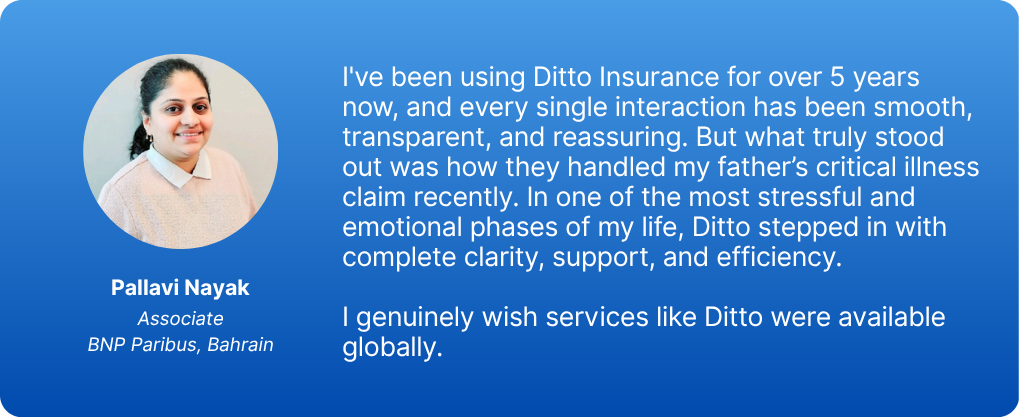
At Ditto, we’ve assisted over 8,00,000 customers with choosing the right insurance policy. Why customers like Pallavi below love us:
- No-Spam & No Salesmen
- Rated 4.9/5 on Google Reviews by 24,000+ happy customers
- Backed by Zerodha
- Dedicated Claim Support Team
- 100% Free Consultation
Confused about the right insurance? Speak to Ditto’s certified advisors for free, unbiased guidance. Book your call or chat on WhatsApp with us now!
Conclusion
Health insurance for children is easiest to get right when you plan before a medical emergency.
Add your child to the policy as soon as they’re eligible, check whether newborn or NICU expenses are actually covered, and don’t settle for a low sum insured floater that gets stretched across the whole family. More importantly, avoid plans with room-rent limits, co-payments, disease-wise sub-limits, or unclear waiting periods.
A good child health insurance setup should provide your child with sufficient usable coverage today and a clear path to continue coverage as they grow older.
Last updated on: