



Overview
According to a study on the prevalence of Cardiovascular Deaths (CVD) among the Indian adult population published in PubMed, India accounts for one-fifth of all global cardiovascular deaths, with a significantly high burden among younger people.
This makes access to health insurance for people with cardiac conditions very important. But in many cases, if you already have a significant history of heart issues, a standard health insurance policy becomes harder to get.
Care Heart health insurance can serve as a safety net in this case. It is designed specifically for people with pre-existing cardiac conditions.
In this review, we will examine what the plan covers, the premiums, sub-limits, and who should consider it.
What Is the Care Heart Health Insurance Plan?
Care Heart is a specialized health insurance policy by Care, designed for people with a history of cardiac diseases. But coverage isn't limited to heart issues. Like any standard health insurance plan, it also covers hospitalizations due to accidents, minor and critical illnesses.
Please Note: Your heart condition might be permanently excluded from this plan. Coverage depends on its severity and the underwriting team. If the insurer accepts the cardiac condition, the coverage begins after a 2-year waiting period.
Key Features of Care Heart Plan
1) Coverage for Individuals and Families: You can buy Care Heart as an individual policy or as a family floater covering up to two adults. The minimum entry age is 18 years, since children are not allowed in this plan.
2) Inpatient Care: The policy covers eligible inpatient hospitalization expenses for illnesses and injuries, subject to the applicable Sum Insured (SI), waiting periods, exclusions, and sub-limits.
3) Day-Care Treatment: The day-care treatments listed in the policy wording of Care Heart are covered up to the SI.
4) Pre- and Post-Hospitalization Expenses: Medical expenses incurred 30 days before and 60 days after a hospitalization are covered up to a maximum of 5% of the SI.
5) Ambulance Cover: Road ambulance expenses are covered up to ₹2,000 per hospitalization for ₹3 lakh and ₹5 lakh cover amounts and up to ₹3,000 per hospitalization for ₹7 lakh and ₹10 lakh cover amounts.
6) AYUSH Treatment: The policy covers eligible treatment under Ayurveda, Yoga and Unani, Siddha and Homeopathy, up to the SI.
7) Domiciliary Hospitalization: Eligible domiciliary treatment can be covered up to the SI if the treatment continues for more than 3 days.
8) Annual Cardiac Health Check-Up: The insured person can use a cardiac health check-up once every policy year after the first 30 days. The check-up is cashless for the set of medical tests specified in the policy wording, depending on the SI, and is available through the insurer's empaneled providers.
9) No-Claim Bonus: For every claim-free year, the SI increases by 10%, up to a maximum of 50%. If you make a claim, the accrued bonus decreases by 10%. This reduction applies only to the bonus and does not reduce the SI.
10) Automatic Recharge: Once the base SI is exhausted, Care Heart provides an automatic recharge of 100% once during the policy year. However, you cannot use it for the same illness.
11) Modern Treatments: Covered up to SI for listed treatments in the policy wording.
Talk to an expert
today and
find
the right
insurance for you.


Care Heart Add-Ons: Care Shield, Care OPD, and Home Care
Care Shield
- Coverage for Consumables: Items such as masks, syringes, gloves, etc., which may otherwise be paid out of pocket.
- Inflation Shield: SI will be increased every year based on the consumer price index inflation rate at renewal.
- No-Claim Bonus Protection: There will be no reduction in the bonus if a claim made is less than 25% of the cover amount.
Care OPD
This covers outpatient expenses that do not require hospitalization. The add-on covers 8 doctor consultations: 4 with general physicians and 4 with specified specialists, up to ₹500 per consultation. This would be covered on a reimbursement basis after a 30-day waiting period.
Home Care
Home Care offers a fixed daily payout for doctor-advised treatment at home.
- ₹1,000 per day on ₹3 lakh and ₹5 lakh cover
- ₹2,000 per day on ₹7 lakh and ₹10 lakh cover
- Available for up to 7 days per illness/injury per policy year
- The benefit is capped at 45 days per insured person
- You can claim this benefit within 30 days of hospital discharge for the same illness
- The first 24 hours of eligible Home Care expenses are not payable
Ditto’s Recommendation: Among these add-ons, Care Shield is worth considering because consumables can create higher out-of-pocket deductions. You can consider Care OPD and Home Care based on your requirements. However, these benefits have limits that may not always justify the premiums you pay.
Care Heart Waiting Periods, Co-Payment, and Disease-Wise Sub-Limits
Care Heart Waiting Periods
- 30-day initial waiting period (accidents are covered from day 1)
- 2-year specific illness waiting period
- 2-year Pre-Existing Disease (PED) waiting period, compared with 3 years for most standard plans
Mandatory Co-Payment
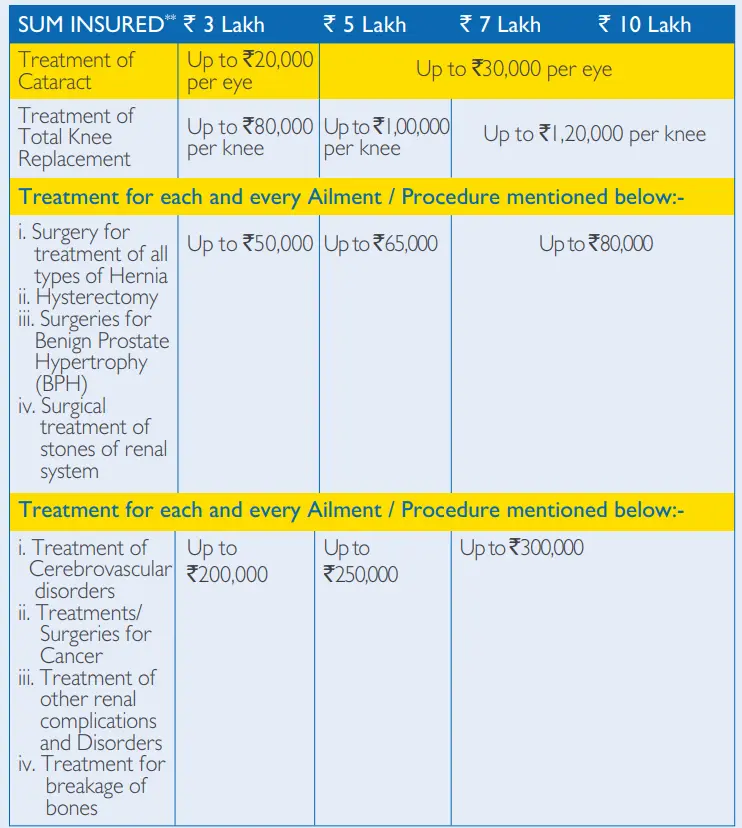
Disease-Wise Sub-Limits
The plan comes with different sub-limits depending on the diagnosis and the sum insured. For details, see the image below.
Source: Care Heart Brochure
Room Rent Restrictions
Care Heart Sample Premium Illustration by Age and Sum Insured
The premiums are illustrative and calculated for adults living in Delhi (pincode: 110010) for a 1-year tenure, including recommended add-ons. Your final premium will be decided based on your age, city, medical history, cover amount, and the add-ons you opt for.
Care Health Insurance: Performance Metrics
Note: At Ditto, we evaluate and recommend insurers based on the average performance of the last 3 years. The data shared above averages FY 2024-2026, except for ICR, which averages FY 2023-2025, as the latest ICR data for FY 2025-26 has not been released yet.
This information is sourced from the IRDAI annual reports, Care Health and HDFC ERGO’s public disclosures. To explore more such data, please refer to Ditto Data Labs.
Care’s complaint volume is on the higher end, but it should not be viewed in isolation. Since Care is a standalone health insurer and has high business volume, complaints can be higher than those of general insurers like HDGC ERGO. Since Care’s CSR is above Ditto’s benchmark of 90% and consistently improving, the complaint numbers should not be seen as a cause for concern.
Pros & Cons of the Care Heart Plan
Pros:
- One of the few plans that people with a history of cardiac disease can apply for.
- The pre-existing disease waiting period for Care Heart is just 2 years. In most standard plans, it is 3 years.
- Annual cardiac health check-up on a cashless basis.
Cons:
- Maximum base cover up to ₹10 lakh.
- The plan has restrictions like co-pay, room rent, and disease-wise sub-limit.
- The insurer may permanently exclude coverage for pre-existing heart conditions or other severe conditions.
Who Should Buy the Care Heart Plan?
Why Choose Ditto for Health Insurance?
At Ditto, we’ve assisted over 12,00,000 customers with choosing the right insurance policy. Why customers like Pallavi love us:
- 100% Free Consultation
- No Spam. No Sales Pressure.
- Rated 4.9/5 on Google Reviews by 30,000+ Happy Customers
- Backed by Zerodha
- Dedicated Claim Support Team
- Compare Plans and Premiums with a Trusted Insurance Advisor
So, if you need help understanding whether standard plans cover your heart condition, talk to Ditto's certified advisors for free, unbiased guidance. Book your call or chat on WhatsApp with us now!
Conclusion
Care Heart fills a gap in the market for people with a history of cardiac disease who may not get a standard plan. Its relatively shorter PED waiting period, an annual cardiac health check-up, and lifelong renewability make it a meaningful alternative.
However, having a heart condition does not automatically mean that Care Heart is the best-suited plan for you. If a standard comprehensive plan is available, it may offer broader coverage without restrictions.
Our Advice: Always check if you are eligible for standard comprehensive plans and apply. If your medical history makes getting one difficult, Care Heart can be a practical choice.
Frequently Asked Questions
Last updated on: