



Overview
As per the IRDAI Annual Report 2024-25, overseas travel policies covered close to 97 lakh people and brought in ₹1,267 crore in premiums. That number looks big, but over 3 crore Indians flew abroad during the same period, according to the Ministry of Tourism. Do the math, and roughly two out of every three travelers are stepping onto a flight with no travel insurance at all.
That's a risky bet. A single doctor visit abroad, especially in the USA or Europe, can cost thousands of dollars, easily wiping out your savings.
So how do you make sure you're not one of those uninsured travelers?
This guide breaks down what travel health insurance covers, how it differs from full travel insurance, and how to choose the right coverage for the USA, Canada, or anywhere else you're headed.
What Is Travel Health Insurance and What It Covers?
Travel health insurance, sometimes called foreign travel health insurance, is a medical-only cover for your trip abroad. It kicks in the moment you land and ends when your trip does.
Think of it as the health-only portion of a bigger product. Comprehensive travel insurance includes everything below plus trip cancellation, baggage, and passport cover. Whereas international travel health insurance sticks to the medical side.
Why You Need Travel Health Insurance for International Trips
You need travel health insurance because your domestic health plan rarely covers overseas medical costs. It protects you from massive hospital bills and pays for emergency medical evacuation when you need it most.
Core Benefits
High-Cost Medical Protection
Emergency Medical Evacuation
Mandatory Entry Requirement
Wider Trip Safeguards
Key Insight
Travel Health Insurance vs. Travel Insurance
These terms get used interchangeably, but they aren't quite the same thing. Travel health insurance is the core of medical coverage. Travel insurance (comprehensive) is the bigger umbrella that includes it.
Bottom Line: For a short business trip with fully refundable tickets, a medical-only plan may be all you need. For an expensive, non-refundable Europe holiday, the non-medical benefits actually carry real value.
Most Indian insurers sell comprehensive plans by default. Here's a quick look at four popular ones and what they include.
Note: This is not an exhaustive list of plans. For details, please check the respective official websites.
Talk to an expert
today and
find
the right
insurance for you.


Travel Health Insurance for the USA and Canada
Travel Health Insurance for the USA
Travel health insurance is not a mandatory requirement for a USA B1/B2 visitor visa. However, a consular officer may request evidence that you can pay the costs of your trip. This is why visitor medical plans are common for parents visiting the USA or long business trips:
- Atlas America (WorldTrips): Coverage up to USD 2 million, with UnitedHealthcare PPO network access for direct billing.
- Patriot America Plus (IMG): Up to USD 1 million, with acute-onset pre-existing condition benefits.
- Safe Travels Advantage: A fixed-benefit, budget-friendly option for shorter trips.
- INF Elite X: Select variants cover pre-existing conditions up to age 99, useful for elderly parents.
Ditto's Take: For parents visiting the USA, prioritize acute-onset PED cover and network access over the headline dollar figure. A USD 2 million plan with a non-existent PED clause helps less than a USD 500,000 plan that actually covers a sudden cardiac event.
Travel Health Insurance for Canada
Travel health insurance Canada is stricter. If you're sponsoring parents or grandparents on a Super Visa, mandatory insurance rules apply, not optional guidance.
- Minimum coverage of CAD 100,000 in emergency medical cover.
- The policy must remain valid for at least 1 year from the date of entry.
- Must cover hospitalization, healthcare, and repatriation.
- Must come from a Canadian insurer or a foreign insurer authorized by Canada's Office of the Superintendent of Financial Institutions (OSFI).

How to Choose and Buy the Right Travel Health Insurance Plan
Match Cover to Your Destination
Healthcare costs vary massively by country. Europe can mean USD 250,000+, the USA or Canada can mean USD 500,000+, while lower limits are usually fine for most of Asia. Don't buy a USD 50,000 plan for a trip where a single ICU stay could cost double that.
Check the Sub-Limits, Not Just the Sum Insured
A plan that says "USD 500,000 coverage" sounds great. But a USD 500,000 headline figure means little if it has a low room rent cap and a per-claim deductible, you could still end up paying a lot out of pocket. Always check the fine print, not just the headline number.
Decide Single-Trip or Multi-Trip
One vacation needs a single-trip plan. Taking three or more international trips a year? Frequent international travel makes an annual multi-trip plan work out cheaper. Traveling with parents to the USA or Canada? Look at a dedicated visitor medical plan instead of a standard leisure one.
Always Declare Pre-Existing Conditions
If you have diabetes, high blood pressure, or any other known condition, declare it and buy the PED add-on. Hiding it to save on premium is the single biggest reason claims get rejected abroad. The extra cost is small compared to the cost of a denied claim during a medical emergency.
Buy From a Regulated Insurer
For outbound plans, stick to insurers listed on IRDAI. For inbound USA or Canada visitor plans, check that the insurer is licensed to sell in that country, since Canada's Super Visa specifically requires an OSFI-authorized insurer. If you're applying for a Schengen visa, also confirm your plan is on the embassy-approved list, as not all Indian plans qualify.
Buy Before You Fly
Purchase your policy before departure, not at the airport or after you land. A policy bought after you've already left doesn't count, and trip-related benefits only apply if you buy early, ideally soon after you book your tickets.
Why Choose Ditto for Insurance?
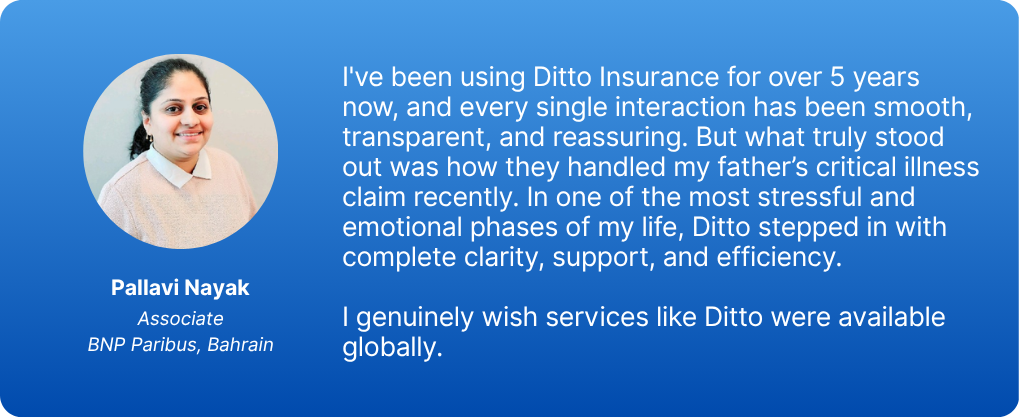
At Ditto, we’ve assisted over 8,00,000 customers with choosing the right insurance policy. Why customers like Pallavi below love us:
- No-Spam & No Salesmen
- Rated 4.9/5 on Google Reviews by 30,000+ happy customers
- Backed by Zerodha
- Dedicated Claim Support Team
- 100% Free Consultation
Confused about the right insurance? Speak to Ditto’s certified advisors for free, unbiased guidance. Book your call or chat with us on WhatsApp now!
Conclusion
Travel health insurance is useful, but it's not a substitute for the health and financial protection you need back home. Here's a quick breakdown of what it actually does and does not do.
What Travel Health Insurance Does Well
- Covers emergency medical expenses abroad.
- Pays for evacuation and repatriation during a trip.
What Travel Health Insurance Does Not Do
- It does not replace the health insurance that covers you in India year-round.
- Does not replace your term life insurance.
- Does not cover planned treatment abroad, chronic condition management, or long-term stays.
Note: Ditto currently does not help with standalone travel insurance plans. What we do help with is health insurance and term life insurance, the two products that form the actual foundation of your financial protection. If you're looking to sort either of those, we've got you covered.
- For health insurance, read our detailed guide on the best health insurance plans in India.
- For term life insurance, refer to our guide on the best term insurance plans in India.
Frequently Asked Questions
Last updated on: