



Overview
In 2024-25, according to IRDAI’s Annual Report, nearly 97 lakh lives were covered under overseas travel insurance policies, generating ₹1,267 crore in premiums. That sounds like a lot until you consider that over 3 crore Indians traveled abroad that same year, according to the Ministry of Tourism, Government of India. The math suggests that around two-thirds of the travelers are still going uninsured.
This gap in coverage exists because travel insurance feels like one more thing to spend money on, for something that probably won't happen. That's a reasonable thought, until something does happen.
In this guide, we break down what travel insurance covers, what it doesn't, how to pick the right plan, and where it fits alongside your health and term cover.
What is Travel Insurance?
Travel insurance is a non-life insurance product that, for regulatory purposes, falls within the health insurance business and is offered by general insurers and standalone health insurance companies in India. It covers financial losses arising from a specific trip and kicks in when your journey starts and ends when you return, or when the policy period lapses.
It's not a savings product. There's no maturity value, no bonus, no fund. You pay a premium, transfer a risk, and if everything goes well, you walk away with nothing. That's exactly how protection (insurance) is supposed to work.
What Does Travel Insurance Cover?
What Travel Insurance Does Not Cover
- Pre-Existing Diseases (PEDs): Diabetes, blood pressure, heart disease, and any sudden illness due to known conditions are excluded unless you buy a PED add-on and declare everything upfront. Non-disclosure is the single biggest reason for claim rejections.
- Planned Treatment Abroad: If you're flying specifically for treatment, travel insurance won't cover it. This can be covered under some global health insurance plans.
- Adventure Sports: Skiing, scuba diving, and bungee jumping are excluded unless you buy the adventure add-on.
- Alcohol or Drug-Related Incidents: Any claim arising from intoxication will be rejected. This falls under self-inflicting behaviors.
- War, Civil Unrest, High-Risk Zones: Claims from government-flagged regions like Iran, Iraq, Afghanistan, and Pakistan are excluded. Check the Ministry of External Affairs (MEA) advisories before you travel.
- Dental (Beyond Emergencies), Pregnancy/Childbirth, Mental Illness: These are either excluded or heavily sub-limited in most plans.
Talk to an expert
today and
find
the right
insurance for you.


Types of Travel Insurance Plans in India
By Geography
- International/Overseas Travel Insurance: This is the most important category. Covers overseas medical emergencies, evacuation, and repatriation. Mandatorily required for Schengen countries, the UAE, Qatar, Cuba, and Turkey.
- Domestic Travel Insurance: Lighter cover for trips within India. Leans on personal accident and baggage cover. Often skippable if you have decent health insurance and a credit card with trip protection.
- Regional Plans: Asia-only plans, for example, cost less than worldwide cover since they exclude the expensive countries like the US and Canada.
By Trip Structure
- Single-Trip: The travel insurance plans that cover one specific overseas trip. Usually, this type of travel insurance has a coverage limit of 180 days and is suitable for annual holiday trips abroad.
- Multi-Trip/Annual: Covers unlimited trips in a year, with each trip capped at a fixed duration (usually 30-60 days). Makes sense if you travel internationally three or more times a year.
By Traveler Profile
- Individual: This plan covers a single traveler for the duration of their trip.
- Family Floater: One policy covers you, your spouse, and your children under a shared sum insured. It's more cost-effective than buying individual plans for each family member.
- Student Travel Insurance: Designed specifically for students heading abroad for higher education, these plans go beyond standard medical cover. They include study interruption cover, sponsor protection, and policy durations long enough to cover the full academic year.
- Senior Citizen Plans: Designed for travelers aged 60 and above, these plans offer higher medical limits to account for the greater health risks associated with age.
- Group/Corporate Plans: These cover a group of employees or travelers under a single policy, typically arranged by a company for business travel.
Did You Know?

How to Choose the Right Travel Insurance Plan
Pick Your Medical Cover Based on Where You're Going
Healthcare costs vary massively by country. A rough guide: $250,000+ for Europe, $500,000+ for the US or Canada, and lower limits are usually fine for most of Asia. Don't anchor your decision on baggage or cancellation limits, the medical cover is what matters.
Read the Sub-Limits, Not Just the Sum Insured
A plan that says "$500,000 coverage" sounds great. But if it has a low room rent cap and a per-claim deductible, you could still end up paying a lot out of pocket. Always check the fine print, not just the headline number.
Pick the Right Plan Type for How You Travel
Going on one trip? A single-trip plan works. Taking three or more international trips a year? An annual multi-trip plan usually works out cheaper. Traveling with family? Go for a floater. Heading abroad to study? You need a student-specific plan, not a regular leisure one.
Always Declare Pre-Existing Conditions
If you have diabetes, high blood pressure, or any other known condition, declare it and buy the PED add-on. Hiding it to save on premiums is the single biggest reason claims get rejected. The extra cost is small compared to the cost of a denied claim during a medical emergency abroad.
Only Buy From IRDAI-Regulated Insurers
Stick to insurers listed on IRDAI. If you're applying for a Schengen visa, also check that your insurer's plan is on the embassy-approved list, as not all Indian plans qualify.
When Should You Not Rely Only on Travel Insurance?
Travel insurance is useful, but it does not take care of your financial protection. Health insurance and term life insurance do that.
Health Insurance
- Your domestic health insurance covers treatment in India year-round.
- It does not cover medical emergencies outside India, that's the gap travel insurance fills.
Ditto’s Take: Health insurance is the foundation. Travel insurance is a layer that activates only when you're outside India. You need both, but one does not replace the other.
Travel Insurance Is Also Not Enough When:
- If you're traveling specifically to get medical treatment abroad, you need international health insurance for that.
- You're relocating or living abroad long-term, so stacking travel policies is not a substitute for proper global health cover. Local health insurance in that country provides comprehensive coverage.
Term Life Insurance
Travel plans do include a personal accident or accidental death benefit, but so do term insurance plans. But here's what it does not cover:
- Death due to illness (not just accidents)
- The years of income your family loses after you're gone
- Your home loan, your children's education, or your family's day-to-day expenses
Ditto’s Take: A term plan pays out a large sum, often ₹2 crore or more, on death from any cause, anywhere in the world. That's what your family actually needs. Travel insurance handles trip logistics. Term life secures their future. They are completely different tools.
Popular Travel Insurance Plans in India
Note: This is not an exhaustive list of plans. For complete details, you can visit each insurer's official website.
How Does the Premium Look?
Note: The premiums are calculated for the HDFC ERGO Explorer plan. The numbers are indicative and for a single-trip policy, considering the following parameters:
- Traveler Age: 30 years
- Trip Duration: 30 days
- Base Sum Insured: USD 50,000
- No optional covers, loadings, discounts, or add-ons
- Premiums are in INR and exclusive of taxes
Why Choose Ditto for Insurance?
At Ditto, we’ve assisted over 8,00,000 customers with choosing the right insurance policy. Why customers like Pallavi below love us:
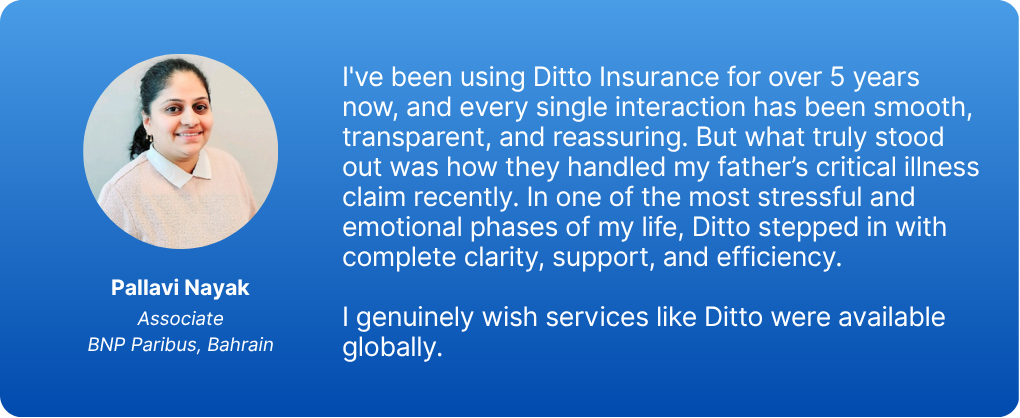
- No-Spam & No Salesmen
- Rated 4.9/5 on Google Reviews by 22,000+ happy customers
- Backed by Zerodha
- Dedicated Claim Support Team
- 100% Free Consultation
Confused about the right insurance? Speak to Ditto’s certified advisors for free, unbiased guidance. Book your call now or chat with our advisors on WhatsApp.
Ditto’s Verdict on Travel Insurance
What Travel Insurance Does Well:
- Covers emergency medical expenses abroad, where a single hospitalization can cost tens of lakhs.
- Pays for evacuation, repatriation, trip cancellation, baggage loss, and passport loss during a trip.
What Travel Insurance Does Not Do:
- Does not replace the health insurance that covers you in India year-round.
- It does not replace your term life insurance.
- It does not cover planned treatment abroad, chronic condition management, or long-term stays.
Ditto's Honest Take: Buy travel insurance if you're traveling internationally, especially to the US, Canada, or Europe. For domestic travel, it's largely optional if you already have health insurance. The best travel insurance plan is not always the cheapest one. Compare the medical cover, sub-limits, exclusions, PED terms, and claim support before buying.
Note: Ditto currently does not help with standalone travel insurance plans. What Ditto does help with is health insurance and term life insurance, the two products that form the actual foundation of your financial protection. If you're looking to sort either of those, we've got you covered:
- For health insurance, read our detailed guide on the best health insurance plans in India.
- For term life insurance, refer to the guide on the best term insurance plans in India.
Frequently Asked Questions
Last updated on: